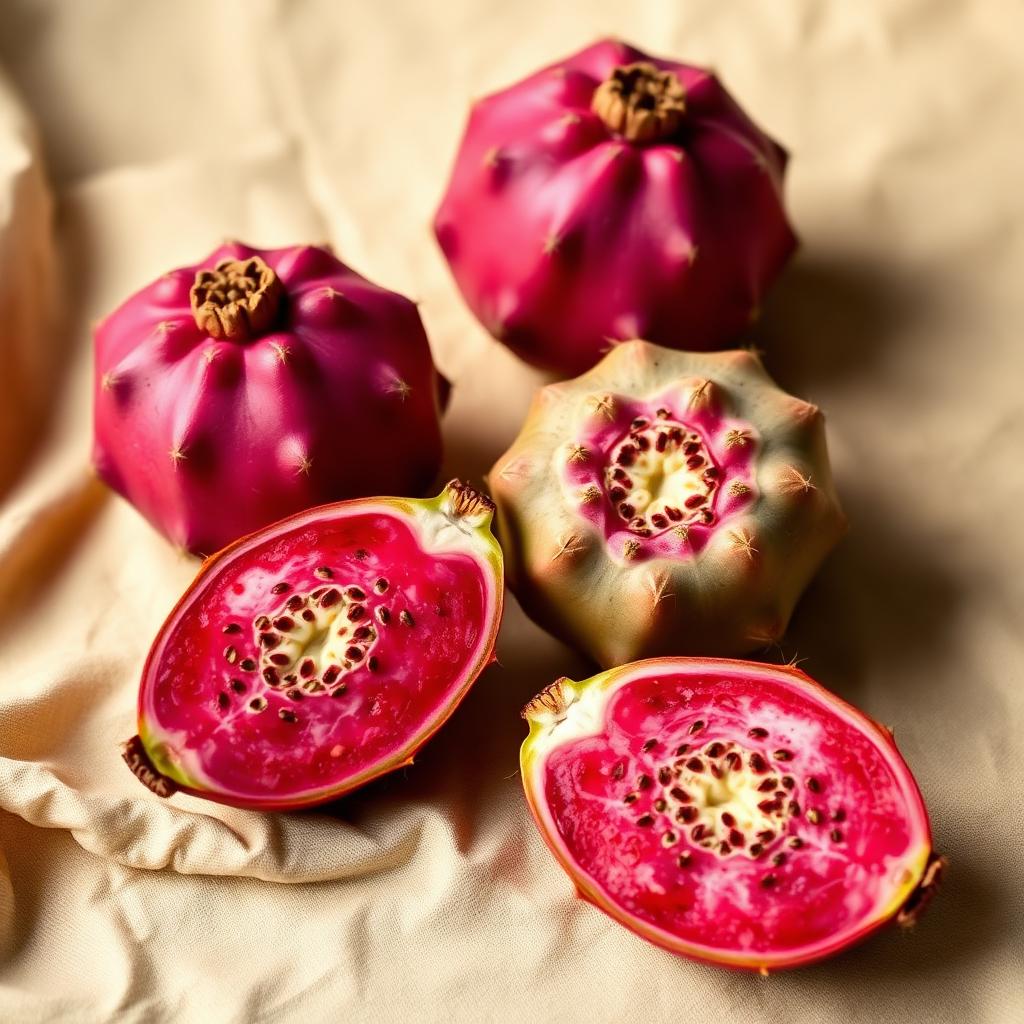
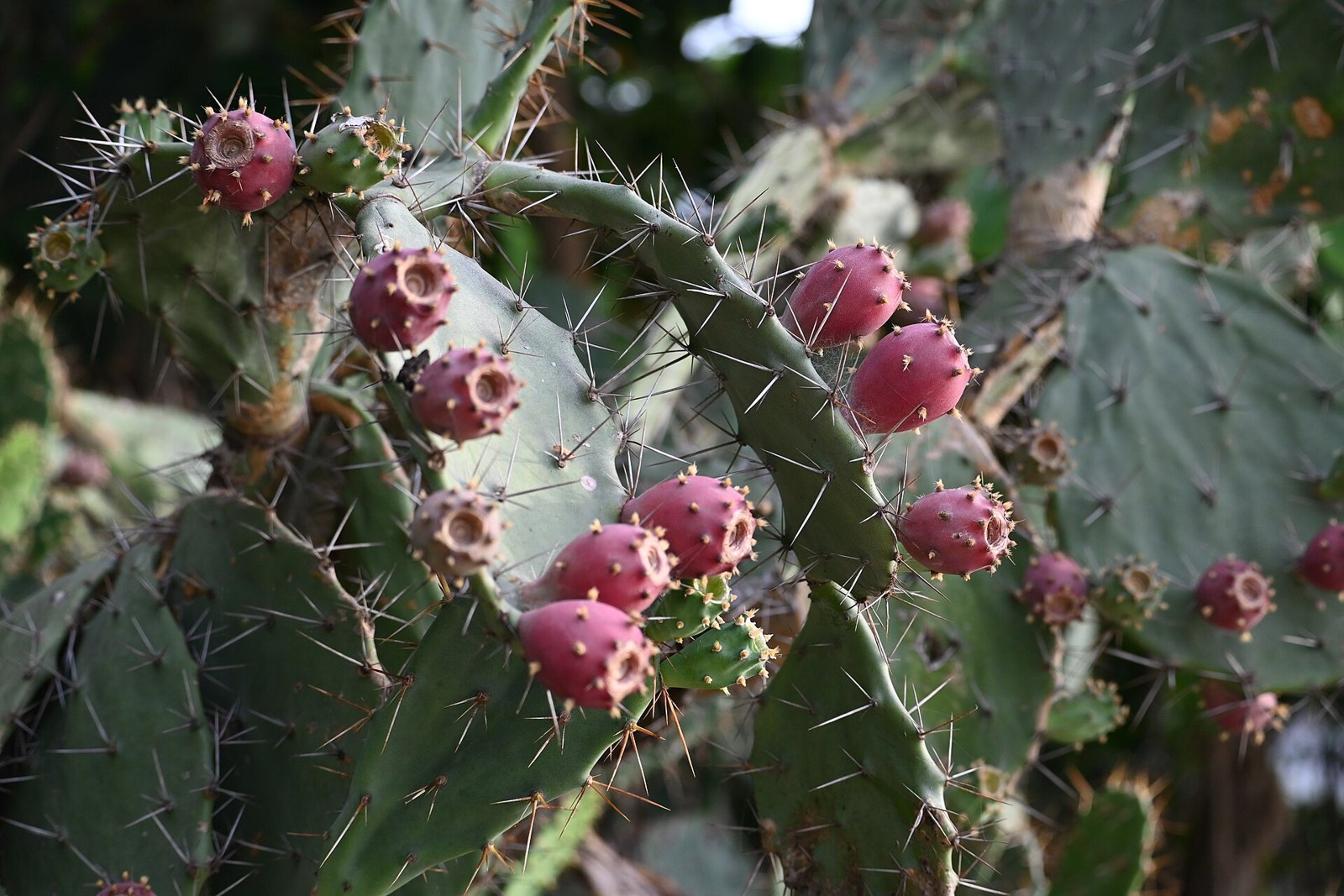
This is one of the few fruits that thrives where almost nothing else grows. It has fed people through droughts that killed other crops.
Its high water, high magnesium, and moderate sugar make prickly pear genuinely refreshing in hot weather. The seeds are the one caution: older adults with slow digestion should strain the juice instead of eating the pulp whole.
It was used: betalain pigments, the same family found in beetroot. Water and soluble fibre for easy hydration.
The prickly pear is the fruit of a flat-padded cactus. Each fruit is an egg-shaped barrel, green to deep magenta, covered in tiny hair-fine spines called glochids. Inside is sweet, watery flesh full of small hard seeds.
Family: Cactaceae (cactus family).
Primary compounds
It was used: betalains (the deep red pigments in beetroot) and vitamin C.
Opuntia ficus-indica intake improved fasting glucose measures in small human trials.Emerging evidence
Opuntia extract reduced hangover symptom scores in a small randomised trial, an unusual but repeatedly cited finding.Emerging evidence
Cactus pear intake lowered total cholesterol in small controlled feeding studies, with the fibre in the pulp the likely reason.Emerging evidence
Chapter 4 of 12
Preparation and Kitchen Use
Never handle bare-handed. Use tongs, a fork or thick gloves.
Rinse under running water to knock the glochids off first.
Hold with a fork, cut off both ends, slit the skin and peel it back.
Chilled, peeled and sliced, with a squeeze of lime.
Blend and strain for juice. The seeds don't soften.
Cooked down into a thick syrup or jam.
Chapter 5 of 12
Medicines and Interactions
Medication interaction:
Diabetes medicine — Opuntia has been studied for blood sugar and may add to the effect of glucose-lowering medicine. Watch for lows if you eat it daily. (moderate concern)
Medication interaction:
Oral medicines generally — The pads are high in mucilage, which can slow absorption. Leave a couple of hours between nopal and tablets. (low concern)
General caution:
Diuretics — Prickly pear has a mild diuretic (makes you pass more urine) reputation, which is worth mentioning if you already take water tablets. (low concern)
Chapter 6 of 12
Who Should Be Careful
General caution:
Betalains (the deep red pigments in beetroot) can turn urine and stool pink or red. It is harmless and passes.
General caution:
Cactus pad (nopal) supplements are a different product from the fruit; claims about one don't carry to the other.
General caution:
Glochids embed in skin and lips and are hard to remove. Prepare with tongs and rinse well.
General caution:
Eating large amounts of seeds has caused bowel blockages in rare cases. Do not eat several fruits' worth of seeds in one sitting.
Chapter 7 of 12
Pregnancy, Children and Older Adults
Pregnancy and breastfeeding
Pregnancy and breastfeeding:
The fruit is ordinary food and rehydrating in hot weather. Concentrated cactus supplements have not been studied in pregnancy, so leave those out.
Children
Children:
Children should never pick or peel these themselves. Serve it already peeled and strained, and the glochids stop being an issue.
Older adults
Older adults:
Watery, cooling, and easy to swallow. Strain the juice well, because the seeds are hard and many and no one enjoys them.
Chapter 8 of 12
Traditional Uses Around the Mediterranean
Persian temperament: Cool & Moist (2nd degree). Strongly cooling and moistening, which is exactly what a desert fruit was expected to be.
Prickly pear came from the New World, so you won't find it in classical Persian texts. Across North Africa and the Middle East, people treat the fruit as cooling and thirst-quenching. The pads have their own separate uses.
In the Household
Eaten to quench thirst in hot, dry climates.
The cactus pads, not the fruit, were used as a cooling poultice (a soft paste held against the skin) for skin.
People brought prickly pear from Mexico to the Mediterranean in the sixteenth century. It spread so completely across Sicily, North Africa and the Levant that many now assume it's native. In Mexico, both fruit and pad remain everyday foods.
Chapter 9 of 12
What It Goes With
Fruit:
Lime
A squeeze of lime is the difference between a bland pink juice and a good one.
Herb:
Mint
Mint and prickly pear together make the coldest-tasting drink you can put in a glass.
Pairing:
Cucumber
Blend the two together with ice and you get a summer drink that actually rehydrates rather than just tasting cold.
Honey:
Honey
The fruit is mildly sweet already. So honey is for balance rather than for sugar.
Chapter 10 of 12
Through the Year
Spring:
Spring
The pads grow and the yellow flowers open. Nothing ripe.
Summer:
Summer
Late summer brings the first fruit, and it's at its best when the heat is worst.
Autumn:
Autumn
The main season. Fruit ripens purple, orange or green depending on the variety, and the pads are cut for cooking too.
Winter:
Winter
Out of season. Bottled juice and syrup are what remain.
Chapter 11 of 12
Questions People Ask
How do I avoid the spines?
Handle with tongs, rinse the fruit under running water, and peel with a knife and fork.
Can I eat the seeds?
You can swallow a few, but don't chew them and don't eat a large quantity at once.
Why did my urine turn pink?
The betalain (the deep red pigments in beetroot) pigment. It's harmless and passes within a day.
Chapter 12 of 12
Sources
Opuntia ficus-indica: nutritional and functional properties — Nutrients. https://pubmed.ncbi.nlm.nih.gov/32050677/
Betalains: sources, bioavailability and health effects — Critical Reviews in Food Science and Nutrition. https://pubmed.ncbi.nlm.nih.gov/28524697/