Here's the thing: when researchers pool the randomised trials, black seed lowers blood pressure, LDL (the harmful type of cholesterol), triglycerides (a type of fat in the blood) and HbA1c (a blood test showing average blood sugar over about three months). The reductions are modest but reproducible — the profile of a slow daily food-medicine.
Smaller trials also point to better asthma control and lower rhinitis (a stuffy, irritated nose) scores with daily ground seed or oil. Using half to one teaspoon a day in food is safe for most adults. Concentrated oil at higher doses needs caution alongside medicines.
The Persian and Prophetic phrase 'a cure for every disease except death' is a devotional statement of blessing. It isn't a clinical claim.
Chapter 2 of 25
Black Seed: What It Is and Which Part Is Used
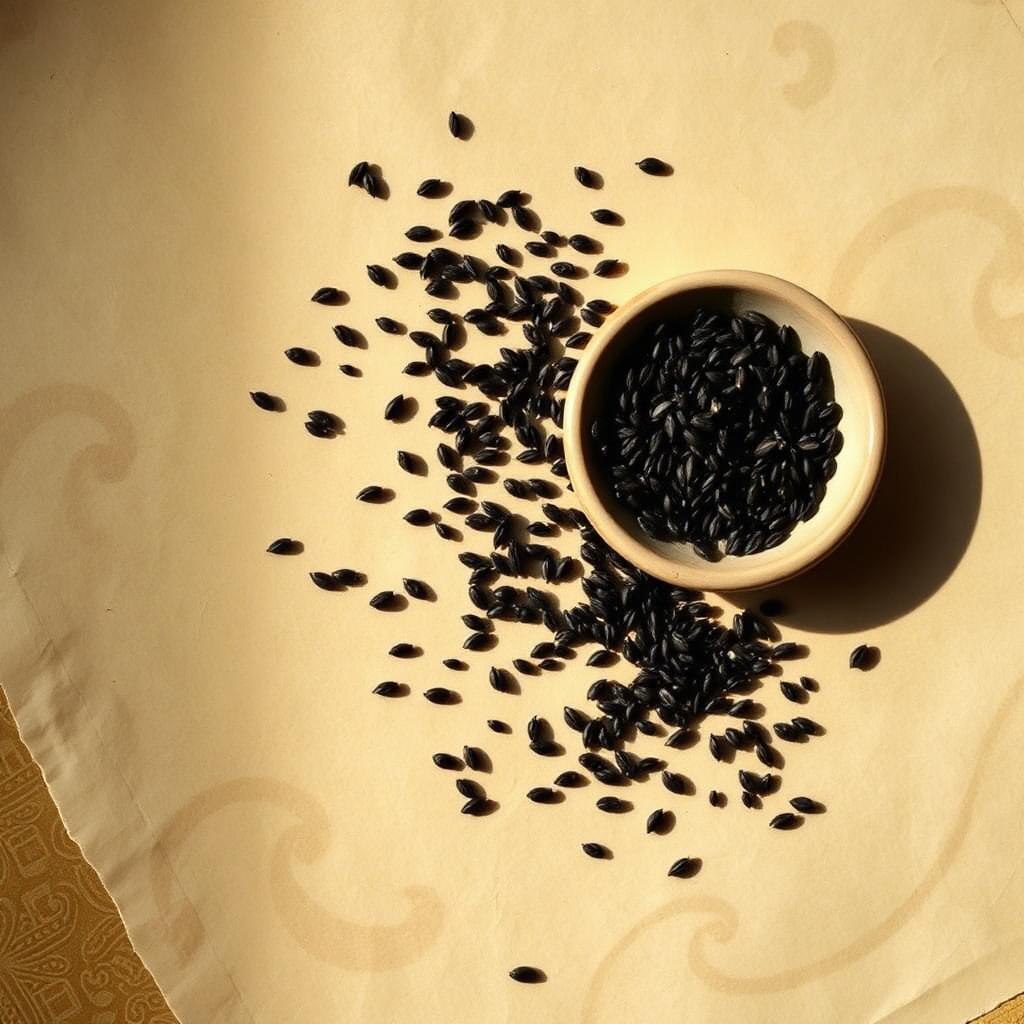
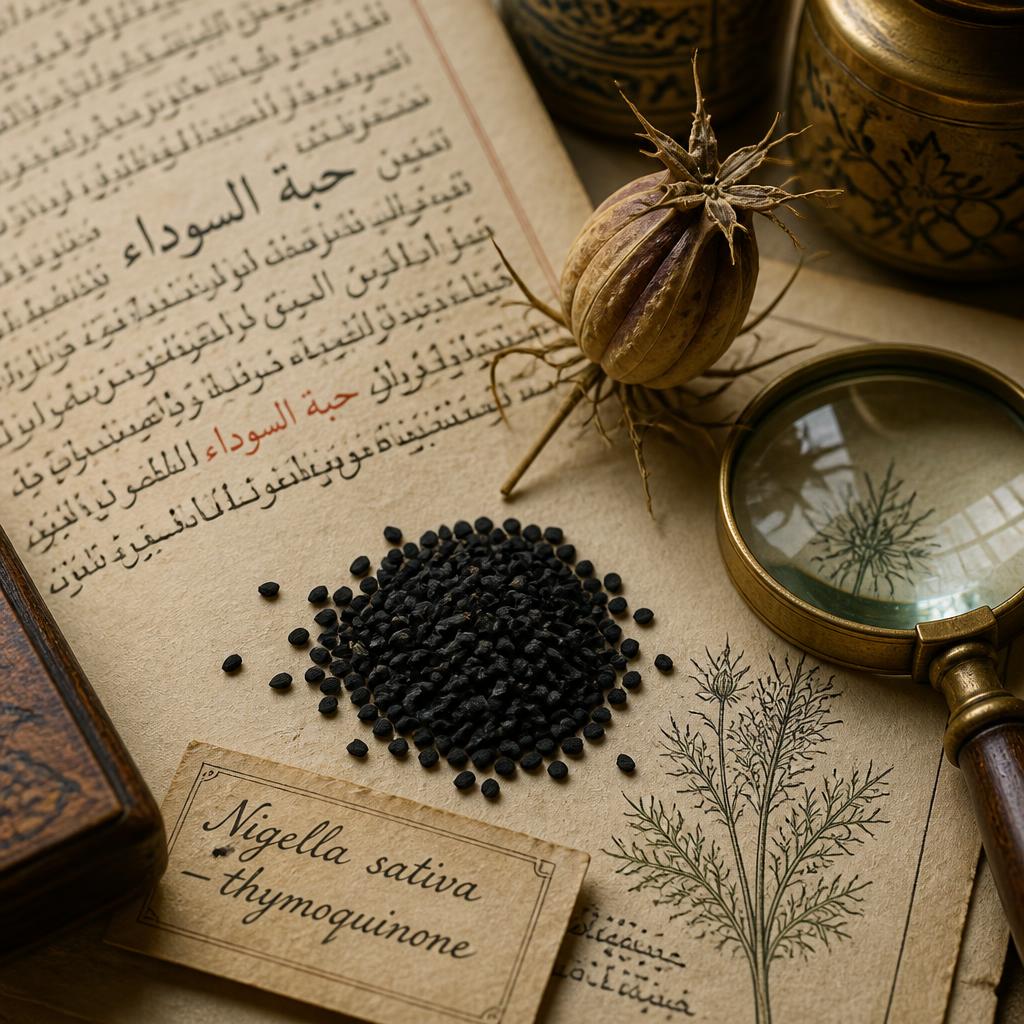
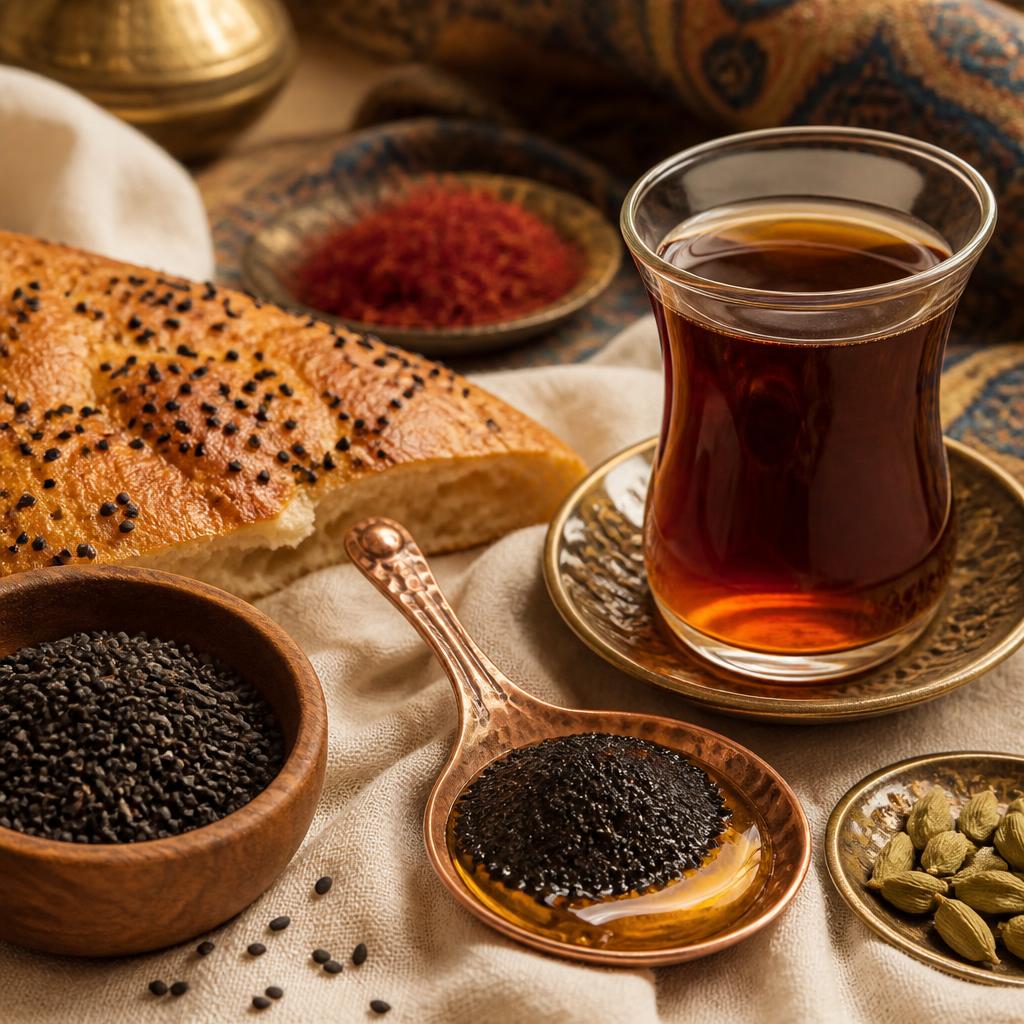
Black seed (Nigella sativa) is the small three-sided seed of a flowering annual in the Ranunculaceae family (the buttercup plant family). Despite the English name 'black cumin,' it isn't cumin at all. People across Persia, the Levant, the Arabian peninsula, the Balkans, and South Asia have used it for at least two thousand years: pressing it into oil, grinding it into honey, sprinkling it on barbari bread (a thick Persian flatbread), or taking a pinch each morning.
What It Is and Which Part Is Used: A Little More Background
Persian physicians saw it as hot and dry, a warming and opening seed for a body that felt cold, damp, phlegmy, sluggish, or wheezy. Modern research, driven largely by thymoquinone (the seed's main active compound, believed to be behind most of its effects), shows modest but repeatable effects on blood pressure, lipids, HbA1c (a blood test showing average blood sugar over about three months), and asthma control. It's one of the better-studied traditional foods, useful without being miraculous.
Chapter 3 of 25
Why Herbalists Still Reach for It
Black seed keeps turning up in research on the everyday pressures that can build with age: rising blood pressure, shifting lipids (fats in the blood, like cholesterol), post-meal glucose swings, and a chest that congests easily in cold months. It's affordable, easy to store, and already belongs beside barbari bread and honey. That makes it a small daily habit rather than a dramatic remedy.
After 50, small daily improvements in blood pressure, lipids, and post-meal glucose can add up over time. Black seed is one of the few traditional seeds with meta-analyses (a study that pools the results of many trials) of randomised trials in each of those areas. The effects are modest and can be delivered in food-scale doses.
What That Means Day to Day
Alongside a Mediterranean-Persian plate, a five-minute after-meal walk, and consistent sleep, it can sit quietly in the background of healthy aging rather than being treated as a cure for any one diagnosis.
Pooled trial data show reductions in systolic and diastolic blood pressure (the lower number, measured between heartbeats). Total cholesterol, LDL (the harmful type of cholesterol) and triglycerides (a type of fat in the blood) shift favourably too, and fasting glucose and HbA1c improve modestly in type 2 diabetes.
Chapter 4 of 25
What Is In It
Thymoquinone is the main terpene (a type of natural plant compound that gives many herbs their scent and effects). It drives most modern research on anti-inflammatory, antioxidant, blood-sugar, and blood-pressure effects.
Thymohydroquinone & p-cymene are related terpenes contributing to antioxidant and antimicrobial (slows the growth of germs) activity.
Nigellone (dithymoquinone): long-studied compound implicated in the airway effects.
Fixed oil (linoleic, oleic acids) & fibre — form the food-matrix in which the terpenes are delivered.
Alkaloids (nigellidine, nigellicine) — minor bioactives (parts of a food that act on the body) under continuing investigation.
Chapter 5 of 25
In the Laboratory
From laboratory work, not from people taking it
Small randomised trials found better asthma control scores and fewer allergic rhinitis symptoms with daily oil or ground seed. In laboratory models, its thymoquinone shows antioxidant and anti-inflammatory activity.
Laboratory studies show thymoquinone exerts anti-inflammatory and antioxidant effects on vascular endothelium (the thin inner lining of blood vessels) and airway tissue — a plausible mechanism for the modest clinical effects, but not itself a clinical outcome. Rated: early research.
Chapter 6 of 25
What Studies in People Show
Moderate evidence
Meta-analysis (a study that pools the results of many trials) of randomised trials: Nigella sativa supplementation modestly reduces systolic and diastolic blood pressure in adults with hypertension (high blood pressure) and healthy adults.Moderate evidence
Early research
Systematic review (a careful summary of all the studies on a question) and meta-analysis: Nigella sativa improves asthma control scores in adults compared with placebo across small randomised trials.Emerging evidence
Chapter 7 of 25
How It Is Prepared
Traditional and most convenient use is first thing in the morning — a spoon of ground seed in raw honey on an empty stomach. Whole seed on bread happily belongs to any meal.
The daily form is half to one teaspoon of ground seed over yogurt, honey or salad. Cold-pressed oil is the alternative, half to one teaspoon a day, kept refrigerated and taken to the label.
Other Ways to Use It
Seeds steeped in raw honey for two weeks give a winter spoonful. Ground with olive oil, the same seed makes a topical (put on the skin) poultice (a soft paste held against the skin) for skin support.
Take half to one teaspoon of freshly ground seed daily, or scatter whole seed generously over bread and food. The traditional tonic is half a teaspoon of ground seed in a teaspoon of raw honey on an empty stomach.
Chapter 8 of 25
How It Is Prepared: Further Preparations
As oil, half to one teaspoon of cold-pressed black-seed oil a day, unheated. For the chest, steep a teaspoon of crushed seed for ten minutes with honey and ginger.
A traditional Persian morning form is nāshtā, taken on an empty stomach: half to one teaspoon of freshly ground black seed with a spoon of raw honey each morning.
For airway support, steep a teaspoon of crushed seed in hot water for ten minutes with honey and a slice of ginger, then sip it warm.
Chapter 9 of 25
Extracts, Capsules and Concentrates
Capsules and standardised extracts carry many times the amount you get from food, which is why the cautions below matter more here.
Beyond that it's a culinary habit rather than a supplement. Scatter whole seeds over warm barbari or sangak (a traditional Persian flatbread baked on hot stones), labneh, salads and lentil soups. If you use the oil, take half to one teaspoon a day in yogurt or on bread, and never heat it.
Chapter 10 of 25
Medicines and Interactions
Medication interaction:
Warfarin / DOACs (newer blood-thinning medicines such as apixaban and rivaroxaban) — Concentrated black-seed oil may increase bleeding risk via antiplatelet activity of thymoquinone. Culinary seed is generally safe; discuss any daily oil dose with your clinician and pause 1–2 weeks before surgery. (moderate concern)
Medication interaction:
Antihypertensives (blood-pressure medicines), including ACE inhibitors, ARBs, diuretics (water tablets) and beta-blockers — Black-seed oil can add to blood-pressure lowering. On more than one blood-pressure medicine this may push toward symptomatic hypotension, meaning blood pressure low enough to cause dizziness or faintness. Monitor BP when starting a daily dose. (moderate concern)
Medication interaction:
Insulin & sulfonylureas (glipizide, glyburide) — Additive glucose-lowering effect at oil doses — on tightly titrated therapy this can push toward hypoglycemia (blood sugar dropping too low). Monitor fasting glucose carefully. (moderate concern)
Chapter 11 of 25
Medicines and Interactions: More Interactions to Know
Medication interaction:
Metformin (a common diabetes medicine) & other oral hypoglycemics (other medicines taken by mouth that lower blood sugar) — Usually a modest and welcome added effect. Monitor fasting glucose when starting a daily oil dose. (low concern)
Medication interaction:
Antiplatelets (aspirin, clopidogrel) & NSAIDs (common pain relievers like ibuprofen) — Concentrated oil may add to bleeding risk. Culinary seed use is generally fine. (low concern)
Medication interaction:
Immunosuppressants (medicines that calm down the immune system), such as cyclosporine and tacrolimus — Thymoquinone can alter CYP enzyme (a liver enzyme that helps break down many medicines) activity in laboratory studies. Caution and clinician oversight at supplemental doses. (moderate concern)
Chapter 12 of 25
Who Should Be Careful
Allergy:
Rare allergic reactions, such as contact dermatitis (a rash where it touches the skin), stomach and gut upset, and breathing symptoms — try a small culinary amount first.
Medication interaction:
May lower blood pressure — monitor closely if already on antihypertensives (blood-pressure medicines), especially at oil doses.
General caution:
Rancid oil is common in poor storage — buy small bottles, refrigerate, and discard if bitter or off-smelling.
Pregnancy and breastfeeding:
Pregnancy at supplemental / concentrated-oil doses — traditional cautions and animal data suggest possible uterine activity, meaning it might cause the uterus to contract. Using whole seed in food on bread is generally considered fine.
Allergy:
Known allergy to Nigella sativa or Ranunculaceae family.
Medication interaction:
Pre-surgical period (within 1–2 weeks) at supplemental oil doses because of bleeding risk.
Chapter 13 of 25
Pregnancy, Children and Older Adults
Pregnancy and breastfeeding
Pregnancy and breastfeeding:
Pregnancy: a sprinkle of whole black seeds on barbari bread or in ordinary food is generally considered safe — the same everyday warmth Persian and Levantine households have always used. Concentrated black-seed oil and heavy supplemental doses of ground seed aren't well studied in pregnancy. Classical texts and animal data suggest possible uterine activity, so daily supplemental doses are best avoided until after delivery unless a clinician who knows your case advises otherwise. Breastfeeding: culinary black seed on bread and food has been part of postpartum Persian and Levantine kitchens for centuries and some traditions specifically encourage it. Concentrated oil at supplemental doses isn't well studied in lactation and is best kept modest until more data exist.
Children
Children:
Small amounts of whole seed baked into bread or sprinkled on food are safe and gentle for children over 2. Honey-based majūn (a honey-based herbal paste) should never be given to infants under 12 months (botulism risk). Concentrated oil isn't needed in children for any established indication; talk with a paediatrician before giving daily supplemental doses.
Chapter 14 of 25
Pregnancy, Children and Older Adults: Other Groups to Consider
Older adults
Medication interaction:
Black seed is one of the highest-leverage daily kitchen habits after 60: gentle nudges to blood pressure, lipids, and post-meal glucose, plus a warming lift for cold digestion and sluggish sinuses. Prefer freshly ground seed with honey or whole seed on bread. Watch for interactions with antihypertensives, warfarin (a blood-thinning medicine), insulin, and sulfonylureas — normal food amounts are almost always safe, but talk with your clinician before adding a daily oil dose.
Chapter 15 of 25
What Persian Medicine Says
Persian temperament: Hot & Dry (2nd–3rd degree). Warming, drying, and opening. Best for cold, damp, phlegmy constitutions and cold-pattern illness — cold digestion, wheezy chest, sinus heaviness, cold aches. Use with restraint in already hot, dry, or inflamed constitutions. Pair with cooling foods (yogurt, cucumber, rose water) if you tend to run warm.
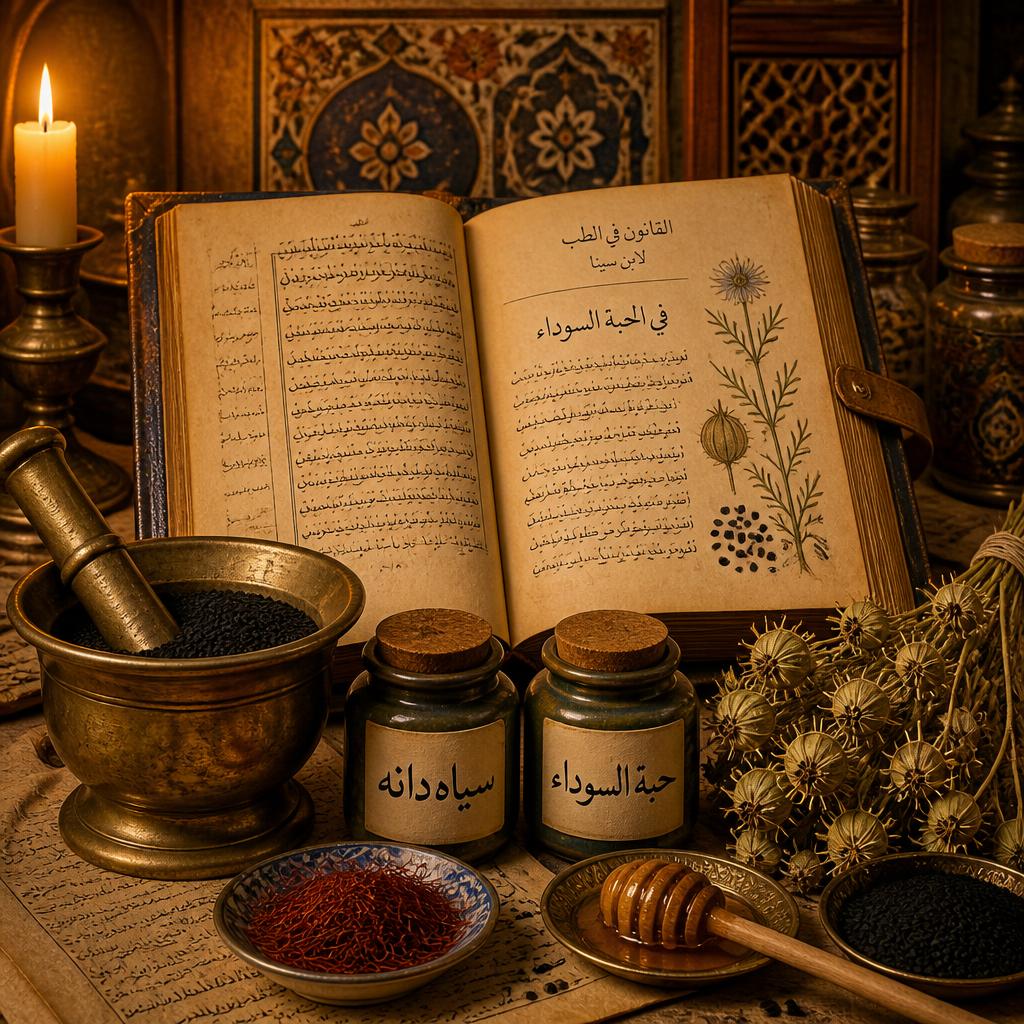
Persian medicine (tebb-e sonnati-ye Iran, meaning 'traditional medicine of Iran') sees black seed (siyāh-dāneh, meaning 'black seed' / ḥabbat al-sawdāʾ, meaning 'the black seed') as hot and dry in the second-to-third degree. It was used as a warming, drying, opening seed to thin phlegm, wake up a cold digestion, move stagnation, and steady a cold, damp chest.
In the Household
Avicenna gave ḥabbat al-sawdāʾ, 'the black seed,' its own chapter in the Canon and recommended it for cold-pattern cough, phlegmy chest, weak digestion, and headaches of cold origin. Al-Rāzī and Jurjānī included it in warming carminative (traditionally used to settle gas and bloating) and expectorant (helps loosen mucus so you can cough it up) formulas. The Prophetic tradition (al-ḥabbat al-barakah, the 'blessed seed') gives it deep devotional meaning across the Islamic world.
Chapter 16 of 25
What Persian Medicine Says: Older Uses
Persian and Arab households have kept the simple habit of taking a daily pinch on bread or in honey ever since.
Black seed is a winter staple for daily immune support. It's also given where digestion runs cold and sluggish with chronic bloating, and where joints stiffen in a cold pattern.
Tradition uses it for mild metabolic and blood-sugar support, and applies it as a paste for stubborn skin issues.
Chapter 17 of 25
In Persian Life
In Iran, black seeds sit beside sesame on the golden crust of barbari bread, bringing an old food tradition into breakfast. In Levantine kitchens, the same seeds appear on labneh (a strained, tangy yogurt cheese), ka'ak (a ring-shaped bread or cracker), and flatbreads. In South Asian kitchens, they perfume naan and pickles. Across the Muslim world, a small spoonful of black seed in raw honey remains a devotional morning ritual: food, blessing, and inherited remedy in one gesture.
Chapter 18 of 25
What It Goes With
Spice:
Ginger
Warming siblings — ginger kindles a cold digestion while black seed thins phlegm and opens a cold, damp chest. Together in a warm decoction (a drink made by simmering the plant in water) for winter coughs.
Spice:
Cinnamon
A Ceylon-cinnamon tea with a spoon of black-seed honey is a classical Persian shoulder-season morning. Two warming, opening spices with modest blood-sugar evidence.
Spice:
Turmeric
Both anti-inflammatory workhorses. A golden-milk variant with a pinch of ground black seed layers thymoquinone onto curcumin (the yellow compound that gives turmeric its colour)'s daily background support.
Chapter 19 of 25
What It Goes With: More Pairings
Spice:
Cardamom
Cardamom's aromatic lift softens black seed's peppery edge. Together they perfume warm bread, morning honey, and a Persian tea.
Honey:
Honey
The classical Persian and Prophetic form — a spoon of raw honey holding freshly ground black seed on an empty stomach. Warming, gently antimicrobial (slows the growth of germs), easy to keep daily.
Pairing:
Olive Oil
Drizzle a spoon of black-seed oil into a small dish of extra-virgin olive oil with warm barbari (two long-storable Mediterranean-Persian fats working the same heart and blood vessel background).
Chapter 20 of 25
What It Goes With: A Few More Pairings
Pairing:
Garlic
A Persian breakfast of labneh with garlic-and-black-seed on bread is a low-friction daily habit for a steady heart. Both quietly nudge blood pressure and lipids in the same direction.
Dairy:
Yogurt
In summer, a spoon of yogurt with ground black seed and mint softens its heat while keeping the digestive and airway gift. The classic labneh-with-black-seed Levantine plate.
Chapter 21 of 25
Through the Year
Spring:
Spring
Sprinkle whole seeds on labneh, salads, and lentil soups to keep the warming, phlegm-thinning habit going as the weather turns damp.
Summer:
Summer
Ease off concentrated oil in a hot summer. Keep the seed on bread and food, and pair with cooling yogurt or cucumber if you tend to run warm.
Autumn:
Autumn
The season black seed belongs to. A daily spoon of ground seed in honey is the classical Persian shoulder-season habit as chest and sinuses shift into cool weather.
Winter:
Winter
A pinch on every barbari, a spoon in honey each morning, and a warm decoction with ginger for a cold chest — the household Persian winter cabinet.
Chapter 22 of 25
Questions People Ask
Is black seed really 'a cure for every disease except death'?
That's a devotional phrase from Prophetic tradition — an expression of blessing, not a clinical claim. Modern trials show real but modest effects on blood pressure, lipids, blood sugar, and asthma. It's a genuinely useful daily food-medicine — not a substitute for prescribed treatment for any serious condition.
Ground seed, oil, or whole seed — which is best?
For daily use, freshly ground seed (½–1 tsp with honey) is closest to the classical Persian and Prophetic form and has the most consistent evidence. Whole seed on bread and food is safe and pleasant. Cold-pressed oil is more concentrated — effective at ½–1 tsp/day but needs more caution with medicines and must be kept cold and fresh.
Is it safe in pregnancy?
A sprinkle of whole seeds on barbari bread as part of ordinary food is generally considered safe. Concentrated black-seed oil and heavy supplemental doses aren't well studied in pregnancy and traditionally cautioned against — best avoided until after delivery unless a clinician who knows your case advises otherwise.
Chapter 23 of 25
Questions People Ask: Blood Pressure
Can it help my blood pressure or cholesterol?
Trials pooled together show modest reductions in systolic (the top blood-pressure number) and diastolic (the bottom blood-pressure number) BP and in LDL (the harmful type of cholesterol) and triglycerides — helpful as an adjunct inside a broader diet, exercise, and medicine plan, not as a replacement. If you take antihypertensives, monitor closely when you start a daily oil dose.
Chapter 24 of 25
Sources
Black Seed (Nigella sativa): memorial Sloan Kettering Integrative Medicine — MSKCC. https://www.mskcc.org/cancer-care/integrative-medicine/herbs/black-seed.
Nigella sativa in blood pressure: systematic review and meta-analysis of RCTs — Sahebkar et al., Pharmacol Res, 2016 — PubMed 27751885. https://pubmed.ncbi.nlm.nih.gov/27751885/
Effect of Nigella sativa on lipid profile: meta-analysis of RCTs — Sahebkar et al., J Hypertens, 2016 — PubMed 27512971. https://pubmed.ncbi.nlm.nih.gov/27512971/
Nigella sativa and glycemic control in type 2 diabetes: meta-analysis of RCTs — Daryabeygi-Khotbehsara et al., Complement Ther Med, 2017 — PubMed 29154046. https://pubmed.ncbi.nlm.nih.gov/29154046/
Nigella sativa in asthma: systematic review and meta-analysis — Koshak et al., Phytother Res, 2017 — PubMed 28093836. https://pubmed.ncbi.nlm.nih.gov/28093836/
Sad Giah Hezar Darman (صد گیاه و هزار درمان) — One Hundred Plants and One Thousand Remedies — Dr. Hossein Erfani, 4th edition (1375 / 1996–1997). Primary traditional Persian herbal reference cited throughout this platform. Presented as traditional knowledge, not as modern medical proof.
Chapter 25 of 25
Sources (continued)
Office of Dietary Supplements: fact Sheets — US National Institutes of Health (NIH). https://ods.od.nih.gov/factsheets/list-all/.
Herbal Database: memorial Sloan Kettering Cancer Center. https://www.mskcc.org/cancer-care/diagnosis-treatment/symptom-management/integrative-medicine/herbs.
Herbs at a Glance: uS NIH National Center for Complementary and Integrative Health (NCCIH). https://www.nccih.nih.gov/health/herbsataglance.
FoodData Central: searchable nutrient database — US Department of Agriculture (USDA). https://fdc.nal.usda.gov/.
The Nutrition Source: harvard T.H. Chan School of Public Health. https://www.hsph.harvard.edu/nutritionsource/.
PubMed — peer-reviewed biomedical literature — US National Library of Medicine. https://pubmed.ncbi.nlm.nih.gov/