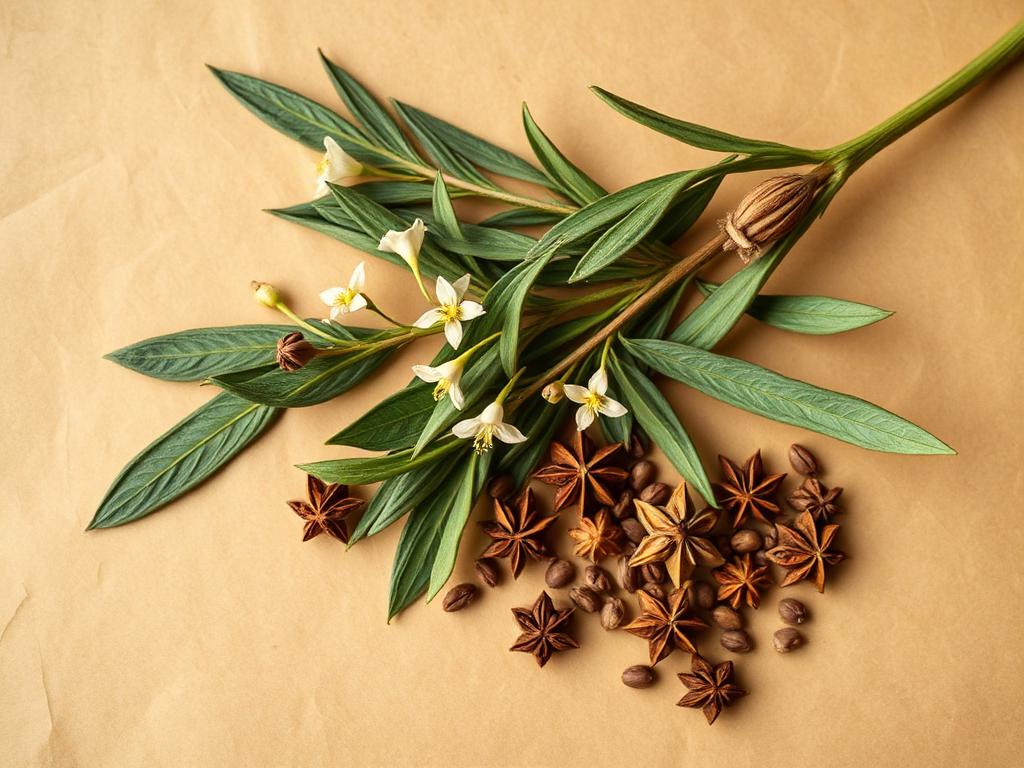
If you've ever wanted something warm after a meal, anise is the sweet, licorice-scented seed Persian households reach for. The habit has chemistry behind it: trans-anethole has documented carminative (traditionally used to settle gas and bloating) effects on the gut, and a lighter expectorant (helps loosen mucus so you can cough it up) action on the chest.
The same seed appears as a folk remedy for cough and colic across Persia, the Mediterranean and the Levant. Stay with the seed itself — the concentrated essential oil (the concentrated aromatic oil of the plant) is avoided in pregnancy and in infants.
People have grown anise around the Mediterranean and Persian plateau since ancient times. Both the Egyptian Ebers Papyrus and Avicenna's Canon describe it as a warming aid for digestion and breathing. Its main aromatic compound, trans-anethole, gives the seed its familiar sweet, licorice-like flavour and explains much of how it works.
Known to botanists as Pimpinella anisum.
Chapter 2 of 11
Why Herbalists Still Reach for It
Bloating, heaviness after a meal, and a dry winter cough can make an ordinary day uncomfortable. A pinch of anise seed in tea offers one of the oldest, simplest, and safest aromatic remedies on the Persian shelf for all three.
Gentle daily support for digestion and breathing matters more as you grow older. A modest cup of anise tea after dinner is an easy Persian habit. It may help with occasional bloating and gas after meals, the kind of discomfort that can get in the way of comfort and sleep.
Chapter 3 of 11
Why Herbalists Still Reach for It: What That Means Day to Day
The trans-anethole in anise works as a carminative, easing gas and bloating. It also relaxes digestive smooth muscle, which is why the cup that settles the stomach eases cramping too.
Anise is an annual herb growing 30–50 cm tall with feathery basal leaves, finely divided upper leaves, and umbels of small white flowers that ripen into ridged, fragrant gray-brown seeds. The seeds are the main medicinal part.
A few small randomized trials, mostly from one country, found anise powder eased indigestion and hot flashes. The trials are small and short, so the results need confirming.
In a 4-week randomized, placebo-controlled (compared against a dummy treatment) trial of 107 adults with indigestion after meals, 3 g of anise powder after each meal reduced symptoms more than placebo.
A small randomized trial in menopausal women found anise capsules reduced how often and how strongly hot flashes occurred compared with placebo.
Chapter 5 of 11
How It Is Prepared
The everyday form is damkardeh. Crush a teaspoon of seeds, pour over a cup of just-boiled water and keep it covered for ten minutes. Blend that teaspoon in equal parts with fennel and cumin and you have the classic Persian three-seed digestive tea.
Winter has its own forms. Seeds steeped in raw honey for two weeks make an anise honey used as a cough syrup, and a handful in hot water under a towel gives a simple steam inhalation for a tight chest.
Other Ways to Use It
Crush a teaspoon of seeds and brew them for ten minutes after meals. With fennel and cumin this becomes the Persian digestive blend, and the whole seed also bakes into breads and syrups or roasts with root vegetables.
After meals, crush a teaspoon of seeds and steep them in a cup of just-boiled water for ten minutes. If it's the breath you want freshened rather than the stomach settled, chew a quarter-teaspoon of dry seeds instead.
The same seed earns its keep in the kitchen, baked into shortbread, biscotti and Persian shirini.
Chapter 6 of 11
Who Should Be Careful
Pregnancy and breastfeeding:
Avoid concentrated anise essential oil in pregnancy and in infants.
Allergy:
Possible allergic cross-reaction with celery, fennel, and dill.
Allergy:
Known Apiaceae (carrot family) allergy.
General caution:
Estrogen-sensitive conditions — use only normal food amounts.
Medication interaction:
May enhance the effect of estrogenic or sedative (medicines that make you sleepy) medicines in large doses.
Chapter 7 of 11
What Persian Medicine Says
Persian medicine considers anise warm and dry in the second degree. It was used to kindle digestion, open the chest, ease spasms of the stomach and womb, and gently increase milk in nursing mothers. Avicenna placed it among the great carminatives, alongside fennel, cumin, and caraway.
Traditional practice reaches for anise when a heavy meal has stalled and left bloating behind. The same cup is given for a dry cough that tightens the chest, and for cramping periods read as a cold-damp pattern.
In the Household
Nursing mothers were also given it as a galactagogue (a substance that increases milk supply).
For a dry, unproductive cough it acts as a mild expectorant (helps loosen mucus so you can cough it up). Its reputation for supporting milk supply is traditional, and the modern evidence for that use is thin.
You'll find anise seeds in Persian flatbreads, Greek ouzo, French pastis, and Turkish raki. They're also brewed as the Middle Eastern after-meal tea called yansoon, a familiar household remedy for colicky infants and bloated grown-ups alike.
Chapter 8 of 11
Traditional Formulas
Sharbat-e anīsun: anise-seed syrup diluted in warm water for indigestion and dry cough.
Mu'tadel digestive blend: anise + fennel + cumin in equal parts, the classic Persian post-meal damkardeh.
Lactation tea: anise + fennel + fenugreek in equal parts, 1 cup 2–3× daily to support breast-milk supply.
Chapter 9 of 11
Questions People Ask
Is anise the same as star anise?
No. Anise (Pimpinella anisum) is a small umbellifer seed. Star anise (Illicium verum) is the dried fruit of a Chinese evergreen tree. Both contain anethole and share the licorice aroma, but they're unrelated botanically.
Is anise safe in pregnancy?
Anise seed used in food, and weak anise tea, are generally considered safe. Concentrated essential oil and high-dose extracts should be avoided in pregnancy because of estrogenic activity.
How is anise tea best prepared?
Lightly crush 1 tsp seeds to release the oils, pour over 1 cup just-boiled water, cover and steep 10 minutes. Covering matters — the active compounds are volatile and will escape with the steam if left open.
Chapter 10 of 11
Sources
Pimpinella anisum L. — A review of its phytochemistry, traditional uses, pharmacology and safety — Phytomedicine (PubMed). https://pubmed.ncbi.nlm.nih.gov/
Anise: drugs and Lactation Database (LactMed) — US National Library of Medicine. https://www.ncbi.nlm.nih.gov/books/NBK501817/.
Sad Giah Hezar Darman (صد گیاه و هزار درمان) — One Hundred Plants and One Thousand Remedies — Dr. Hossein Erfani, 4th edition (1375 / 1996–1997). Primary traditional Persian herbal reference cited throughout this platform. Presented as traditional knowledge, not as modern medical proof.
Office of Dietary Supplements: fact Sheets — US National Institutes of Health (NIH). https://ods.od.nih.gov/factsheets/list-all/.
Herbal Database: memorial Sloan Kettering Cancer Center. https://www.mskcc.org/cancer-care/diagnosis-treatment/symptom-management/integrative-medicine/herbs.
Chapter 11 of 11
Sources (continued)
Herbs at a Glance: uS NIH National Center for Complementary and Integrative Health (NCCIH). https://www.nccih.nih.gov/health/herbsataglance.
FoodData Central: searchable nutrient database — US Department of Agriculture (USDA). https://fdc.nal.usda.gov/.
The Nutrition Source: harvard T.H. Chan School of Public Health. https://www.hsph.harvard.edu/nutritionsource/.
PubMed — peer-reviewed biomedical literature — US National Library of Medicine. https://pubmed.ncbi.nlm.nih.gov/