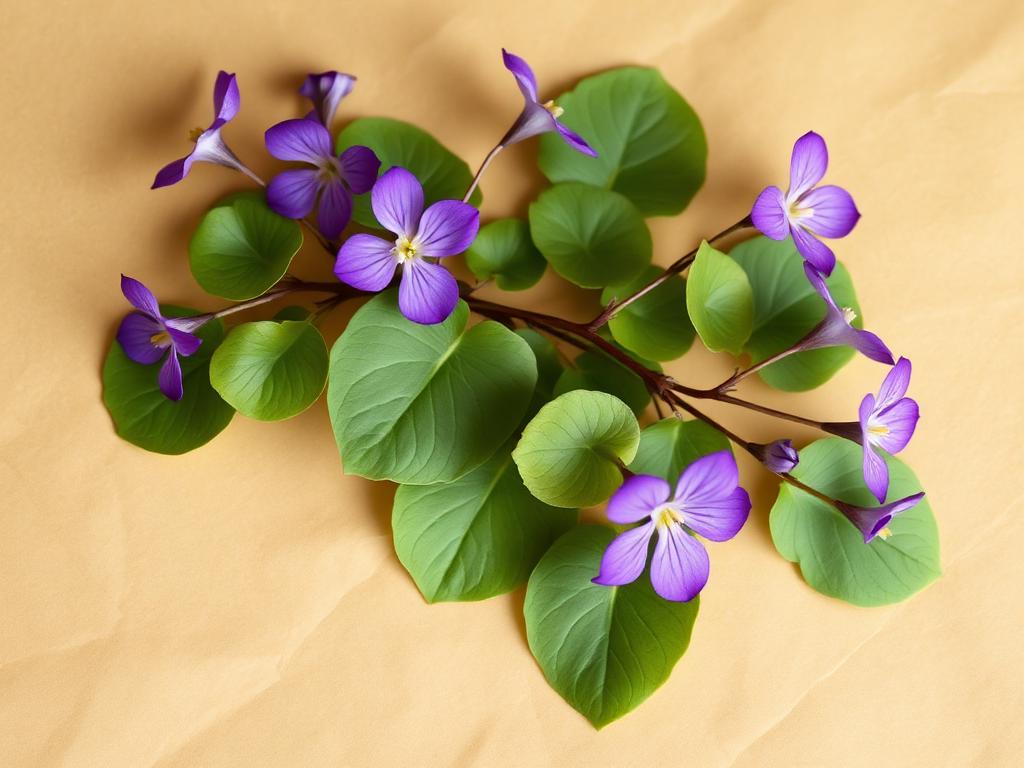
Cooling, moistening flower — Avicenna's go-to for dry cough and feverish heat.
Sharbat-e banafsheh (violet syrup) is a Persian household sore-throat remedy.
Common 'African violet' is a different plant — use Viola odorata only.
Known to botanists as Viola odorata.
Chapter 2 of 11
Why Herbalists Still Reach for It
Dry coughs, restless nights, and tension headaches from over-heated days can quietly build on each other. Violet is one of the rare herbs that soothes all three patterns with the same cooling, moistening signature, and it fits easily into a Persian household tea or sharbat.
Dry mucous membranes, broken sleep, and tension headaches all become more common with age. Paired with rose, linden, or chamomile, sweet violet's gentle moistening and cooling action becomes a traditional Persian evening ritual that addresses all three patterns without sedatives (medicines that make you sleepy).
Soothing mucilage (a soft, slippery plant gel) coats a dry throat and eases a cough.
What That Means Day to Day
Calming for restless sleep tied to heat.
Sweet violet is a low-growing perennial with heart-shaped basal leaves and small fragrant deep-purple (occasionally white) flowers borne on slender stalks in early spring. Both flower and leaf are used.
Family: Violaceae (violet family).
Chapter 3 of 11
What Is In It
Vitamins: Vitamin C (leaves), Vitamin A (leaves)
Antioxidants: Anthocyanins (the natural colour pigments that make fruit red, purple or blue), Rutin, Quercetin (a plant compound found in onions, apples and tea)
Anthocyanin (the natural colour pigments that make fruit red, purple or blue) pigments offer antioxidant activity.
What studies in people show
Two small randomized trials from Iran found violet syrup helped: one for cough in children with asthma (alongside their usual inhaler) and one for sleep in menopausal women. The evidence is early.
In a randomized, double-blind (neither the people nor the researchers knew who got what) trial of 182 children with intermittent asthma, violet syrup added to their usual inhaler shortened how long the cough lasted compared with placebo.
In a randomized, triple-blind trial of menopausal women (84 analysed), 5 mL of violet syrup twice daily for a month improved sleep-quality scores compared with placebo.
Chapter 5 of 11
How It Is Prepared
Steep 1 tsp dried flowers in 1 cup hot water, covered 5–8 min, before bed.
Sharbat-e banafsheh — simmer flowers in water + sugar, bottle, dilute 1 Tbsp per glass.
Cold infusion (a drink made by steeping the plant in hot water) in summer — handful of flowers in cool water 4 h.
Other Ways to Use It
Compress: strong infusion (a drink made by steeping the plant in hot water) soaked on a cloth, applied to the forehead.
In the kitchen: sharbat: 1 Tbsp violet syrup in cool water for sore throat and combine with rose petals + linden for a calming evening tea.
Chapter 6 of 11
Who Should Be Careful
General caution:
Identify the plant carefully — 'African violet' (Saintpaulia) is NOT the same and not edible.
General caution:
Concentrated violet seed/root preparations are emetic — use only flower and leaf.
Pregnancy and breastfeeding:
Rare allergic reactions; avoid concentrated essential oil (the concentrated aromatic oil of the plant) in pregnancy.
Allergy:
Known violet-family allergy.
Pregnancy and breastfeeding:
Pregnancy — use food/sharbat amounts only, not concentrated extracts.
General caution:
Salicylate sensitivity (rare).
Chapter 7 of 11
What Persian Medicine Says
Persian medicine sees sweet violet as cool and moist in the first degree. It softens dryness, calms feverish heat, eases tension headaches, invites sleep, and gently moves the bowels.
Dry, irritating cough and hoarse throat.
Headaches from heat, sun, or mental strain.
Traditionally used as a gentle laxative and fever-cooler.
Violet syrup (sharbat-e banafsheh) is a Persian household drink for children with sore throats and elders on summer evenings. The flower is also a beloved Persian poetic symbol of modesty and renewal.
Chapter 8 of 11
Traditional Formulas
Sharbat-e banafsheh: classical Persian violet-flower syrup — flowers simmered in water with sugar, bottled, and diluted as needed.
Joulab-e banafsheh: heart-cooling drink of rosewater, violet syrup, and water for restless, hot temperaments.
Triple-cooling evening tea: violet + rose petals + linden in equal parts for restless sleep and tension headaches.
Chapter 9 of 11
Questions People Ask
Is the violet in florist bouquets the same plant?
Florist 'violets' are often pansies (Viola × wittrockiana) or African violets (Saintpaulia). Medicinal banafsheh is specifically Viola odorata, the small fragrant spring flower. Buy from an attari, herbal apothecary, or grow it from seed.
What is sharbat-e banafsheh?
It's a Persian violet syrup: flowers simmered with sugar and water, strained, and bottled. A tablespoon stirred into cool water makes a cooling, sore-throat-soothing drink that's part of the household summer apothecary.
Chapter 10 of 11
Sources
Viola odorata L. — A review of its phytochemistry and traditional uses — Journal of Ethnopharmacology (PubMed). https://pubmed.ncbi.nlm.nih.gov/
Avicenna's Canon of Medicine, Book II — Materia Medica entry on Banafsaj — Classical Persian medicine.
Sad Giah Hezar Darman (صد گیاه و هزار درمان) — One Hundred Plants and One Thousand Remedies — Dr. Hossein Erfani, 4th edition (1375 / 1996–1997). Primary traditional Persian herbal reference cited throughout this platform. Presented as traditional knowledge, not as modern medical proof.
Office of Dietary Supplements: fact Sheets — US National Institutes of Health (NIH). https://ods.od.nih.gov/factsheets/list-all/.
Herbal Database: memorial Sloan Kettering Cancer Center. https://www.mskcc.org/cancer-care/diagnosis-treatment/symptom-management/integrative-medicine/herbs.
Chapter 11 of 11
Sources (continued)
Herbs at a Glance: uS NIH National Center for Complementary and Integrative Health (NCCIH). https://www.nccih.nih.gov/health/herbsataglance.
FoodData Central: searchable nutrient database — US Department of Agriculture (USDA). https://fdc.nal.usda.gov/.
The Nutrition Source: harvard T.H. Chan School of Public Health. https://www.hsph.harvard.edu/nutritionsource/.
PubMed — peer-reviewed biomedical literature — US National Library of Medicine. https://pubmed.ncbi.nlm.nih.gov/