Persian and Greek medicine's classic herb for the throat, the gums, and 'weakness of the brain.'.
Trials of a standardised sage extract (~280 mg/day) show clear help with hot flashes and a gentle lift for memory and focus.
Culinary pinches are safe long-term. Concentrated tinctures (a liquid extract made with alcohol) are best used short-term.
Used intentionally for weaning: so avoid during active nursing.
Sage's botanical name, Salvia, comes from the Latin 'salvare' — to save. That tells you how highly it was regarded. Its aromatic compounds have a long history in memory, oral health, and respiratory traditions.
Known to botanists as Salvia officinalis.
Studied for cognitive (to do with thinking and memory) support and memory.
Antioxidant rosmarinic acid.
May ease hot flashes.
Chapter 2 of 15
The Plant Itself
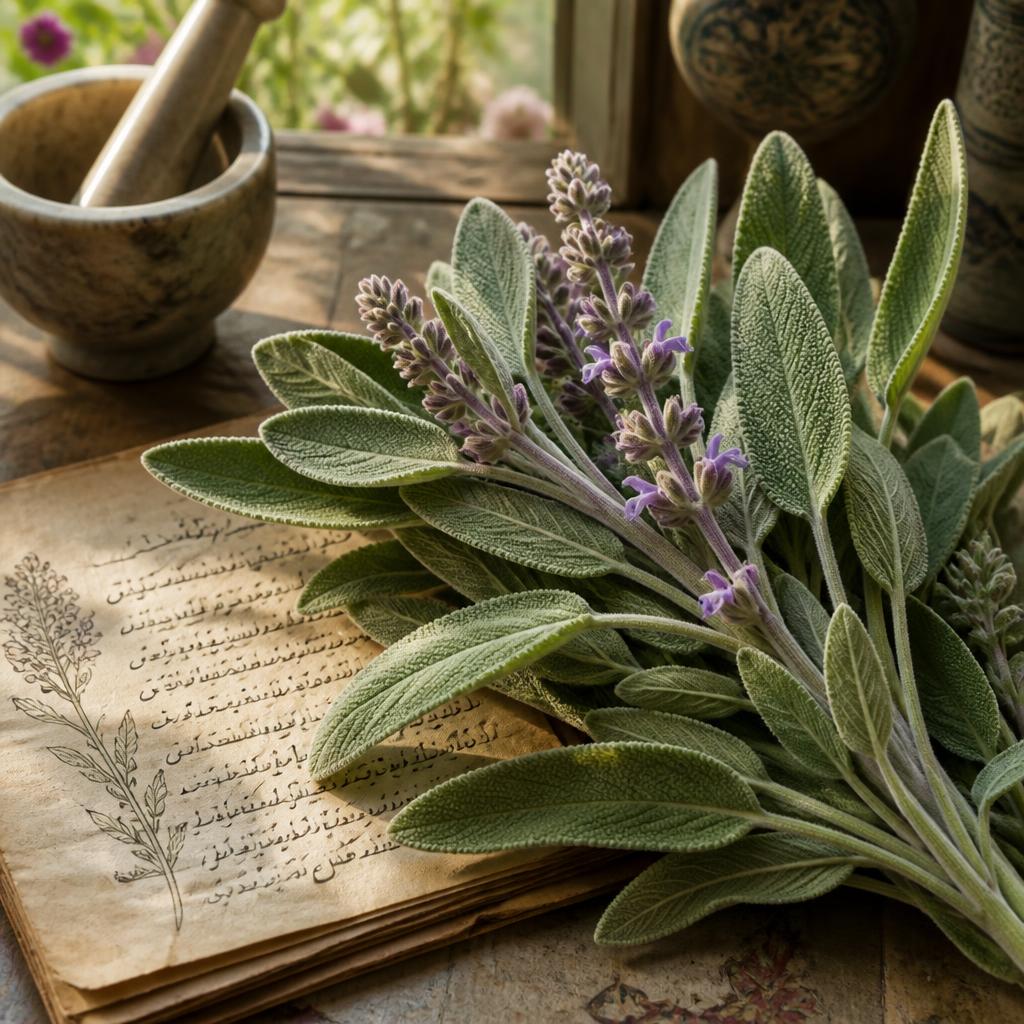
A small evergreen Mediterranean shrub 30–70 cm tall with grey-green, velvety lance-shaped leaves and purple-blue flower spikes. The aromatic leaves are rich in thujone, camphor, rosmarinic acid, and carnosic acid — compounds behind sage's astringent (tightens tissue and leaves a dry feeling in the mouth), warming, and acetylcholinesterase-inhibiting effects.
Family: Lamiaceae (mint family).
Chapter 3 of 15
What Is In It
Primary compounds
Carnosic acid & carnosol: carnosane diterpenes. Neuroprotective and AChE-inhibiting in vitro (in laboratory dishes, not in people).
Salvia officinalis extract produced significant benefit in mild-to-moderate Alzheimer's disease over 4 months (randomised, double-blind, placebo-controlled).Moderate evidence
European Medicines Agency (HMPC) herbal monograph accepts traditional use of sage leaf for symptoms of dyspepsia (indigestion), excessive sweating, and inflammation of the mouth and throat.Moderate evidence
Early research
Salvia officinalis leaf extract (~280 mg/day) reduced hot-flash frequency and severity in menopausal women vs placebo in an open trial.Emerging evidence
Salvia officinalis extract improved cognitive (to do with thinking and memory) performance and mood in healthy older adults in a randomised, placebo-controlled (compared against a dummy treatment) crossover.Emerging evidence
Sage extract mouth rinse reduced gingival inflammation and plaque vs placebo in small RCTs.Emerging evidence
Chapter 5 of 15
How It Is Prepared
Throat gargle: 1 Tbsp dried leaves steeped in 1 cup hot water 10 min, cooled, gargle 3× daily.
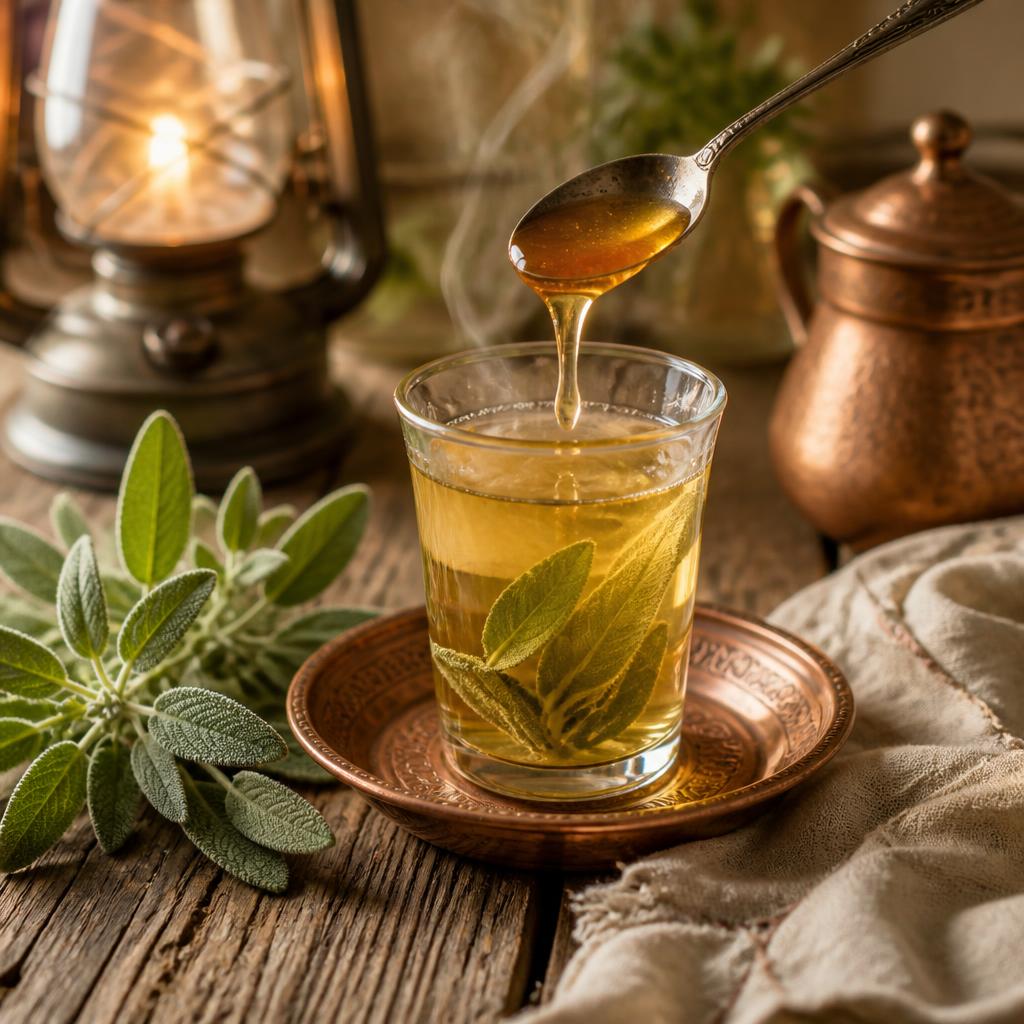
Sage honey is bruised fresh leaves macerated (soaked to draw out the flavour) in raw honey 2 weeks.
Sage tea: 1 tsp dried leaves 5 min, 1 cup morning and afternoon (not before bed).
Mouthwash: strong cooled infusion (a drink made by steeping the plant in hot water) swished after brushing.
Add to roasted vegetables, beans, and pasta.
Use sage honey for sore throats.
Chapter 6 of 15
Medicines and Interactions
Medication interaction:
Antidiabetic medication (metformin, sulfonylureas, insulin) — Sage leaf extract has shown mild fasting-glucose lowering in small trials; additive with hypoglycaemics at extract doses. Culinary use compatible. (low concern)
Medication interaction:
Sedatives (medicines that make you sleepy) / GABAergics (benzodiazepines, Z-drugs) — Concentrated sage extracts and essential oil (the concentrated aromatic oil of the plant) have mild CNS-depressant activity in preclinical work; additive drowsiness possible with high extract doses. (low concern)
General caution:
Antiepileptics — Concentrated sage essential oil (thujone, camphor) has lowered seizure threshold in animal models; concentrated oil avoided in poorly controlled epilepsy. (moderate concern)
More Interactions to Know
Medication interaction:
Anticholinergic drugs — Sage compounds (rosmarinic, carnosic acid) inhibit acetylcholinesterase in vitro; theoretical opposition to anticholinergics at extract doses. (low concern)
Avoid medicinal doses in pregnancy and breastfeeding.
General caution:
Thujone — use culinary amounts, not extracts long-term.
Pregnancy and breastfeeding:
Pregnancy and breastfeeding — sage can reduce milk supply and contains thujone.
Epilepsy
General caution:
Epilepsy — high thujone exposure may lower seizure threshold; skip concentrated extracts.
General caution:
Hormone-sensitive cancers — discuss long-term sage extracts with a clinician first.
General caution:
Limit medicinal extracts to a few weeks at a time rather than daily indefinitely.
Chapter 8 of 15
Pregnancy, Children and Older Adults
Pregnancy and breastfeeding
Pregnancy and breastfeeding:
Culinary sage on roast lamb, in bean stews, on butternut squash, or in a small pinch through pasta is safe throughout pregnancy. Medicinal daily sage tea, standardised sage extracts, and sage essential oil in any form are reserved for the non-pregnant window given classical emmenagogue (traditionally used to bring on a menstrual period) records and thujone content.
Children
Children:
Culinary sage in family food is safe from weaning. Weak sage gargle (cooled, well-diluted infusion) from around age 6 for a sore throat is fine as an occasional remedy — don't swallow. Sage essential oil is never applied undiluted, and never on the face or chest of infants and small children (1,8-cineole / camphor reflex-breath-holding risk). Concentrated sage extracts aren't appropriate in paediatric use without a clinician.
Chapter 9 of 15
Pregnancy, Children and Older Adults: A modest daily habit
Older adults
Older adults:
A modest daily habit — a pinch of sage on the roast, a small maramiya tea with honey after the morning walk — is one of the more useful cephalic-and-oral levers on the Mediterranean-Persian table after 60. Standardised sage-leaf extract (~280 mg/day for 4–8 weeks) has trial data for hot-flash frequency in perimenopausal women and modest cognitive-and-mood support in older adults. A cooled sage-tea mouth rinse tones the gums between dental visits.
Chapter 10 of 15
What Persian Medicine Says
Persian temperament: Warm & Dry (2nd degree). Persian and Greek medicine — Avicenna in the Canon and Aghili Khorasani in Makhzan al-Adwiya — place maramiya / maryam-goli as warm and dry in the second degree: a cephalic-and-pectoral tonic that strengthens the memory, quiets excessive sweats, tones spongy gums, and clears cold-damp fog from the head. The classical remedy for weakness of the brain in later life, hot flashes with a chilled mizaj, and a lax, bleeding gum.
Persian and European herbalists read sage as warm and dry, and turned to it whenever the body seemed damp or leaking: night sweats and hot flushes at menopause, spongy or bleeding gums, a mouth and throat that won't dry, a memory that has grown foggy with age.
Chapter 11 of 15
What Persian Medicine Says: In the Household
They were particular about the form — a strong cooled infusion as a mouth rinse, a weak warm one as a drink — and they kept the course short on purpose, because sustained high doses were long recognised as unsuitable. Nursing mothers were given it deliberately for the opposite reason: it dries the milk.
It was used: hot flashes and night sweats in perimenopause. Inflamed gums and mouth ulcers (mouthwash). Excess sweating (hyperhidrosis).
Sage tea is sipped from Anatolia to Lebanon, and the same plant is burned as smudge in ceremonial traditions.
Chapter 12 of 15
Traditional Formulas
Maramiya: levantine sage tea — the daily morning cup across Lebanon, Palestine, and Syria, often sweetened with honey.
Sage gargle decoction (a drink made by simmering the plant in water): strong sage tea + a pinch of salt + a teaspoon of honey for the first sign of sore throat.
Sage memory tea: 1 tsp sage + 1 tsp rosemary + a sprig of fresh peppermint, brewed midmorning for clarity and focus.
Chapter 13 of 15
Questions People Ask
Why avoid sage in pregnancy and breastfeeding?
Sage can reduce milk supply (sometimes used intentionally for weaning) and contains thujone, which is best avoided in pregnancy. Culinary pinches in food are fine. Avoid daily tea.
How does sage help memory?
Two of sage's compounds (rosmarinic acid, carnosic acid) slow down acetylcholinesterase, the enzyme that breaks down a key memory messenger — the same thing some Alzheimer's medicines aim at. In trials, sage extract gave small improvements in memory and mood in healthy adults and in early Alzheimer's.
Chapter 14 of 15
Sources
Sad Giah Hezar Darman (صد گیاه و هزار درمان) — One Hundred Plants and One Thousand Remedies — Dr. Hossein Erfani, 4th edition (1375 / 1996–1997). Primary traditional Persian herbal reference cited throughout this platform. Presented as traditional knowledge, not as modern medical proof.
Office of Dietary Supplements: fact Sheets — US National Institutes of Health (NIH). https://ods.od.nih.gov/factsheets/list-all/.
Herbal Database: memorial Sloan Kettering Cancer Center. https://www.mskcc.org/cancer-care/diagnosis-treatment/symptom-management/integrative-medicine/herbs.
Herbs at a Glance: uS NIH National Center for Complementary and Integrative Health (NCCIH). https://www.nccih.nih.gov/health/herbsataglance.
FoodData Central: searchable nutrient database — US Department of Agriculture (USDA). https://fdc.nal.usda.gov/.
Chapter 15 of 15
Sources (continued)
The Nutrition Source: harvard T.H. Chan School of Public Health. https://www.hsph.harvard.edu/nutritionsource/.
PubMed — peer-reviewed biomedical literature — US National Library of Medicine. https://pubmed.ncbi.nlm.nih.gov/