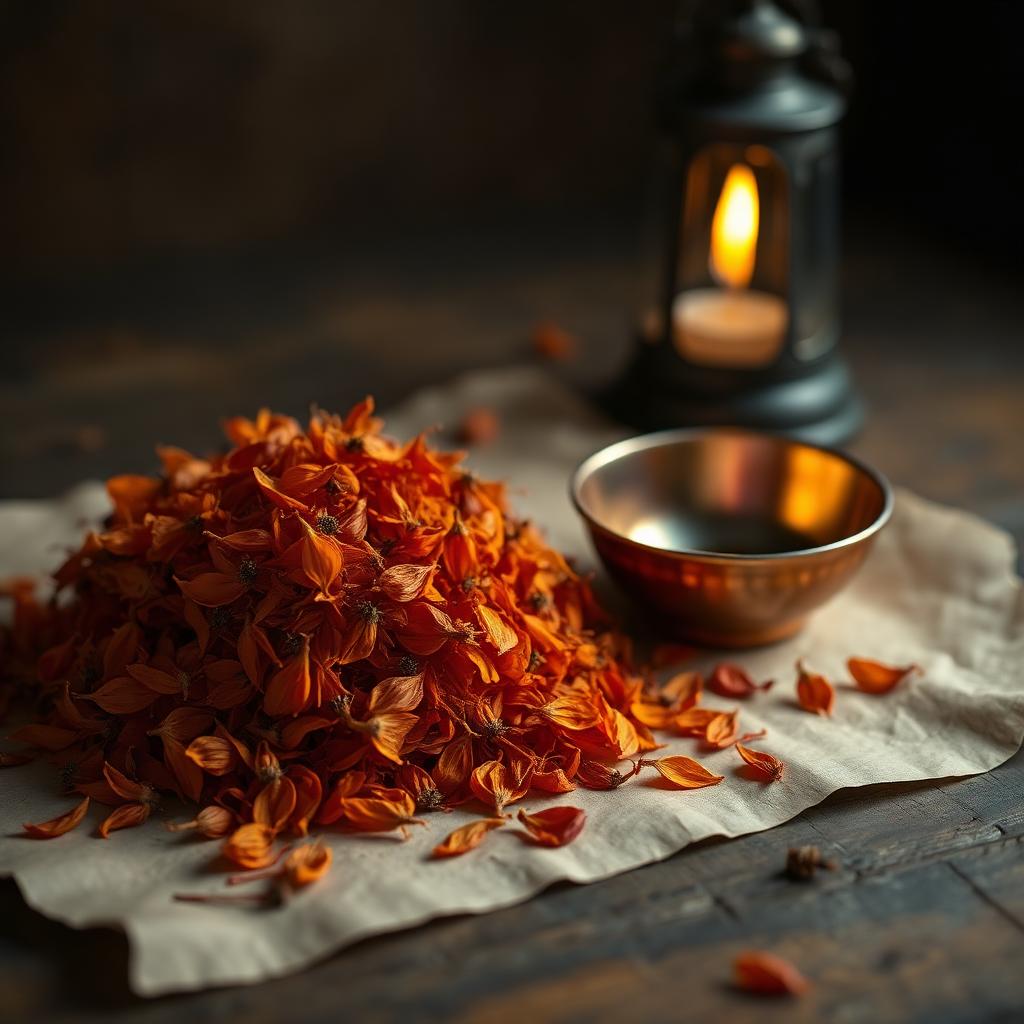
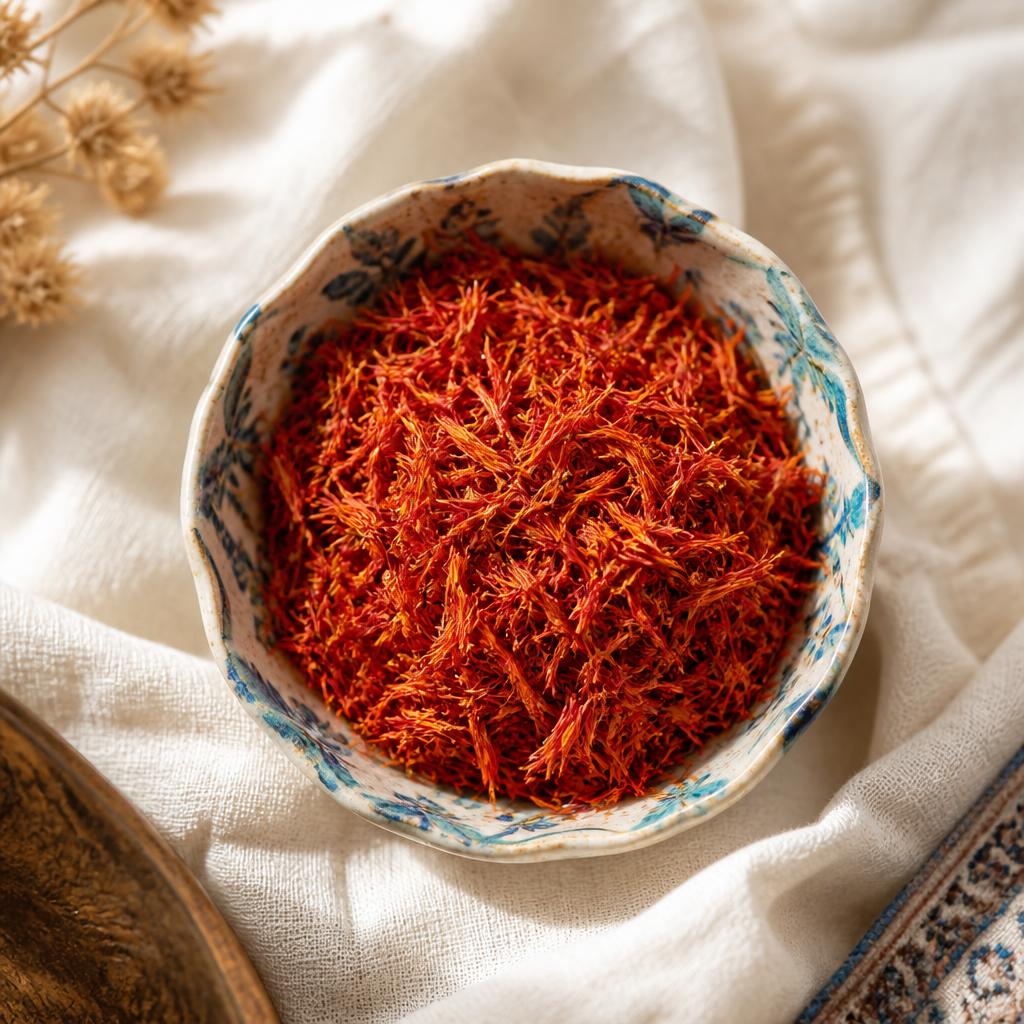
The florets are colour and gentle warmth — never a nutritional or clinical replacement for real saffron (Crocus sativus).
Cold-pressed high-linoleic safflower oil is one of the richest dietary sources of the essential omega-6 linoleic acid.
Persian and Chinese traditions both use safflower florets to move stagnant blood — powerful enough to be contraindicated (should not be used) in pregnancy at medicinal doses.
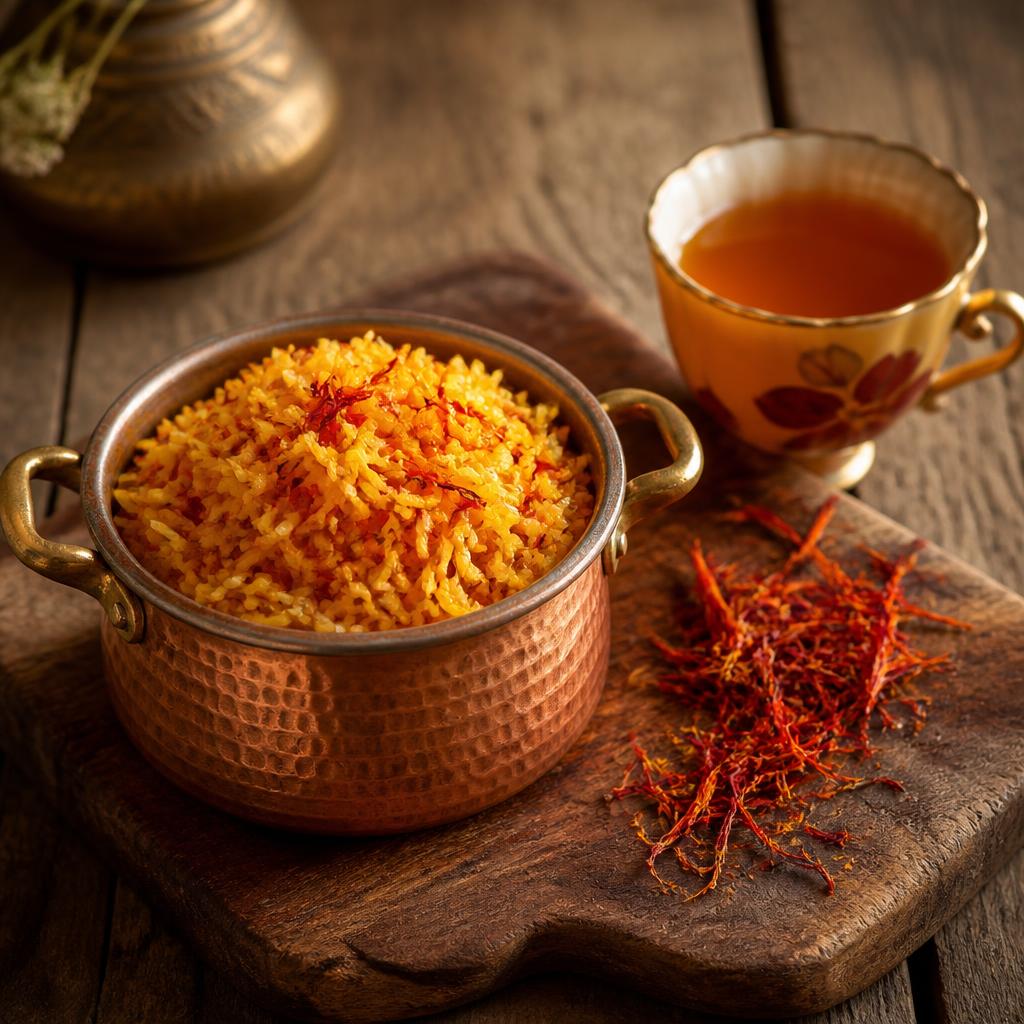
A culinary Persian tradition is colouring rice, kuku, khoresh — long before it was a lab-studied lipid modifier.
Chapter 2 of 21
Safflower: What It Is and Which Part Is Used
Safflower (Carthamus tinctorius) is a spiny annual thistle grown across the Iranian plateau, Anatolia, India, and western China. It gives us two very different products. The dried orange-red florets (Golrang) colour rice and khoresh and have long been sold as the poor cook's saffron. The pressed seed makes one of the most linoleic-acid-rich edible oils on record. Persian medicine reads safflower as warm and dry, while traditional Chinese medicine (as hónghuā) uses it to move blood stasis. Modern trials are modest but consistent. At culinary doses, it may be a gentle cardiometabolic ally, but its potent effect on menstrual bleeding and pregnancy deserves respect.
Chapter 3 of 21
Why Herbalists Still Reach for It
Safflower lives in two places at once. A little of it belongs in the everyday kitchen. A lot of it belongs in the herbal cabinet. So use its colour, its warmth, and its cold-pressed oil at home, and leave concentrated tinctures (a liquid extract made with alcohol) to trained practitioners.
Safflower's honest place in a longevity kitchen is small and steady. Colour your rice with the florets, keep a cold-pressed bottle of the seed oil in your fat rotation, and leave medicinal doses to trained hands. Used that way, it quietly adds variety to your plant fats and a little warmth, without ever asking to be more than it's.
Cold-pressed high-linoleic safflower oil supplies the essential omega-6 linoleic acid — associated with modest LDL-cholesterol reduction when it replaces saturated fat in the diet.
Chapter 4 of 21
Why Herbalists Still Reach for It: What That Means Day to Day
Florets colour rice and khoresh with carthamin and safflor-yellow pigments — a warming, iron-tinted lift at very low cost.
Early trials have looked at CLA-enriched safflower oil for trunk fat and blood-sugar markers in postmenopausal women with type 2 diabetes.
Contains luteolin and quercetin (a plant compound found in onions, apples and tea) glycosides in the florets — flavonoids (a family of protective plant compounds) studied for vascular (relating to the blood vessels) and anti-inflammatory support.
Chapter 5 of 21
What Is In It
Primary compounds
Safflor-yellow A and B (hydroxysafflor yellow) — water-soluble flavonoid (a family of protective plant compounds) pigments studied for vasodilation, antiplatelet (medicines that stop blood cells sticking together, such as aspirin) activity, and blood-moving traditional use.
Carthamin is the red pigment responsible for silk and wool dye and the deep orange-red of tinted rice.
Linoleic acid (up to 75% of high-linoleic seed oil) — the essential omega-6 fatty acid. Α- and γ-tocopherol (vitamin E): antioxidant scaffolding in the pressed seed oil.
Vitamins
Vitamin K1 (trace)
Other notable constituents
Minerals: Iron (trace, in florets), Potassium (trace)
Notable: High-linoleic safflower oil is ~70–75% linoleic acid — one of the highest edible-oil concentrations recorded, High-oleic safflower oil (a modern cultivar) is ~75% oleic acid, closer in profile to olive oil
Chapter 6 of 21
In the Laboratory
From laboratory work, not from people taking it
Hydroxysafflor yellow A (the water-soluble floret pigment) shows vasodilator and antiplatelet (medicines that stop blood cells sticking together, such as aspirin) activity in preclinical and small clinical work — mechanistic support for the traditional 'blood-moving' use rather than a showed hard clinical outcome. Rated: early research.
Chapter 7 of 21
What Studies in People Show
What studies in people show
Replacing dietary saturated fat with high-linoleic safflower oil (a plant-based polyunsaturated fat) is linked to reduced LDL (the harmful type of cholesterol) cholesterol and lower heart and blood vessel event rates in pooled RCT analyses.Moderate evidence
In postmenopausal women with type 2 diabetes, 8 g/day safflower oil for 16 weeks modestly reduced trunk fat, improved HDL (the helpful type of cholesterol), and lowered inflammatory markers versus CLA.Emerging evidence
Chapter 8 of 21
How It Is Prepared
Culinary golrang belongs to any warm-food meal — kateh, khoresh, shole zard. Medicinal floret tea, when prescribed, is traditionally taken in short courses tied to a specific complaint.
Bloom the florets briefly in hot (not boiling) water to release the water-soluble safflor-yellow before adding to rice or stew.
Store dried florets in an airtight tin away from light — the orange-red colour fades in months of sunlight exposure.
Other Ways to Use It
Use cold-pressed high-linoleic safflower oil within its harvest year and refrigerate after opening — polyunsaturated fats oxidise quickly.
Never confuse safflower florets with real saffron threads — colour is similar, aroma and price aren't. Genuine saffron carries the honeyed picrocrocin note safflower lacks.
A pinch of dried florets steeped 5 minutes in hot water, then poured over rice as it steams — Persian golrang colour.
Stir a teaspoon of steeped floret liquid into khoresh, kuku, or shole zard for warm colour without saffron cost.
Choose cold-pressed high-linoleic safflower oil for gentle-heat cooking (dressings, low sauté) — not for high-heat frying.
Medicinal safflower-floret tea for menstrual pain: 1 g dried florets in hot water, only under clinician supervision, never in pregnancy.
Chapter 9 of 21
Medicines and Interactions
Medication interaction:
Warfarin (a blood-thinning medicine), DOACs (apixaban, rivaroxaban, edoxaban, dabigatran) — Medicinal safflower-floret preparations (tea, tincture, extract) may increase bleeding risk through hydroxysafflor-yellow antiplatelet (medicines that stop blood cells sticking together, such as aspirin) activity. Culinary pinches aren't clinically meaningful. Stop medicinal doses 1–2 weeks before elective surgery. (moderate concern)
Medication interaction:
Antiplatelets (aspirin, clopidogrel, ticagrelor) — Additive antiplatelet effect at medicinal floret doses; culinary use isn't meaningful. Skip medicinal safflower before dental or surgical procedures. (moderate concern)
Medication interaction:
Antihypertensives — Mild additive vasodilator effect at medicinal floret doses. Monitor blood pressure if a concentrated preparation is added to layered therapy. (low concern)
Medication interaction:
Statins (cholesterol-lowering medicines) and antidiabetics — CLA-enriched safflower oil in trial doses (~8 g/day) modestly shifts trunk fat and glycaemic markers in postmenopausal women. Effects are additive at supplement doses, not culinary intake. (low concern)
Chapter 10 of 21
Who Should Be Careful
Pregnancy and breastfeeding:
AVOID medicinal safflower (flower tea, tincture, extract) throughout pregnancy — the florets are a traditional emmenagogue (traditionally used to bring on a menstrual period) and animal work shows uterine-stimulant activity.
Allergy:
Asteraceae (daisy family) allergy — cross-reacts with ragweed, chrysanthemum, marigold; avoid the whole plant if sensitive.
General caution:
Very high seed-oil intake in isolation can skew the omega-6: omega-3 ratio — pair with walnut, flax, or oily fish.
General caution:
Not a substitute for saffron in either flavour or clinical use — don't swap in trials of saffron-specific evidence (depression, PMS, AMD).
Chapter 11 of 21
Pregnancy, Children and Older Adults
Pregnancy and breastfeeding
Pregnancy and breastfeeding:
Medicinal safflower — the floret tea, the tincture (a liquid extract made with alcohol), the concentrated extract — should be avoided in pregnancy. Persian and Chinese tradition both read it as a strong blood-mover, and animal work agrees that it can stir the womb. Cold-pressed safflower seed oil used the way you would use any cooking oil is a different matter and is generally considered safe. The flower preparations, though, are set aside from conception through delivery.
Chapter 12 of 21
Pregnancy, Children and Older Adults: Other Groups to Consider
Children
Children:
Culinary golrang-tinted rice and shole zard are part of Persian childhood from the first year on solid food. Medicinal safflower-floret tea isn't given to children — the blood-moving action that traditional medicine values in adults isn't appropriate for the paediatric body. Cold-pressed safflower oil at ordinary culinary amounts is fine.
Older adults
Medication interaction:
Elders benefit from cold-pressed safflower oil as one gentle plant-fat rotation among olive, walnut, and sesame — its high linoleic-acid content supports LDL (the harmful type of cholesterol) when it replaces saturated fat, not when it's added on top. Medicinal floret doses require caution in anyone on anticoagulation, antiplatelet (medicines that stop blood cells sticking together, such as aspirin) therapy, or scheduled for surgery — a wide category after 65.
Chapter 13 of 21
What Persian Medicine Says
Persian temperament: Warm & Dry (2nd degree — florets. 1st degree, warm & moist for the seed oil). Persian medicine holds safflower florets as a warm, dry mover of thick humours — helpful for cold, sluggish constitutions and cold-uterus menstrual pain, but destabilising for very warm or dry constitutions at medicinal dose. The seed oil is read as warmer and moister, lubricating rather than drying.
In the Household
Persian traditional medicine (Ibn Sīnā, Aghili Khorasani) reads safflower florets as warm and dry (2nd degree) — a mover of thick humours, a mild aperient at high dose, and a warmer of a cold uterus. It reads the seed and its oil as warm and moist, lubricating for the intestines and softening for dry constitutions. Traditional Chinese medicine calls the flower hónghuā and uses it to invigorate blood, disperse stasis, and relieve pain — most famously in gynaecological formulas.
Golrang-tinted kateh and shole zard: persian everyday rice colour when saffron was reserved for guests.
Safflower-petal dye for silk, wool, and the deep orange-red of Persian miniatures and Isfahan textiles.
Chapter 14 of 21
What Persian Medicine Says: Older Uses
Hónghuā decoction (a drink made by simmering the plant in water) in Chinese medicine for menstrual stasis, bruising, and post-partum blood movement (professional prescription).
Kusum oil in Deccan India as a daily cooking and lamp oil, and as a warming body-oil massage.
Traditional Persian and Chinese use to ease sluggish digestion and cold-uterus painful periods (medicinal dose, under supervision).
Safflower florets and their extracts show uterine-stimulant activity in animal models, aligning with the traditional Persian and Chinese classification as a strong emmenagogue (traditionally used to bring on a menstrual period) and the modern pregnancy contraindication. Rated: traditional observation.
Chapter 15 of 21
What It Goes With
Spice:
Saffron
The pair are cousins in the kitchen — saffron for aroma and clinical evidence, safflower for colour and cost. Never a swap in trials.
Spice:
Cardamom
A pinch of cardamom with steeped safflower florets in shole zard adds cool aromatic depth to safflower's warm colour.
Rose:
Rose
The cool floral note of rose against warm golrang. Rosewater and safflower petals scatter over shole zard together.
Chapter 16 of 21
What It Goes With: More Pairings
§ A Few More Pairings
Grain:
Rice
Persian kateh and chelo take a pinch of steeped safflower for warm colour. Golrang rice is the everyday saffron stand-in.
Dairy:
Yogurt
A drizzle of cold-pressed safflower oil over thick yogurt with dill lifts a simple side into a linoleic-acid-rich lunch.
Pairing:
Walnut
Walnut's plant omega-3 balances safflower oil's high omega-6. That makes it a Persian answer to the modern fatty-acid ratio question.
Pairing:
Beetroot
Steeped safflower florets over roast beetroot deepen both the sweetness and the ruby colour of a winter salad.
Chapter 17 of 21
Through the Year
Spring:
Spring
Fresh florets appear in late spring across the Iranian plateau. The season for laying in a small tin of dried petals for the year's cooking.
Summer:
Summer
Colour cold rice salads and shole zard with a pinch of steeped florets. Use cold-pressed safflower oil in bright summer dressings.
Autumn:
Autumn
Warm khoresh season — golrang lifts the colour of pumpkin, beetroot, and quince stews as saffron is reserved for celebration meals.
Winter:
Winter
Warm the belly with golrang-tinted kateh. Traditional medicine reserves the medicinal floret tea for cold-constitution winter aches, under supervision.
Chapter 18 of 21
Questions People Ask
Can safflower replace saffron?
In colour, yes — steeped florets tint rice and shole zard a warm gold-orange for a fraction of the cost. In aroma and clinical evidence, no. Real saffron carries picrocrocin and safranal, plus a decade of RCTs on mood, PMS, and macular health that safflower doesn't. Use safflower for everyday colour. Use saffron when the evidence or the aroma matters.
Is safflower oil healthy?
Cold-pressed high-linoleic safflower oil is a plant polyunsaturated fat rich in the essential omega-6 linoleic acid. When it replaces saturated fat it modestly lowers LDL (the harmful type of cholesterol) cholesterol. When it's added on top of an already fat-heavy diet, that benefit disappears. Rotate it with olive, walnut, and sesame oils — a variety of plant fats is the Persian and Mediterranean answer.
Chapter 19 of 21
Questions People Ask: Pregnancy and Breastfeeding
Is safflower safe in pregnancy?
Medicinal safflower — the floret tea, tincture (a liquid extract made with alcohol), or concentrated extract — is NOT safe in pregnancy. Persian and Chinese medicine both classify it as a strong blood-mover. Animal work shows uterine stimulation. Cold-pressed safflower oil in ordinary cooking amounts is a different category and is generally regarded as safe.
Chapter 20 of 21
Sources
Safflower Oil (Carthamus tinctorius): monograph — Memorial Sloan Kettering — About Herbs. https://www.mskcc.org/cancer-care/integrative-medicine/herbs/safflower.
Effects of Conjugated Linoleic Acid and Safflower Oil on Body Composition — RCT — American Journal of Clinical Nutrition (PubMed). https://pubmed.ncbi.nlm.nih.gov/19366826/
PUFA Replacement of Saturated Fat: rCT Meta-analysis — PLoS Medicine (PubMed). https://pubmed.ncbi.nlm.nih.gov/20351774/.
Sad Giah Hezar Darman (صد گیاه و هزار درمان) — One Hundred Plants and One Thousand Remedies — Dr. Hossein Erfani, 4th edition (1375 / 1996–1997). Primary traditional Persian herbal reference cited throughout this platform. Presented as traditional knowledge, not as modern medical proof.
Office of Dietary Supplements: fact Sheets — US National Institutes of Health (NIH). https://ods.od.nih.gov/factsheets/list-all/.
Chapter 21 of 21
Sources (continued)
Herbal Database: memorial Sloan Kettering Cancer Center. https://www.mskcc.org/cancer-care/diagnosis-treatment/symptom-management/integrative-medicine/herbs.
Herbs at a Glance: uS NIH National Center for Complementary and Integrative Health (NCCIH). https://www.nccih.nih.gov/health/herbsataglance.
FoodData Central: searchable nutrient database — US Department of Agriculture (USDA). https://fdc.nal.usda.gov/.
The Nutrition Source: harvard T.H. Chan School of Public Health. https://www.hsph.harvard.edu/nutritionsource/.
PubMed — peer-reviewed biomedical literature — US National Library of Medicine. https://pubmed.ncbi.nlm.nih.gov/