One of the best-studied culinary herbs for memory and focus — aroma and low-dose extract trials show small but repeatable gains in working memory and mood.
Persian medicine's classic warm & dry cephalic — the herb for a dull head, weak memory, and cold, slow circulation.
Standardised extracts (~500 mg dried leaf / day) show modest calming and blood-sugar effects in short clinical trials.
Topical (put on the skin) rosemary essential oil (the concentrated aromatic oil of the plant) at ~2% matched 2% minoxidil for androgenetic hair-count over six months in one head-to-head trial.
Culinary rosemary is deeply safe. Concentrated essential-oil doses are the safety line — never taken internally, avoided in pregnancy and in poorly controlled epilepsy or hypertension (high blood pressure).
Chapter 2 of 20
Rosemary: What It Is and Which Part Is Used
Rosemary — iklīl al-jabal, eklil-e kuhi — is one of the oldest Mediterranean garden herbs to travel east along the Persian trade routes. From Dioscorides to Avicenna, physicians reached for it when the head felt heavy, memory dulled, or circulation ran cold and slow. Modern research now gives that tradition a surprisingly clear foundation: rosmarinic acid, carnosic acid, and 1,8-cineole are the compounds behind small human trials on memory, mood, blood-sugar response, and circulation to the hair follicles. Few kitchen herbs move so easily between an autumn roast, an after-dinner tea, and a real body of small trials.
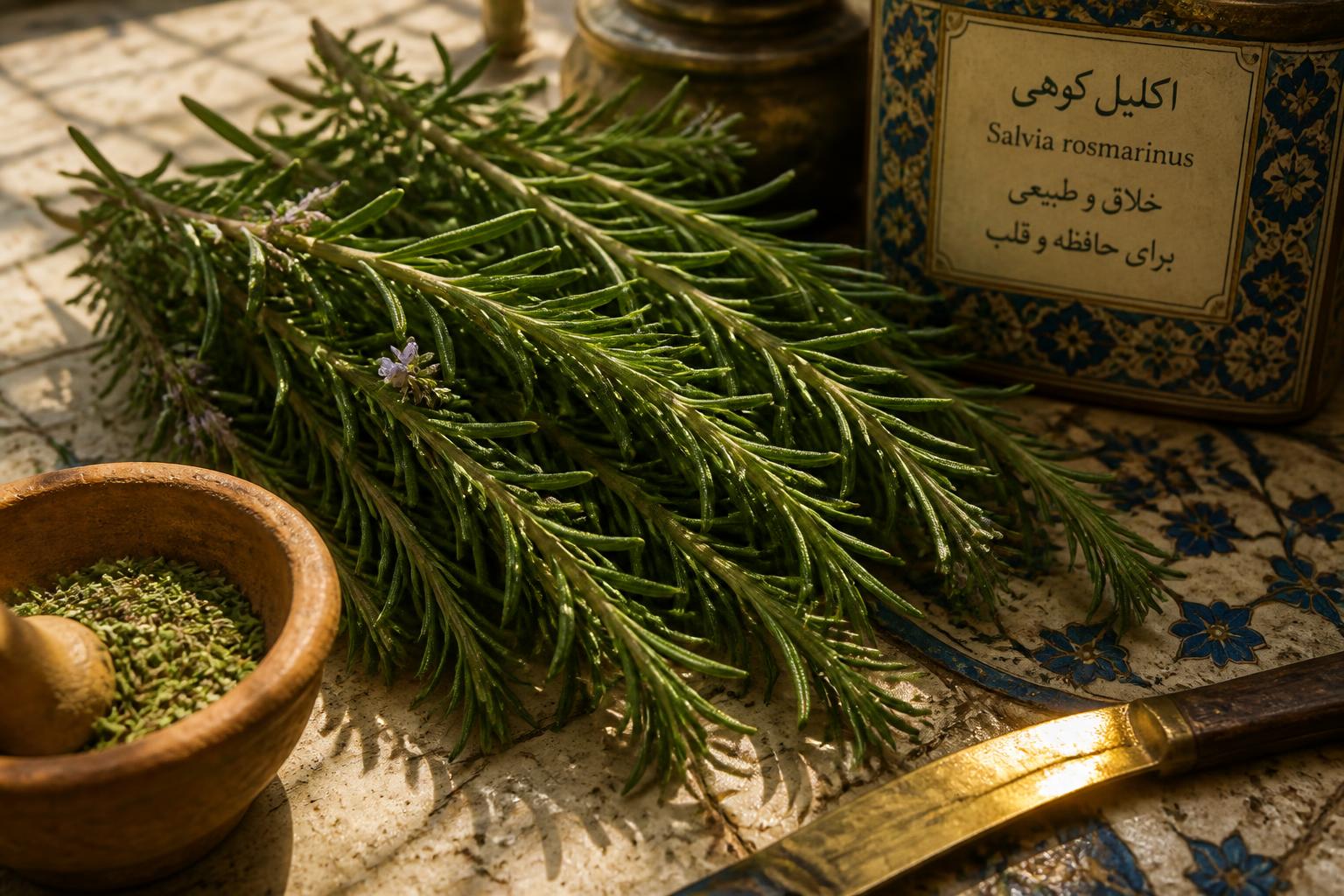
Known to botanists as Salvia rosmarinus (syn. Rosmarinus officinalis).
Chapter 3 of 20
Why Herbalists Still Reach for It
Think of a dull head at 4pm, a slow stomach after lunch, a subtle memory slip after 50, or thinning hair at the crown. These are small daily frictions of modern longevity, and rosemary is one of the few household herbs that meets several of them at once, in normal food amounts, without a supplement bottle.
Small mid-afternoon cognitive (to do with thinking and memory) dips, minor working-memory slips, dull hair at the crown, and cold hands and feet in winter are ordinary frictions of the sixth and seventh decade. Rosemary meets several of them at once, in normal food amounts, through a Mediterranean-Persian kitchen habit that also brings polyphenol (protective plant compounds) antioxidants and warms a sluggish digestion.
Small trials support gentle improvement in working memory and alertness — aroma and low-dose leaf.
Rosmarinic and carnosic acids carry a substantial polyphenol (protective plant compounds) antioxidant load.
Emerging small-trial evidence for post-meal glucose response at ~500 mg dried leaf / day.
Chapter 4 of 20
The Plant Itself
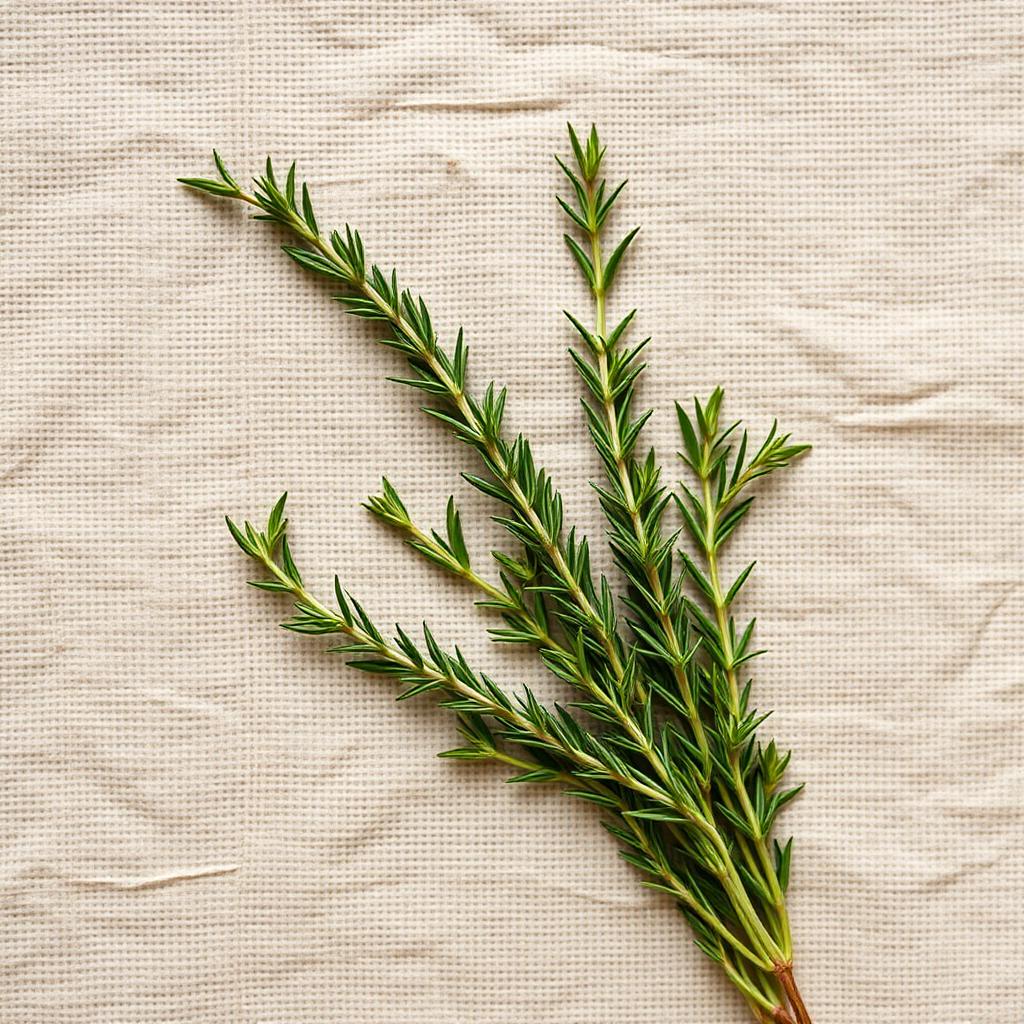
An evergreen Mediterranean shrub 0.5–1.5 m tall with woody stems and dense, needle-like leaves — dark green above, silvery beneath — that release a resinous, camphoraceous aroma when crushed. Pale blue lipped flowers appear along the branches from late winter through spring. Native to the rocky coastal hills of the Mediterranean and long naturalised across the Persian and Anatolian highlands, where it's grown in courtyard gardens and hillside terraces.
Family: Lamiaceae (mint family).
Chapter 5 of 20
What Is In It
Primary compounds
Rosmarinic acid is a hydroxycinnamic-acid polyphenol (protective plant compounds) shared with sage, mint, and lemon balm. Antioxidant, mild anti-inflammatory, mild anxiolytic (calms anxiety) in preclinical work.
Carnosic acid & carnosol: diterpenes concentrated in the leaf. Free-radical scavenging and neuroprotective mechanism in cell and animal studies.
1,8-cineole (eucalyptol) — the dominant monoterpene of the aroma. Associated with acetylcholinesterase inhibition and the small memory-and-mood aromatherapy trials.
Other Constituents
α-pinene and camphor: resinous monoterpenes contributing to the piney warmth and to the classical warming action.
Ursolic acid is a pentacyclic triterpene with anti-inflammatory and metabolic direction in preclinical work.
Aroma of rosemary essential oil (1,8-cineole) improved secondary-memory and alertness performance in a healthy-adult crossover trial.Moderate evidence
500 mg dried rosemary leaf twice daily for one month improved anxiety, depression, memory and sleep vs placebo in a student RCT.Moderate evidence
Standardised rosemary extract improved cognitive (to do with thinking and memory) performance in older adults in a dose-response crossover trial.Moderate evidence
Early research
Rosmarinic acid, carnosic acid and carnosol show antioxidant, neuroprotective, and anti-inflammatory mechanisms across preclinical models.Emerging evidence
Chapter 7 of 20
How It Is Prepared
After a heavy midday meal (a small covered damkardeh) or in the mid-afternoon before focused work (a bruised sprig near the desk). Evening scalp-oil ritual three times a week for thinning hair.
Damkardeh: 1 tsp fresh (or ½ tsp dried) leaves per cup, steeped covered 5–7 min · Rosemary-infused olive oil: sprigs in warm oil 2 weeks for cooking and scalp.
Other Ways to Use It
Hair rinse: strong cooled infusion (a drink made by steeping the plant in hot water) as a final shampoo rinse.
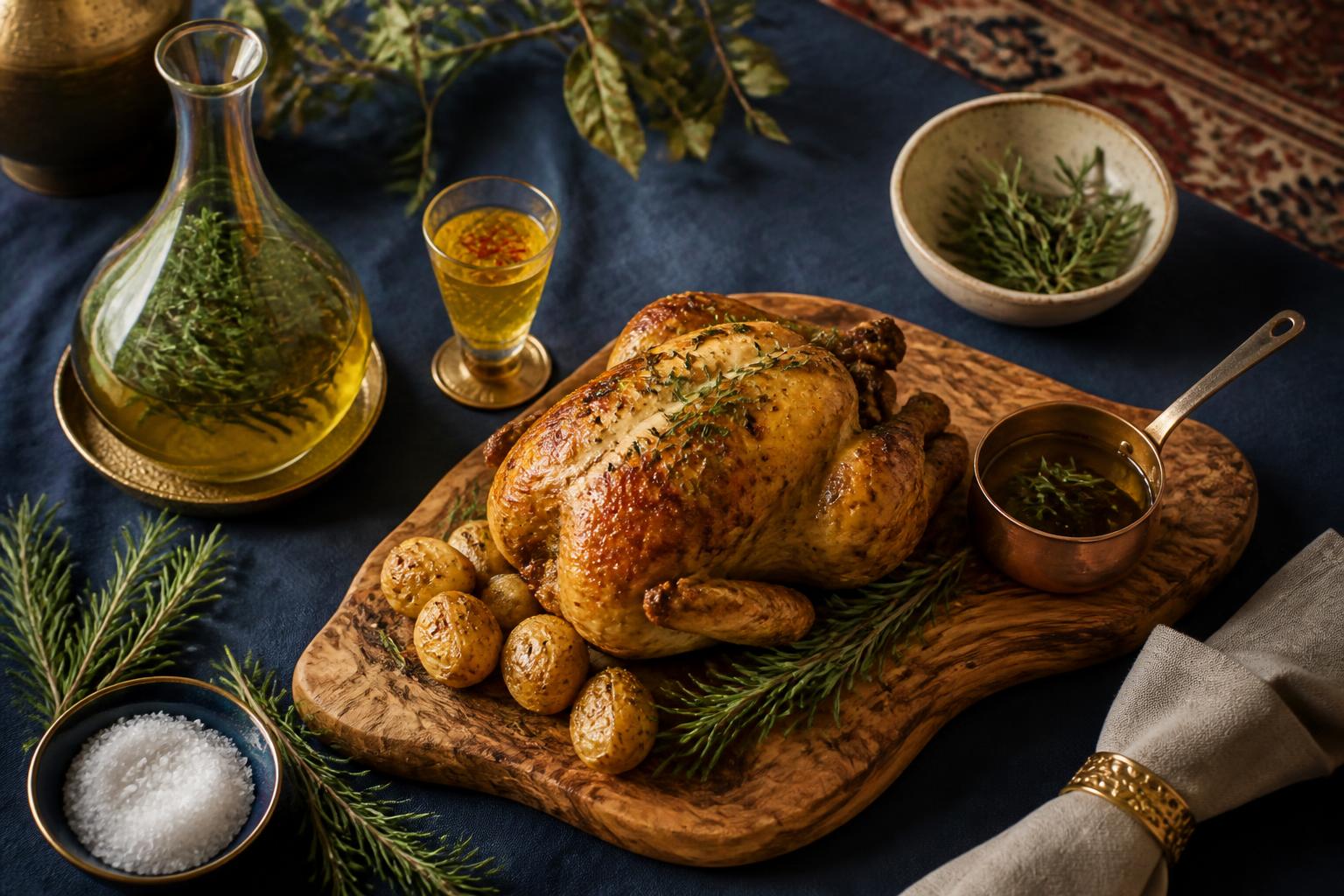
Roast with potatoes, lamb, chicken, or olive-oil-rubbed vegetables.
Rosemary-infused olive oil: 3–4 sprigs warmed gently in 250 ml olive oil, cooled, stored dark.
Chapter 8 of 20
Extracts, Capsules and Concentrates
Capsules and standardised extracts carry many times the amount you get from food, which is why the cautions below matter more here.
Aromatic inhalation is crushed fresh leaves or diluted essential oil to lift focus.
Scalp massage is a few drops of essential oil in a Tbsp of jojoba or almond oil, worked in 3–4 times weekly.
Aroma inhalation before study or focused work — bruise a sprig or open a dropper of essential oil.
Chapter 9 of 20
Medicines and Interactions
Medication interaction:
Warfarin (a blood-thinning medicine) / DOACs — Concentrated rosemary extracts and essential oil show mild antiplatelet (medicines that stop blood cells sticking together, such as aspirin) activity in vitro (in laboratory dishes, not in people); culinary use is generally compatible, extract or essential-oil supplementation warrants clinician discussion. (low concern)
Medication interaction:
Antihypertensives — Very high essential-oil doses have raised blood pressure in animal models; culinary and low-dose leaf extract are compatible. (low concern)
Chapter 10 of 20
Medicines and Interactions: More Interactions to Know
General caution:
Antiepileptics — 1,8-cineole from concentrated essential oil has lowered seizure threshold in animal work; concentrated oil avoided in poorly controlled epilepsy. (moderate concern)
Medication interaction:
Antidiabetic medication (metformin, sulfonylureas, insulin) — Small RCTs of ~500 mg dried leaf / day modestly lowered fasting glucose; usually additive and gentle at culinary doses, worth monitoring on layered therapy. (low concern)
General caution:
CYP450 substrates (theoretical) — Rosemary constituents adjusts CYP1A2 and CYP2B6 in preclinical work; clinically relevant only for very high or long-term concentrated extract use. (low concern)
Chapter 11 of 20
Who Should Be Careful
Medication interaction:
Rosemary essential oil is never taken internally — small doses are toxic.
Pregnancy and breastfeeding:
Medicinal rosemary doses (tea > 3 cups/day, extracts, essential oil in any form) avoided in pregnancy — traditional emmenagogue (traditionally used to bring on a menstrual period) and possible uterine effects at high dose.
Medication interaction:
Poorly controlled hypertension — very high rosemary essential-oil doses have been associated with blood-pressure elevation in animal work.
Allergy:
Known Lamiaceae (mint family) allergy.
Chapter 12 of 20
Pregnancy, Children and Older Adults
Pregnancy and breastfeeding
Pregnancy and breastfeeding:
Culinary rosemary sprinkled on roast lamb, potatoes, or beans is safe and traditional throughout pregnancy. Medicinal doses (strong tea taken as a therapy, standardised leaf extracts, rosemary essential oil in any form) are reserved for the non-pregnant window given classical emmenagogue (traditionally used to bring on a menstrual period) records and possible uterine effects at high dose.
Children
Children:
Culinary rosemary in family food is safe from weaning. Weak rosemary tea from around age 4 for a dull head or cold. Rosemary essential oil isn't applied to the face or chest of infants and small children — 1,8-cineole and camphor can trigger reflex breath-holding in the very young.
Older adults
Medication interaction:
A small daily habit — a sprig on the roast, a covered after-dinner cup of damkardeh-e eklil, an evening scalp oil three times a week — is one of the lower-friction longevity levers on the Persian table: polyphenol (protective plant compounds) antioxidant load, gentle cognitive (to do with thinking and memory) support, warmed peripheral circulation, and a familiar aromatic ritual, all inside food-dose safety.
Chapter 13 of 20
What Persian Medicine Says
Persian temperament: Warm & Dry (2nd degree). Avicenna, Razi and Aghili Khorasani place rosemary (eklil-e kuhi) as warm and dry in the second degree — a classical cephalic and cardiac herb that opens obstructions of cold-moist phlegm, quickens circulation, and lifts a dull head. It's the archetypal Persian remedy for the ‘cold-slow’ constitution.
Mediterranean, Persian, and European herbalists all read rosemary as warm and dry, and give it when the picture is dull and cold rather than hot and tense: fog after illness, poor concentration, cold hands, a heavy stomach after fatty meat. Because it's considered stimulating, the traditional timing is morning and midday, not bedtime, and hot-dry or highly strung people are advised to keep it culinary.
Chapter 14 of 20
What Persian Medicine Says: In the Household
Its oldest household use is the simplest — the sprig cooked with rich meat, understood at once to help the dish digest and to sharpen the mind at the table.
It was used: dull memory, brain fog, and mental fatigue. Sluggish digestion and post-meal heaviness. Poor circulation, cold hands and feet.
Known as the herb of remembrance, rosemary appears in breads, roasted foods, oils, and ritual bouquets across many cultures.
Chapter 15 of 20
Traditional Formulas
Chāi-e eklil o rosewater: after-dinner tea of rosemary and a spoon of rosewater — Persian household calmative for a busy head.
Rosemary–thyme roast rub — Equal parts rosemary and thyme with salt and olive oil, which is the archetypal warming Mediterranean roast for lamb and chicken.
Hair-and-scalp oil: 2% rosemary essential oil in jojoba or sweet-almond carrier — 3–4 evenings a week, massaged in for a full minute.
Chapter 16 of 20
What It Goes With
Herb:
Thyme
Different aromatics, same warm-and-dry temperament. Rosemary + thyme is the archetypal warming Mediterranean roast rub.
Herb:
Sage
Two Lamiaceae cephalics — sage cools while rosemary warms. The pair balances a mind that runs either hot or dull.
Herb:
Mint
A pinch of dried mint added to a rosemary damkardeh brightens the aroma and doubles the after-meal digestive lift.
Chapter 17 of 20
What It Goes With: More Pairings
Pairing:
Olive oil
The archetypal Mediterranean carrier — rosemary-infused olive oil is a single small habit that quietly finishes vegetables, beans and warm bread.
Pairing:
Garlic
Garlic + rosemary + olive oil is the working base of Mediterranean roasts — vascular (relating to the blood vessels) polyphenols (protective plant compounds) meeting circulation-quickening aromatics.
Pairing:
Potato / bean
Rosemary is the herb that turns a plain roast potato or warm white-bean stew into a rounded winter dish.
Chapter 18 of 20
Through the Year
Spring:
Spring
Fresh growth is at its most aromatic — the season for roast lamb with rosemary and for gently steamed rosemary-infused olive oil.
Summer:
Summer
A short cold rosemary-lemon infusion (a drink made by steeping the plant in hot water) cools a heavy head after a hot afternoon.
Autumn:
Autumn
Rosemary comes into its own with autumn roots, beans and squash — the classical warming Mediterranean partner to a cooler table.
Winter:
Winter
Warm damkardeh-e eklil after a heavy winter dinner, and a scalp-oil evening ritual for dry, cold-weather hair.
Chapter 19 of 20
Sources
Sad Giah Hezar Darman (صد گیاه و هزار درمان) — One Hundred Plants and One Thousand Remedies — Dr. Hossein Erfani, 4th edition (1375 / 1996–1997). Primary traditional Persian herbal reference cited throughout this platform. Presented as traditional knowledge, not as modern medical proof.
Office of Dietary Supplements: fact Sheets — US National Institutes of Health (NIH). https://ods.od.nih.gov/factsheets/list-all/.
Herbal Database: memorial Sloan Kettering Cancer Center. https://www.mskcc.org/cancer-care/diagnosis-treatment/symptom-management/integrative-medicine/herbs.
Herbs at a Glance: uS NIH National Center for Complementary and Integrative Health (NCCIH). https://www.nccih.nih.gov/health/herbsataglance.
FoodData Central: searchable nutrient database — US Department of Agriculture (USDA). https://fdc.nal.usda.gov/.
Chapter 20 of 20
Sources (continued)
The Nutrition Source: harvard T.H. Chan School of Public Health. https://www.hsph.harvard.edu/nutritionsource/.
PubMed — peer-reviewed biomedical literature — US National Library of Medicine. https://pubmed.ncbi.nlm.nih.gov/