A dense, slow-burning plant protein and fibre source — 1 oz gives ~6 g protein, ~5 g fibre, and meaningful folate, magnesium, and iron.
Persian medicine classes nokhodchi as warm and dry — strengthening, filling, and best paired with cool-moist kishmish raisins for balance.
Trials of chickpea intake show better LDL (the harmful type of cholesterol) cholesterol (the kind that can build up in artery walls), longer fullness, and steadier after-meal blood sugar than matched refined-carb snacks.
Legume allergy is uncommon but real. Salted commercial varieties can undo the blood-sugar and heart benefits that whole nokhodchi carries.
Chapter 2 of 18
Getting to Know Roasted Chickpea
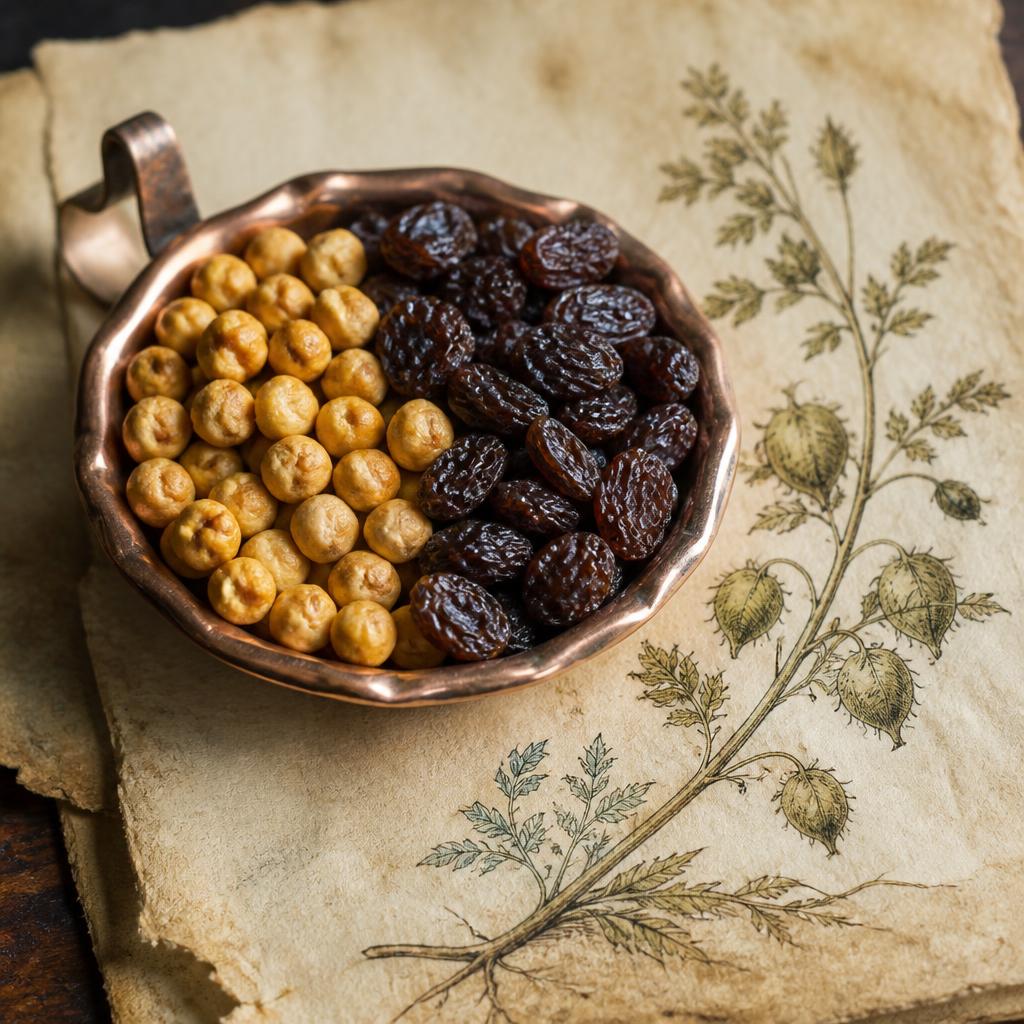
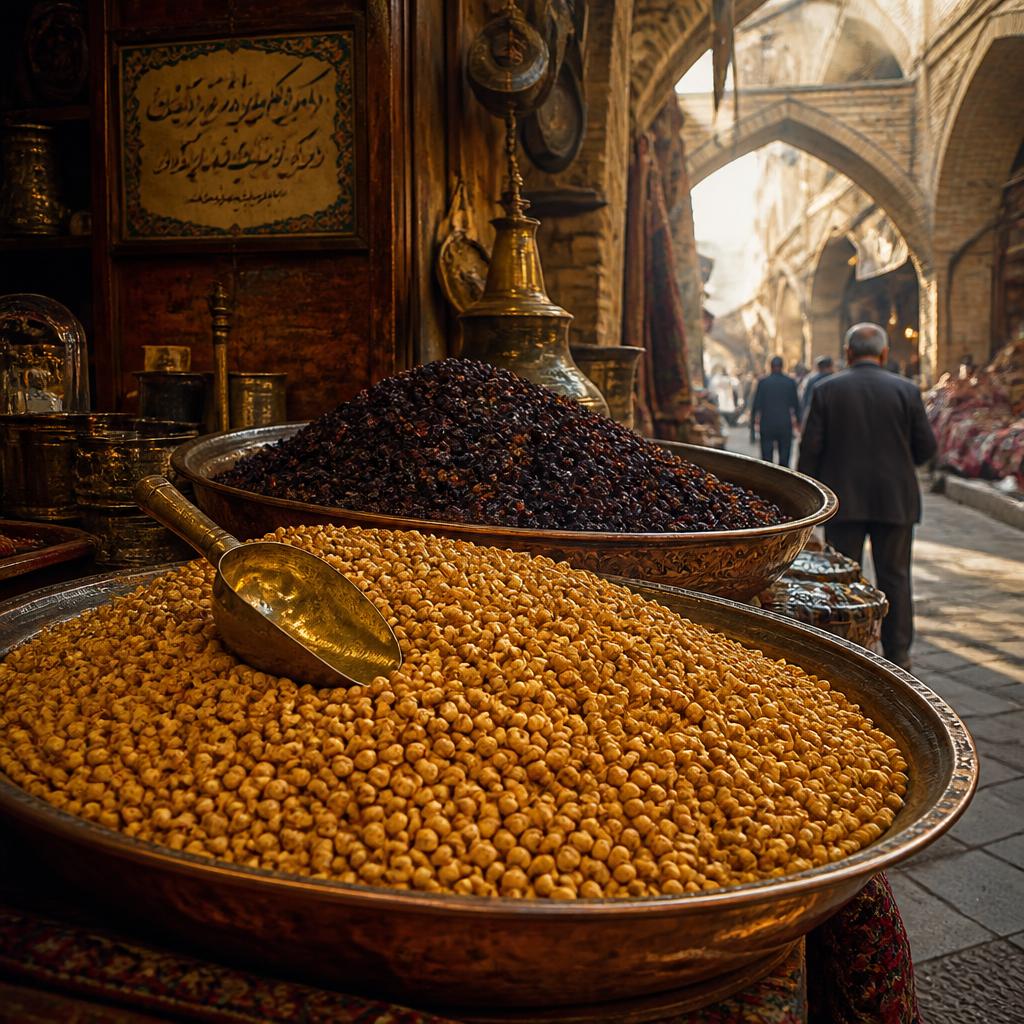
Nokhodchi is Cicer arietinum — the same chickpea that thickens ābgousht and stuffs kufteh Tabrizi — split, hulled, and roasted twice until you can crush it between your teeth and eat it by the handful. In the classical Persian bazaar, you'll find it on copper trays beside dark kishmish raisins in the everyday nokhodchi-kishmish pair: warm, dry protein and fibre in one hand. Cool, moist natural sugar in the other. Modern nutrition sees the same plate as a complete, low-glycaemic snack. The chickpeas bring plant protein, resistant starch, folate, magnesium and iron, while the raisins bring polyphenols (natural plant compounds studied for antioxidant activity) and quick glucose.
Chapter 3 of 18
Why It Matters
Between meals is where many modern diets quietly lose their way. Refined crackers and sweets can send blood sugar and appetite in the wrong direction. A small handful of nokhodchi with kishmish is one of the oldest documented answers to that pattern.
It brings enough plant protein and fibre to soften the blood-sugar spike, enough natural sugar to satisfy without leading to more snacking, and enough folate, magnesium, and iron to matter for older adults, plant-forward eaters, and children in the ājīl years.
What That Means Day to Day
Nokhodchi brings together three quiet things that shape how the second half of life feels: steady plant protein for holding on to muscle, slow-burning fibre for steady blood sugar and a healthy heart, and folate and magnesium, which quietly slip after 60. A small handful with kishmish and afternoon tea is one of the oldest, cheapest, and best-loved daily rituals for supporting all three at once. Just remember that the classical prescription has always meant unsalted, whole nokhodchi.
Chapter 4 of 18
Why It Matters: Blood Sugar
Dense plant protein (~6 g/oz) and fibre (~5 g/oz) for real satiety (the feeling of being full).
Low glycaemic index (a measure of how quickly a food raises blood sugar) — steady energy without the crash.
Folate (~50 µg/oz) supports red-cell formation and neural-tube health.
It was used: magnesium and iron in a form the body reliably absorbs. Resistant starch feeds the colonic microbiome (the community of bacteria living in your gut).
Chapter 5 of 18
What It Contains
Primary compounds
Plant protein (~22 g per 100 g) — dense lysine-rich pulse protein.
Resistant starch and soluble fibre is the low-glycaemic and colonic-microbiome signal.
Folate (~180 µg per 100 g) — red-cell formation and neural-tube support.
Other Constituents
Iron (~5 mg per 100 g) — non-haem iron. Absorption improves with vitamin C from a lemon-dressed torshi or barberry garnish.
Magnesium (~115 mg per 100 g) — vascular (relating to the blood vessels) tone, sleep, and neuromuscular calm.
Chapter 6 of 18
What It Contains: The Rest of the Picture
Isoflavones (biochanin A, formononetin) — mild phyto-oestrogen contribution.
Saponins (soap-like plant compounds) and phytic acid — modest cholesterol- and glucose-modulating polyphenols (protective plant compounds).
Regular pulse consumption (~130 g/day) lowered LDL (the harmful type of cholesterol) cholesterol in a meta-analysis (a study that pools the results of many trials) of 26 randomised controlled trials (a study where people are put into groups by chance). The difference was unlikely to be due to chance (researchers call this statistically significant).Strong evidence
Moderate evidence
Chickpea consumption improves satiety (the feeling of being full), post-prandial glucose response, and LDL (the harmful type of cholesterol) cholesterol compared with matched refined-carb foods.Moderate evidence
Chickpea-based meals produce a lower glycaemic response than matched refined-carb meals in randomised crossover studies.Moderate evidence
Chickpea intake is linked to improved appetite regulation and modest reductions in energy intake in short-term feeding trials.Moderate evidence
Chapter 8 of 18
Preparation and Kitchen Use
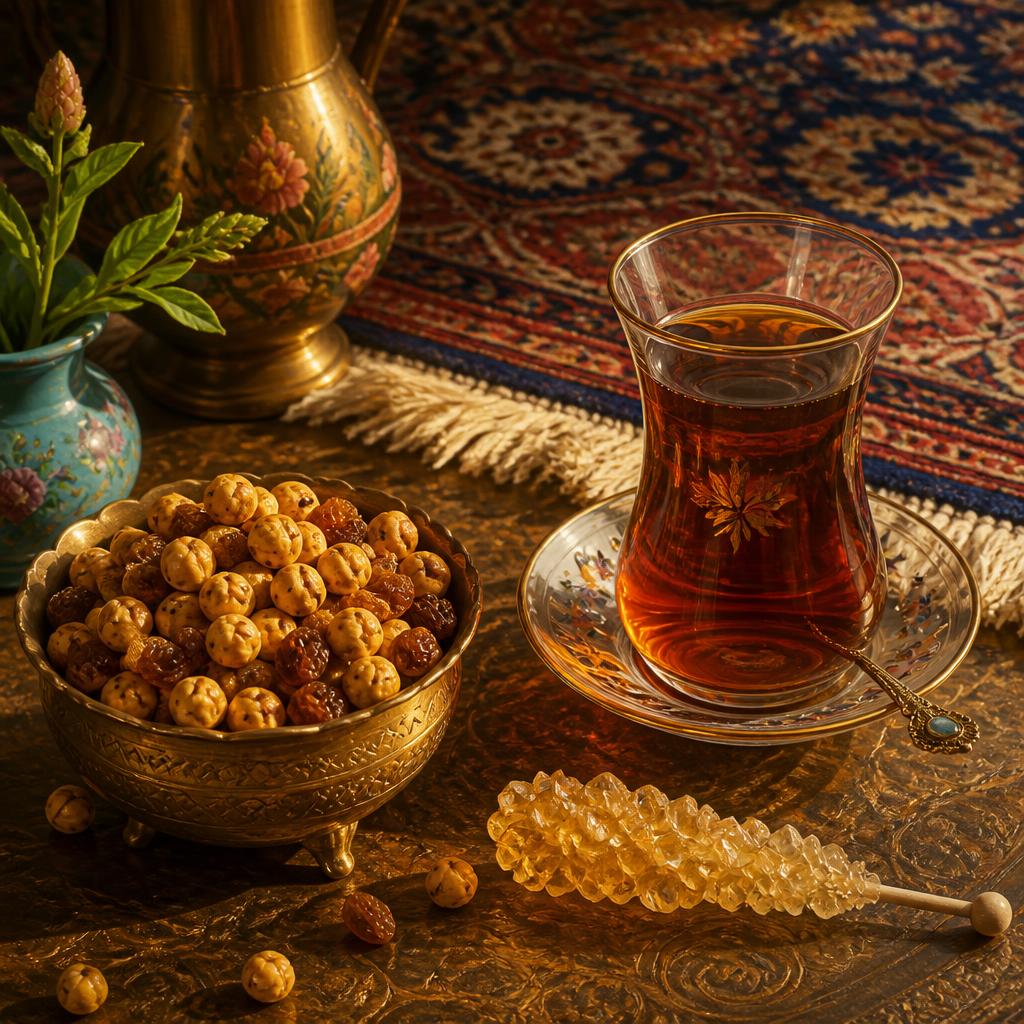
A daily 1 oz handful with a spoon of kishmish and afternoon tea — the classical Persian ritual. A second small portion before physical work is the labourer's tradition. Avoid a large portion right at bedtime on a sensitive digestion.
Dry-toasted whole and eaten by the handful with kishmish raisins.
Grind into ārd-e nokhodchi (roasted-chickpea flour) — the flour that binds qarabiyeh, nan-e nokhodchi, and gluten-free doughs.
Chapter 9 of 18
Preparation and Kitchen Use: Other Ways to Use It
In the kitchen: scattered over ash reshteh, salad Shirazi, or Persian rice as savoury crunch. Steeped whole in a hot broth with saffron as a light convalescent soup.
Blend 2 tablespoons into a date-and-cardamom smoothie for a plant-protein breakfast.
The classical Persian daily handful: ~1 oz (~28 g) nokhodchi mixed with a spoon of kishmish raisins, eaten with black tea.
Bake into gluten-free qarabiyeh with rose water and cardamom.
Buy unsalted: commercial salted-fried nokhodchi undoes the metabolic signal.
Chapter 10 of 18
Medicines and Interactions
General cautions
Medication interaction:
Very large single portions can cause gas and bloating on a low-FODMAP prescription.
Specific medicines
Medication interaction:
Antidiabetic medication (metformin, sulphonylureas, insulin) — Low-glycaemic fibre and protein modestly improve post-prandial glucose control. A daily handful is food-scale and complementary; unusually large single portions should prompt home glucose monitoring on insulin. (low concern)
Medication interaction:
Levothyroxine, bisphosphonates, tetracyclines, fluoroquinolones — Divalent minerals (calcium, magnesium, zinc, iron) from a chickpea-heavy meal can bind and reduce absorption. Separate dosing by ≥ 2 hours from a large nokhodchi serving. (moderate concern)
Medication interaction:
Warfarin — Vitamin K content is modest and stable at culinary doses. No meaningful INR (the blood test that shows how fast your blood clots) swing at a daily handful. (low concern)
Chapter 11 of 18
Who Should Be Careful
Allergy:
Confirmed chickpea or wider legume allergy.
General caution:
Active low-FODMAP protocol — nokhodchi is a moderate-FODMAP food and can trigger IBS symptoms in the elimination phase.
General caution:
Salted-fried commercial varieties on a sodium-restricted cardiac or renal diet.
Chapter 12 of 18
Pregnancy, Children and Older Adults
General
Children:
Whole nuts and seeds are a choking hazard for young children.
Children:
Whole nokhodchi is a choking hazard for children under age 4 — use crushed or ground.
Pregnancy and breastfeeding
Pregnancy and breastfeeding:
A daily 1 oz handful of unsalted nokhodchi with kishmish is safe and useful throughout pregnancy — a dense source of folate (specifically indicated in the peri-conception and first-trimester window), plant protein, iron, and magnesium. The classical Persian household continues the nokhodchi-kishmish pair into the post-partum weeks. Confirmed chickpea allergy is the only stop.
Children
Children:
Ground nokhodchi and roasted-chickpea flour can be introduced from around 8–9 months once solids are established, watching for the uncommon chickpea allergy. Whole nokhodchi waits until age 4 due to choking risk. From the ājīl years onward, the small paper cone of nokhodchi-kishmish is one of the most nourishing after-school snacks in the Persian household — steady energy, plant protein, iron, and folate in a form children actually reach for.
Chapter 13 of 18
Pregnancy, Children and Older Adults: A Few More Points
Older adults
Older adults:
Among the more useful daily snacks after 60: steady plant protein for muscle preservation, low-glycaemic fibre for cardiometabolic stability, and reliable folate, magnesium, and iron in a portable form. Choose unsalted; the classical afternoon-tea handful with kishmish is one of the gentlest ways to hold appetite steady between smaller meals. For unreliable chewing, ground nokhodchi stirred into yogurt or a warm broth carries the same signal.
Chapter 14 of 18
Traditional Persian Perspective
Persian temperament: Warm & Dry (Warm 2nd, Dry 1st–2nd degree — Ibn Sīnā, Aghili Khorasani). Persian medicine classifies nokhod-e boo dādeh as warm (2nd degree) and dry (1st–2nd degree) — muqawwī (strengthening), muhazzil on damp constitutions, mufattih (mildly opening for chest and urinary passages). Classical caution: eaten alone in a dry constitution it aggravates dryness — the household correction is to pair with cool-moist kishmish raisins, dates, or a spoon of honey. Ayurvedic bhuna chana runs the same warm-and-dry, kapha-pacifying line and is specifically prescribed as the wrestler's plant protein.
It was used: daily pocket food for scholars, travellers, and labourers (Persian and Yūnānī). Gentle chest-opening food during winter dryness (paired with kishmish).
Post-fever restorative in a light broth with saffron and warm oil.
Chapter 15 of 18
In Persian Life
Nokhodchi-kishmish is the pocket food of Iranian childhood. It's sold from copper trays in bazaars from Tabriz to Kerman, wrapped in a paper cone for the walk home from school, and set on every Yalda and Nowruz ājīl plate. In Turkey, the same nut is called leblebi and has a whole street-food tradition around it. In North India, it's bhuna chana, the wrestler's plant protein. Across the Levant, it appears in mixed nut trays beside pistachio and roasted almond.
Chapter 16 of 18
Questions People Ask
Why pair chickpeas with raisins?
Persian medicine reads the pair as warming protein balanced by cool-moist sweetness. Modern nutrition reads it as low-glycaemic fibre and protein blunting the glucose curve of the raisin sugar — a complete, portable snack.
Is nokhodchi safe for diabetes?
The whole, unsalted, low-glycaemic form is one of the friendliest snacks for glucose control. Commercial salted-fried varieties aren't — read the label and pair with a modest raisin portion.
Can I use nokhodchi flour instead of wheat flour?
It's gluten-free and higher in protein, but it behaves differently: expect denser, more tender baked goods. Persian qarabiyeh and nan-e nokhodchi are the classical templates that show it at its best.
How much folate and iron does a handful actually give?
About 15% of the daily folate target and ~10% of the daily iron target per ounce — modest but reliable, and stacked across the day the numbers matter.
Chapter 17 of 18
Sources
Office of Dietary Supplements: nuts & Seeds — US National Institutes of Health (NIH). https://ods.od.nih.gov/factsheets/list-all/.
FoodData Central: uS Department of Agriculture. https://fdc.nal.usda.gov/.
Chickpeas and satiety, glucose control, and lipid profile — systematic review — Nutrients (PubMed). https://pubmed.ncbi.nlm.nih.gov/30583504/
Chickpea consumption and glycaemic response is randomised trials — Br J Nutr (PubMed). https://pubmed.ncbi.nlm.nih.gov/17010224/.
Pulses and LDL cholesterol: meta-analysis of 26 RCTs — CMAJ (PubMed). https://pubmed.ncbi.nlm.nih.gov/24710915/.
Chickpea (Cicer arietinum): a review of nutritional composition and health effects — Br J Nutr (PubMed). https://pubmed.ncbi.nlm.nih.gov/22916813/