Rambutan looks alarming, but it isn't. Once you know the spines are soft and the skin twists open, it's one of the simplest fruits to serve.
Vitamin C and copper both matter for collagen, which holds skin and blood vessels together. Rambutan gives you both in a fruit most people will actually enjoy eating.
A good source of vitamin C from just a few fruits.
What That Means Day to Day
Low in calories for how sweet it tastes.
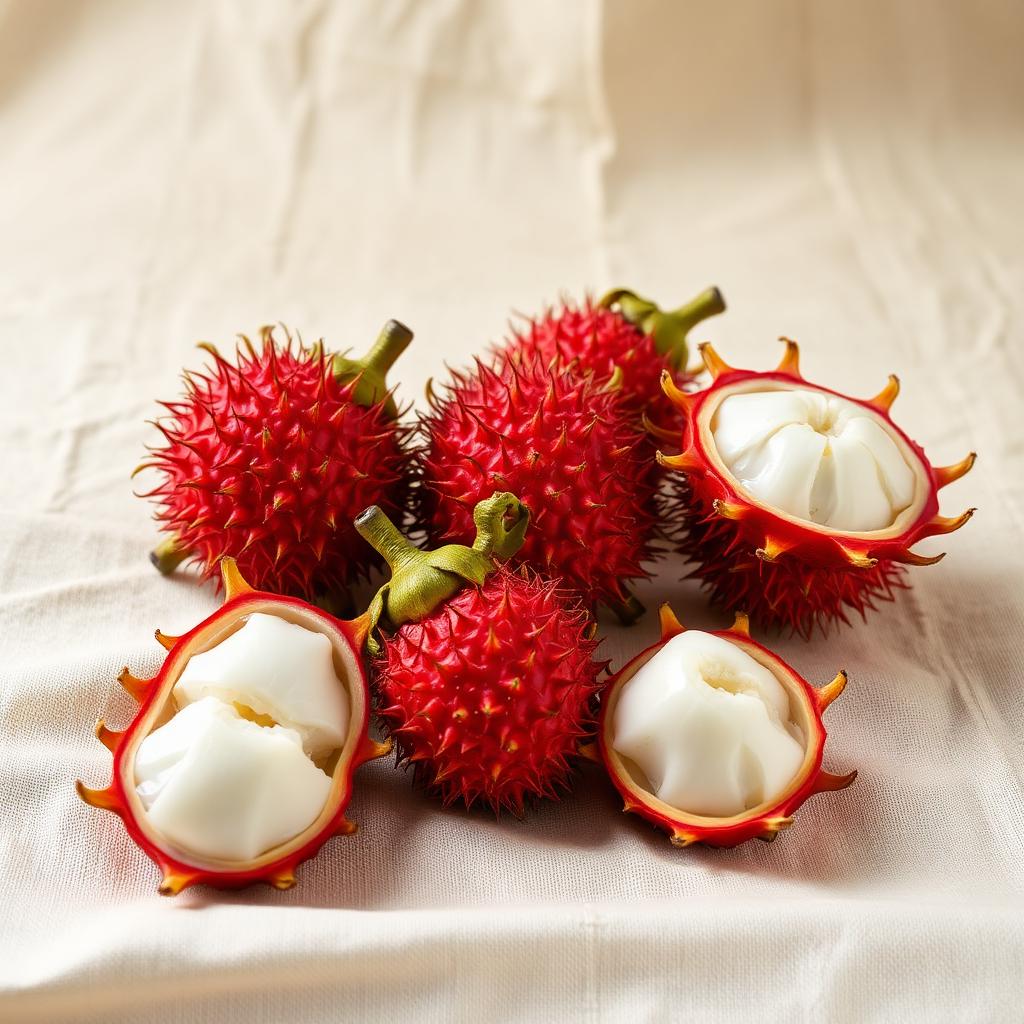
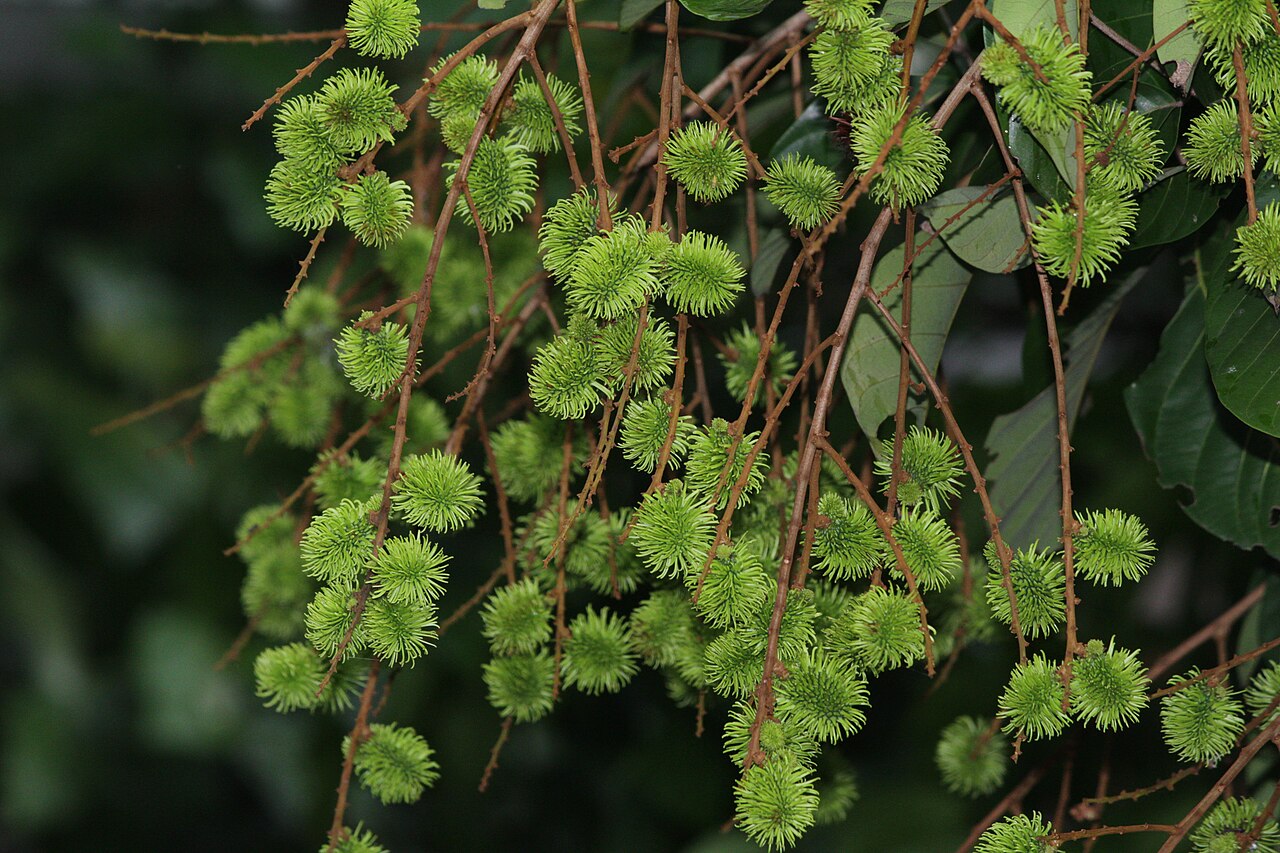
Rambutan grows on a spreading evergreen tree. The fruit is the size of a small egg, covered in soft, bendy red or yellow spines. Under the skin is firm white flesh around a single flat seed.
Minerals: Potassium, Iron · Antioxidants: Ellagic acid, Corilagin, Geraniin · Fiber: ~1 g per 100 g
Chapter 4 of 13
In the Laboratory
From laboratory work, not from people taking it
Rambutan peel and flesh contain measurable ellagitannins and flavonoids (a family of protective plant compounds) with antioxidant activity in laboratory assays. Rated: early research.
Chapter 5 of 13
Preparation and Kitchen Use
Cut a shallow ring around the skin and twist. Don't try to peel it like an orange.
The thin brown film on the seed can stay attached — trim it if you notice it.
Store in the fridge in a loose bag. The spines darken within days but the fruit is fine.
In the kitchen: fresh and cold, peeled at the table. Sliced off the seed into a fruit salad.
Other Ways to Use It
Stuffed with soft cheese or nuts, as street stalls in Thailand do.
Score the skin around the middle with a knife, then twist the halves apart.
Eat the flesh off the seed. It clings, which is normal.
Chill before serving: it's much better cold.
Chapter 6 of 13
Medicines and Interactions
Medication interaction:
Diabetes medicine — Ripe rambutan is high in sugar. Ten or twelve at a sitting will show on a glucose reading. (low concern)
Chapter 7 of 13
Who Should Be Careful
General caution:
Do not eat the seed. Raw rambutan seed contains compounds that can cause nausea, and it isn't treated as food.
General caution:
People who react to lychee or longan may react to rambutan; the three are close relatives.
General caution:
Canned rambutan is packed in syrup and is far sweeter than the fresh fruit.
Chapter 8 of 13
Pregnancy, Children and Older Adults
Pregnancy and breastfeeding
Pregnancy and breastfeeding:
The fresh fruit is an ordinary food and safe. The seeds and the peel extracts sold as supplements have not been studied and should be left alone.
Children
Children:
The stone is a choking hazard and doesn't separate cleanly. Peel and de-stone the fruit before giving it to a child under five.
Older adults
Older adults:
Soft and easy to eat once peeled, though the peeling is fiddly with stiff hands. Ask for it prepared, or buy the fruit already shelled where that's offered.
Chapter 9 of 13
Traditional Uses in Southeast Asia
Persian temperament: Hot & Moist (1st degree). Malay and Javanese practice counts rambutan among the warming fruits, eaten in small quantity and balanced with something cooling.
Rambutan doesn't appear in classical Persian medicine because it never grew within its reach. A Persian temperament reading would place a sweet, juicy tropical fruit on the warm and moist side. South-East Asian tradition treats it as a cooling, thirst-quenching fruit.
Eaten in season as a cooling fruit in South-East Asian household practice.
Rambutan is native to the Malay Peninsula, and its name comes from the Malay word rambut, meaning hair. In Malaysia, Indonesia and Thailand, you'll see it sold by the bunch along roadsides during the mid-year season.
Chapter 10 of 13
What It Goes With
Fruit:
Lime
Rambutan is sweet without much acid. Lime juice over the peeled fruit fixes that in one squeeze.
Fruit:
Pineapple
A bowl of both eats better than either alone: one brings the perfume, the other the sharpness.
Pairing:
Coconut
Coconut milk over chilled rambutan is a Southeast Asian dessert built on exactly this pairing.
Herb:
Mint
Torn mint lifts a fruit that can taste flat once it warms to room temperature.
Chapter 11 of 13
Through the Year
Spring:
Spring
Rarely available and rarely good. What arrives has usually been chilled too long and the hairs have blackened.
Summer:
Summer
The Southeast Asian season begins. Look for bright red skin with green-tipped hairs.
Autumn:
Autumn
A second crop in much of the region, often sweeter than the first.
Winter:
Winter
Out of season. Canned fruit in syrup is what is left, and it's mostly sugar.
Chapter 12 of 13
Questions People Ask
Are the hairs sharp?
No. They bend under your finger. The fruit looks far more defensive than it's.
Is it the same as lychee?
A close cousin. Rambutan is firmer, less perfumed, and its skin is spiny rather than pebbled.
Why does the flesh stick to the seed?
That's normal for most varieties. Freestone types exist but are rare outside growing regions.
Chapter 13 of 13
Sources
Nephelium lappaceum: nutritional and phenolic profile — Food Chemistry. https://pubmed.ncbi.nlm.nih.gov/25148989/
Antioxidant compounds of tropical Sapindaceae fruits — Journal of Agricultural and Food Chemistry. https://pubmed.ncbi.nlm.nih.gov/19860427/