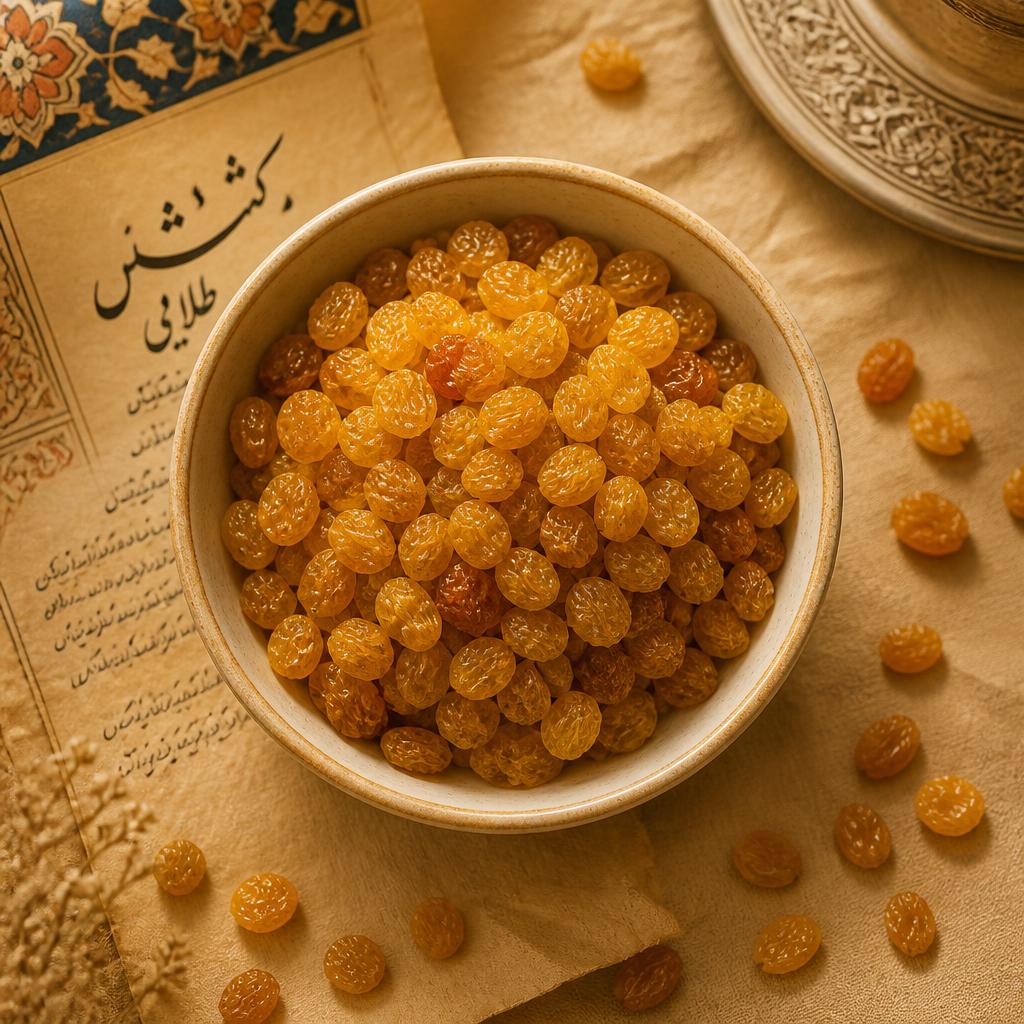
Concentrated iron, potassium, and boron — a small handful delivers meaningful minerals for bone and blood.
Naturally sweet without added sugar is better than candy for a hungry child or an afternoon slump.
Boron in raisins helps the body use calcium and magnesium well for bone.
Iran is one of the ancient homes of the raisin. You'll find golden keshmesh-e talā'i, tiny keshmesh-e sabz, and dark mavizeh in ājeel mixes, rice pilaf, and on the morning table beside walnuts and tea.
Known to botanists as Vitis vinifera (dried).
In a Persian household, raisins are a small everyday habit that quietly brings iron, potassium, and boron across decades — three minerals that often run low in modern diets.
Boron to help the body use its bone minerals.
Prebiotic (fibre that feeds the helpful bacteria in your gut) fibre for the gut.
Chapter 2 of 13
Start Here: What Else to Know
Natural sweetness without added sugar.
Iran sells several distinct raisins and treats them as different ingredients. Small seedless keshmesh sabz is pale green-gold, tart and delicate. Maviz is a darker, larger, sweeter raisin. Golden raisins owe their colour to sulphur dioxide treatment during drying. Sun-dried ones go brown.
Shade-dried raisins keep more of their acidity and fragrance and cost more. Sun-dried are darker, sweeter and flatter in flavour.
Chapter 3 of 13
What It Contains
Primary compounds
Resveratrol (a natural compound in grape skins that scientists study for heart health). Quercetin (a plant compound found in onions, apples and tea).
Vitamins
B vitamins, Vitamin K
Other notable constituents
Minerals: Potassium, Copper, Manganese · Antioxidants: Catechins (plant compounds common in green tea) · Fiber: ~1 g per 30 g
Chapter 4 of 13
In the Laboratory
From laboratory work, not from people taking it
Boron influences calcium, magnesium, and vitamin D handling in metabolic laboratory studies.Emerging evidence
What studies in people show
Daily raisins improved blood pressure and glycaemia vs common snack foods in randomised comparisons.Moderate evidence
Raisins in place of processed snacks lowered post-meal blood sugar in people with type 2 diabetes.Moderate evidence
Chapter 5 of 13
Using It in the Kitchen
Morning is soaked overnight, taken with the water on an empty stomach. And in cool-weather cooking through the winter.
Soaked (āb-e keshmesh) at breakfast.
Stir into cooked rice with saffron and slivered pistachio.
In the kitchen: blended into halwa and served raw in ājeel.
Soak 8–10 golden raisins overnight. Drink the water and eat the fruit at breakfast.
Other Ways to Use It
Blend into oatmeal or aash for iron-rich sweetness.
Serve in ājeel with almonds and walnut.
Raisins are fried briefly in oil or butter until they swell before they meet rice — this is what gives shirin polo and many pilafs their bursts of sweetness. Added dry, they stay hard and taste dusty.
They also carry sweetness into savoury dishes: dolmeh fillings, kuku, and the classic pairing of raisins with walnuts served alongside tea.
Chapter 6 of 13
Medicines and Interactions
Medication interaction:
Diabetes medicine — Raisins are concentrated sugar, around 60 grams per hundred. A handful raises blood glucose faster than the same weight of grapes. (moderate concern)
Medication interaction:
Blood thinners — Raisins carry some vitamin K, though far less than leafy greens. Large daily quantities are what would matter. (low concern)
Chapter 7 of 13
Sugar, Teeth and Portion
General caution:
Energy-dense — a small handful (~30 g) is a moderate serving.
General caution:
Sticky texture can cling to teeth; rinse or brush after.
General caution:
Sulphured golden raisins may trigger sulphite-sensitive asthma — buy sun-dried.
General caution:
Severe fructose malabsorption.
Chapter 8 of 13
Pregnancy, Children and Older Adults
Pregnancy and breastfeeding
Pregnancy and breastfeeding:
A useful source of iron and potassium in a small package, and easier to keep down than most foods when appetite is poor. Watch the quantity if gestational diabetes is in the picture.
Children
Children:
Whole raisins are a choking risk under three and stick to teeth at any age. Rinse them, serve them with a meal rather than alone, and follow with water.
Older adults
Older adults:
Small, dense, mineral-rich — one of the easiest ways to strengthen the daily mineral intake after 65.
Chapter 9 of 13
Traditional Persian Perspective
Persian temperament: Warm & Moist (1st degree). Nourishing, blood-building, chest-softening. Warmer than the fresh grape.
Persian medicine reads keshmesh as warm and moist. It's seen as nourishing, blood-building, chest-softening, and gently laxative when soaked. Morning soaked-raisin water (āb-e keshmesh) is a classical liver and heart tonic.
Keshmesh appears in polo, ājeel, halwa, and on every tray beside the Nowruz haft-sin. Soaked-raisin water is both a Sufi and household longevity ritual.
Chapter 10 of 13
What It Goes With
§ More Pairings
Pairing:
Walnut
Sweet with bitter, soft with crisp. Iranians have eaten this pair with tea for centuries and it needs no improving.
Pairing:
Persian Chai
Raisins are held in the cheek and the tea drunk through them, instead of sugar in the glass.
Dairy:
Yogurt
Soak them for ten minutes first. Dry raisins pull moisture out of yogurt and go hard.
Grain:
Barley
A handful into barley soup near the end sweetens it without sugar and thickens it slightly.
Chapter 11 of 13
Through the Year
Spring:
Spring
In rice dishes and with nuts. A handful at a time rather than by the bowl.
Summer:
Summer
Fresh grapes are better now. Keep raisins for cooking.
Autumn:
Autumn
Drying season. New-crop raisins are softer and taste of grape rather than sugar.
Winter:
Winter
The main season. Raisins and walnuts together are the standard Persian winter snack.
Chapter 12 of 13
Sources
Sad Giah Hezar Darman (صد گیاه و هزار درمان) — One Hundred Plants and One Thousand Remedies — Dr. Hossein Erfani, 4th edition (1375 / 1996–1997). Primary traditional Persian herbal reference cited throughout this platform. Presented as traditional knowledge, not as modern medical proof.
Office of Dietary Supplements: fact Sheets — US National Institutes of Health (NIH). https://ods.od.nih.gov/factsheets/list-all/.
Herbal Database: memorial Sloan Kettering Cancer Center. https://www.mskcc.org/cancer-care/diagnosis-treatment/symptom-management/integrative-medicine/herbs.
Herbs at a Glance: uS NIH National Center for Complementary and Integrative Health (NCCIH). https://www.nccih.nih.gov/health/herbsataglance.
FoodData Central: searchable nutrient database — US Department of Agriculture (USDA). https://fdc.nal.usda.gov/.
Chapter 13 of 13
Sources (continued)
The Nutrition Source: harvard T.H. Chan School of Public Health. https://www.hsph.harvard.edu/nutritionsource/.
PubMed — peer-reviewed biomedical literature — US National Library of Medicine. https://pubmed.ncbi.nlm.nih.gov/