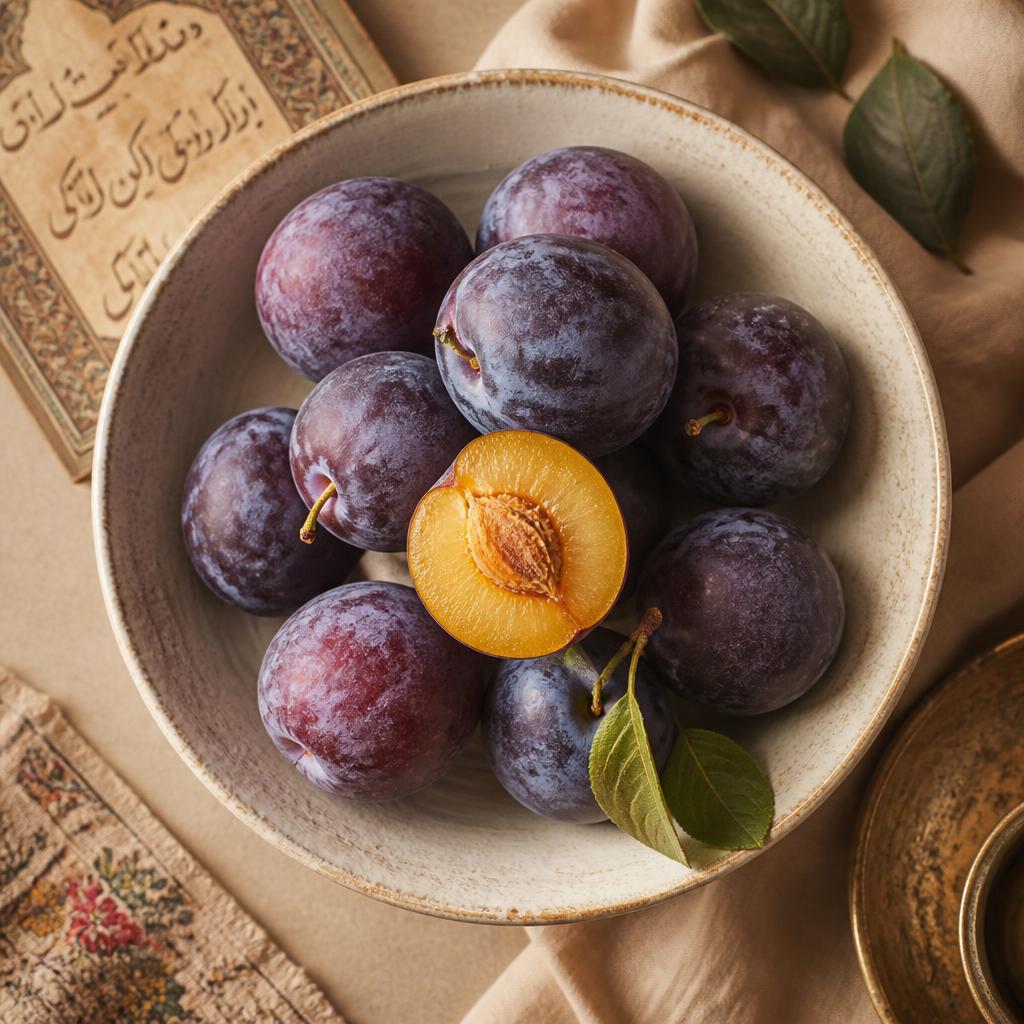
One of the most reliable fruits for gentle daily regularity — sorbitol and soluble fibre work together.
Rich in anthocyanins (the natural colour pigments that make fruit red, purple or blue) and vitamin C — a real antioxidant contribution at ordinary portions.
Dried plums (prunes) are the single best-evidenced food for post-menopausal bone density.
People have grown plums on the Iranian plateau for millennia. We eat them fresh in summer and dried (ālū-Bokhārā) all year. They bring the classic Persian sour-sweet note to khoresh-e ālū and gently help a sluggish bowel.
Known to botanists as Prunus domestica.
Chapter 2 of 12
Why It Matters
Bone density, regular bowels, and antioxidants that support blood vessels all matter quietly as we age. Plums bring all three in one fruit that the Persian pantry keeps both fresh and dried.
As we age, bowels can slow down and bone density can fall. Dried plums are among the very few foods with real trial evidence for both. The bone studies used five or six a day, which is a manageable habit.
Gentle laxative action (sorbitol + fibre).
Anthocyanin (the natural colour pigments that make fruit red, purple or blue) antioxidants for vascular (relating to the blood vessels) health.
It was used: prebiotic fibre feeds the good gut bacteria. Vitamin C and potassium at ordinary servings.
Primary compounds
It was used: chlorogenic and neochlorogenic acids. Soluble fibre (pectin).
Other notable constituents
Minerals: Potassium, Copper
Chapter 3 of 12
What Studies in People Show
What studies in people show
Daily prunes preserved bone mineral density in post-menopausal women (12-month RCT). Rated: strong evidence. Prunes improved stool frequency and consistency vs psyllium in chronic constipation.Moderate evidence
Chapter 4 of 12
Using It in the Kitchen
In the kitchen: fresh in the height of summer. Dried through autumn and winter, especially soaked at breakfast. Fresh out of hand.
Soaked overnight in warm water.
Simmer dried ālū-Bokhārā into lamb khoresh for its sour-sweet accent.
Blend into a compote with cardamom and rose.
Eat fresh, chilled, as a summer afternoon snack.
Soak 4–5 prunes overnight. Eat on an empty stomach for gentle regularity.
Chapter 5 of 12
Medicines and Interactions
Medication interaction:
Warfarin — Plums carry vitamin K. Ordinary portions aren't a problem; a sudden jump from none to a bowl a day is what shifts an INR (the blood test that shows how fast your blood clots). (low concern)
Medication interaction:
Potassium-sparing diuretics — Dried plums are concentrated potassium. Several a day on top of a potassium-holding drug adds up. (moderate concern)
General caution:
Laxatives and stool softeners — The effects stack. If you already take one, add plums slowly rather than at full quantity. (low concern)
Chapter 6 of 12
Who Should Be Careful
General caution:
Sorbitol content can loosen the bowel in large portions.
General caution:
Dried plums are energy-dense — 4–6 per day is a moderate serving.
General caution:
Fructose-malabsorption sensitivity may require smaller portions.
General caution:
Severe IBS-D flare (start with small amounts).
Chapter 7 of 12
Pregnancy, Children and Older Adults
Pregnancy and breastfeeding
Pregnancy and breastfeeding:
Useful, because constipation is close to universal in later pregnancy and dried plums work gently where iron tablets don't. Start with three or four and drink water alongside.
Children
Children:
Fresh plums are fine from the point a child chews well. Dried plums move a young bowel fast, so one or two is plenty. Whole dried plums with stones in are a choking risk for toddlers.
Older adults
Older adults:
One of the best-evidenced everyday foods after 60 — bones and bowel at once.
Chapter 8 of 12
Traditional Persian Perspective
Persian temperament: Cool & Moist (1st degree). Cools bilious heat, softens the bowel, cleanses the blood.
Persian medicine sees plum as cool and moist. It was used to cool excess heat, calm bile, soften the bowel, and cleanse the blood. Sour dried ālū-Bokhārā is the classic addition to lamb khoresh for someone with a hot-dry constitution.
In the Household
Dried sour plums traded west from Bukhara, which is where the Persian name comes from.
It was used: given as a household remedy for a sluggish bowel long before anyone measured sorbitol and simmered into a sharp syrup for hot-weather drinking.
Ālū-Bokhārā (sour dried plums from Bukhara) gives khoresh-e ālū and Nowruz-era rice pilafs their defining flavor. Fresh yellow ālū-zard and red ālū-qermez fill summer markets.
Chapter 9 of 12
What It Goes With
§ More Pairings
Pairing:
Lamb
Sour dried plums in a lamb khoresh cut the fat and make the meat taste lighter than it's.
Pairing:
Walnut
Stone fruit and walnut is an old autumn plate. The oil in the nut softens the plum's acid.
Dairy:
Yogurt
Chopped plums into thick yogurt. If regularity is the reason you're eating them. This is the useful version.
Spice:
Cinnamon
Warm spice against cool fruit. That makes it the Persian correction for a cold constitution eating a cooling fruit.
Chapter 10 of 12
Through the Year
Spring:
Spring
Nothing local. Dried alu-Bokhara carries the household until the trees crop.
Summer:
Summer
The season. Yellow alu-zard first, then the red plums, and both are best eaten within a day or two of ripening.
Autumn:
Autumn
The late varieties are the sweetest of the year. This is also drying season for anyone who does it at home.
Winter:
Winter
Dried plums only, in the stew pot and in the fruit bowl.
Chapter 11 of 12
Sources
Sad Giah Hezar Darman (صد گیاه و هزار درمان) — One Hundred Plants and One Thousand Remedies — Dr. Hossein Erfani, 4th edition (1375 / 1996–1997). Primary traditional Persian herbal reference cited throughout this platform. Presented as traditional knowledge, not as modern medical proof.
Office of Dietary Supplements: fact Sheets — US National Institutes of Health (NIH). https://ods.od.nih.gov/factsheets/list-all/.
Herbal Database: memorial Sloan Kettering Cancer Center. https://www.mskcc.org/cancer-care/diagnosis-treatment/symptom-management/integrative-medicine/herbs.
Herbs at a Glance: uS NIH National Center for Complementary and Integrative Health (NCCIH). https://www.nccih.nih.gov/health/herbsataglance.
FoodData Central: searchable nutrient database — US Department of Agriculture (USDA). https://fdc.nal.usda.gov/.
Chapter 12 of 12
Sources (continued)
The Nutrition Source: harvard T.H. Chan School of Public Health. https://www.hsph.harvard.edu/nutritionsource/.
PubMed — peer-reviewed biomedical literature — US National Library of Medicine. https://pubmed.ncbi.nlm.nih.gov/