Fully ripe and soft only — unripe persimmon is heavily astringent (tightens tissue and leaves a dry feeling in the mouth) and can, in rare cases, form a phytobezoar in the stomach.
Among the fibre-densest common fruits (~6 g per fruit) and rich in beta-carotene, cryptoxanthin, and lycopene (the red pigment in tomatoes).
Traditionally soothing for a hot, dry throat and cough — the Persian late-autumn cooling fruit.
Best eaten between meals, not with heavy animal-protein courses, to reduce tannin-related digestive discomfort.
Chapter 2 of 13
Getting to Know Persimmon
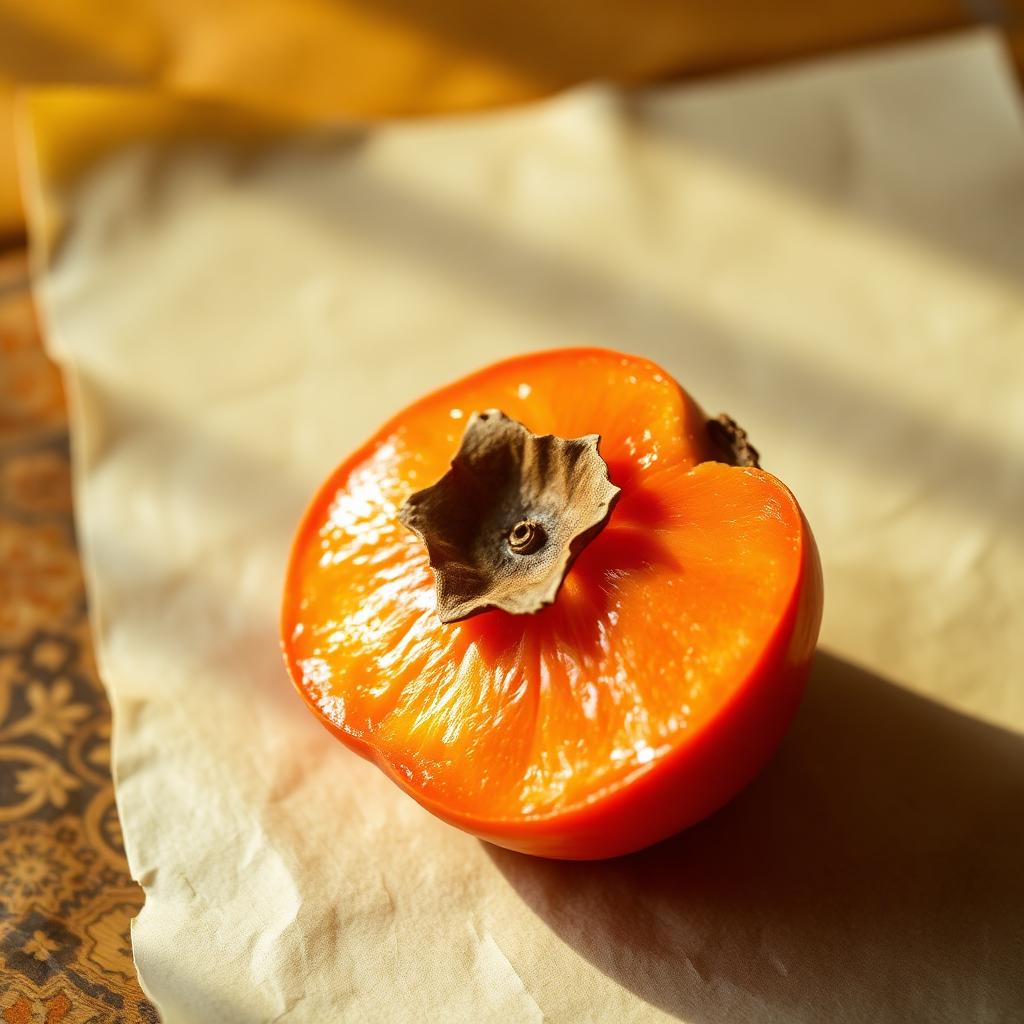
Persimmon (Diospyros kaki): khormalou, literally 'date-plum' — ripens on the Persian plateau in late autumn, turning gold, then amber, then almost translucent. Let it become fully ripe and soft, and you get one of the most carotenoid- and fibre-dense fruits on the household shelf. Persian autumn tables have kept it beside pomegranate, quince, and Yalda-night watermelon for generations. The astringent (tightens tissue and leaves a dry feeling in the mouth) shibugaki (soft-ripe) type is the Persian household form, while crisp Fuyu is a modern kitchen convenience.
Chapter 3 of 13
Why It Matters
Healthy skin and tissues, regular bowel movements, and steady support for your blood vessels all matter as you age. A soft ripe persimmon at afternoon tea in October–November brings all three together — real fibre, dense carotenoids (the orange and yellow plant pigments your body can use), and a texture many older adults find easier than most raw fruit.
Persimmon gives you carotenoids (the orange and yellow plant pigments your body can use) for the eyes and skin, fibre for regularity and lipids, and a soft texture many older adults tolerate well. Eat it ripe and between meals, and it becomes an easy seasonal choice for healthy aging.
High soluble + insoluble fibre supports regularity and cholesterol.
Dense beta-carotene, cryptoxanthin, and lycopene for skin, eye, and vascular (relating to the blood vessels) health.
Vitamin C and manganese support the body's antioxidant defences.
Gentle on blood sugar when eaten ripe and whole.
Chapter 4 of 13
What It Contains
Primary compounds
Beta-carotene, beta-cryptoxanthin, and lycopene — the dense carotenoid stack behind the eye, skin, and vascular reputation.
Proanthocyanidins (a group of plant compounds concentrated in grape seeds and skins) and soluble tannins — the mechanism behind astringency, throat-soothing action, and phytobezoar risk when unripe.
Other Constituents
Soluble + insoluble fibre is the driver of the fullness and cholesterol effect in normal food amounts.
Vitamin C, manganese, and potassium — the everyday food-form nutrients.
Other notable constituents
Minerals: Copper
Chapter 5 of 13
In the Laboratory
From laboratory work, not from people taking it
Persimmon-derived proanthocyanidins (a group of plant compounds concentrated in grape seeds and skins) and dietary fibre modestly improve lipid profile and reduce oxidised LDL (the harmful type of cholesterol) in small human and animal studies. Rated: early research.
Chapter 6 of 13
What Studies in People Show
What studies in people show
Beta-cryptoxanthin — a carotenoid (the orange and yellow plant pigments your body can use) enriched in persimmon — is linked to reduced risk of osteoporosis and metabolic-syndrome markers in prospective cohort studies (a study that follows a group of people over time).Emerging evidence
Case series and reviews document diospyrobezoar (persimmon phytobezoar) as a recognised — though uncommon — gastric complication of heavy unripe persimmon consumption, especially in patients with gastroparesis or prior gastric surgery.Emerging evidence
Chapter 7 of 13
Preparation and Kitchen Use
Late October through early January, at the exact softness the tree intended. One ripe fruit at afternoon tea is a classical Persian autumn habit — enough to warm the mood and cool the chest without loading the digestion.
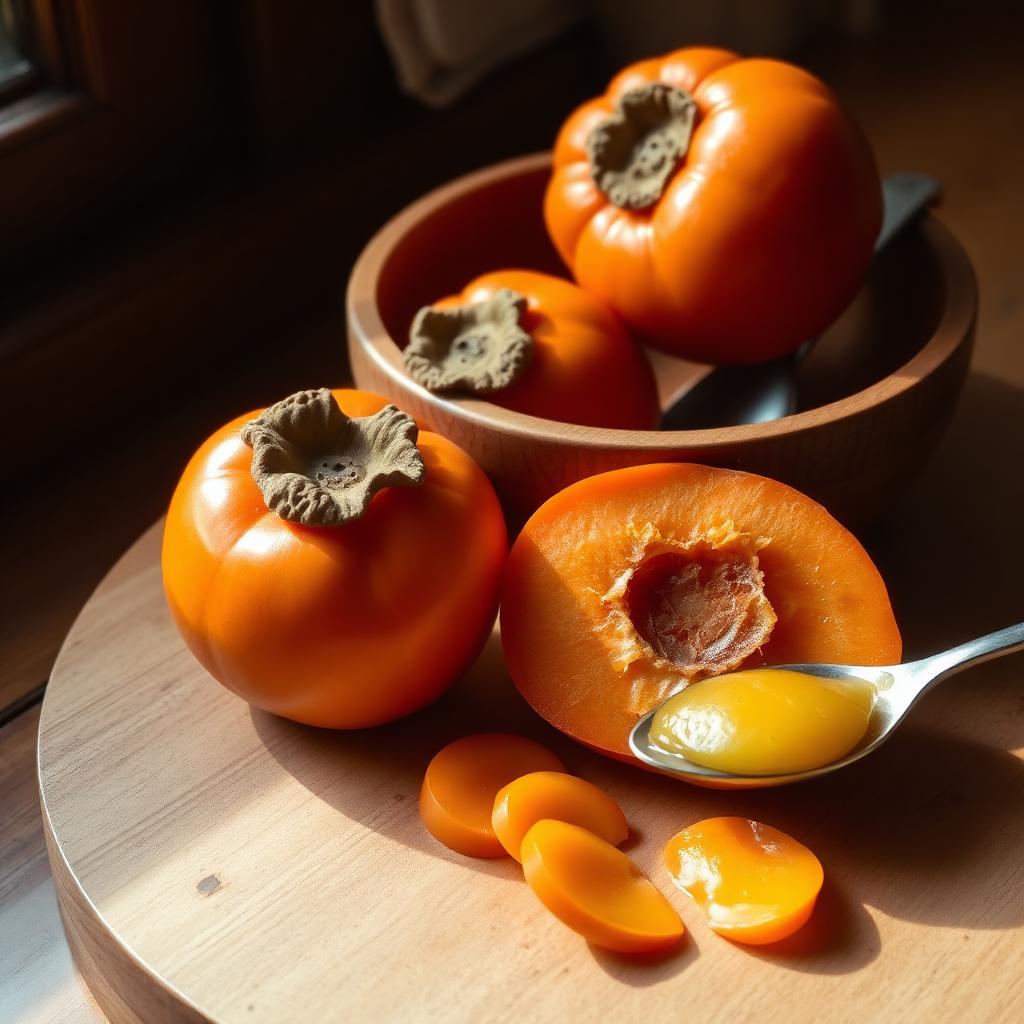
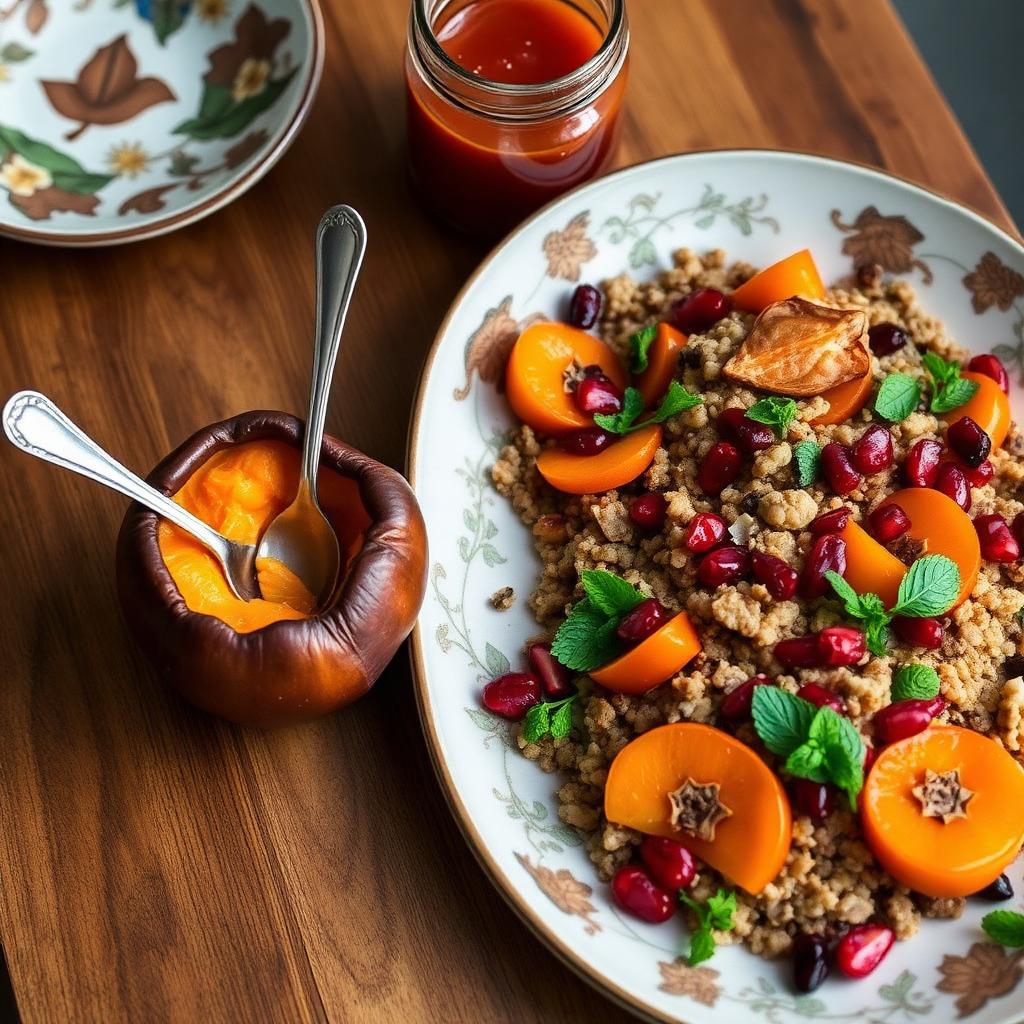
Spooned: ripe shibugaki eaten from the skin with a small spoon.
Slice firm Fuyu varieties into autumn grain salads with pomegranate arils and walnut.
Other Ways to Use It
Simmer with cinnamon and cardamom into a compote for yogurt and oat porridge.
Baked is folded into autumn loaves and porridge crumbles.
Wait for full softness (jelly-like give under the skin), then spoon out the flesh chilled.
Blend one ripe persimmon into a smoothie with orange, ginger, and yogurt.
Bake into a lightly sweetened autumn loaf with cardamom and walnut.
Chapter 8 of 13
Medicines and Interactions
General cautions
Medication interaction:
History of phytobezoar, gastroparesis, or bariatric surgery with delayed gastric emptying — persimmon (especially unripe) is a documented risk food.
Specific medicines
Medication interaction:
Iron supplements — Tannins (plant compounds that give a dry, puckering taste) can bind iron and blunt absorption when eaten with iron supplements — space by 1–2 hours if iron-deficient. (low concern)
More Interactions to Know
Medication interaction:
Warfarin — Persimmon isn't particularly high in vitamin K and doesn't typically destabilise INR (the blood test that shows how fast your blood clots) in normal food amounts; sudden large increases in fruit intake are still worth flagging while INR is being tuned. (low concern)
Medication interaction:
Prokinetic and anticholinergic medications — Anticholinergics slow gastric emptying and heavy or unripe persimmon intake on top of them can theoretically raise phytobezoar risk. Prefer ripe fruit and moderate portions in gastroparesis and layered anticholinergic therapy. (moderate concern)
Unripe persimmon contains high soluble tannins — very astringent (tightens tissue and leaves a dry feeling in the mouth) and, in rare cases (especially with high animal-protein meals or bariatric anatomy), associated with diospyrobezoar (phytobezoar) formation.
General caution:
Eat between meals, not with heavy meat courses, to reduce tannin-related fullness or mild bloating.
General caution:
Diabetics: even ripe persimmon is naturally sweet — one fruit per sitting is a reasonable portion.
Allergy:
Rare oral-allergy syndrome reactions in birch-pollen sensitivity.
General caution:
Severe fructose intolerance.
Chapter 10 of 13
Pregnancy, Children and Older Adults
Pregnancy and breastfeeding
Pregnancy and breastfeeding:
Fully ripe persimmon is safe and traditional in pregnancy, offering a hydrating carotenoid- and fibre-dense fruit through the autumn. Unripe or firm astringent (tightens tissue and leaves a dry feeling in the mouth) varieties are avoided; concentrated persimmon-leaf extracts have not been studied in pregnancy and are set aside.
Children
Children:
Soft, fully ripe persimmon flesh, spoon-fed, from ~9–10 months (skin removed). Never offer unripe astringent (tightens tissue and leaves a dry feeling in the mouth) persimmon to children — the puckering tannins (plant compounds that give a dry, puckering taste) can cause discomfort and refusal for months. Firm Fuyu slices from age 3 as finger food.
Older adults
Older adults:
One of the kindest late-autumn fruits for older adults: spoonable, cooling for over-warmed indoor bodies, quietly moves the bowel, and delivers dense carotenoids in a form that doesn't require chewing raw fibre. Avoid entirely in known gastroparesis or after bariatric surgery unless cleared.
Chapter 11 of 13
Traditional Persian Perspective
Persian temperament: Cool & Moist (2nd degree). Persian medicine reads khormalou as cool and moist — soothing for hot, dry throats and calming for an over-warm chest. Best in autumn, in cool weather, and separate from heavy protein meals.
Persian medicine reads khormalou as cool and moist in the 2nd degree. It's used to soothe a hot, dry throat, cool a chest irritated by winter in warm rooms, and sit gently with a hot-stomach constitution. Aghili Khorasani notes that it sweetens the mouth and quiets a dry cough. The shibugaki form is preferred because it's softer on digestion.
Hot, dry throat and dry cough (soft ripe fruit, taken cool).
In the Household
Mild cold-and-dry constipation (soft ripe fruit at breakfast).
Convalescence is nourishing and easily eaten with a spoon.
Persimmons glow beside pomegranate and quince on the Persian autumn table — the trinity of fall fruit. Ripe khormalou is sliced onto Yalda-night trays, spooned over yogurt with a wooden spoon, or served whole and cold after a large family lunch.
Chapter 12 of 13
Sources
Sad Giah Hezar Darman (صد گیاه و هزار درمان) — One Hundred Plants and One Thousand Remedies — Dr. Hossein Erfani, 4th edition (1375 / 1996–1997). Primary traditional Persian herbal reference cited throughout this platform. Presented as traditional knowledge, not as modern medical proof.
Office of Dietary Supplements: fact Sheets — US National Institutes of Health (NIH). https://ods.od.nih.gov/factsheets/list-all/.
Herbal Database: memorial Sloan Kettering Cancer Center. https://www.mskcc.org/cancer-care/diagnosis-treatment/symptom-management/integrative-medicine/herbs.
Herbs at a Glance: uS NIH National Center for Complementary and Integrative Health (NCCIH). https://www.nccih.nih.gov/health/herbsataglance.
FoodData Central: searchable nutrient database — US Department of Agriculture (USDA). https://fdc.nal.usda.gov/.
Chapter 13 of 13
Sources (continued)
The Nutrition Source: harvard T.H. Chan School of Public Health. https://www.hsph.harvard.edu/nutritionsource/.
PubMed — peer-reviewed biomedical literature — US National Library of Medicine. https://pubmed.ncbi.nlm.nih.gov/