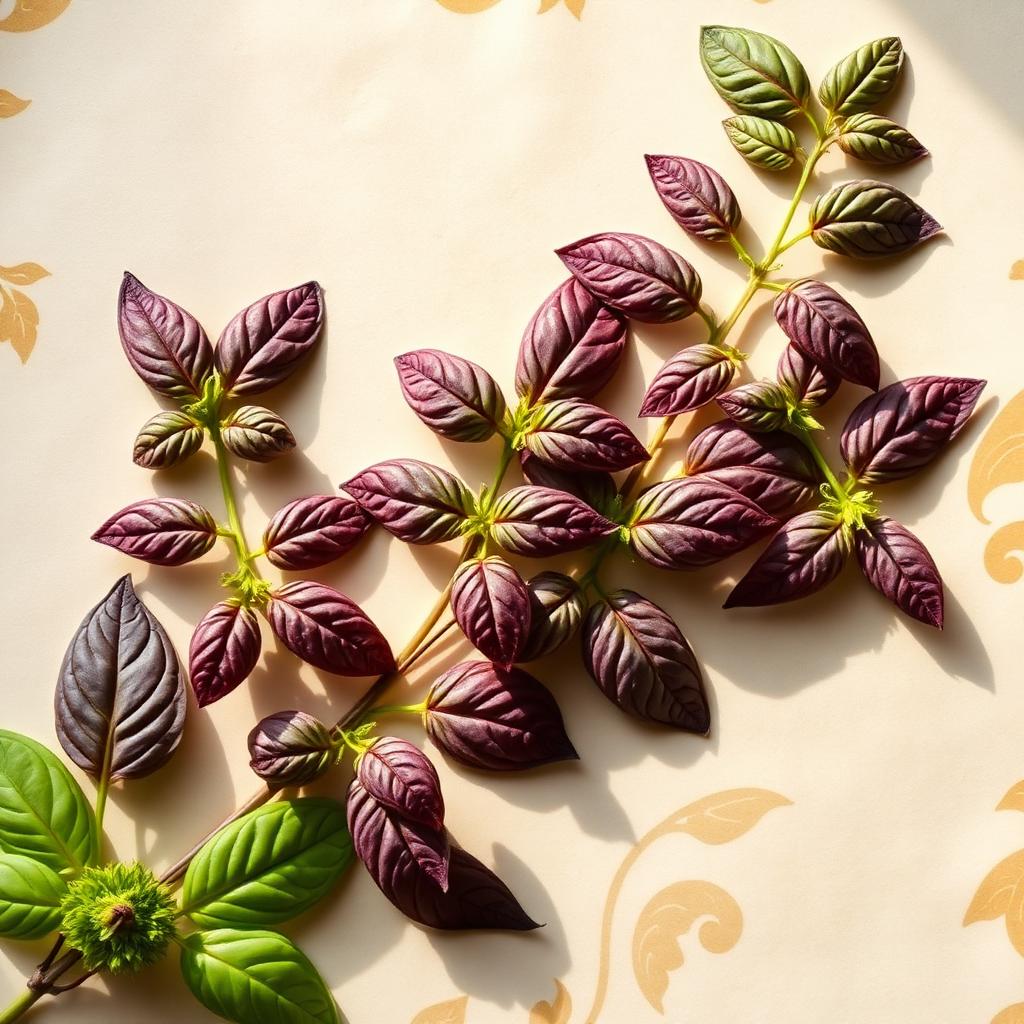
You'll notice basil at almost every Persian meal, fresh sprigs waiting on the table. Tradition reads it as warm, dry and aromatic, and credits the same handful with lifting the spirits and waking up digestion.
Two practical notes matter at home. Basil seeds (tokhm-e sharbati) aren't chia. They're cooling and belong in summer drinks. And tear the fresh leaves rather than chopping them, since bruising releases the aromatic oils with less oxidation.
What Else to Know
Rayhān, or Persian basil, is an everyday household herb with a deeper, more clove-like scent than Italian basil. It anchors the sabzi-khordan plate (the fresh herb platter served at Persian meals) and finds its way into summer salads and stews.
Known to botanists as Ocimum basilicum.
The leaves carry antioxidant flavonoids (a family of protective plant compounds) and are a source of vitamin K.
Chapter 2 of 15
The Plant Itself
Persian basil is an aromatic annual herb that grows 30–80 cm tall. It has square stems and opposite ovate (egg-shaped) leaves, which are often tinged purple in Persian cultivars (plant varieties). Small white-to-purple flowers grow in clusters at the tips of the stems. The plant's aromatic oils include eugenol, linalool, and methyl chavicol, which give rayhān its dark-clove fragrance.
Family: Lamiaceae (mint family).
Chapter 3 of 15
What It Holds and What Studies Show
Vitamins: Vitamin K, Vitamin A, Vitamin C · Minerals: Manganese, Iron, Calcium · Antioxidants: Eugenol, Rosmarinic acid
From laboratory work, not from people taking it
Ocimum basilicum extracts show antioxidant and antimicrobial (slows the growth of germs) activity in laboratory testing. Rated: early research.
What studies in people show
Fresh basil is a concentrated source of vitamin K relative to other culinary herbs. Rated: strong evidence.
Chapter 4 of 15
How It Is Prepared
The default preparation is no preparation at all: fresh leaves on the sabzi-khordan platter with feta, walnuts, radishes and lavash. Dried, a teaspoon of leaves steeped five minutes makes a damkardeh (steeped digestive tea).
The seed goes its own way, a teaspoon of soaked tokhm-e sharbati in rose lemonade for summer. The leaves also blend pesto-style with walnuts, olive oil and a touch of saffron.
Eat basil fresh, with cheese, walnuts and bread. Tear it into salads and yogurt dishes rather than cutting it, and keep the dried leaf for tea.
Chapter 5 of 15
Medicines and Interactions
Medication interaction:
Blood thinners — Basil leaf contains vitamin K, and a large daily herb plate can shift a warfarin (a blood-thinning medicine) reading. Keep intake steady rather than stopping and starting. (moderate concern)
Medication interaction:
Blood pressure medicine — Basil extracts have lowered blood pressure in animal studies. Normal food amounts aren't a concern; concentrated oil is untested alongside treatment. (low concern)
Medication interaction:
Diabetes medicine — Holy basil, a different species, lowers blood sugar. Reyhan has not been shown to, but supplements often blend the two. (low concern)
Chapter 6 of 15
Who Should Be Careful
General caution:
Generally very safe in food amounts.
General caution:
Avoid concentrated basil essential oil (the concentrated aromatic oil of the plant) internally because it contains methyl chavicol (also called estragole).
Pregnancy and breastfeeding:
Pregnancy — culinary fine; skip strong tea and oil.
Chapter 7 of 15
Pregnancy, Children and Older Adults
Pregnancy and breastfeeding
Pregnancy and breastfeeding:
Basil as food is safe and traditional throughout pregnancy. Basil essential oil taken internally isn't, and contains methyl chavicol in amounts no one should swallow.
Children
Children:
Children take to reyhan earlier than to most herbs because it's sweet rather than bitter. Serve it torn into bread with cheese.
Older adults
Medication interaction:
A daily herb plate is one of the easiest ways to add greens to an appetite that has narrowed. Watch the vitamin K if you take warfarin (a blood-thinning medicine).
Chapter 8 of 15
What Persian Medicine Says
Persian temperament: Hot & Dry (2nd degree). Reyhan is read as warming and drying, given after heavy food and kept off the plate of anyone already hot and dry in temperament.
Persian medicine sees basil as warm and dry, uplifting for the spirit, clearing for the head, and gentle on digestion.
Traditional use puts basil where the day has gone flat or heavy — low spirits and mental dullness above all. It's also given for the weight that follows a meal of bread and cheese, which is exactly where the sprigs sit on the table.
In the Household
Mild heat-and-exhaustion headaches and a sluggish appetite are the other classical signs.
Basil's aromatic compounds are traditionally credited with lifting mood. Its eugenol supports digestion and freshens the breath, which is why the sprigs sit beside the cheese rather than arriving after it.
At nearly every Iranian meal, a small bunch of fresh basil comes to the table to be eaten by hand with cheese, walnuts, and flatbread.
Chapter 9 of 15
Traditional Formulas
Sabzi-khordan is the fresh-herb plate of basil, mint, tarragon, radish, scallion — Persian medicine's first course, eaten before main dishes to wake digestion.
Sharbat-e tokhm-e rayhān: basil-seed cooler with rose syrup and lemon — Persian summer hydration with gentle fiber and cooling effect.
Joulab-e rayhān: light decoction (a drink made by simmering the plant in water) of basil leaves + rose petals for the heart and spirits.
Chapter 10 of 15
What It Goes With
Herb:
Mint
The two anchor the herb plate together, mint cooling where basil warms.
Pairing:
Tarragon
Tarragon is sweet and anise-like, basil peppery. Side by side on the plate.
Pairing:
Chives
Chives add the onion note the plate otherwise lacks, and they don't compete for perfume.
Pairing:
Feta
Salt cheese, warm bread and a few basil leaves is the standard Persian breakfast plate, and it needs nothing more.
Chapter 11 of 15
What It Goes With: More Pairings
Pairing:
Walnut
Wrap basil and walnut in flatbread with cheese. The fat carries the aroma further than the leaf does alone.
Pairing:
Tomato
Not the Italian pairing but the Persian one: raw tomato, raw basil, salt, and no oil.
Fruit:
Pomegranate
Pomegranate seeds through torn basil make a salad that's sharp, sweet and aromatic at once.
Chapter 12 of 15
Through the Year
Spring:
Spring
First cuttings are tender and mild. This is when reyhan belongs on the sabzi khordan plate every day.
Summer:
Summer
Peak growth, and the leaf is at its most aromatic. Pinch out flower heads to keep it coming.
Autumn:
Autumn
The plant bolts and the leaf coarsens. Strip what is left and freeze it in oil.
Winter:
Winter
Dried basil loses most of what makes it worth eating. Use frozen leaf or leave it until spring.
Chapter 13 of 15
Questions People Ask
Is Persian rayhān the same as Italian basil?
Both are Ocimum basilicum, but the Persian cultivar is more clove-like and slightly purple-tinged. It's heartier in salads and pairs naturally with walnuts and feta.
What about tokhm-e sharbati (basil seeds)?
Soaked basil seeds form a gentle gel that's hydrating, mildly cooling, and rich in fiber — a Persian summer drink ingredient.
Chapter 14 of 15
Sources
Sad Giah Hezar Darman (صد گیاه و هزار درمان) — One Hundred Plants and One Thousand Remedies — Dr. Hossein Erfani, 4th edition (1375 / 1996–1997). Primary traditional Persian herbal reference cited throughout this platform. Presented as traditional knowledge, not as modern medical proof.
Office of Dietary Supplements: fact Sheets — US National Institutes of Health (NIH). https://ods.od.nih.gov/factsheets/list-all/.
Herbal Database: memorial Sloan Kettering Cancer Center. https://www.mskcc.org/cancer-care/diagnosis-treatment/symptom-management/integrative-medicine/herbs.
Herbs at a Glance: uS NIH National Center for Complementary and Integrative Health (NCCIH). https://www.nccih.nih.gov/health/herbsataglance.
FoodData Central: searchable nutrient database — US Department of Agriculture (USDA). https://fdc.nal.usda.gov/.
Chapter 15 of 15
Sources (continued)
The Nutrition Source: harvard T.H. Chan School of Public Health. https://www.hsph.harvard.edu/nutritionsource/.
PubMed — peer-reviewed biomedical literature — US National Library of Medicine. https://pubmed.ncbi.nlm.nih.gov/