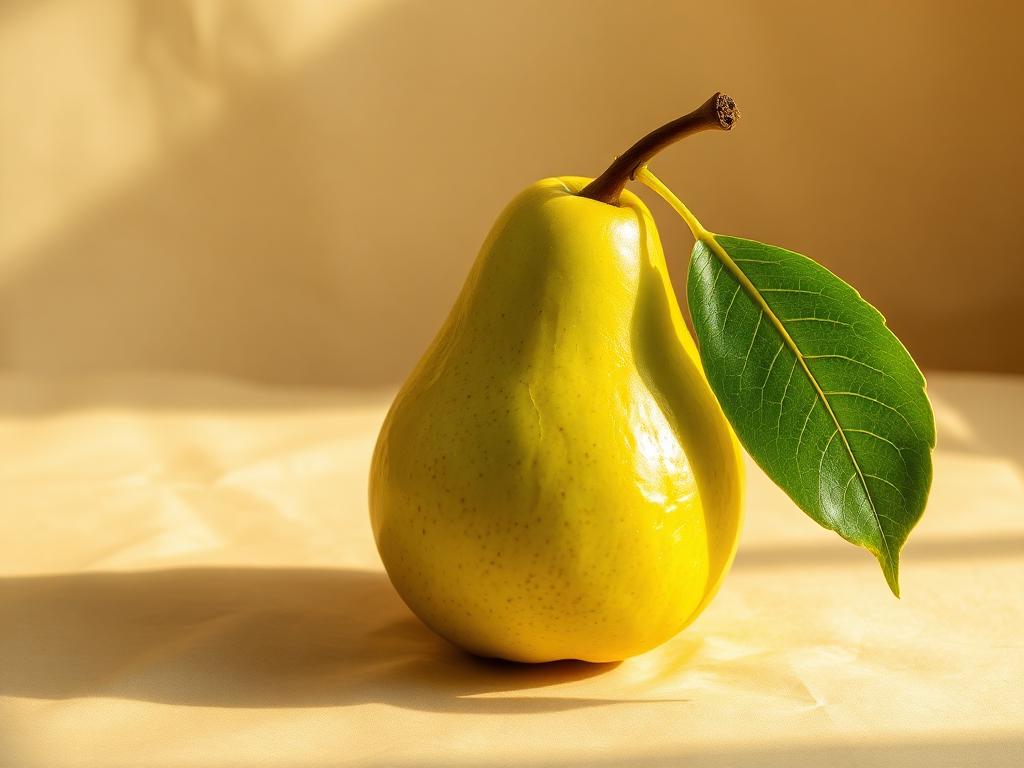
A medium pear carries around six grams of fibre — most of it in the peel.
Low acid and low irritation makes it one of the easiest fruits on a sensitive stomach.
Poached with rock candy, it's the classical Persian remedy for a dry, tickling cough.
Pears are among the gentlest fruits you can eat — high in soluble fibre, low in acid, and naturally hydrating. Persian medicine has long used poached pear with rock candy to soothe a dry cough and a raw throat. Golabi is still one of the first fruits offered to someone who is unwell or recovering.
Known to botanists as Pyrus communis.
Chapter 2 of 14
Why It Matters
If other fruit feels hard to manage, golabi may suit you. It's gentle, hydrating, and quietly one of the highest-fibre choices in the market.
Pears combine high soluble fiber with a low glycemic load and gentle hydration — three qualities that age-friendly digestion needs daily. The traditional Persian poached pear is a model of an aging-well dessert: gently sweet, soothing, and supportive rather than burdensome.
It was used: hydrating with potassium for blood pressure and low acid: easy on a sensitive stomach.
Chapter 3 of 14
What It Contains
Primary compounds
Pectin (a soft fibre in fruit that thickens jam). Chlorogenic acid. Arbutin. Sorbitol.
Vitamins
Vitamin C, Vitamin K, Folate
Other notable constituents
Minerals: Potassium, Copper, Manganese · Antioxidants: Flavonoids (a family of protective plant compounds), Anthocyanins (red varieties)
Chapter 4 of 14
What Studies in People Show
Strong evidence
Higher soluble fibre intake improves stool frequency and consistency in chronic constipation.Strong evidence
Higher dietary fibre intake is linked to lower all-cause mortality across large cohorts.Strong evidence
Early research
Pear intake was associated with lower body weight and better diet quality in a US population analysis.Emerging evidence
Chapter 5 of 14
Preparation and Kitchen Use
Autumn and winter, when Persian pears are in season. Poached in the evening for a dry cough.
Eat ripe and fresh with the peel.
Poach with rock candy and rosewater for a soothing dessert.
Slice over yogurt with walnuts and honey.
Simmer into a soft compote for a sore throat.
Chapter 6 of 14
Medicines and Interactions
General caution:
Diuretics — Pears carry potassium. Ordinary amounts are fine, but anyone on a potassium-sparing diuretic (makes you pass more urine) should keep intake steady rather than swinging. (low concern)
Medication interaction:
Medicines taken with food timing — The soluble fibre slows stomach emptying a little. If a medicine must be taken on an empty stomach, don't take it with a pear. (low concern)
Chapter 7 of 14
Who Should Be Careful
General caution:
FODMAP-sensitive people may react in larger amounts — sorbitol is the reason.
General caution:
Choose ripe but firm — overripe pears turn mushy and ferment quickly.
General caution:
Very high fibre in quantity can loosen the bowel.
General caution:
Fructose malabsorption or IBS — pears are high in sorbitol and fructose and can cause bloating and loose stools.
General caution:
Anyone advised to follow a low-FODMAP diet during a flare should limit pears.
Chapter 8 of 14
Pregnancy, Children and Older Adults
Pregnancy and breastfeeding
Pregnancy and breastfeeding:
One of the safest and most useful fruits in pregnancy. The fibre helps with the constipation that most people get, the water content helps with the swelling, and it rarely causes reflux (stomach acid rising into the throat) the way citrus does.
Children
Children:
Pear purée is often the first fruit a baby is given, and for good reason: low acid, low allergy risk, and gentle on the gut. Peel it for anyone under one. Whole raw pear can be too much fibre for a small child in quantity.
Older adults
Older adults:
Poached pear is genuinely useful for anyone whose swallowing or chewing has become difficult, and the fibre helps a bowel that has slowed with age. Soft, sweet, and needing no effort.
Chapter 9 of 14
Traditional Persian Perspective
Persian temperament: Cool & Moist (1st degree). Soothing and lubricating. Poached when the digestion is weak.
Persian medicine reads golabi as cool and moist. It's used to soothe the chest, sit gently on the stomach, and moisten dry tissues. People gave it for dry coughs, thirst, and recovery after illness, poaching it when digestion was weak.
In the Household
It was used: pear with honey and rosewater as a soothing winter dessert. Mashed cooked pear for infants beginning solid foods. Pear slices with walnut and cheese as a gentle afternoon snack.
Poached pear with saffron and rosewater often closes a rich winter meal. A peeled golabi is also what a Persian household may hand a guest who feels unwell.
Chapter 10 of 14
What It Goes With
Pairing:
Walnut
Slice a firm pear, add walnuts, and you have the plainest good thing in the Persian autumn.
Pairing:
Feta
Salt against sweet. A wedge of pear next to a piece of sheep feta needs no dressing.
Pairing:
Rock Candy
The classical pairing: pear poached with nabāt, given for a dry cough.
Spice:
Cardamom
One crushed pod in the poaching water changes the whole dish. Two is too many.
Chapter 11 of 14
Through the Year
Spring:
Spring
Stored fruit, softening and mealy. Poach it rather than eat it raw.
Summer:
Summer
Early varieties arrive small and crisp. Good raw, poor cooked.
Autumn:
Autumn
The season. Firm, fragrant, and cheap enough to eat daily.
Winter:
Winter
Keeps well in the cold. This is when the poached pear with rock candy appears.
Chapter 12 of 14
Questions People Ask
Should I peel a pear?
Only if the skin bothers you. Most of the fibre and antioxidants sit in the peel, so eat it whole when your stomach allows.
Does poached pear really help a cough?
It soothes a dry throat and it's comforting, which is why Persian households have made it for generations. It doesn't treat an infection, and a cough that lasts needs a doctor.
Why is my pear hard in the shop and mush two days later?
Pears ripen off the tree, from the inside out. Buy them firm, keep them out of the fridge, and press near the stem — if that gives, it's ready.
Can I use any pear for poaching?
Use a firm one. A soft ripe pear collapses in the syrup. This is the one case where slightly underripe fruit is what you want.
Dietary fiber and digestive health: review — World Journal of Gastroenterology (NIH PMC). https://www.ncbi.nlm.nih.gov/pmc/articles/PMC3435786/.
Sad Giah Hezar Darman (صد گیاه و هزار درمان) — One Hundred Plants and One Thousand Remedies — Dr. Hossein Erfani, 4th edition (1375 / 1996–1997). Primary traditional Persian herbal reference cited throughout this platform. Presented as traditional knowledge, not as modern medical proof.
Office of Dietary Supplements: fact Sheets — US National Institutes of Health (NIH). https://ods.od.nih.gov/factsheets/list-all/.
Herbal Database: memorial Sloan Kettering Cancer Center. https://www.mskcc.org/cancer-care/diagnosis-treatment/symptom-management/integrative-medicine/herbs.
Herbs at a Glance: uS NIH National Center for Complementary and Integrative Health (NCCIH). https://www.nccih.nih.gov/health/herbsataglance.
Chapter 14 of 14
Sources (continued)
FoodData Central: searchable nutrient database — US Department of Agriculture (USDA). https://fdc.nal.usda.gov/.
The Nutrition Source: harvard T.H. Chan School of Public Health. https://www.hsph.harvard.edu/nutritionsource/.
PubMed — peer-reviewed biomedical literature — US National Library of Medicine. https://pubmed.ncbi.nlm.nih.gov/