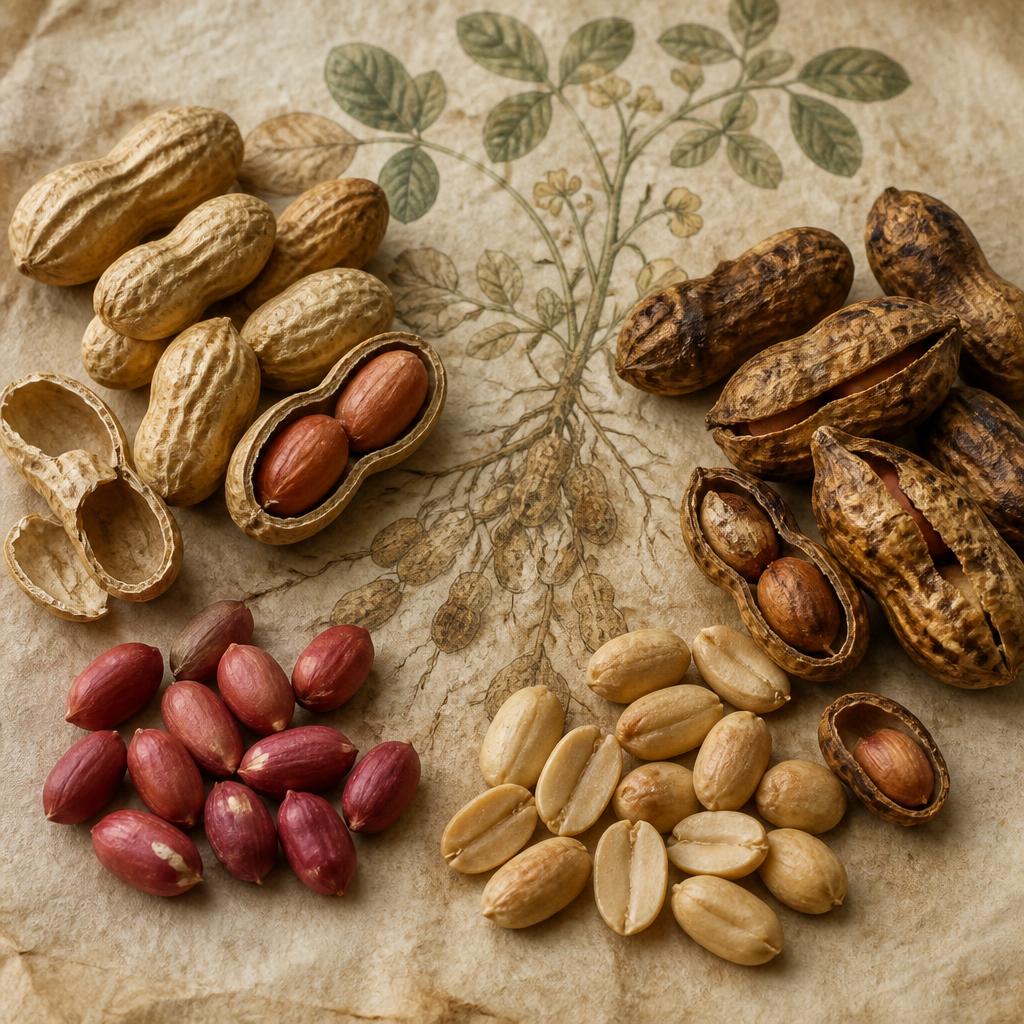
Botanically a legume, nutritionally comparable to a tree nut — the highest-protein 'nut' in the ājīl mix (~7 g per oz).
One of the top eight paediatric food allergens. Strict avoidance in known allergy and cautious introduction in at-risk households.
Regular unsalted-peanut consumption is linked to lower heart and blood vessel mortality in large cohorts, comparable to tree nuts.
Choose reputable brands to minimise aflatoxin — a mould toxin that concentrates in poorly stored peanut lots.
Chapter 2 of 15
Getting to Know Peanut
Arachis hypogaea is a South American legume with an unusual habit: it flowers above ground, then buries its pods underground to ripen — which is where the name 'groundnut' comes from. After the Age of Sail, it found its way into Persian and Mediterranean kitchens and became one of the world's cheapest, most widely eaten sources of plant protein. Think of the paper cones sold from Tehran carts, in Cairo souks, at Mumbai stations, or in American baseball parks. That same humble handful brings monounsaturated fat, niacin, folate, magnesium, and resveratrol (a natural compound in grape skins that scientists study for heart health). It's also one of the most consequential paediatric allergens on earth, so a household with a known peanut-allergic child needs to handle it with care.
Chapter 3 of 15
Why It Matters
In cohort data the daily unsalted-peanut handful behaves like the daily tree-nut handful — associated with lower heart and blood vessel mortality, better lipid and glucose profiles, and a plant-protein signal that matters for muscle preservation after 60. Peanut is the accessible, affordable version of the Mediterranean daily-nut habit for populations for whom almond and walnut aren't the household norm. The one caveat that quietly matters more with age is aflatoxin exposure from poorly stored bulk peanut — reputable brands and sealed packaging are the reliable answer.
It was used: niacin (B3): skin, DNA repair, and energy metabolism. Monounsaturated (oleic) fats consistent with a Mediterranean pattern. Magnesium and folate for healthy blood vessels and making red blood cells.
Chapter 4 of 15
What It Contains
Primary compounds
Plant protein (~26 g per 100 g) — the highest-protein common 'nut.'. Oleic and linoleic fats (~24 and ~16 g per 100 g respectively) — Mediterranean-compatible fat profile.
Folate (~240 µg per 100 g) — red-cell formation and neural-tube support.
Other Constituents
Resveratrol is the polyphenol (protective plant compounds) shared with red grape skin. Mild vascular (relating to the blood vessels) and antioxidant activity.
Magnesium (~168 mg per 100 g) — vascular (relating to the blood vessels) tone, sleep, neuromuscular calm.
Fiber: ~2.5 g per 1 oz · Notable: Highest protein per ounce among common 'nuts'
Chapter 6 of 15
In the Laboratory
From laboratory work, not from people taking it
Resveratrol is the same polyphenol (natural plant compounds studied for antioxidant activity) found in red grapes.
Strong evidence
Higher total nut intake (including peanuts) was associated with lower total and heart and blood vessel mortality across two large US cohorts. The difference was unlikely to be due to chance (researchers call this statistically significant). This is an observed link, not proof that nuts caused the lower risk.Strong evidence
Peanut consumption was associated with lower heart and blood vessel mortality in a low-income, racially diverse Southern US cohort.Strong evidence
Early introduction of peanut-containing foods in high-risk infants reduced peanut-allergy incidence by ~81% at age 5 in a randomised trial.Strong evidence
Moderate evidence
Regular peanut consumption improved LDL (the harmful type of cholesterol) cholesterol and post-prandial triglycerides (a type of fat in the blood) in randomised feeding studies.Moderate evidence
Chapter 7 of 15
Preparation and Kitchen Use
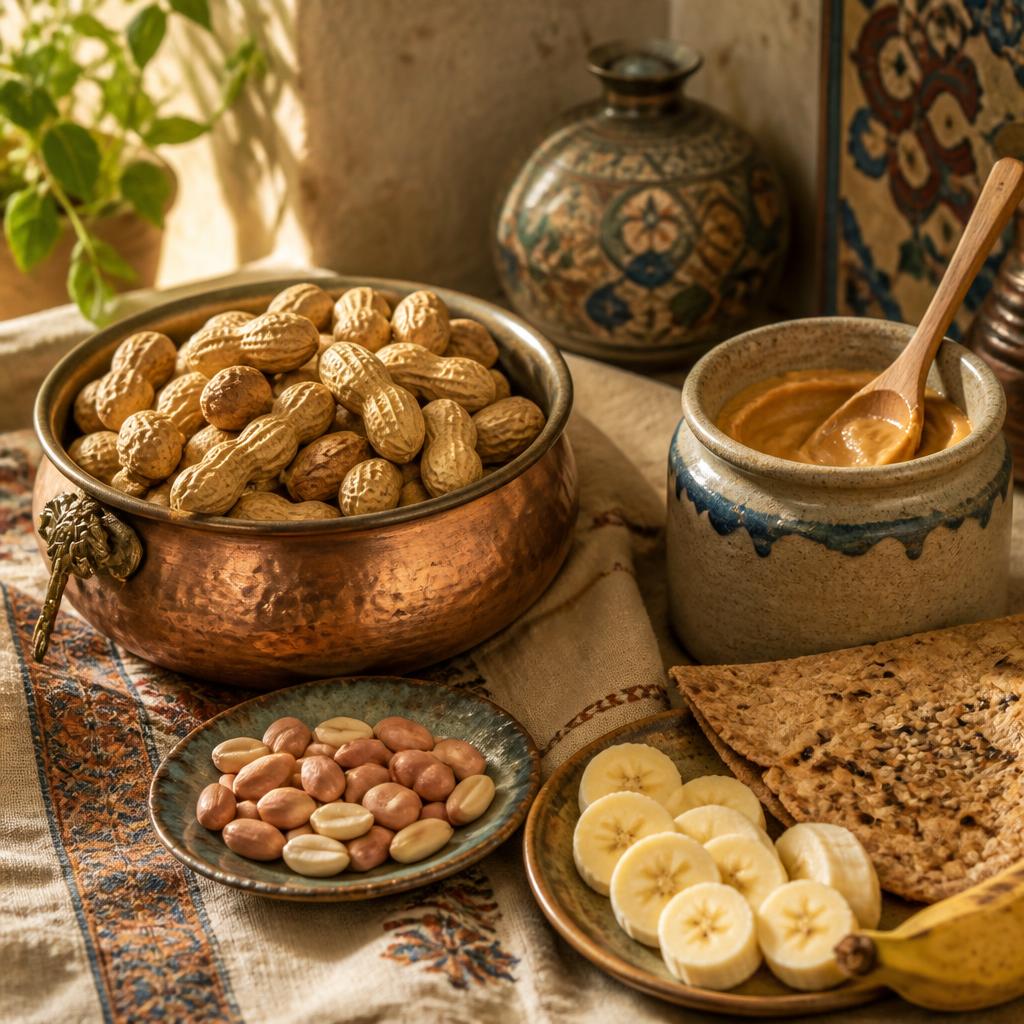
A daily 1 oz (~28 nuts) small handful mid-morning or mid-afternoon, or a spoon of natural peanut butter on whole-grain toast at breakfast. Avoid a very large peanut-heavy meal right at bedtime on a sensitive digestion.
A daily 1 oz (~28 g, ~28 nuts) small handful — unsalted, roasted in shell or dry-roasted.
Natural peanut butter (just peanuts, maybe salt) on whole-grain toast with banana or a spoon of tahini.
In the kitchen: stirred into satay sauces, kung pao, and West African groundnut stew. Cold-pressed peanut oil for salad dressings. Refined peanut oil for high-heat frying.
Boiled in the shell is a Southern American and West African rural preparation.
Stir into Asian noodle bowls, satay sauces, and Persian salad dressings for savoury depth.
Add to oatmeal, yogurt, or a smoothie for extra protein.
Store in airtight, cool, dry conditions. Discard if bitter, mouldy, or musty.
Grind into peanut flour for a low-fat, high-protein baking base.
Chapter 8 of 15
Medicines and Interactions
Medication interaction:
Warfarin (a blood-thinning medicine) / DOACs — Vitamin K content is modest and stable at culinary portions; no meaningful INR (the blood test that shows how fast your blood clots) swing at a daily handful. (low concern)
Medication interaction:
Statins — Oleic fats and plant sterols in unsalted peanut are complementary to statin LDL (the harmful type of cholesterol) lowering (portfolio-diet direction). No pharmacokinetic interaction at a daily 1 oz. (low concern)
More Interactions to Know
Medication interaction:
Antihypertensives — Magnesium, arginine, and oleic fat contribute a modest additive blood-pressure-lowering direction at a daily 1 oz — a food-scale effect that layers gently with prescribed therapy. (low concern)
Medication interaction:
Levothyroxine, bisphosphonates, tetracyclines, fluoroquinolones — Divalent minerals from a peanut-heavy meal can bind and reduce absorption. Separate dosing by ≥ 2 hours from a peanut-butter breakfast. (moderate concern)
Chapter 9 of 15
Who Should Be Careful
General caution:
Aflatoxin — Aspergillus mould in poorly stored peanut can concentrate liver-toxic aflatoxin B1; choose reputable brands with mould testing and discard any bitter or musty batch.
General caution:
Salted-and-fried commercial varieties add meaningful sodium and displace the metabolic signal.
General caution:
Commercial peanut butter with added sugar and palm oil is a sweet, not a protein — read the label.
Confirmed peanut IgE allergy
Allergy:
Confirmed peanut IgE allergy — one of the most anaphylaxis-prone food allergies. Strict avoidance and prescribed adrenaline auto-injector.
Allergy:
History of anaphylaxis to any legume — introduce peanut only under allergist supervision.
Allergy:
Peanut oil in confirmed peanut allergy — refined peanut oil is often tolerated but this decision belongs with an allergist.
Chapter 10 of 15
Pregnancy, Children and Older Adults
General
Children:
Whole nuts and seeds are a choking hazard for young children.
Children:
Whole peanuts are a choking hazard for children under age 4 — use smooth peanut butter or finely ground.
Pregnancy and breastfeeding
Pregnancy and breastfeeding:
A daily 1 oz handful of unsalted peanuts or a spoon of natural peanut butter is safe and useful throughout pregnancy — a dense source of folate, plant protein, magnesium, niacin, and monounsaturated fat. Current allergy guidance no longer advises pregnant women to avoid peanut to prevent childhood peanut allergy; the evidence base has shifted the other way, with the LEAP trial supporting early paediatric introduction. Confirmed peanut allergy is the only true stop. Reputable, mould-tested brands minimise aflatoxin exposure.
Children
Children:
The 2017 NIAID guidelines (LEAP-based) recommend early introduction of peanut-containing foods (from around 4–6 months, in age-appropriate smooth form — never whole nuts) for most infants, with allergist evaluation first for high-risk infants (severe eczema, egg allergy). This is a change from older 'avoid until age 3' advice and reflects strong RCT (studies where people are randomly assigned to different groups) evidence that early introduction reduces the risk of peanut allergy. Whole peanuts wait until age 4 due to choking risk; smooth peanut butter thinned with breast milk or formula, or a peanut-puff snack, are the age-appropriate forms.
Chapter 11 of 15
Pregnancy, Children and Older Adults: A Few More Points
Older adults
Older adults:
One of the more useful and accessible daily 'nuts' after 60: dense plant protein for muscle preservation, oleic fat for the Mediterranean vascular (relating to the blood vessels) signal, niacin and folate for energy and red-cell formation, and a satisfying texture that adapts to smooth peanut butter for anyone whose chewing is unreliable. Choose unsalted and reputable-brand — the two habits that separate the protective food from the salted-fried snack it often becomes. Refrigerate opened peanut butter; the polyunsaturated fraction turns rancid on a warm shelf.
Chapter 12 of 15
Traditional Persian Perspective
Persian temperament: Warm & Dry (Warm 2nd, Dry 1st degree — modern Persian household reading). Classical Persian medicine did not know the peanut — Arachis hypogaea reached Persia only after the 17th century — so Persian household use inherited a reading from Indian, Chinese, and Levantine kitchens. Persian and North African street tradition classes bādām-e zamīnī as warm (2nd degree) and dry (1st degree) — muqawwī, satiating, and specifically labourer's food.
In the Household
Traditional Chinese medicine reads huāshēng as sweet, neutral-warm, spleen-nourishing, and lung-moistening. Ayurveda reads mūng-phalī as warming, heavy, and building on thin constitutions but excessive on damp ones.
Labourer's and traveller's daily snack for steady working-day energy.
Post-illness protein rebuild in modern global household use.
Groundnut oil for cooking across West Africa, India, and East Asia.
Follow roasted peanuts around the world and you'll meet them at Tehran's dusk carts, Cairo souks, Mumbai station platforms, Kabul roadside stalls, American baseball stadiums, and Chinese tea houses. They anchor West African groundnut stews, Southeast Asian satay, Sichuanese kung pao, American PB&J, and the modern Iranian ājīl mix. Few foods cross cultures so easily.
Chapter 13 of 15
Questions People Ask
Are peanuts as heart-healthy as tree nuts?
In large observational (based on watching what people already do) cohorts, regular unsalted-peanut intake is linked to lower heart and blood vessel mortality on the same order as walnut and almond. The catch is the form — salted-fried and sugar-added varieties don't carry the signal.
Is peanut butter healthy?
Yes, when the label reads 'peanuts' (and maybe salt). Sugar, palm oil, and hydrogenated fat turn peanut butter into a sweet — read the ingredient list.
What should I know about aflatoxin?
Aflatoxin is a mould toxin that can concentrate in poorly stored peanut lots. Reputable brands routinely test. Discard any peanut or peanut butter that tastes bitter or smells musty.
Chapter 14 of 15
Sources
Office of Dietary Supplements: nuts & Seeds — US National Institutes of Health (NIH). https://ods.od.nih.gov/factsheets/list-all/.
FoodData Central: uS Department of Agriculture. https://fdc.nal.usda.gov/.
Nut consumption and risk of heart and blood vessel disease and mortality (Nurses' Health & Health Professionals cohorts) — N Engl J Med (PubMed). Https://pubmed.ncbi.nlm.nih.gov/24256379/
Peanut consumption and heart and blood vessel disease mortality — Southern Community Cohort Study — JAMA Intern Med (PubMed). Https://pubmed.ncbi.nlm.nih.gov/25730101/
LEAP: randomised trial of early introduction of peanut in infants at high risk of allergy — N Engl J Med (PubMed). https://pubmed.ncbi.nlm.nih.gov/25705822/
NIAID Addendum Guidelines for the Prevention of Peanut Allergy in the United States (2017) — J Allergy Clin Immunol (PubMed). https://pubmed.ncbi.nlm.nih.gov/28065278/
Aflatoxin contamination of peanut and human health — review — Toxins (PubMed). https://pubmed.ncbi.nlm.nih.gov/29036891/
Chapter 15 of 15
Sources (continued)
FoodData Central — Peanuts, all types, dry-roasted — USDA FoodData Central. https://fdc.nal.usda.gov/