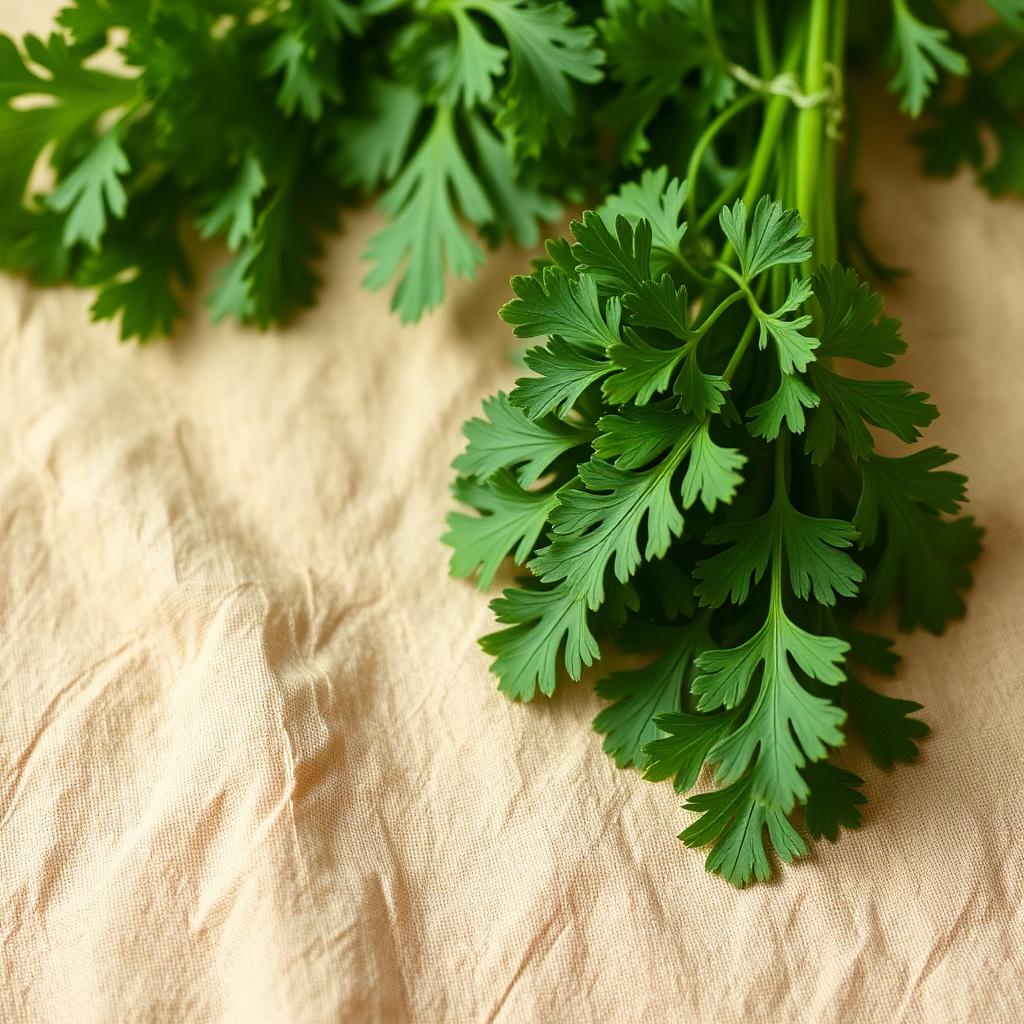
One of the most nutrient-dense everyday herbs — exceptional vitamin K, C, iron, and folate.
Gentle daily diuretic (makes you pass more urine) that flushes the kidneys without depleting potassium.
Eaten by the handful: persian medicine treats parsley as food.
Apiol content means: enjoy the herb generously, skip concentrated essential-oil supplements.
What Else to Know
Parsley — ja'fari — is one green the Persian table never treats as decoration. It goes into ghormeh sabzi, tabbouleh, and kuku by the handful, bringing concentrated support for blood, bones, and kidneys along with its fresh flavour.
Known to botanists as Petroselinum crispum.
Chapter 2 of 11
Why Herbalists Still Reach for It
A handful of parsley quietly brings vitamin K, folate, iron, and gentle kidney flushing — four underrated supports for healthy aging. Persian medicine has kept parsley near the table for centuries. Modern nutrition science helps explain why.
Exceptional vitamin K and C density.
Gentle kidney flush and mild diuretic (makes you pass more urine).
Chlorophyll freshens breath naturally.
Chapter 3 of 11
The Plant Itself
A biennial usually grown as an annual, 30–60 cm tall, with deeply lobed bright-green leaves (flat-leaf or curly cultivars) and small greenish-yellow umbel flowers in the second year. Exceptionally rich in vitamins C and K, folate, iron, and the flavonoid (a family of protective plant compounds) apigenin — the chemistry behind parsley's nutrient-density and gentle diuretic (makes you pass more urine) action.
There are no good clinical trials of parsley as a remedy. Germany's herbal review accepted its traditional use for flushing the urinary tract, and warned against the essential oil (the concentrated aromatic oil of the plant) because it's toxic.
Chapter 5 of 11
How It Is Prepared
Sabzi-khordan: fresh sprigs with feta, walnuts, and lavash at the start of meals · Tabbouleh: parsley + mint + tomato + bulgur + lemon + olive oil.
Damkardeh-ye ja'fari: 1 Tbsp finely chopped fresh parsley steeped 10 min in hot water.
Other Ways to Use It
Parsley-lemon water is a small handful of chopped parsley + lemon juice in a glass of water, sipped through the day.
Eat fresh in salads, tabbouleh, and sabzi-khordan.
Add handfuls to ghormeh sabzi and kuku.
Brew a strong infusion (a drink made by steeping the plant in hot water) for mild urinary and digestive support.
Chapter 6 of 11
Who Should Be Careful
Pregnancy and breastfeeding:
Concentrated apiol oil is toxic and contraindicated (should not be used) in pregnancy.
Medication interaction:
Kidney disease — discuss medicinal-dose use with nephrology.
Pregnancy and breastfeeding:
Pregnancy — avoid medicinal doses and concentrated apiol oil; culinary use is fine.
Prescription diuretics
Medication interaction:
Vitamin K can interact with warfarin — keep intake consistent.
Medication interaction:
Diuretic (makes you pass more urine) effect — caution with prescription diuretics.
Medication interaction:
Prescription diuretics — possible additive fluid loss.
Chapter 7 of 11
What Persian Medicine Says
Persian medicine considers parsley warm and dry. It was used to open obstructions, flush the kidneys, freshen the breath, and warm a cold, sluggish digestion.
Kidney and bladder support — flushing fine grit before stones form.
It was used: bad breath, especially after garlic and onion. Mild fluid retention, especially in hot weather.
Parsley anchors ghormeh sabzi, kuku sabzi, and the fresh sabzi-khordan plate. Once you notice how often it appears, a Persian meal without parsley is almost unimaginable.
Chapter 8 of 11
Traditional Formulas
Ghormeh sabzi: iconic Persian green herb stew — parsley, cilantro, fenugreek leaves, and leek with kidney beans and lamb.
Kuku sabzi: persian green herb frittata, packed with parsley, dill, cilantro, and walnuts, which is a Nowruz dish of renewal.
Chapter 9 of 11
Questions People Ask
Is parsley safe daily?
Yes — eaten in food amounts it's one of the safest and most nutrient-dense daily greens. Reserve concentrated apiol oil supplements for clinician guidance, and skip those in pregnancy entirely.
Does parsley really freshen breath?
Yes — its chlorophyll content binds and neutralizes the volatile sulfur compounds released by garlic and onion. A chewed sprig at the end of the meal is the classic remedy.
Chapter 10 of 11
Sources
Sad Giah Hezar Darman (صد گیاه و هزار درمان) — One Hundred Plants and One Thousand Remedies — Dr. Hossein Erfani, 4th edition (1375 / 1996–1997). Primary traditional Persian herbal reference cited throughout this platform. Presented as traditional knowledge, not as modern medical proof.
Office of Dietary Supplements: fact Sheets — US National Institutes of Health (NIH). https://ods.od.nih.gov/factsheets/list-all/.
Herbal Database: memorial Sloan Kettering Cancer Center. https://www.mskcc.org/cancer-care/diagnosis-treatment/symptom-management/integrative-medicine/herbs.
Herbs at a Glance: uS NIH National Center for Complementary and Integrative Health (NCCIH). https://www.nccih.nih.gov/health/herbsataglance.
FoodData Central: searchable nutrient database — US Department of Agriculture (USDA). https://fdc.nal.usda.gov/.
Chapter 11 of 11
Sources (continued)
The Nutrition Source: harvard T.H. Chan School of Public Health. https://www.hsph.harvard.edu/nutritionsource/.
PubMed — peer-reviewed biomedical literature — US National Library of Medicine. https://pubmed.ncbi.nlm.nih.gov/