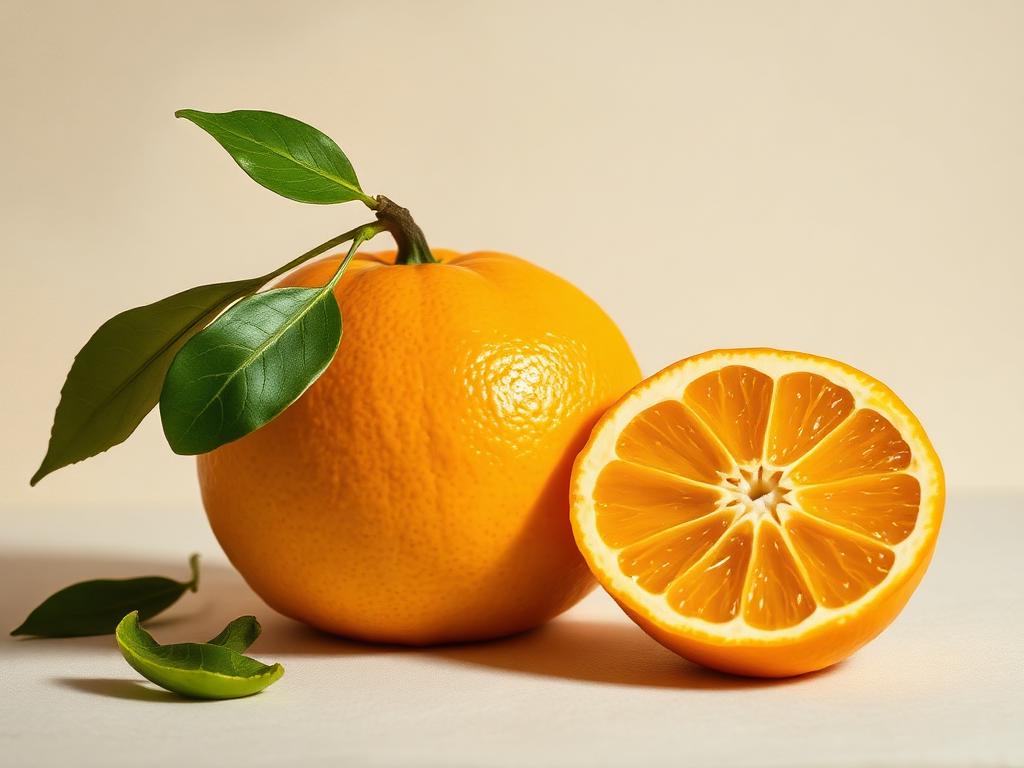
One medium orange covers a day's vitamin C, with fibre the juice leaves behind.
Hesperidin, the flavonoid (a family of protective plant compounds) concentrated in the pith and peel, is the compound most studied for blood vessels.
Orange blossom (bahar narenj) is a separate remedy from the fruit — calming, distilled, and used for sleep.
Winter brings sweet oranges into Iranian and Mediterranean kitchens, ready to eat in slices or squeeze fresh. The blossoms take a different path, becoming bahar narenj for nerves and sleep. Beyond vitamin C, the fruit brings flavonoids (a family of protective plant compounds) like hesperidin that support blood vessels, while the northern groves of Mazandaran and Fars supply the country from November to March.
Known to botanists as Citrus sinensis.
Chapter 2 of 11
Why It Matters
Porteghal arrives just when daylight, appetite for fresh produce, and vitamin C intake all tend to fall. That's why it works so well as the Persian winter fruit: people eat it daily for months.
Vitamin C is one of the most studied nutrients for healthy aging — supporting immunity, collagen, and antioxidant defenses. Whole oranges deliver vitamin C alongside hesperidin, a flavonoid (a family of protective plant compounds) linked to vascular (relating to the blood vessels) health. A daily orange is a quietly powerful aging-well habit, especially in winter when fresh produce is limited.
What That Means Day to Day
Hesperidin and naringenin support blood vessels.
Soluble fiber (whole fruit) supports cholesterol and gut.
Hydrating with natural electrolytes.
Persian kitchens distinguish sharply between porteghal, the sweet orange eaten as fruit, and narenj, the sour bitter orange whose juice is used the way lemon is used elsewhere — over fish, in marinades, and in khoresh.
Chapter 3 of 11
Why It Matters: The Rest of It
Narenj peel is candied into khoshkbar and its blossom is distilled into bahar narenj water. Sweet orange peel is used too, but it's a milder, less resinous ingredient.
Juicing removes the segment walls and pith, which is where most of an orange's fibre sits, and it makes the sugars quicker to absorb. Three oranges become one glass, and few people would eat three oranges in a sitting.
This is a difference in how the food behaves, not a claim that juice is harmful. Whole fruit is simply the more filling and slower form.
Chapter 4 of 11
What It Holds and What Studies Show
Primary compounds
Beta-cryptoxanthin. Pectin (a soft fibre in fruit that thickens jam).
Vitamins
Folate, Thiamin (B1)
Other notable constituents
Minerals: Potassium, Calcium
From laboratory work, not from people taking it
Vitamin C is required for collagen synthesis and functions as an antioxidant in laboratory work. Rated: early research.
Chapter 5 of 11
What Studies in People Show
What studies in people show
Citrus flavonoid (a family of protective plant compounds) intake was associated with lower stroke risk in large prospective cohorts.Emerging evidence
Hesperidin supplementation improved endothelial (relating to the thin inner lining of your blood vessels) function and blood-pressure measures in randomised trials.Moderate evidence
Chapter 6 of 11
Preparation and Kitchen Use
In the kitchen: late morning or afternoon through the winter, eaten as whole fruit rather than juice. Eaten fresh in segments. Freshly squeezed juice.
Add zest to salads, yogurt, and saffron rice.
Simmer the peel into marmalade or morabbā-ye porteghal.
Eat the whole fruit for fiber instead of juice.
Squeeze fresh juice — drink within minutes for highest vitamin C.
Chapter 7 of 11
Who Should Be Careful
General caution:
Juice is concentrated sugar — pair with protein or eat whole fruit.
General caution:
Acidity can aggravate reflux (stomach acid rising into the throat) in some people.
Medication interaction:
Citrus may interact with certain blood-pressure and cholesterol medications.
Older adults:
Older adults: Easy to segment, hydrating, and a reliable vitamin-C source when appetite is small; the whole fruit is preferable to juice for blood sugar.
Chapter 8 of 11
Traditional Persian Perspective
Persian temperament: Cool & Moist (1st degree). Refreshing to the heart and lungs. Taken through the cold months.
Persian medicine reads porteghal as cool and moist — refreshing to the heart, lifting to the mood, and supportive of the lungs in the cold months. The blossom distillate (the liquid collected after steaming the plant) had its own role, used separately for the nerves and sleep.
In the Household
Fresh orange juice (ab-porteghal) at breakfast as a winter immune tonic.
Orange-blossom water (bahar narenj) stirred into warm water for nerves and sleep.
Orange peel candied with sugar and saved as a digestif.
Orange-blossom water (bahar narenj) is one of Persia's prized distillates (the liquid collected after steaming the plant), sprinkled into sweets and stirred into calming bedtime drinks. The fruit itself is piled high on the Yalda and winter guest table.
Chapter 9 of 11
Questions People Ask
Is juice as good as the fruit?
No. Juicing removes the fibre and concentrates the sugar. Fresh juice still carries vitamin C, but the whole fruit is the better daily habit.
Is orange-blossom water the same thing?
No. Bahar narenj is distilled from the blossom of the bitter orange tree and is used for calm and sleep — a different remedy from the fruit.
Chapter 10 of 11
Sources
Vitamin C: nIH Office of Dietary Supplements — US NIH ODS. https://ods.od.nih.gov/factsheets/VitaminC-HealthProfessional/.
Hesperidin and vascular function: meta-analysis — European Journal of Nutrition (PubMed). https://pubmed.ncbi.nlm.nih.gov/30903399/.
Citrus consumption and heart and blood vessel disease — Systematic review — Nutrients (NIH PMC). Https://www.ncbi.nlm.nih.gov/pmc/articles/PMC6627086/
Sad Giah Hezar Darman (صد گیاه و هزار درمان) — One Hundred Plants and One Thousand Remedies — Dr. Hossein Erfani, 4th edition (1375 / 1996–1997). Primary traditional Persian herbal reference cited throughout this platform. Presented as traditional knowledge, not as modern medical proof.
Office of Dietary Supplements: fact Sheets — US National Institutes of Health (NIH). https://ods.od.nih.gov/factsheets/list-all/.
Herbal Database: memorial Sloan Kettering Cancer Center. https://www.mskcc.org/cancer-care/diagnosis-treatment/symptom-management/integrative-medicine/herbs.
Chapter 11 of 11
Sources (continued)
Herbs at a Glance: uS NIH National Center for Complementary and Integrative Health (NCCIH). https://www.nccih.nih.gov/health/herbsataglance.
FoodData Central: searchable nutrient database — US Department of Agriculture (USDA). https://fdc.nal.usda.gov/.
The Nutrition Source: harvard T.H. Chan School of Public Health. https://www.hsph.harvard.edu/nutritionsource/.
PubMed — peer-reviewed biomedical literature — US National Library of Medicine. https://pubmed.ncbi.nlm.nih.gov/