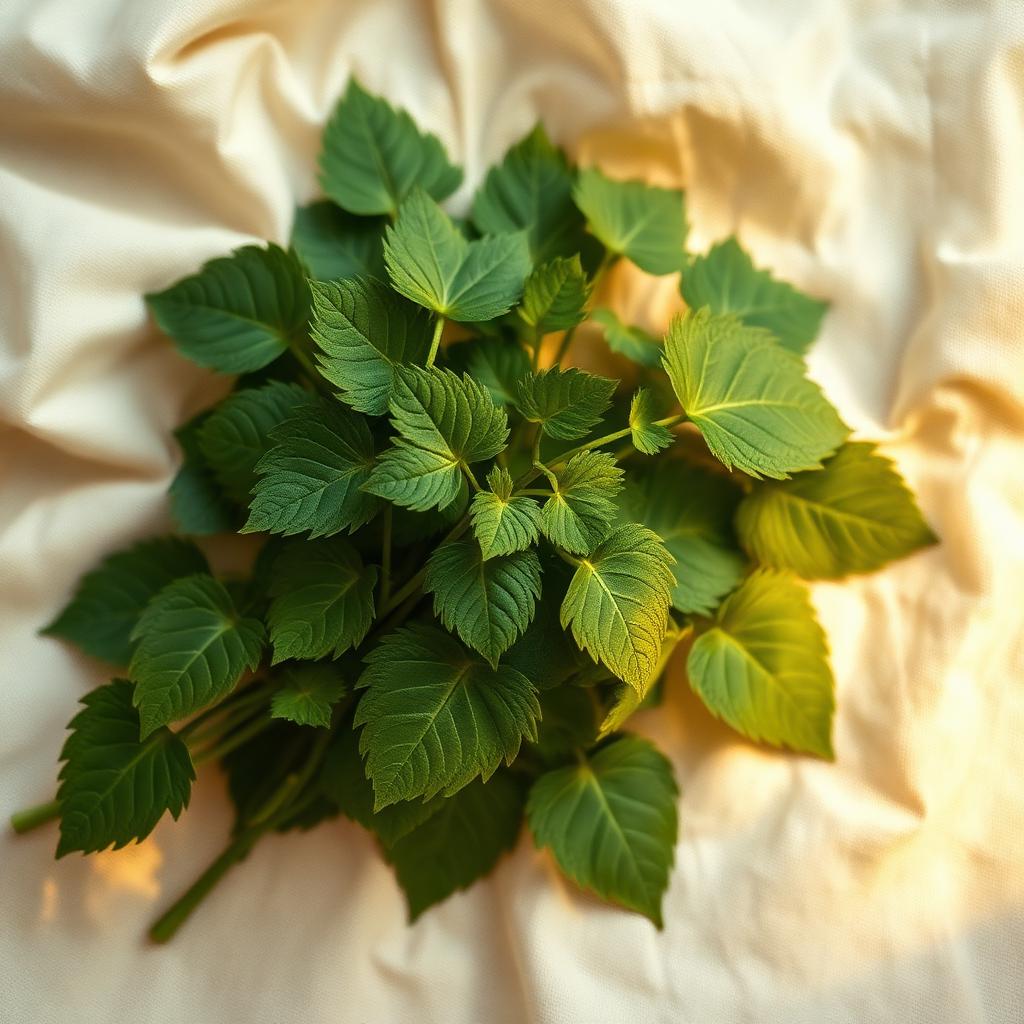
One of the most mineral-dense green plants — exceptional iron, calcium, and potassium.
Nettle-root extract has prostate trial data for BPH symptom relief.
Cooking, drying, or pounding completely destroys the sting.
Nettle — gazaneh — is one of the most nutrient-dense wild greens you can eat. Persian, European, and Anatolian traditions cook the young spring shoots as food, then dry the summer leaf for tea. It has long been used for blood-building, allergy relief, and joint and urinary support.
Known to botanists as Urtica dioica.
Chapter 2 of 16
Why Herbalists Still Reach for It
After age 60, mineral intake quietly drops, blood becomes thinner, and joints stiffen. Nettle speaks to all three concerns: a single cup of long-infused nettle delivers more usable calcium and iron than most supplements, supports the joints, and was the Caspian Persian spring tonic that kept rural elders walking strong into their eighties.
Eases hay fever and allergy symptoms.
Root supports prostate (BPH) symptom relief.
Chapter 3 of 16
What Is In It
Vitamins
Vitamin A, Vitamin C, Vitamin K
Other notable constituents
Minerals: Iron, Calcium, Potassium, Magnesium
Antioxidants: Quercetin (a plant compound found in onions, apples and tea), Chlorophyll, Carotenoids (the orange and yellow plant pigments your body can use)
Protein: ~3 g per cup cooked
Chapter 4 of 16
What Studies in People Show
What studies in people show
Nettle root extract improved lower urinary tract symptoms in men with benign prostatic hyperplasia in a randomised trial.Moderate evidence
Chapter 5 of 16
How It Is Prepared
Ash-e gazaneh: persian nettle soup with parsley, lentils, and onions in spring · Damkardeh-ye gazaneh: 1 Tbsp dried leaf steeped 10 min, 2–3 cups daily.
Nettle infusion (overnight): 1 oz dried leaf in 1 L boiling water, covered overnight, strained, sipped through the next day for deep mineral nourishment.
Other Ways to Use It
Cooked young leaves in soups and frittatas.
Capsules and standardised extracts carry many times the amount you get from food, which is why the cautions below matter more here.
Freeze-dried capsules: 300 mg at the first sign of hay-fever symptoms, up to 3× daily.
Chapter 6 of 16
Medicines and Interactions
Medication interaction:
Blood thinners — Nettle leaf is high in vitamin K, which works against warfarin (a blood-thinning medicine). Steady intake matters more than avoidance; tell whoever manages your dose. (moderate concern)
General caution:
Diuretics — Nettle increases urine output, and adding it to a prescribed water tablet can drop potassium and leave you dehydrated. (moderate concern)
More Interactions to Know
Medication interaction:
Blood pressure medicine — The diuretic (makes you pass more urine) effect can add to blood pressure treatment and cause lightheadedness on standing. (moderate concern)
Medication interaction:
Diabetes medicine — Nettle has lowered blood sugar in small human studies. Check readings more often in the first weeks. (low concern)
Chapter 7 of 16
Who Should Be Careful
General caution:
Wear gloves to harvest fresh nettle.
Pregnancy and breastfeeding:
Pregnancy — generally regarded as safe in food amounts; reserve concentrated extracts for clinician guidance.
Chapter 8 of 16
Pregnancy, Children and Older Adults
Pregnancy and breastfeeding
Pregnancy and breastfeeding:
Nettle appears in many pregnancy teas, but the evidence is traditional rather than tested, and the herb has been used to stimulate the uterus. Ask your midwife before drinking it daily.
Children
Children:
Cooked nettle as a vegetable is fine for children. Nettle tea as a medicine isn't, and the fresh plant stings badly enough to frighten a child.
Older adults
Older adults:
Nettle root, not the leaf, is what has been studied for prostate symptoms. The leaf's diuretic (makes you pass more urine) effect deserves respect if you already take a water tablet.
Chapter 9 of 16
What Persian Medicine Says
Persian temperament: Hot & Dry (2nd degree). Persian and Greek sources both use nettle to move stagnation and dry damp, which is why it appears in spring tonics rather than summer ones.
Persian medicine considers nettle warm and dry. Traditionally, people use it to cleanse the blood, strengthen the kidneys, ease joint pain, and support older adults through cold winters.
In the Household
It was used: hay fever, allergic rhinitis, and seasonal nasal congestion. Mild urinary irritation and prostate fullness in older men.
Spring renewal is clearing winter sluggishness from the blood.
In Anatolian and Caspian Iranian villages, people still eat young nettle in spring as ash-e gazaneh (nettle soup) and kuku-style frittatas. It's a centuries-old tradition of spring renewal and blood-building.
Chapter 10 of 16
Traditional Formulas
Nettle long infusion (a drink made by steeping the plant in hot water): 1 oz dried nettle in 1 L just-boiled water, covered 4–8 hours, strained. That makes it a deep mineral tonic from Western herbalism.
Allergy quartet: nettle + quercetin (a plant compound found in onions, apples and tea) + local raw honey + saline rinse (a layered, drug-free hay-fever protocol).
Chapter 11 of 16
What It Goes With
Herb:
Mint
Mint covers the hay-like taste of nettle tea, which is the main reason people give up on it.
Pairing:
Dandelion
Both are spring bitters with a diuretic (makes you pass more urine) effect. Traditional tonics use them together rather than separately.
Pairing:
Rosemary
A sprig in the pot lifts a dull infusion (a drink made by steeping the plant in hot water) and adds nothing that fights the nettle.
Chapter 12 of 16
What It Goes With: More Pairings
§ A Few More Pairings
Dairy:
Yogurt
Cooked nettle folded through yogurt with garlic makes a side dish that eats like spinach borani.
Pairing:
Walnut
Nettle is mineral and green. Walnut is fat and bitter. The combination shows up in soups across the Caucasus.
Grain:
Barley
Nettle and barley soup is old peasant food and still one of the best uses of a spring picking.
Pairing:
Garlic
Cook the garlic first, then wilt the nettle into it. Raw garlic on top overpowers the leaf.
Chapter 13 of 16
Through the Year
Spring:
Spring
The only season that matters for the leaf. Pick the top four leaves before the plant flowers, wearing gloves.
Summer:
Summer
Once nettle flowers the leaf turns gritty and is best left. The seed, gathered later, is used differently.
Autumn:
Autumn
Root season for those who use it. The leaf on the plant now is old and not worth picking.
Winter:
Winter
Dried leaf from spring, or nothing. Winter nettle tea is a spring harvest drunk months later.
Chapter 14 of 16
Questions People Ask
Does cooking destroy the sting?
Completely. Even a few minutes of boiling, steaming, or pounding wilts the hollow stinging hairs. Dried leaf is also fully sting-free.
Can I forage nettle myself?
Yes — it's one of the easiest wild greens to identify (square stem, opposite serrated leaves, stinging hairs). Harvest young spring tops with gloves, away from roadsides and sprayed land.
Chapter 15 of 16
Sources
Sad Giah Hezar Darman (صد گیاه و هزار درمان) — One Hundred Plants and One Thousand Remedies — Dr. Hossein Erfani, 4th edition (1375 / 1996–1997). Primary traditional Persian herbal reference cited throughout this platform. Presented as traditional knowledge, not as modern medical proof.
Office of Dietary Supplements: fact Sheets — US National Institutes of Health (NIH). https://ods.od.nih.gov/factsheets/list-all/.
Herbal Database: memorial Sloan Kettering Cancer Center. https://www.mskcc.org/cancer-care/diagnosis-treatment/symptom-management/integrative-medicine/herbs.
Herbs at a Glance: uS NIH National Center for Complementary and Integrative Health (NCCIH). https://www.nccih.nih.gov/health/herbsataglance.
FoodData Central: searchable nutrient database — US Department of Agriculture (USDA). https://fdc.nal.usda.gov/.
Chapter 16 of 16
Sources (continued)
The Nutrition Source: harvard T.H. Chan School of Public Health. https://www.hsph.harvard.edu/nutritionsource/.
PubMed — peer-reviewed biomedical literature — US National Library of Medicine. https://pubmed.ncbi.nlm.nih.gov/