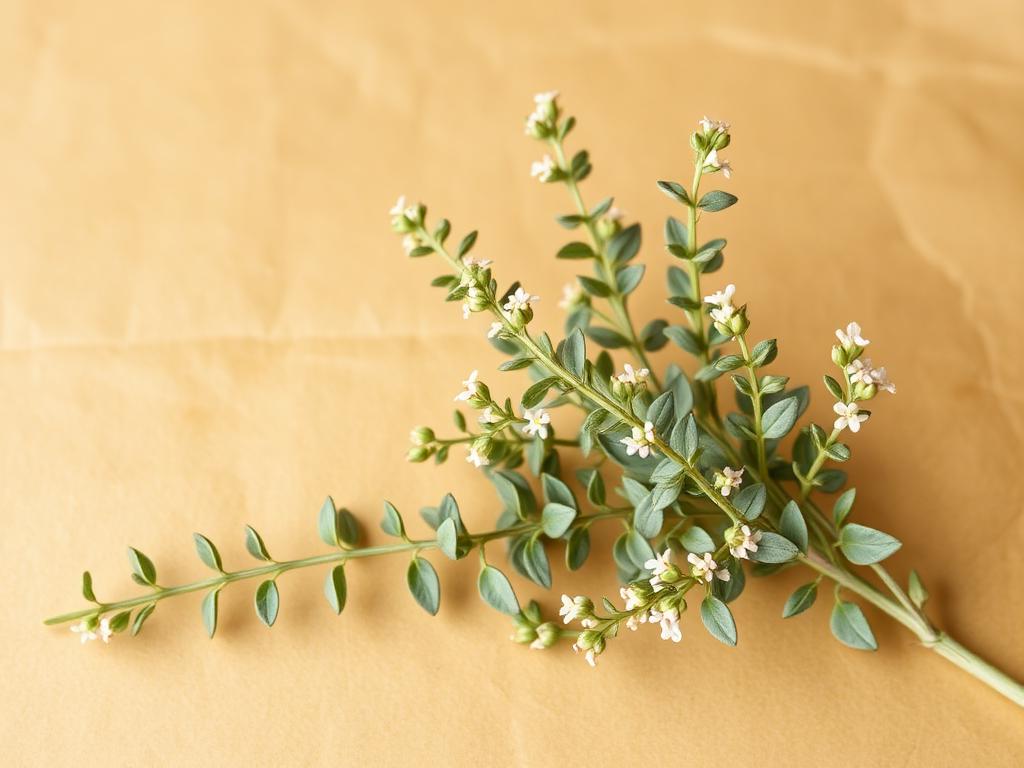
Sweet, calming mint-family herb at home in tea and food.
Traditionally used for headaches, anxious nerves, and gas.
Often confused with oregano: marjoram is softer, sweeter, more aromatic.
Generally very safe in culinary amounts. Ease back the essential oil (the concentrated aromatic oil of the plant) in pregnancy.
Marjoram has brought its soft fragrance to Mediterranean kitchens and Persian apothecaries for over two millennia. Dioscorides and Avicenna both wrote about its warming, calming nature. Today, researchers are exploring its antioxidant volatile oil (terpinen-4-ol, sabinene hydrate) for blood pressure, anxiety, and digestive comfort.
Known to botanists as Origanum majorana.
Chapter 2 of 12
Why Herbalists Still Reach for It
Tense shoulders, nagging headaches, restless evenings, and heaviness after meals often arrive together. Marjoram combines warming aromatic oils with relaxing flavonoids (a family of protective plant compounds), making it one of the gentlest household herbs for that whole-body 'tight and tired' feeling.
Daily stress, tense muscles, and sluggishness after meals can build over the years into elevated blood pressure, poor sleep, and weaker digestion. A mild marjoram tea in the evening or its topical (put on the skin) oil can become the kind of small, repeatable habit that softens that pattern without medication.
It was used: calming for anxious nerves and tension. Antioxidant volatile oils (terpinen-4-ol, carvacrol).
Eases gas and bloating.
Chapter 3 of 12
The Plant Itself
Sweet marjoram is a tender perennial 30–60 cm tall with slender stems, small oval gray-green leaves covered in fine hairs, and tiny white-to-pink flowers grouped in knot-like clusters (hence the folk name 'knotted marjoram'). The leaves and flowering tops are the medicinal parts.
Family: Lamiaceae (mint family).
Chapter 4 of 12
What Is In It
Vitamins
Vitamin K, Vitamin A, Vitamin C
Other notable constituents
Minerals: Iron, Calcium, Manganese · Antioxidants: Rosmarinic acid, Carvacrol, Terpinen-4-ol · Notable: Aromatic volatile oils (the concentrated aromatic oil of the plant)
Chapter 5 of 12
What Studies in People Show
What studies in people show
Human evidence is very limited: one small pilot trial of marjoram tea in women with PCOS. Larger studies are needed before any benefit can be claimed.
In a pilot randomized trial of 25 women with PCOS, marjoram tea twice daily for a month lowered one adrenal hormone (DHEA-S) compared with placebo. The authors said larger studies are needed.
Chapter 6 of 12
How It Is Prepared
Brew 1 tsp dried herb per cup, covered 8 min, in the evening.
Marjoram-infused olive oil: gentle warm infusion (a drink made by steeping the plant in hot water) 2 weeks. Massage into tight muscles.
Bath — handful of dried herb tied in cloth in a warm bath for tension.
Other Ways to Use It
Marjoram honey: sprigs steeped in raw honey for a calming evening spoonful.
Cook with beans, tomato sauce, lamb, and roasted vegetables.
Capsules and standardised extracts carry many times the amount you get from food, which is why the cautions below matter more here.
Topical (put on the skin): 1% diluted essential oil in carrier oil for tense muscles.
Chapter 7 of 12
Who Should Be Careful
Pregnancy and breastfeeding:
Avoid medicinal doses and concentrated essential oil in pregnancy (uterine stimulant).
Allergy:
Lamiaceae (mint family) allergy.
Medication interaction:
May lower blood sugar and blood pressure modestly — caution with diabetes or hypotension medication.
Medication interaction:
Mild blood-thinning effect at high doses — pause before surgery.
Medication interaction:
Active bleeding disorders or surgery within 2 weeks.
Chapter 8 of 12
What Persian Medicine Says
Persian medicine views marjoram as warm and dry in the third degree. Traditionally, it gladdens the heart, eases the cold, tight kind of headache, disperses gas, warms a sluggish stomach, and brings on delayed menses with cold-damp patterns.
It was used: sluggish, gassy digestion. Menstrual cramps with cold pattern. Tight, tired shoulders and necks (topical oil).
People have called marjoram 'the herb of happiness' since antiquity. It was woven into Greek wedding crowns, grown in monastic gardens, and steeped as a calming tea in Lebanese and Persian homes.
Chapter 9 of 12
Traditional Formulas
Damkardeh-ye marzanjūsh: classical Persian covered infusion (a drink made by steeping the plant in hot water) of dried marjoram flowering tops, taken in the evening for nervous tension.
Three-calming blend: marjoram + chamomile + lemon balm in equal parts as a before-bed tea for restless sleep.
Rūghan-e marzanjūsh: marjoram-infused olive oil for tense shoulders, jaw, and lower back.
Chapter 10 of 12
Questions People Ask
Is marjoram safe in pregnancy?
Culinary use in food is generally considered safe. Medicinal doses (strong tea daily, capsules) and concentrated essential oil should be avoided in pregnancy because marjoram is a traditional emmenagogue (traditionally used to bring on a menstrual period).
How does marjoram tea taste?
Soft, slightly sweet, with notes of pine and citrus — much gentler than oregano. It blends beautifully with chamomile, linden, and lemon balm.
Chapter 11 of 12
Sources
Origanum majorana L. — A phytochemical and pharmacological review — Journal of Ethnopharmacology (PubMed). https://pubmed.ncbi.nlm.nih.gov/
Marjoram: drugs and Lactation Database (LactMed) — US National Library of Medicine. https://www.ncbi.nlm.nih.gov/books/NBK501817/.
Sad Giah Hezar Darman (صد گیاه و هزار درمان) — One Hundred Plants and One Thousand Remedies — Dr. Hossein Erfani, 4th edition (1375 / 1996–1997). Primary traditional Persian herbal reference cited throughout this platform. Presented as traditional knowledge, not as modern medical proof.
Office of Dietary Supplements: fact Sheets — US National Institutes of Health (NIH). https://ods.od.nih.gov/factsheets/list-all/.
Herbal Database: memorial Sloan Kettering Cancer Center. https://www.mskcc.org/cancer-care/diagnosis-treatment/symptom-management/integrative-medicine/herbs.
Chapter 12 of 12
Sources (continued)
Herbs at a Glance: uS NIH National Center for Complementary and Integrative Health (NCCIH). https://www.nccih.nih.gov/health/herbsataglance.
FoodData Central: searchable nutrient database — US Department of Agriculture (USDA). https://fdc.nal.usda.gov/.
The Nutrition Source: harvard T.H. Chan School of Public Health. https://www.hsph.harvard.edu/nutritionsource/.
PubMed — peer-reviewed biomedical literature — US National Library of Medicine. https://pubmed.ncbi.nlm.nih.gov/