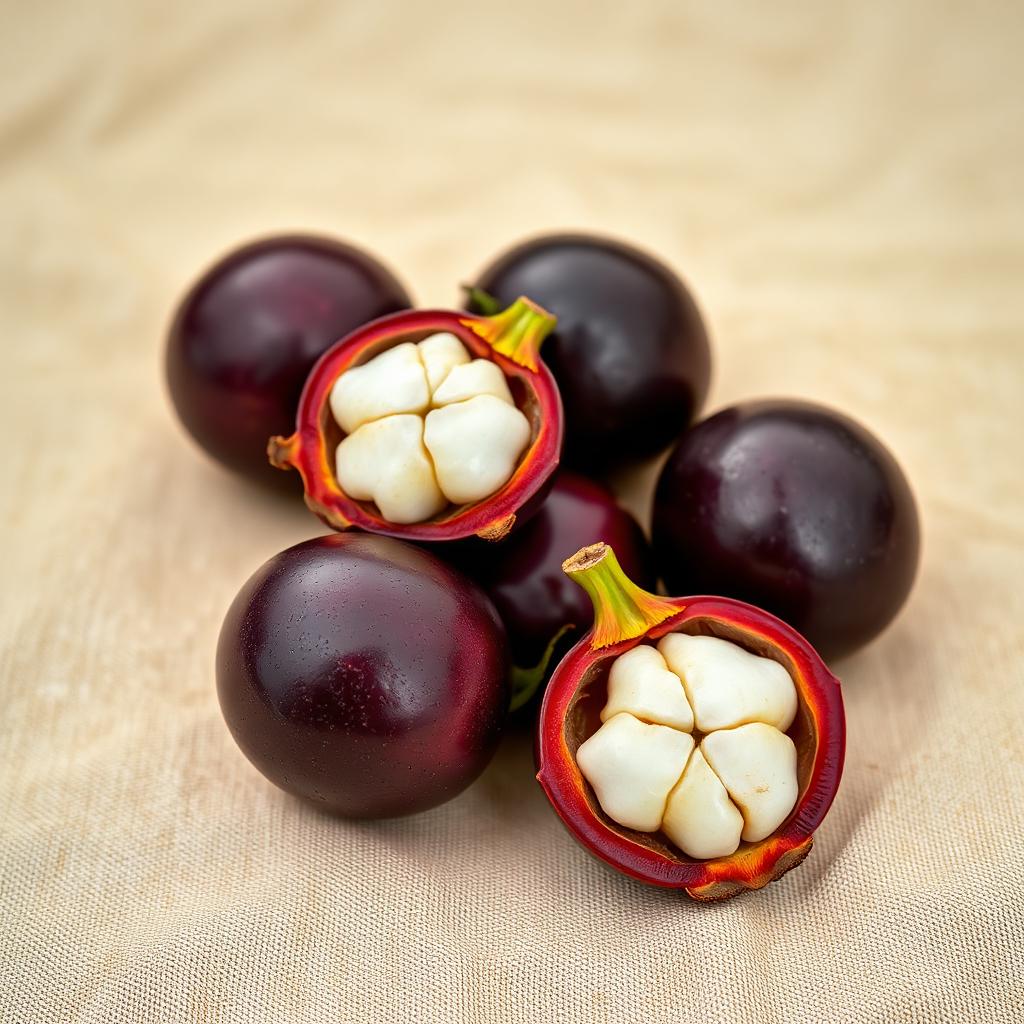
Only the white segments are eaten. The rind is bitter.
The petals on the base tell you how many segments are inside.
Crack open the hard purple shell and you'll find soft white segments that taste sweet, tart, and faintly of peach.
Known to botanists as Garcinia mangostana.
Chapter 2 of 14
Why It Matters
You'll see mangosteen sold two ways: as fresh fruit, or as expensive juice and capsules making large health claims. They aren't the same thing, and only one of them is food.
As fresh fruit, mangosteen is a pleasant, low-sugar source of folate and vitamin C. Its real value for healthy aging is simple: it can replace a sweet. It doesn't need to deliver everything a supplement label promises.
Provides vitamin C and fibre in an easy-to-eat form.
The rind is rich in xanthones, which are studied in laboratories.
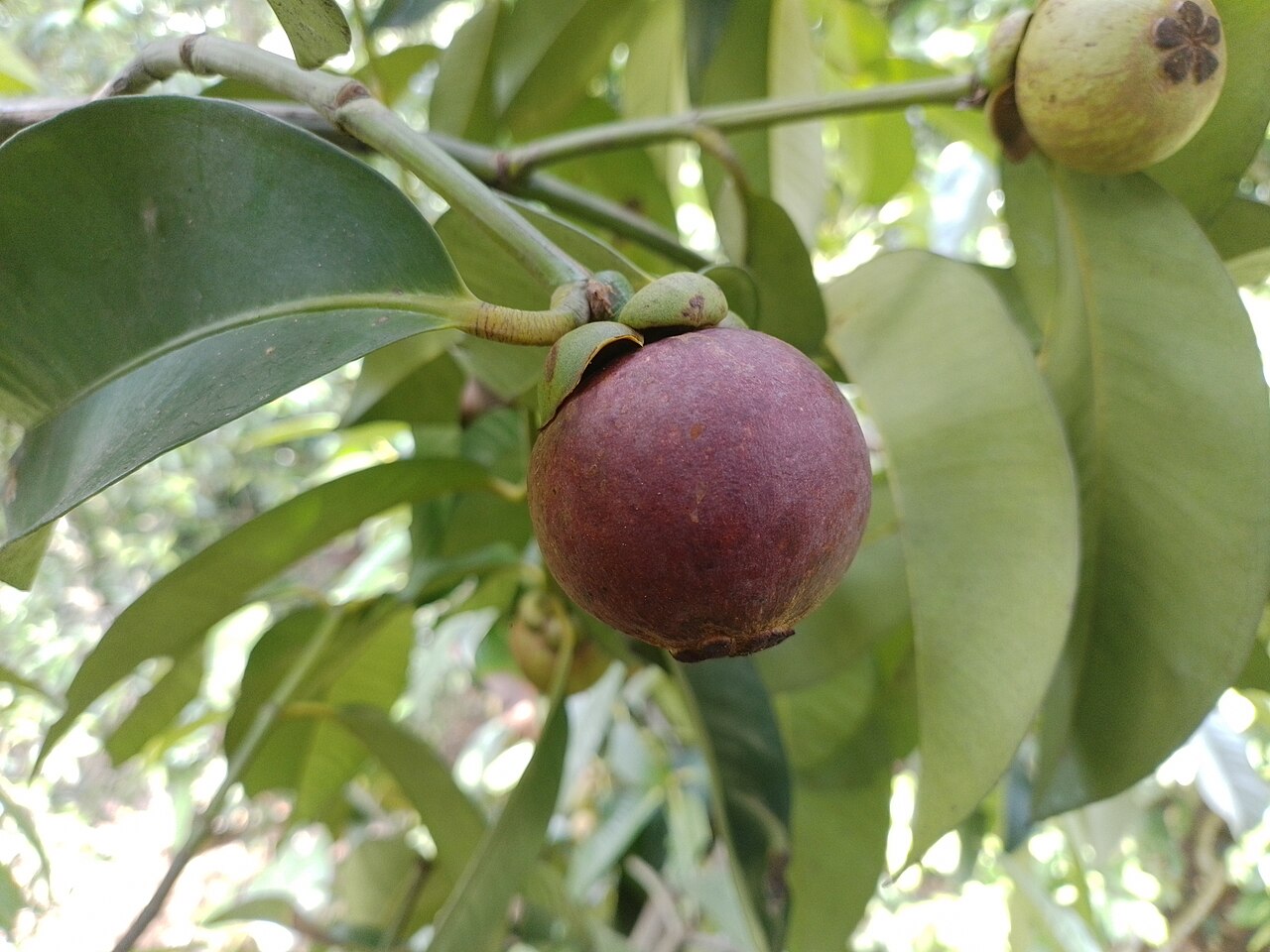
Mangosteen grows on a slow, dense evergreen tree that can take eight years to bear fruit. The fruit is round, deep purple, and topped with a green cap of stiff sepals. The rind is thick and bitter. Inside are white segments like a peeled tangerine.
Family: Clusiaceae (mangosteen family).
Chapter 4 of 14
What It Holds and What Studies Show
Primary compounds
Xanthones (alpha-mangostin).
Vitamins
Thiamin (B1)
Other notable constituents
Minerals: Manganese, Magnesium, Potassium · Antioxidants: Gamma-mangostin, Garcinone E
From laboratory work, not from people taking it
Mangosteen xanthones show anti-inflammatory activity in laboratory and small human studies. Rated: early research.
Chapter 5 of 14
What Studies in People Show
Moderate evidence
Severe lactic acidosis was reported after prolonged daily use of mangosteen rind juice.Moderate evidence
Early research
In a small trial, a mangosteen-based drink lowered C-reactive protein, a marker of inflammation, in adults who were overweight. The trial was short and the drink was not plain fruit.Emerging evidence
Reviews of mangosteen supplements in people find the human evidence thin. Most of the promising work is still in cells and animals, not in patients.Emerging evidence
Chapter 6 of 14
Preparation and Kitchen Use
Never cut all the way through. You'll cut the segments in half.
Wipe your hands after opening is the purple rind juice stains cloth permanently.
Segments with a visible seed are fine. Just eat around it.
In the kitchen: fresh, opened at the table and eaten segment by segment. Chilled and served after a heavy meal.
Other Ways to Use It
Blended into a light drink: though it's better plain · Press the shell gently: it should give slightly. Rock-hard means old.
Cut a shallow ring around the middle and lift the top half off.
Count the little petals underneath: that's the segment count.
Chapter 7 of 14
Medicines and Interactions
General cautions
Medication interaction:
Some laboratory work suggests mangosteen extracts may slow blood clotting. If you take a blood thinner, avoid extracts and supplements, and mention the fruit to your doctor before surgery.
Specific medicines
Medication interaction:
Blood thinners — Concentrated mangosteen rind juices have been linked to slower clotting. The fresh white flesh isn't the issue; the supplement is. (moderate concern)
More Interactions to Know
Medication interaction:
Chemotherapy — High-dose xanthone supplements may interfere with some cancer treatments. Ask your oncologist before taking any of them. (moderate concern)
Medication interaction:
Diabetes medicine — The fruit is sweet and the commercial juices sweeter still. Count them as sugar. (low concern)
Chapter 8 of 14
Who Should Be Careful
General caution:
The rind isn't food. Do not chew or steep it at home.
General caution:
Concentrated mangosteen supplements aren't the same as the fruit and have been linked to a small number of reports of severe acidosis. Stick to the fruit.
General caution:
Commercial mangosteen juices are usually blends with cheap fruit juice and added sugar.
Chapter 9 of 14
Pregnancy, Children and Older Adults
Pregnancy and breastfeeding
Pregnancy and breastfeeding:
The fresh fruit is an ordinary food. Mangosteen rind juices and xanthone capsules have no pregnancy safety data and should be avoided.
Children
Children:
Children usually love it. The segments contain occasional hard seeds, so check before handing a whole one to a small child.
Older adults
Medication interaction:
Soft, easy to eat and needing no preparation beyond opening the shell. Keep the fruit and skip the rind supplements, which is where the interaction risk sits.
Chapter 10 of 14
Traditional Uses in Southeast Asia
Persian temperament: Cold & Moist (2nd degree). Southeast Asian practice pairs it with durian for exactly this reason: one is read as hot, the other as cooling, and they're eaten in the same season.
Mangosteen isn't part of classical Persian medicine. In South-East Asian tradition, it's read as a cooling fruit and often eaten beside durian, which is seen as heating. That pairing is tradition.
Rind decoctions (a drink made by simmering the plant in water) used in South-East Asian folk practice for digestive upsets.
Native to island South-East Asia, mangosteen has long been called the queen of fruits, with durian as the king. People used its rind as a dye and tanning agent long before the fruit reached export markets.
Chapter 11 of 14
What It Goes With
Fruit:
Lime
A squeeze over the segments stops a very sweet fruit becoming cloying by the third one.
Pairing:
Coconut
Coconut milk and mangosteen is the standard tropical dessert pairing. And the fat carries the perfume.
Fruit:
Pineapple
Sharp pineapple next to soft mangosteen gives a fruit plate two different textures instead of one.
Dairy:
Yogurt
Spoon the white segments through plain yogurt for a breakfast that needs no sweetening at all.
Chapter 12 of 14
Through the Year
Spring:
Spring
Early fruit in the tropics, usually costly and not at its best.
Summer:
Summer
The season, and the same months as durian. The two are sold side by side.
Autumn:
Autumn
The tail of the harvest. Look for a shell that still gives under a thumb.
Winter:
Winter
Frozen or imported only. Fresh fruit at this time of year is rarely worth the price.
Chapter 13 of 14
Questions People Ask
Can I eat the purple rind?
No. It's bitter, astringent (tightens tissue and leaves a dry feeling in the mouth), and used for dye rather than food.
Are mangosteen supplements worth it?
No good human evidence supports the claims made for them, and some have caused harm. Eat the fruit instead.
Chapter 14 of 14
Sources
Garcinia mangostana: xanthones and clinical evidence review — Journal of Ethnopharmacology. https://pubmed.ncbi.nlm.nih.gov/23088849/
Severe lactic acidosis associated with mangosteen juice — Journal of Medical Toxicology. https://pubmed.ncbi.nlm.nih.gov/18696215/