Traditional unpasteurised kashk carries live cultures. Pasteurised jars don't.
Keeps for a long time when dried — a historic pantry staple.
Adds savory depth without meat.
Kashk isn't a cheese, not a yogurt and not a sauce. Here's what it actually is: what is left when yogurt or buttermilk is drained, salted and dried down to a preserved solid — a way of keeping the protein of milk through a whole year without a fridge. Everything about the taste follows from that. It's intensely sour, salty, savoury, and far more concentrated than the dairy it came from. One name covers several products.
Chapter 2 of 12
Why Kashk Still Earns Its Place
Kashk is what a pastoral people did with surplus milk before refrigeration: sour it, drain it, salt it, dry it in the sun, eat it a year later. That history is still on the plate — it's the savoury backbone of āsh reshteh and kashk-e bademjan, and the reason those dishes feel complete without meat.
Its usefulness is culinary rather than nutritional: kashk makes vegetable and legume dishes rich enough to be a main course. Against that, it's salty — spoonfuls.
Primary compounds
It was used: vitamin B12 and riboflavin. Lactic acid and free glutamates from fermentation. Sodium, added as the preservative.
Other notable constituents
Minerals: Phosphorus
Chapter 3 of 12
What Studies in People Show
What studies in people show
Fermented dairy shows neutral to modestly favourable heart and blood vessel associations in cohort studies (a study that follows a group of people over time).Moderate evidence
High dietary sodium raises blood pressure in a dose-dependent way in randomized trials.Strong evidence
Chapter 4 of 12
Cooking With Kashk
Cold weather, with the long-cooked āsh and stews it belongs to. It's added at the end of cooking, never as a base.
Drizzle on ash reshteh with fried mint.
Layer into kashk-e bademjan.
Thin with warm water and heat gently — boiling makes it grainy.
Other Ways to Use It
Fry dried mint in oil and pour over. This balances kashk's heaviness.
Taste before salting anything else: kashk is already salt.
Safe use — Salty — moderate portions if monitoring sodium. Source quality matters — choose reputable Persian brands.
Chapter 5 of 12
From Milk to Pantry Food
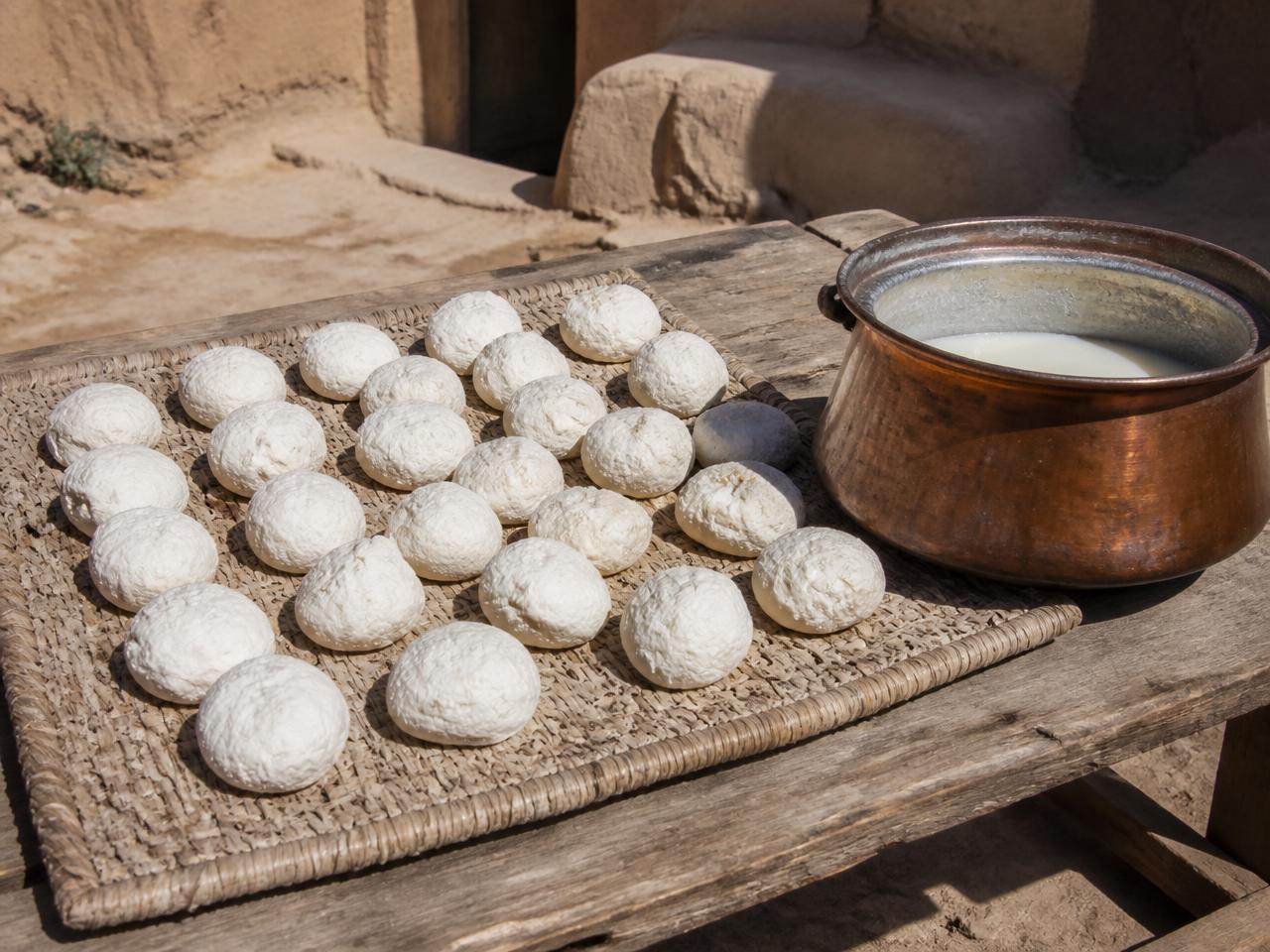
The drying stage: shaped while soft, then left in the sun until the balls are hard enough to rattle. Hardness — not colour — is what tells the maker the water has gone.
Yogurt is churned and the butter removed. The remaining doogh is boiled and strained, then salted and shaped by hand into hard white balls or discs, which are dried in the sun until they rattle.
To use dried kashk you soak it, then grind or blend it back into a cream with water. This is the form still made in villages, and it's the reference point every bottled product is judged against.
The white swirl on a bowl of āsh reshteh is kashk, added at the table rather than cooked into the pot. It cuts the earthiness of the beans and herbs with sourness and salt.
Thin it with a little warm water first and stir it in off the heat. Boiled kashk splits and turns grainy.
Chapter 6 of 12
Kashk-e Bademjan
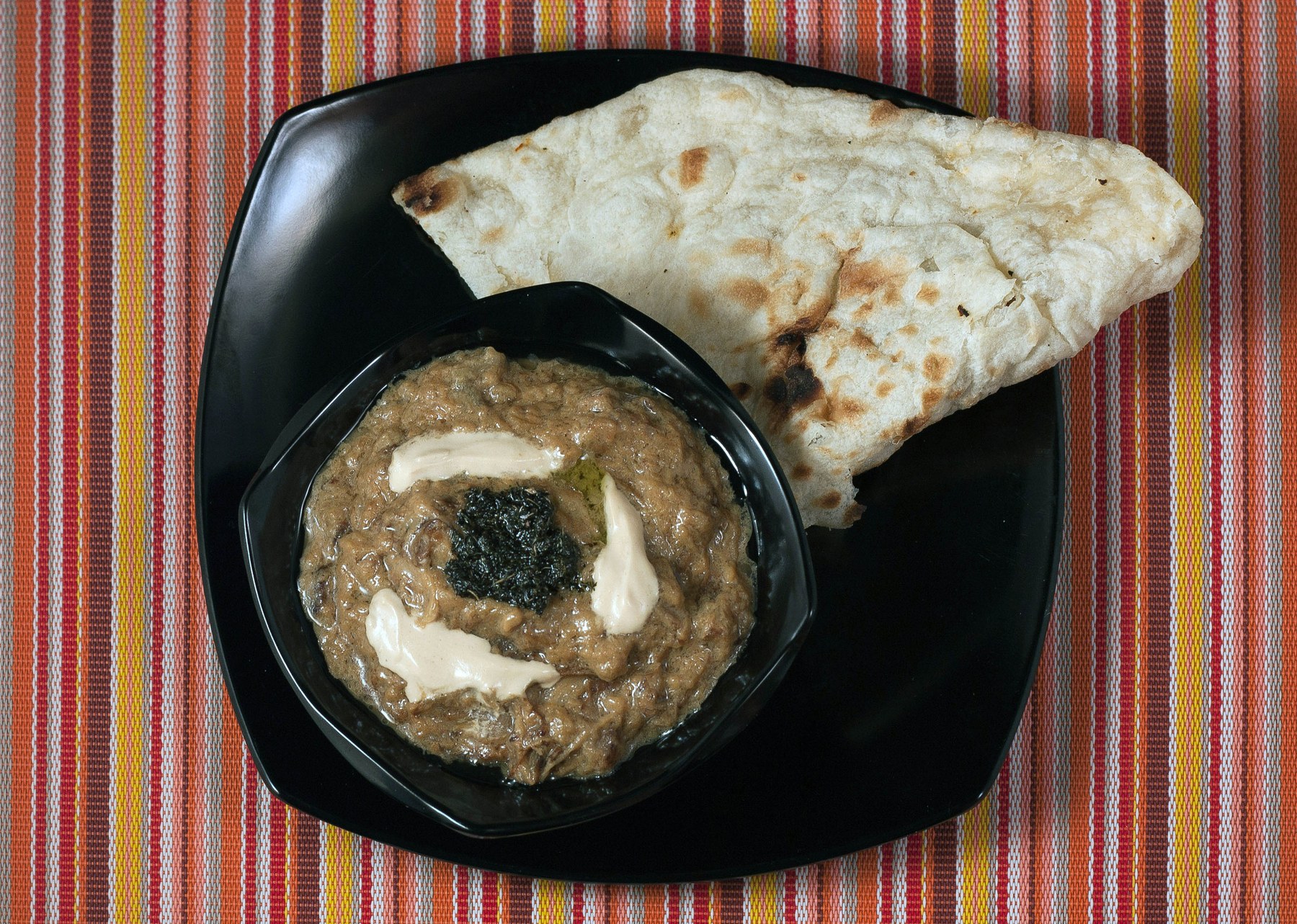
Here the kashk is beaten in until eggplant and kashk are one cream — no white swirl left. The dark oil on top is mint fried in oil, added last.
Here kashk isn't a finishing swirl but the dish itself. Fried or roasted eggplant is beaten to a pulp and loosened with kashk until the two are one savoury cream, then topped with mint fried in oil, caramelised onion and often crushed walnut.
This is the dish that separates good kashk from ordinary kashk. With bottled kashk it's pleasant. With soaked dried kashk it's sharper, saltier and unmistakably itself — which is why the recipe is worth the soaking.
Chapter 7 of 12
Dried Kashk vs Bottled Kashk
Bottled liquid kashk is convenient and consistent: already reconstituted, usually pasteurised, often thinner and saltier, with no live cultures.
Dried kashk, kept properly dry and sealed, keeps for a year or more — long enough to carry a household from one milking season to the next, which is the point of making it. It tastes sharper and more complex and lets you control thickness, but it takes soaking, grinding and straining before it's usable.
For āsh, either works. For kashk-e bademjan, where kashk is the flavour rather than a background note, the dried form is noticeably better.
Chapter 8 of 12
Buying and Storing Kashk
Bottled kashk keeps for months unopened and a few weeks refrigerated once opened. It separates on standing, which is normal — stir rather than discard.
Dried kashk should be stone-hard, chalky white to pale beige, and kept dry and sealed. Softness or a musty smell means it has taken up moisture.
Taste before using. Salt levels vary widely between producers, and a salty kashk means less salt everywhere else in the dish.
Chapter 9 of 12
What Persian Medicine Made of Kashk
Persian temperament: Warm & Dry (2nd degree). Persian medicine reads kashk as concentrated and strengthening — food for cold weather and recovery — and warns that it's heavy. The traditional correction is what the kitchen already does: mint, garlic and warm water, never kashk alone.
Persian medicine reads kashk as warm and dry — concentrated dairy that builds you back up when you're worn out.
It was used: drizzled over āsh reshteh with fried mint and caramelised onion. Dried balls carried as pantry food by pastoral families.
Kashk-e bademjan, and kashk spooned over ash reshteh — take the kashk away and Persian comfort food is just not the same.
Chapter 10 of 12
Questions About Kashk
Is it a probiotic (live helpful bacteria) food?
Traditional unpasteurised kashk carries live cultures. The jars sold in shops don't.
Can I substitute yogurt?
For texture, roughly. Thick salted labneh with lemon is the closest everyday stand-in.
Why did mine go grainy?
It boiled. Warm gently with a little water. Once split at high heat it doesn't recover.
Chapter 11 of 12
Sources
Sad Giah Hezar Darman (صد گیاه و هزار درمان) — One Hundred Plants and One Thousand Remedies — Dr. Hossein Erfani, 4th edition (1375 / 1996–1997). Primary traditional Persian herbal reference cited throughout this platform. Presented as traditional knowledge, not as modern medical proof.
Office of Dietary Supplements: fact Sheets — US National Institutes of Health (NIH). https://ods.od.nih.gov/factsheets/list-all/.
Herbal Database: memorial Sloan Kettering Cancer Center. https://www.mskcc.org/cancer-care/diagnosis-treatment/symptom-management/integrative-medicine/herbs.
Herbs at a Glance: uS NIH National Center for Complementary and Integrative Health (NCCIH). https://www.nccih.nih.gov/health/herbsataglance.
FoodData Central: searchable nutrient database — US Department of Agriculture (USDA). https://fdc.nal.usda.gov/.
Chapter 12 of 12
Sources (continued)
The Nutrition Source: harvard T.H. Chan School of Public Health. https://www.hsph.harvard.edu/nutritionsource/.
PubMed — peer-reviewed biomedical literature — US National Library of Medicine. https://pubmed.ncbi.nlm.nih.gov/