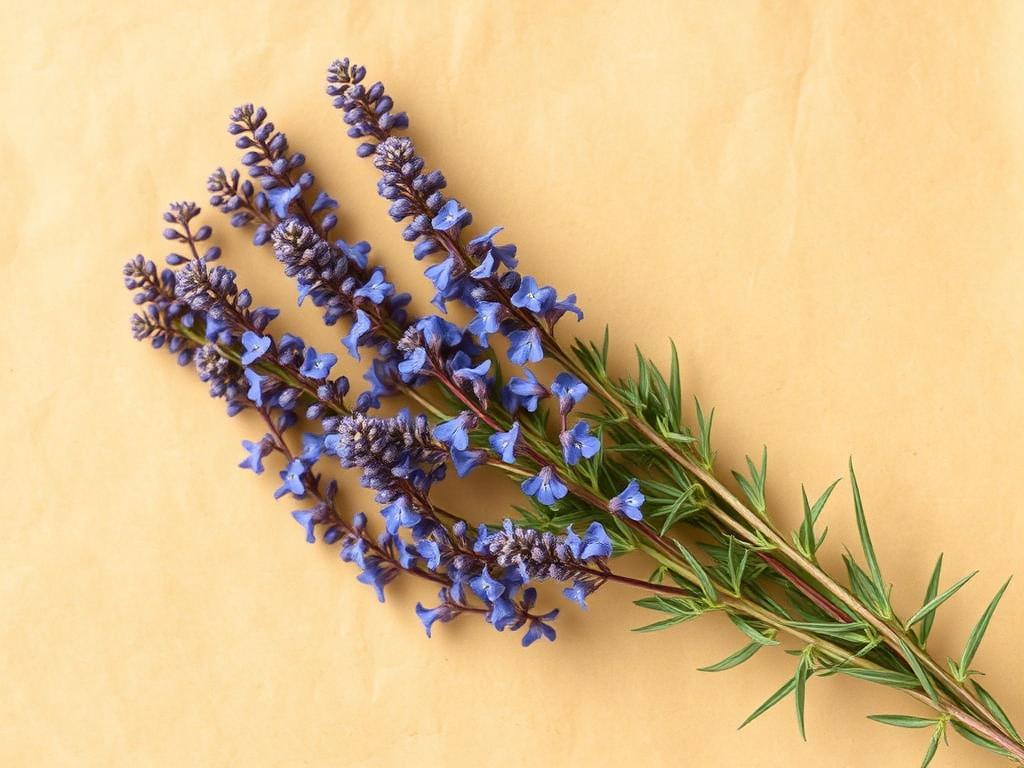
Aromatic chest herb with a well-documented ability to loosen phlegm. Mentioned in Avicenna's Canon and the Old Testament alike.
Strong tea with honey is the classical winter cough remedy.
Concentrated essential oil (the concentrated aromatic oil of the plant) isn't safe for internal use — stay with the herb.
Hyssop appears in the Old Testament as a ritual purifier, while Dioscorides, Galen, and Avicenna wrote about it as a herb for the chest and digestion. Modern research focuses on its volatile oil (pinocamphone, isopinocamphone) and rosmarinic acid, looking at how they may help loosen phlegm and protect cells from damage.
Known to botanists as Hyssopus officinalis.
Chapter 2 of 15
Why Herbalists Still Reach for It
A lingering wet cough, blocked sinuses, and slow digestion can quietly drain your energy in cold weather. Hyssop is one of the oldest household answers to that pattern. As a tea it's simple and gentle, yet its long tradition stretches across three continents.
Frequent winter chest infections and lingering postnasal congestion after 65 are closely linked with becoming frail sooner. A weekly cup of hyssop tea, or steam inhalation when symptoms first appear, is a low-cost traditional habit that may help keep the lungs and sinuses open over the years.
Aromatic antimicrobial (slows the growth of germs) volatile oils (the concentrated aromatic oil of the plant).
What That Means Day to Day
It was used: antioxidant rosmarinic acid and gently warming for cold digestive patterns.
Hyssop is a low evergreen shrub 30–60 cm tall with slender, woody stems, narrow lance-shaped dark green leaves, and elegant spikes of small deep-blue, sometimes pink or white, flowers. The aerial parts in flower are the medicinal portion.
Hyssop extracts show antiviral and antimicrobial (slows the growth of germs) activity in laboratory assays. Rated: early research.
What studies in people show
Pinocamphone in hyssop essential oil has caused convulsions in reported human cases of ingestion. Rated: moderate evidence.
Chapter 4 of 15
How It Is Prepared
Steep 1 tsp dried flowering tops in 1 cup hot water, covered 10 min, sweetened with honey.
Hyssop honey: sprigs steeped in raw honey 2 weeks, 1 tsp as needed · Steam inhalation: handful of herb under a towel for chest comfort.
Other Ways to Use It
Use a strong cooled infusion (a drink made by steeping the plant in hot water) as a sore-throat gargle.
Sweeten with honey only after the tea has cooled below 110°F.
Add a handful of dried herb to a hot-water bowl for steam inhalation.
Tuck a few sprigs into bean soups and roasts for digestive lift.
Chapter 5 of 15
Medicines and Interactions
Medication interaction:
Anticonvulsants — Hyssop essential oil contains pinocamphone and has triggered seizures at high doses. Anyone with epilepsy should avoid the oil entirely. (high concern)
Medication interaction:
Blood pressure medicine — Hyssop has been reported to raise blood pressure in some people, which works against treatment. (moderate concern)
Medication interaction:
Diabetes medicine — Hyssop extracts have altered blood sugar in animal work. Check readings if you drink it daily. (low concern)
Chapter 6 of 15
Who Should Be Careful
General caution:
Concentrated hyssop essential oil can be neurotoxic — do NOT take it internally.
General caution:
Caution with epilepsy or seizure history (essential oil only).
Chapter 7 of 15
Pregnancy, Children and Older Adults
General
Pregnancy and breastfeeding:
Avoid in pregnancy, breastfeeding, and children under 6.
Pregnancy and breastfeeding
Pregnancy and breastfeeding:
Avoid hyssop in pregnancy in any form. It has a traditional reputation for stimulating the uterus and the essential oil is neurotoxic at modest doses.
Children
Children:
The essential oil must never be given to children or used on their skin. Weak tea is used traditionally for coughs in older children, but a doctor is the better first stop.
Older adults
Older adults:
A useful cough tea if blood pressure is well controlled and there's no seizure history. Keep courses to a week or two rather than drinking it through the winter.
Chapter 8 of 15
What Persian Medicine Says
Persian temperament: Hot & Dry (3rd degree). Zufa is read as strongly heating and drying, used for wet coughs and cold chests, and kept short in anyone already dry.
Persian and Greco-Arab medicine see hyssop as hot and dry in the third degree. Traditionally, people used it to open the chest, shift thick cold-damp phlegm, warm a sluggish stomach, and brighten a melancholy mood.
In the Household
It was used: wet, productive cough and bronchial congestion. Low spirits in cold, damp weather.
Traditional expectorant (helps loosen mucus so you can cough it up): helps clear thick phlegm.
Hyssop has scented monastic gardens, appeared in biblical cleansing rituals, and flavoured the herbal liqueur Chartreuse. You can still find it in Persian apothecaries (attari), sold for winter cough syrup and steam inhalation.
Chapter 9 of 15
Traditional Formulas
Damkardeh-ye zūfā: classical Persian covered infusion (a drink made by steeping the plant in hot water) of dried hyssop flowering tops for wet cough and chest heaviness.
Zūfā wa 'asal: hyssop honey — sprigs steeped in raw honey 2 weeks, a daily teaspoon in cold weather.
Three-chest blend: hyssop + thyme + licorice in equal parts as a productive-cough damkardeh.
Chapter 10 of 15
What It Goes With
Herb:
Thyme
The classic chest pairing. Thyme loosens, hyssop dries, and together they suit a cough that has turned wet.
Pairing:
Licorice
Licorice softens a harsh infusion (a drink made by steeping the plant in hot water) and helps a dry throat. Keep it short if your blood pressure runs high.
Herb:
Sage
Both are drying. Use one or the other for a sore throat rather than doubling up.
Chapter 11 of 15
What It Goes With: More Pairings
Honey:
Honey
Hyssop tea is bitter and camphorous.
Fruit:
Lemon
Lemon cuts the resin taste and adds nothing that fights the herb.
Grain:
Barley
Barley water with a little hyssop is an old convalescent drink, thin enough to take when appetite is gone.
Chapter 12 of 15
Through the Year
Spring:
Spring
New growth is soft and the oil is light. Good for a mild tea, less good for a stubborn cough.
Summer:
Summer
Cut the flowering tops and dry them. This is the harvest the whole year's tea comes from.
Autumn:
Autumn
The season the herb is actually needed, as chests begin to rattle. Use the summer stock.
Winter:
Winter
Steam inhalation and honeyed infusions (a drink made by steeping the plant in hot water). Hyssop earns its place in the cupboard in these months.
Chapter 13 of 15
Questions People Ask
Is hyssop tea safe for daily use?
Short-term daily use of mild hyssop infusion (1 cup) is traditional and generally well tolerated by healthy adults. Avoid continuous long-term use and stay with the herb rather than the essential oil.
Where do I find hyssop?
Look in well-stocked Persian and Middle Eastern attari (apothecary) shops as 'zufā', or in European herb-tea sections under Hyssopus officinalis. Grow it easily from seed in a sunny spot.
Chapter 14 of 15
Sources
Hyssopus officinalis L. — Botanical and pharmacological review — Journal of Ethnopharmacology (PubMed). https://pubmed.ncbi.nlm.nih.gov/
Hyssop: drug Information — Memorial Sloan Kettering Cancer Center.
Sad Giah Hezar Darman (صد گیاه و هزار درمان) — One Hundred Plants and One Thousand Remedies — Dr. Hossein Erfani, 4th edition (1375 / 1996–1997). Primary traditional Persian herbal reference cited throughout this platform. Presented as traditional knowledge, not as modern medical proof.
Office of Dietary Supplements: fact Sheets — US National Institutes of Health (NIH). https://ods.od.nih.gov/factsheets/list-all/.
Herbal Database: memorial Sloan Kettering Cancer Center. https://www.mskcc.org/cancer-care/diagnosis-treatment/symptom-management/integrative-medicine/herbs.
Herbs at a Glance: uS NIH National Center for Complementary and Integrative Health (NCCIH). https://www.nccih.nih.gov/health/herbsataglance.
Chapter 15 of 15
Sources (continued)
FoodData Central: searchable nutrient database — US Department of Agriculture (USDA). https://fdc.nal.usda.gov/.
The Nutrition Source: harvard T.H. Chan School of Public Health. https://www.hsph.harvard.edu/nutritionsource/.
PubMed — peer-reviewed biomedical literature — US National Library of Medicine. https://pubmed.ncbi.nlm.nih.gov/