Supports stress resilience and steady daytime mood — trials using 500–1200 mg of leaf extract per day.
Modest fasting-glucose and post-prandial-glucose lowering: helpful adjunct with monitoring in type 2 diabetes.
Traditional respiratory support — warm tea for winter cough, damp chest, and mild seasonal congestion.
Chapter 2 of 15
What Is In It
Primary compounds
Eugenol: dominant volatile phenylpropanoid. Antioxidant, anti-inflammatory, mild analgesic (pain-relieving) and antimicrobial (slows the growth of germs) · Ursolic acid & oleanolic acid: pentacyclic triterpenoids. Adaptogen-associated actives, mild HMG-CoA-reductase and anti-inflammatory activity.
Rosmarinic acid is the Lamiaceae polyphenol (protective plant compounds) shared with sage and rosemary. Antioxidant and mildly anxiolytic (calms anxiety) in preclinical work.
Other Constituents
Ocimumosides A & B: glycolipids identified from tulsi leaf. Adaptogen-associated in preclinical stress models. Apigenin & luteolin flavonoids (a family of protective plant compounds): antioxidant and mild GABA-A modulating activity. Β-caryophyllene: cB2-receptor agonist. Contributes to anti-inflammatory profile.
Chapter 3 of 15
What Is In It
Vitamins
Vitamin K, Vitamin A
Other notable constituents
Minerals: Calcium, Iron, Magnesium
Notable: Adaptogenic (a traditional term for a plant said to help the body cope with stress) aromatic compounds
Chapter 4 of 15
What Studies in People Show
Moderate evidence
Ocimum sanctum leaf extract (500 mg twice daily, 60 days) reduced perceived stress, sleep disturbance, and forgetfulness vs placebo in a double-blind (neither the people nor the researchers knew who got what) RCT of stressed adults.Moderate evidence
Tulsi extract (1200 mg/day, 90 days) improved measures of general stress and cognitive (to do with thinking and memory) function vs placebo in a randomised trial in adults with chronic stress.Moderate evidence
Tulsi leaf (2.5 g/day dried leaf powder) reduced fasting and post-prandial glucose vs placebo over 4 weeks in non-insulin-dependent type 2 diabetes (randomised crossover).Moderate evidence
Further Findings
Standardised Ocimum sanctum extract (250 mg twice daily, 12 weeks) improved lipid profile and fasting glucose vs placebo in adults with metabolic syndrome (RCT).Moderate evidence
Systematic review (a careful summary of all the studies on a question) of clinical trials of Ocimum sanctum concluded consistent evidence for stress, immunity, and metabolic benefits, with generally excellent short-term safety.Moderate evidence
Early research
Preclinical antifertility and mild uterine-stimulant signals in Ocimum sanctum leaf extract underlie the traditional caution against medicinal doses during pregnancy and active conception planning.Emerging evidence
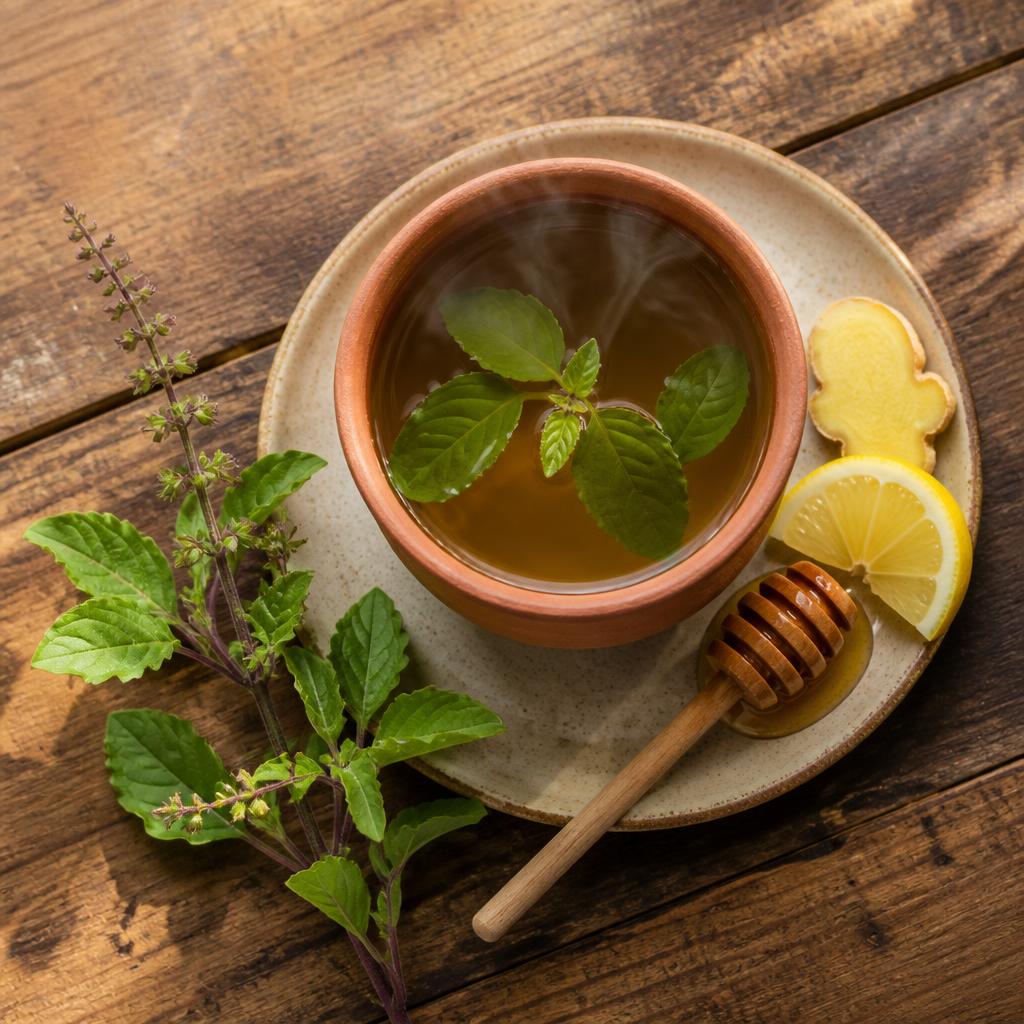
Fresh-leaf infusion (a drink made by steeping the plant in hot water): 5–8 fresh leaves in a small pot of hot water with a slice of ginger for a winter cold.
Other Ways to Use It
Add small amounts of fresh leaf to soups and rasam (never as a bulk cooking herb).
Small dried-leaf pinch under the tongue as a traditional bedtime calmative in Ayurveda.
Capsules and standardised extracts carry many times the amount you get from food, which is why the cautions below matter more here.
Standardised leaf extract: 300–600 mg twice daily in trial protocols for 6–12 weeks.
Chapter 6 of 15
Medicines and Interactions
General cautions
Medication interaction:
1–2 weeks pre-elective surgery on concentrated extracts.
Specific medicines
Medication interaction:
Antidiabetic medication (metformin, sulfonylureas, insulin) — Tulsi lowers fasting and post-prandial glucose in clinical trials; additive with hypoglycaemics — clinician-monitored dose adjustments and home monitoring recommended. (moderate concern)
Medication interaction:
Anticoagulants (blood-thinning medicines) / antiplatelets (warfarin, DOACs, aspirin, clopidogrel) — Eugenol and rosmarinic acid show mild antiplatelet direction in preclinical work; concentrated extracts moderated, especially peri-operatively. (moderate concern)
Medication interaction:
Thyroid hormone (levothyroxine) — Tulsi mildly modulated thyroid indices in animal work; theoretical only at extract dose, but worth screening TSH on layered therapy. (low concern)
Chapter 7 of 15
Medicines and Interactions: More Interactions to Know
Medication interaction:
Sedatives (medicines that make you sleepy) / GABAergics — Flavonoid-associated mild GABA-A activity; theoretical additive drowsiness at very high extract doses. (low concern)
Medication interaction:
Antihypertensives — Small trials show modest blood-pressure lowering; additive at extract dose worth home-monitoring in the first two weeks. (low concern)
Medication interaction:
CYP450 substrates (theoretical) — Preclinical CYP1A2 and CYP3A4 (a liver enzyme that breaks down many medicines) modulation; clinical impact not established but worth caution with narrow-therapeutic-index drugs at concentrated-extract dose. (low concern)
Chapter 8 of 15
Who Should Be Careful
Medication interaction:
May reduce fertility at high extract doses in preclinical work — reserved for non-conception-planning windows at extract dose.
Pregnancy and breastfeeding:
Pregnancy at medicinal daily doses given preclinical uterine-stimulant and antifertility signals.
General caution:
Active bleeding disorder on concentrated extracts.
General caution:
Poorly controlled hypoglycaemia (blood sugar dropping too low) on antidiabetic therapy without close monitoring.
Chapter 9 of 15
Pregnancy, Children and Older Adults
Pregnancy and breastfeeding
Pregnancy and breastfeeding:
Culinary or occasional-tea amounts of tulsi are compatible with pregnancy — a fresh leaf in a soup, a small cup of weak damkardeh for a winter cold. Daily medicinal-strength tulsi tea and concentrated leaf extracts are reserved for the non-pregnant window given preclinical uterine-stimulant signals and animal antifertility data. If you're actively trying to conceive, hold concentrated extracts. Breastfeeding: Traditional Ayurvedic morning tulsi tea is widely used by nursing parents in India and generally compatible with occasional-to-moderate cups. Concentrated leaf extracts don't have breastfeeding safety data and are moderated.
Chapter 10 of 15
Pregnancy, Children and Older Adults: Other Groups to Consider
Children
Children:
Weak tulsi–honey tea (honey only after age 1) is a traditional Indian household remedy for a winter cough and mild fever in older children, from around age 4. Concentrated Western commercial extracts aren't appropriate in paediatric use without a clinician. Do not give the fresh essential oil (the concentrated aromatic oil of the plant) internally or apply undiluted to skin.
Older adults
Older adults:
One of the more useful gentle adaptogens after 60 — a small morning cup of tulsi–ginger–honey tea supports steady mood, clears the chest at the start of a damp-cold morning, and mildly nudges fasting glucose. Standardised leaf extract (300 mg twice daily) has trial data for perceived stress and glycaemic control in older adults with metabolic syndrome; screen for antidiabetic therapy and warfarin (a blood-thinning medicine) before starting and monitor blood pressure at home in the first fortnight.
Chapter 11 of 15
What Persian Medicine Says
Persian temperament: Warm & Dry (2nd degree). Ayurveda classifies tulsi as ushna (warming), tikta-katu rasa (bitter-pungent taste), laghu-ruksha guna (light and dry qualities), sattvic in mental effect, and pacifying to kapha and vata while mildly aggravating pitta in excess. In the Unani parallel it's asgand's kin — warm and dry in the second degree, cephalic (clearing head-fog) and pectoral (opening a damp chest), with a lifting rather than sedating quality on mood.
In the Household
Ayurveda treats holy basil (tulsi) as a daily household tea rather than a treatment, kept by the door and drunk by the whole family — the reason it's described as a plant for resilience rather than for a diagnosis. It's read as warm, light, and drying, which suits damp, foggy, congested states: a heavy chest in a wet season, a mind clouded by strain, a lingering low-grade cold.
Because it's mildly warming, hot constitutions take it as a weaker infusion (a drink made by steeping the plant in hot water), and classical practice keeps it away from pregnancy and from anyone trying to conceive.
Tulsi is grown near homes and temples across India, symbolizing protection, presence, and everyday spiritual care.
Chapter 12 of 15
Questions People Ask
Is holy basil the same as Italian basil?
No — different species. Holy basil (Ocimum sanctum) is more peppery, clove-like, and used medicinally as a tea. Italian sweet basil (Ocimum basilicum) is a culinary herb. The two aren't interchangeable.
How long until tulsi 'works'?
Adaptogen (a traditional term for a plant said to help the body cope with stress) effects build with daily use. Trials on stress and glucose usually report benefit at 6–12 weeks of daily 300–600 mg extract or 2–3 cups tea. It isn't a same-day anxiolytic (calms anxiety).
Chapter 13 of 15
Questions People Ask: More Questions
Morning or evening tulsi?
Ayurveda favours the morning cup: tulsi is gently uplifting and sattvic. A small evening cup is fine for people who find it calming rather than stimulating.
Can I take tulsi with metformin (a common diabetes medicine)?
Traditional daily tea is compatible. Concentrated extracts add real fasting-glucose lowering to metformin (a common diabetes medicine) and can drive hypoglycaemia (blood sugar dropping too low). Home-monitor for the first two weeks and speak with a clinician before starting an extract.
Chapter 14 of 15
Sources
Ocimum sanctum: about Herbs (MSK) — Memorial Sloan Kettering Cancer Center. https://www.mskcc.org/cancer-care/integrative-medicine/herbs/holy-basil.
The Clinical Efficacy and Safety of Tulsi — Systematic Review — Jamshidi & Cohen, Evid Based Complement Alternat Med 2017. https://pubmed.ncbi.nlm.nih.gov/28400848/
Sad Giah Hezar Darman (صد گیاه و هزار درمان) — One Hundred Plants and One Thousand Remedies — Dr. Hossein Erfani, 4th edition (1375 / 1996–1997). Primary traditional Persian herbal reference cited throughout this platform. Presented as traditional knowledge, not as modern medical proof.
Office of Dietary Supplements: fact Sheets — US National Institutes of Health (NIH). https://ods.od.nih.gov/factsheets/list-all/.
Herbal Database: memorial Sloan Kettering Cancer Center. https://www.mskcc.org/cancer-care/diagnosis-treatment/symptom-management/integrative-medicine/herbs.
Herbs at a Glance: uS NIH National Center for Complementary and Integrative Health (NCCIH). https://www.nccih.nih.gov/health/herbsataglance.
Chapter 15 of 15
Sources (continued)
FoodData Central: searchable nutrient database — US Department of Agriculture (USDA). https://fdc.nal.usda.gov/.
The Nutrition Source: harvard T.H. Chan School of Public Health. https://www.hsph.harvard.edu/nutritionsource/.
PubMed — peer-reviewed biomedical literature — US National Library of Medicine. https://pubmed.ncbi.nlm.nih.gov/