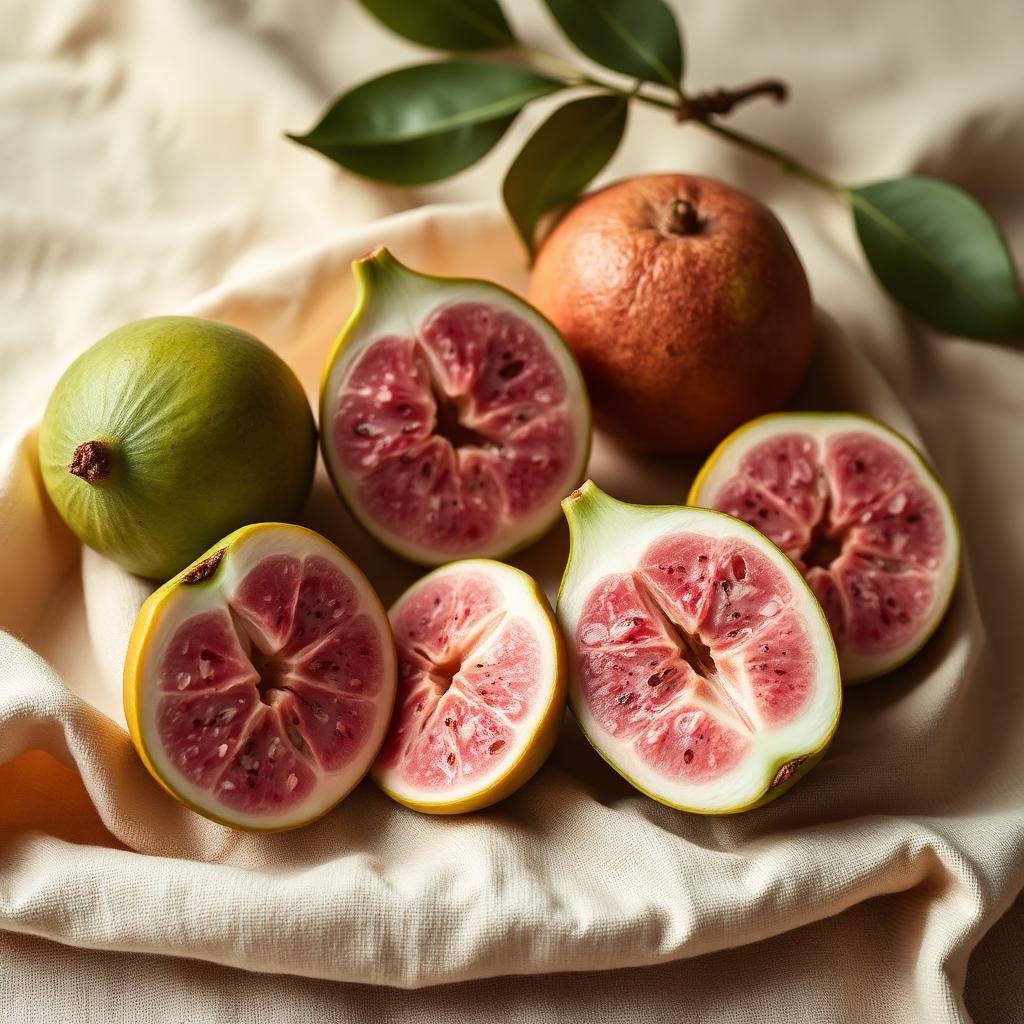
About four times the vitamin C of an orange, in one fruit.
You eat skin and seeds, so the fibre is high — around 9 grams in a cup.
Pink varieties also carry lycopene (the red pigment in tomatoes), the pigment found in tomato.
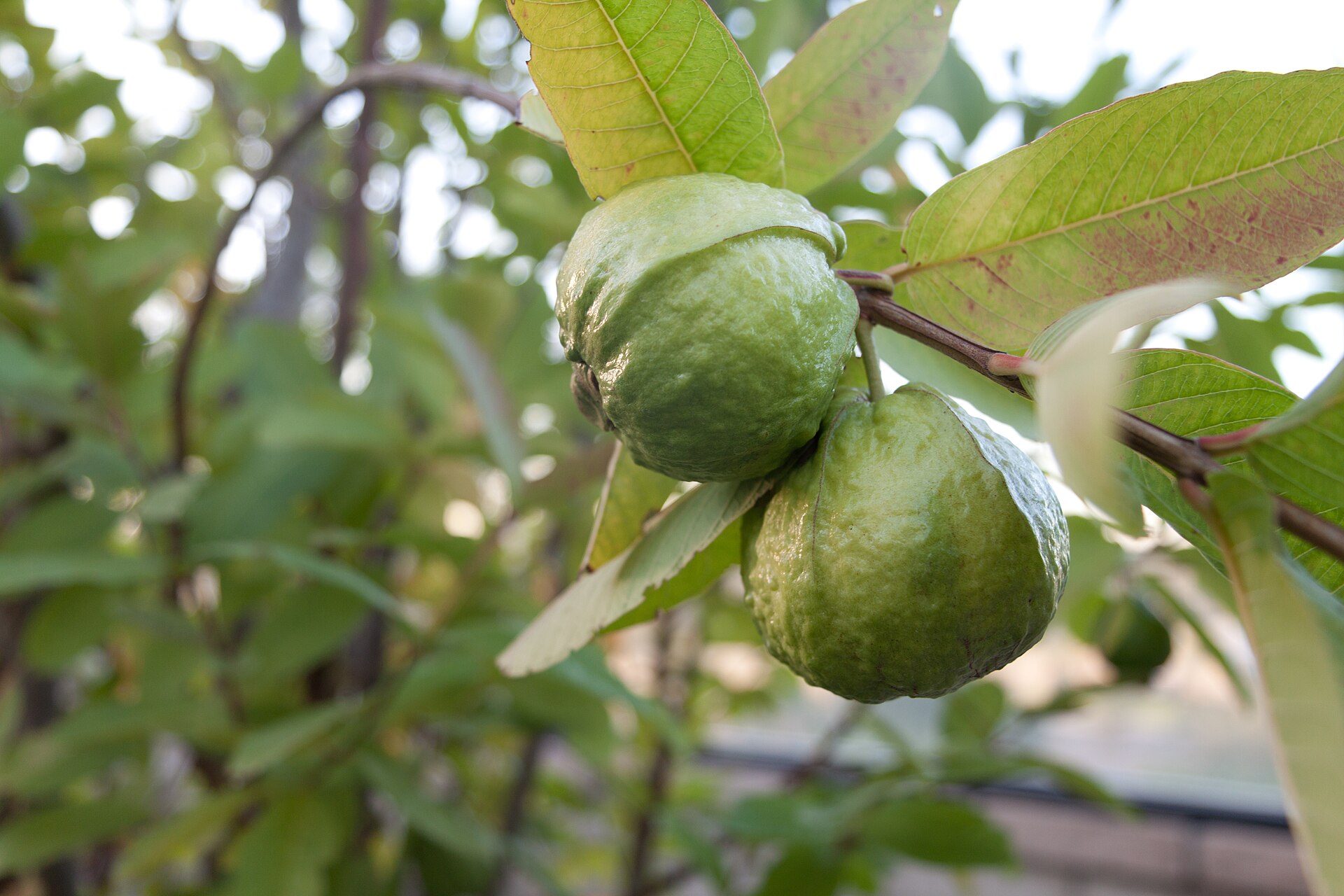
Guava is a quiet record-holder. One fruit gives you more vitamin C than several oranges, plus plenty of fibre because you eat the skin and seeds too. It tastes somewhere between a pear and a strawberry, with a fragrance that can fill a room. In tropical countries, people value the leaf as much as the fruit. Guava leaf tea is one of the world's most widely used traditional remedies for diarrhoea, and small trials have supported it reasonably well.
Known to botanists as Psidium guajava.
Chapter 2 of 15
Why It Matters
We talk a lot about vitamin C, but few single foods give you this much in such a satisfying form. Guava does, and adds fibre and potassium at the same time. Where oranges are expensive and guava trees grow in the yard, this one fruit has quietly helped nourish whole communities.
Your body needs vitamin C to build collagen, which holds skin, blood vessels and joints together, and that need doesn't fall with age. One guava covers a day's requirement several times over, with fibre attached in a whole food rather than a tablet.
Guava is a round or pear-shaped fruit with thin green or yellow skin and flesh that may be white, pink, or deep red depending on the variety. The centre is full of small hard seeds. It grows on a small tree with smooth, peeling bark, and the leaves — used as a tea — are as important in traditional medicine as the fruit.
Family: Myrtaceae (myrtle family).
Chapter 4 of 15
What It Contains
Primary compounds
Quercetin (a plant compound found in onions, apples and tea). Tannins (in the leaf).
Vitamins
Vitamin A, Folate
Other notable constituents
Minerals: Potassium, Magnesium, Copper · Fiber: ~9 g per cup
Chapter 5 of 15
What Studies in People Show
What studies in people show
Guava intake was associated with modest reductions in blood pressure and blood lipids in a controlled trial.Moderate evidence
Guava contains substantially more vitamin C by weight than citrus fruit.Strong evidence
Chapter 6 of 15
Preparation and Kitchen Use
Eaten whole like an apple is the simplest and most common form.
Slice and sprinkle with salt and chilli, as is done across the tropics.
Thick guava paste, cooked slowly with sugar until it sets.
Guava leaf tea is dried leaves steeped ten minutes, a distinct traditional remedy.
Eat whole, like an apple, skin and all.
Blend into a thick pink juice with a squeeze of lime.
Cook into a firm paste to eat with salty white cheese.
Chapter 7 of 15
Medicines and Interactions
General cautions
Medication interaction:
Leaf tea is a medicine, not a daily drink.
Specific medicines
Medication interaction:
Diabetes medicine — Guava is high in fibre and has been studied for lowering blood sugar. Eating a lot of it alongside glucose-lowering tablets can push readings lower than expected. (low concern)
Medication interaction:
Blood pressure medicine — The fruit is rich in potassium. This matters mainly if you also take a potassium-sparing diuretic (makes you pass more urine) or have kidney disease. (low concern)
Chapter 8 of 15
Who Should Be Careful
General caution:
The seeds are very hard — take care with dental work.
General caution:
Unripe guava is astringent (tightens tissue and leaves a dry feeling in the mouth) and can be constipating.
General caution:
Guava leaf preparations should not be used for more than a few days without advice.
General caution:
People with fructose intolerance may find large amounts uncomfortable.
Chapter 9 of 15
Pregnancy, Children and Older Adults
Pregnancy and breastfeeding
Pregnancy and breastfeeding:
Ordinary amounts of the fruit are fine and the vitamin C content is unusually high. Guava leaf tea and leaf extracts are a different matter and have not been studied in pregnancy.
Children
Children:
The seeds are hard and many. Scoop the seedy centre out for children under four and give them the firm outer flesh.
Older adults
Older adults:
One guava carries more fibre than most fruit and can help a sluggish gut. If chewing the seeds is difficult, halve the fruit and spoon out the surrounding flesh.
Chapter 10 of 15
Traditional Uses in the Tropics
Persian temperament: Cold & Dry (1st degree). Unani practice in India treats ripe guava as cooling and the unripe fruit as strongly binding, which is why it was given for loose stools.
Guava is a New World fruit, so you'll not find it in classical Persian texts. Ayurvedic and tropical folk practice treats the ripe fruit as cooling and loosening. The unripe fruit and leaf are considered binding and drying, and were used specifically for loose bowels and mouth and gum complaints. This is traditional use, not a modern medical recommendation — guava leaf tea and leaf extract supplements are medicines, and pregnant readers or anyone on blood-sugar medication should check with a doctor first.
Chapter 11 of 15
Traditional Uses in the Tropics: In the Household
It was used: leaf tea for diarrhoea and dysentery. Leaf gargle for gums and toothache. Ripe fruit for a slow, dry gut.
Guava travelled from tropical America to Asia on Spanish and Portuguese ships, then made itself completely at home. In India and Pakistan, you'll find sliced fruit with salt and chilli sold as street food. In Latin America, thick guava paste with cheese is a national dessert.
Chapter 12 of 15
What It Goes With
§ More Pairings
Fruit:
Lime
A squeeze of lime and a pinch of salt is how most of the world eats guava. Try it before you try anything else.
Dairy:
Yogurt
Chop firm guava through thick yogurt. The seeds give it crunch and the fruit keeps its shape.
Herb:
Mint
Mint sharpens the perfume of a very ripe guava, which can otherwise turn heavy.
Pairing:
Walnut
Guava paste with walnuts and a hard cheese is a Latin American plate worth borrowing.
Chapter 13 of 15
Through the Year
Spring:
Spring
Thin on the ground and usually shipped green. Cook it into a paste rather than eating it raw.
Summer:
Summer
Early fruit in the tropics. Eat it firm, sliced with salt and chilli, the way it's sold on the street.
Autumn:
Autumn
The best months. Fruit is fragrant enough to scent a room, and the flesh is soft to the seed.
Winter:
Winter
Peak season in India and Pakistan, where guava is a winter fruit and eaten in quantity.
Chapter 14 of 15
Questions People Ask
Is guava leaf tea safe?
For short use, generally yes, and it has a long traditional record for diarrhoea. It's astringent (tightens tissue and leaves a dry feeling in the mouth), so it isn't meant for daily long-term drinking, and persistent diarrhoea needs a doctor.
Chapter 15 of 15
Sources
Psidium guajava: a review of its traditional uses and pharmacology — Journal of Ethnopharmacology. https://pubmed.ncbi.nlm.nih.gov/18353572/
Vitamin C and immune function: nutrients. https://pubmed.ncbi.nlm.nih.gov/29099763/.