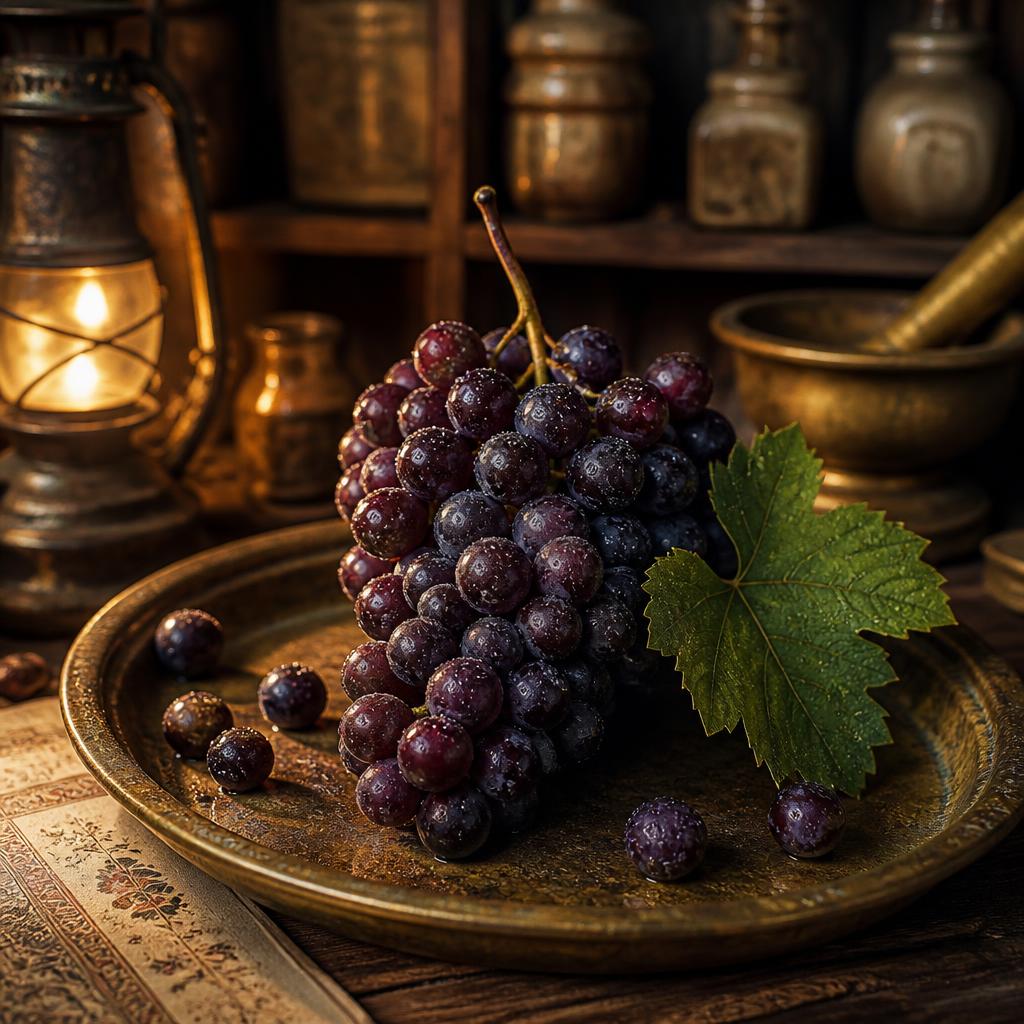
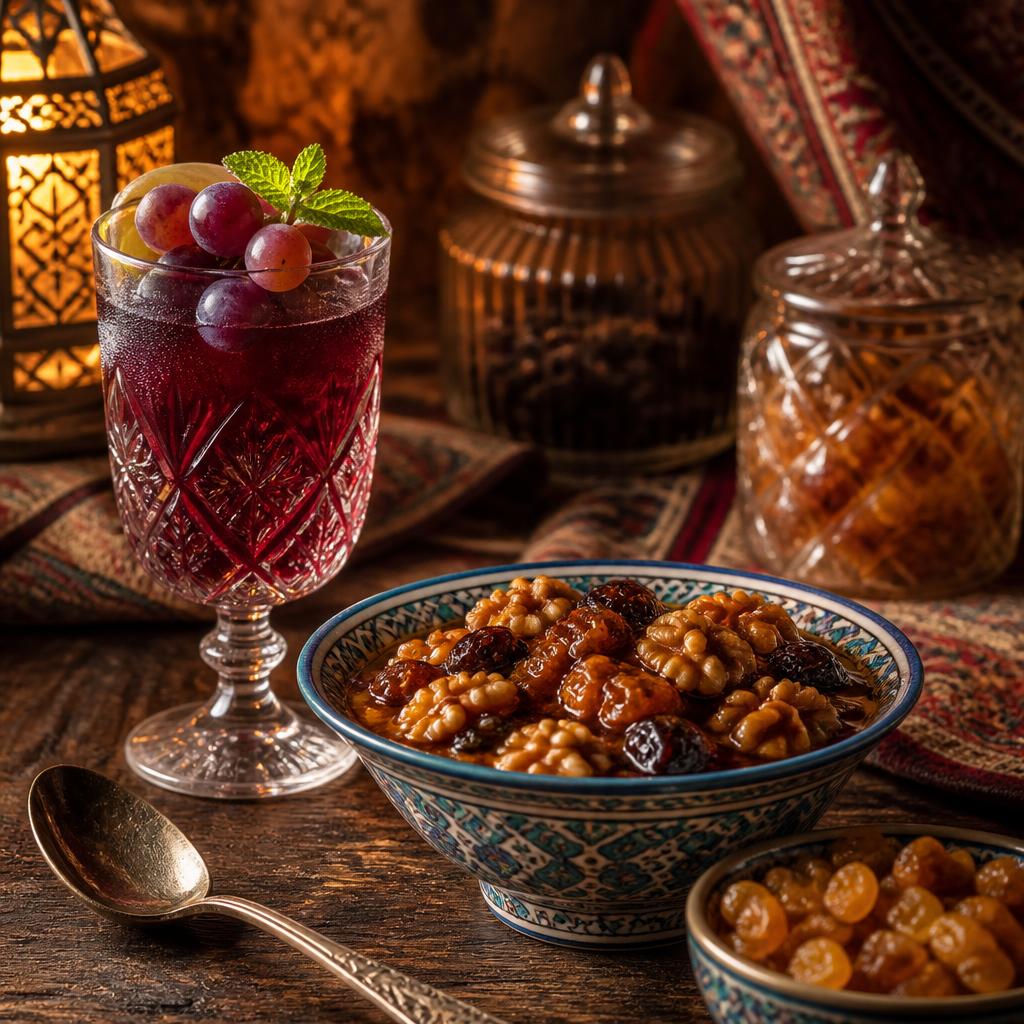
Ripe angur, sour ghureh, and dried keshmesh are three different tools of the same plant — mizaj, use, and portion each differ.
Red grapes carry the strongest research for heart and blood-vessel health, thanks to plant compounds in their skin and seeds (resveratrol, anthocyanins and proanthocyanidins).
Whole grapes are a serious choking hazard for children under 4 and for older adults who have trouble swallowing (dysphagia) — always cut them in half.
Grapes and grapefruit aren't the same fruit, even though the names sound alike. The well-known medicine warnings are about grapefruit — they don't apply to ordinary grapes.
Chapter 2 of 13
What Grapes Actually Is
Grapes have belonged in Persian meals and gardens for thousands of years. One vine gives you four different foods: small sour grapes (ghureh) picked early to brighten a summer stew, sweet ripe grapes (angur) eaten by the bunch, thick grape syrup (shireh angur) simmered down for winter, and raisins (keshmesh) dried in the sun for the tea tray. That's how grapes stay in a Persian kitchen all year. Scientists now study them for compounds like resveratrol and anthocyanins — natural substances in the skin that are linked to heart health — along with potassium, a mineral your body needs every day.
Known to botanists as Vitis vinifera.
Chapter 3 of 13
Why It Matters
A small daily bowl of red grapes with a handful of walnuts gives an older person protective plant compounds, potassium and water in one easy serving. Heart health is often built on small habits like this, kept up over the years.
Grapes bring three quiet supports for healthy aging in one fruit: whole-food potassium for blood pressure, resveratrol and anthocyanins for vascular (relating to the blood vessels) tone, and natural sweetness that can take the place of refined sweets. It's the same simple combination the Persian tea tray has trusted for generations.
What That Means Day to Day
Resveratrol and other grape plant compounds support the lining of the blood vessels and overall heart health.
Hydrating with meaningful potassium in normal food amounts.
Anthocyanins (the natural colour pigments that make fruit red, purple or blue), in red and black varieties, linked to lower rates of heart attacks and strokes in long studies that follow large groups.
Sour ghureh delivers acidity and vitamin C without refined lemon.
Chapter 4 of 13
What It Contains
Primary compounds
Resveratrol is the driver of the heart and blood vessel polyphenol (protective plant compounds) literature.
Anthocyanins and proanthocyanidins are the red/black skin pigments behind cohort-level heart and blood vessel associations.
Quercetin (a plant compound found in onions, apples and tea) and other flavonoids — vascular (relating to the blood vessels) tone and inflammatory-marker support.
Other Constituents
Potassium is the food-dose driver of blood-pressure benefit.
Tartaric and malic acids (higher in ghureh) — the source of the sour brightener effect.
Other notable constituents
Minerals: Copper, Manganese · Fiber: ~1 g per cup fresh. ~2 g per ¼ cup raisins
Chapter 5 of 13
What Studies in People Show
Strong evidence
Dietary potassium from fruit is linked to modest reductions in blood pressure across controlled-trial meta-analyses (a study that pools the results of many trials).Strong evidence
Early research
Red-grape polyphenol (protective plant compounds) supplementation improves endothelial (relating to the thin inner lining of your blood vessels) function markers in randomised controlled trials (a study where people are put into groups by chance).Emerging evidence
Grape-seed proanthocyanidin extracts show meta-analytic benefit on blood pressure and heart and blood vessel risk markers.Emerging evidence
Chapter 6 of 13
Using It in the Kitchen
Fresh angur through late summer and early autumn. Keshmesh year-round in small tea-tray portions. Shireh angur as a winter tonic. Small daily portions matter more than large occasional ones.
Fresh: ripe angur, halved for the youngest and the oldest.
Press sour unripe ghureh for ab-ghureh, and use in place of lemon in summer khoresh.
Simmered: shireh angur grape molasses, thick and dark.
Other Ways to Use It
Eat a small bowl of ripe red or black grapes with the skins on — where most polyphenols (protective plant compounds) live.
Stir 1 tsp shireh angur into warm water or over yogurt as a winter tonic.
Pair a small handful of keshmesh with almond or walnut on the tea tray.
Halve or quarter grapes for anyone under 4 or with unreliable chewing.
Chapter 7 of 13
Medicines and Interactions
Medication interaction:
Warfarin — Grapes are moderate in vitamin K and stable in normal food amounts; sudden shifts in raisin intake are still worth flagging while INR (the blood test that shows how fast your blood clots) is being tuned. (low concern)
Medication interaction:
Antidiabetic medication (insulin, sulfonylureas) — Dried raisins and shireh angur are concentrated sugar — coordinate portions and pair with walnut or yogurt to blunt the glycaemic curve. (low concern)
Medication interaction:
CYP3A4 substrates (statins, calcium-channel blockers, some immunosuppressants) — Grapefruit contains a compound (furanocoumarin) that blocks a liver enzyme called CYP3A4, which is how the body clears many medicines. Grapes don't contain it. Eating normal amounts of grapes alongside these medicines is fine — people often mix the two fruits up. (low concern)
Chapter 8 of 13
Who Should Be Careful
General caution:
Advanced kidney disease on strict potassium restriction — check per-portion.
General caution:
Conventional grapes carry a heavy pesticide load — choose organic or wash thoroughly.
General caution:
Fructose-malabsorption and IBS elimination phases — moderate fresh and dried portions.
Medication interaction:
Poorly controlled diabetes at heavy raisin or shireh-angur intake without dose adjustment.
Allergy:
Known grape or grape-mould allergy.
Chapter 9 of 13
Pregnancy, Children and Older Adults
Pregnancy and breastfeeding
Pregnancy and breastfeeding:
Fresh grapes and modest raisin portions are safe and traditional in pregnancy for hydration, potassium, and iron support. Concentrated grape-seed extracts aren't well-studied in pregnancy and are avoided.
Children
Children:
Halved grapes only under age 4 given choking risk. Small raisin portions from ~12 months. Wash conventional grapes thoroughly or choose organic given pesticide load.
Older adults
Older adults:
A small daily bowl of red grapes with a handful of walnut is one of the least stressful ways to layer polyphenols (protective plant compounds) and potassium into an older diet. Halve or crush grapes for anyone with unreliable chewing or dysphagia (difficulty swallowing).
Chapter 10 of 13
Traditional Persian Perspective
Persian temperament: Warm & Moist (1st degree ripe. Sour ghureh treated as cooling and correcting). Persian medicine reads ripe angur as warm-moist and blood-restoring, sour ghureh as cooling for hot summer khoresh, and shireh angur as a concentrated warming winter tonic.
It was used: weakness and low spirits (small bowl of ripe grapes with walnut). Hot-weather khoresh brightening (ab-ghureh in place of lemon).
Winter tonic for a dry, tired constitution (shireh angur in warm water).
Chapter 11 of 13
In Persian Life
Angur-o-gerdoo — grapes with walnut — is one of the oldest plates on the Persian tea table. Ab-ghureh, pressed from sour unripe grapes, gives ghormeh sabzi and ash-e reshteh their signature bright edge. Before refined sugar, Persian households relied on shireh angur as their main sweetener for centuries. Keshmesh still sits on every Nowruz haft-sīn and in every winter ājeel bowl.
Chapter 12 of 13
Sources
Sad Giah Hezar Darman (صد گیاه و هزار درمان) — One Hundred Plants and One Thousand Remedies — Dr. Hossein Erfani, 4th edition (1375 / 1996–1997). Primary traditional Persian herbal reference cited throughout this platform. Presented as traditional knowledge, not as modern medical proof.
Office of Dietary Supplements: fact Sheets — US National Institutes of Health (NIH). https://ods.od.nih.gov/factsheets/list-all/.
Herbal Database: memorial Sloan Kettering Cancer Center. https://www.mskcc.org/cancer-care/diagnosis-treatment/symptom-management/integrative-medicine/herbs.
Herbs at a Glance: uS NIH National Center for Complementary and Integrative Health (NCCIH). https://www.nccih.nih.gov/health/herbsataglance.
FoodData Central: searchable nutrient database — US Department of Agriculture (USDA). https://fdc.nal.usda.gov/.
Chapter 13 of 13
Sources (continued)
The Nutrition Source: harvard T.H. Chan School of Public Health. https://www.hsph.harvard.edu/nutritionsource/.
PubMed — peer-reviewed biomedical literature — US National Library of Medicine. https://pubmed.ncbi.nlm.nih.gov/