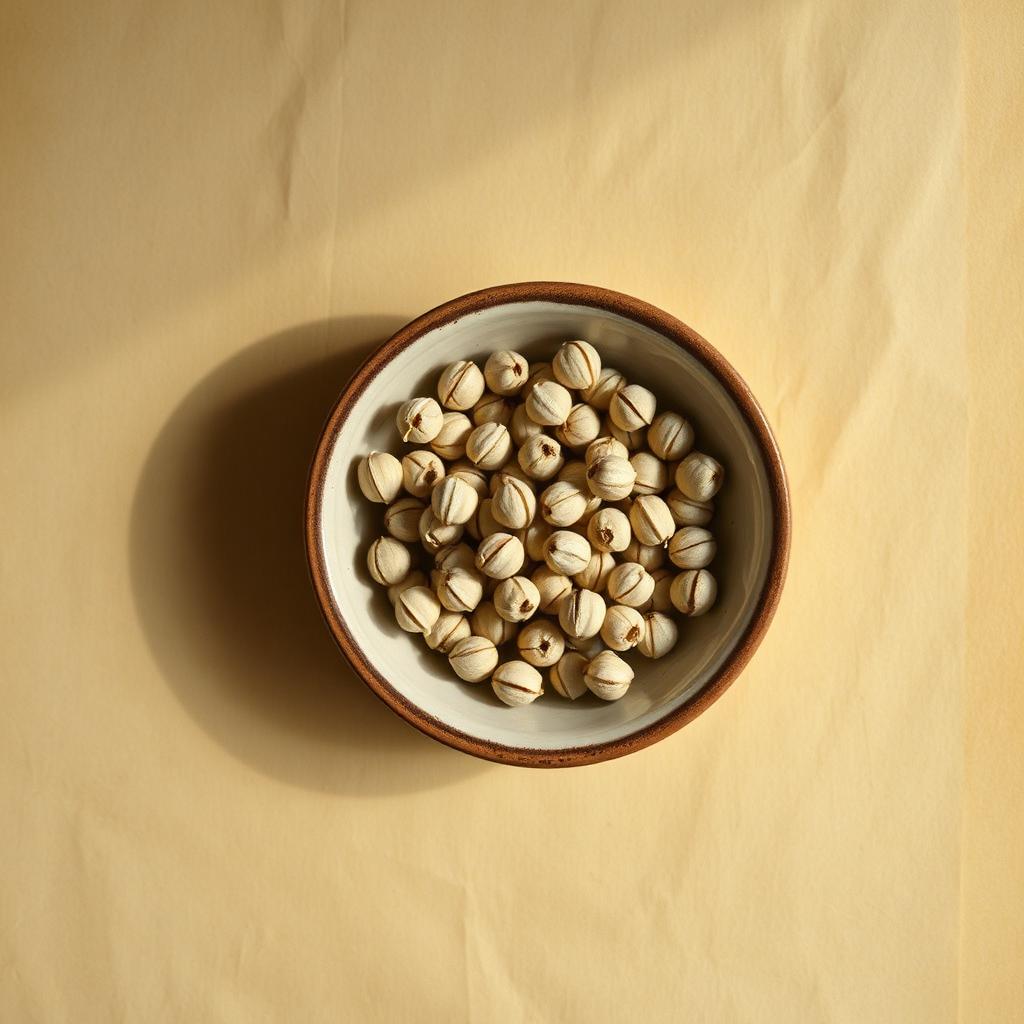
Uniquely Persian: golpar belongs to Iranian cooking the way sumac belongs to the kebab. Tames the 'cold' nature of beans, pomegranate, and cucumber — Persian medicine in a pinch.
Use small amounts. The flavor is concentrated and dominates quickly.
Buy whole seeds when possible and grind fresh — pre-ground golpar fades within months.
What Else to Know
Golpar — Persian hogweed — is a distinctly Persian spice ground from the dried seeds of Heracleum persicum. Sprinkle a little over snacks and stews and you'll notice its warm, slightly piney aroma. Traditionally, it's also used to ease digestion.
Aids digestion of beans and heavy foods. Aromatic antioxidant compounds. Warming spice for cold constitutions.
Chapter 2 of 15
The Plant Itself
A tall perennial 1–2 m high native to the mountains of northern Iran, with large divided leaves and broad white umbel flowers. The ribbed, flat, oval fruits (3–8 mm) are dried and ground to a fine fragrant powder — uniquely Persian and not found in most other cuisines.
Family: Apiaceae (carrot/parsley family).
Chapter 3 of 15
What It Holds and What Studies Show
Antioxidants: Coumarins, Flavonoids (a family of protective plant compounds) · Notable: Volatile aromatic oils
From laboratory work, not from people taking it
Heracleum persicum extracts show antioxidant and antimicrobial (slows the growth of germs) activity in laboratory testing. Rated: early research.
Chapter 4 of 15
What Studies in People Show
What studies in people show
Furanocoumarins (a compound found in grapefruit that blocks that enzyme) in Heracleum species cause phototoxic skin reactions on contact with the fresh plant.Moderate evidence
Chapter 5 of 15
How It Is Prepared
Steamed fava beans (bāqalā): sprinkle generously with golpar and salt · Pomegranate seeds: dust with golpar to balance their cooling nature.
Lentil and bean stews: pinch added at the end of cooking · Pickle (torshi): small amounts in eggplant and vegetable pickles.
Chapter 6 of 15
Medicines and Interactions
Medication interaction:
Blood thinners — Golpar belongs to a plant family rich in coumarin compounds, which in quantity can affect clotting. Cooking amounts are small, but supplements aren't. (low concern)
Allergy:
Photosensitising medicine — Related Heracleum species contain furanocoumarins (a compound found in grapefruit that blocks that enzyme) that make skin burn more easily in sun. This matters for handling the fresh plant, not for the spice on your plate. (moderate concern)
Chapter 7 of 15
Who Should Be Careful
General caution:
Photosensitivity: large amounts on skin can cause sun sensitivity.
General caution:
Use culinary amounts only.
General caution:
Photosensitivity — avoid heavy topical (put on the skin) use before sun exposure (coumarin content).
Pregnancy and breastfeeding:
Pregnancy — culinary use is fine; skip concentrated extracts.
Allergy:
Apiaceae allergy — cross-reactive with celery, fennel, anise.
Chapter 8 of 15
Pregnancy, Children and Older Adults
Pregnancy and breastfeeding
Pregnancy and breastfeeding:
The pinch used in cooking is ordinary Persian food. Concentrated golpar extracts and the fresh plant sap are a different matter and should be avoided.
Children
Children:
Fine as a seasoning from the age children eat family food. Start with less than you would use for yourself; the flavour is strong.
Older adults
Older adults:
Often the reason older Persians can eat beans and dairy comfortably. It is also a way to season food without reaching for the salt.
Chapter 9 of 15
What Persian Medicine Says
Persian temperament: Hot & Dry (2nd degree). Persian practice reads golpar as warming and drying, which is exactly why it's scattered on cold, damp foods like yogurt and beans.
Persian medicine sees golpar as warm and dry. It's used to balance the cold, heavy nature of beans and pomegranate, ease cold joints, and wake up digestion.
Heaviness and gas from beans, fava, and lentils.
In the Household
Cold, stiff joints — especially in winter.
It was used: sluggish appetite and weak digestion. Persian tradition: balancing the 'cold' nature of pomegranate seeds.
Traditional support for cold joints and muscles.
You'll find golpar dusted over steamed fava beans, pomegranate seeds, and saffron rice. It's a small touch, but an irreplaceable one.
Chapter 10 of 15
Traditional Formulas
Bāqalā pokhteh + golpar: boiled broad beans dressed with golpar, salt, and vinegar, which is the iconic Persian autumn street snack.
Anār + golpar: pomegranate seeds dusted with golpar to balance their cool, contracting nature for sensitive digestions.
Torshi-ye bādenjān bā golpar: eggplant pickle seeded with golpar for warmth, aroma, and digestive benefit.
Chapter 11 of 15
What It Goes With
Dairy:
Yogurt
A pinch on plain yogurt is the everyday Persian use. And the point is digestion as much as taste.
Pairing:
Beans
Sprinkled over steamed broad beans with salt. Sold from carts this way all spring.
Fruit:
Pomegranate
Golpar and salt on pomegranate seeds sounds odd until you try it. Then it's obvious.
Pairing:
Lentils
A small spoon into a lentil pot near the end. Traditional cooks say it stops the wind that legumes cause.
Chapter 12 of 15
Through the Year
Spring:
Spring
On broad beans. The pairing of steamed baghali and golpar is a spring street food.
Summer:
Summer
On yogurt drinks and cucumber salads, where it warms an otherwise cold plate.
Autumn:
Autumn
Into pickle jars. Golpar is standard in Persian torshi and helps the jar keep.
Winter:
Winter
On bean and lentil pots, for the same reason cooks add bay elsewhere.
Chapter 13 of 15
Questions People Ask
What plant is golpar from?
Golpar comes from the dried seeds of Heracleum persicum — Persian hogweed — native to the mountains of northern Iran. It's distinct from related Heracleum species elsewhere, some of which are skin-irritating.
What does golpar taste like?
Warm, slightly piney, citrusy, with a soft bitter edge. A little goes a long way — small pinches.
Is golpar safe daily?
Yes in culinary pinches. Avoid large amounts on skin in sunlight (the coumarins can cause photosensitivity), and skip medicinal extracts in pregnancy.
Chapter 14 of 15
Sources
Sad Giah Hezar Darman (صد گیاه و هزار درمان) — One Hundred Plants and One Thousand Remedies — Dr. Hossein Erfani, 4th edition (1375 / 1996–1997). Primary traditional Persian herbal reference cited throughout this platform. Presented as traditional knowledge, not as modern medical proof.
Office of Dietary Supplements: fact Sheets — US National Institutes of Health (NIH). https://ods.od.nih.gov/factsheets/list-all/.
Herbal Database: memorial Sloan Kettering Cancer Center. https://www.mskcc.org/cancer-care/diagnosis-treatment/symptom-management/integrative-medicine/herbs.
Herbs at a Glance: uS NIH National Center for Complementary and Integrative Health (NCCIH). https://www.nccih.nih.gov/health/herbsataglance.
FoodData Central: searchable nutrient database — US Department of Agriculture (USDA). https://fdc.nal.usda.gov/.
Chapter 15 of 15
Sources (continued)
The Nutrition Source: harvard T.H. Chan School of Public Health. https://www.hsph.harvard.edu/nutritionsource/.
PubMed — peer-reviewed biomedical literature — US National Library of Medicine. https://pubmed.ncbi.nlm.nih.gov/