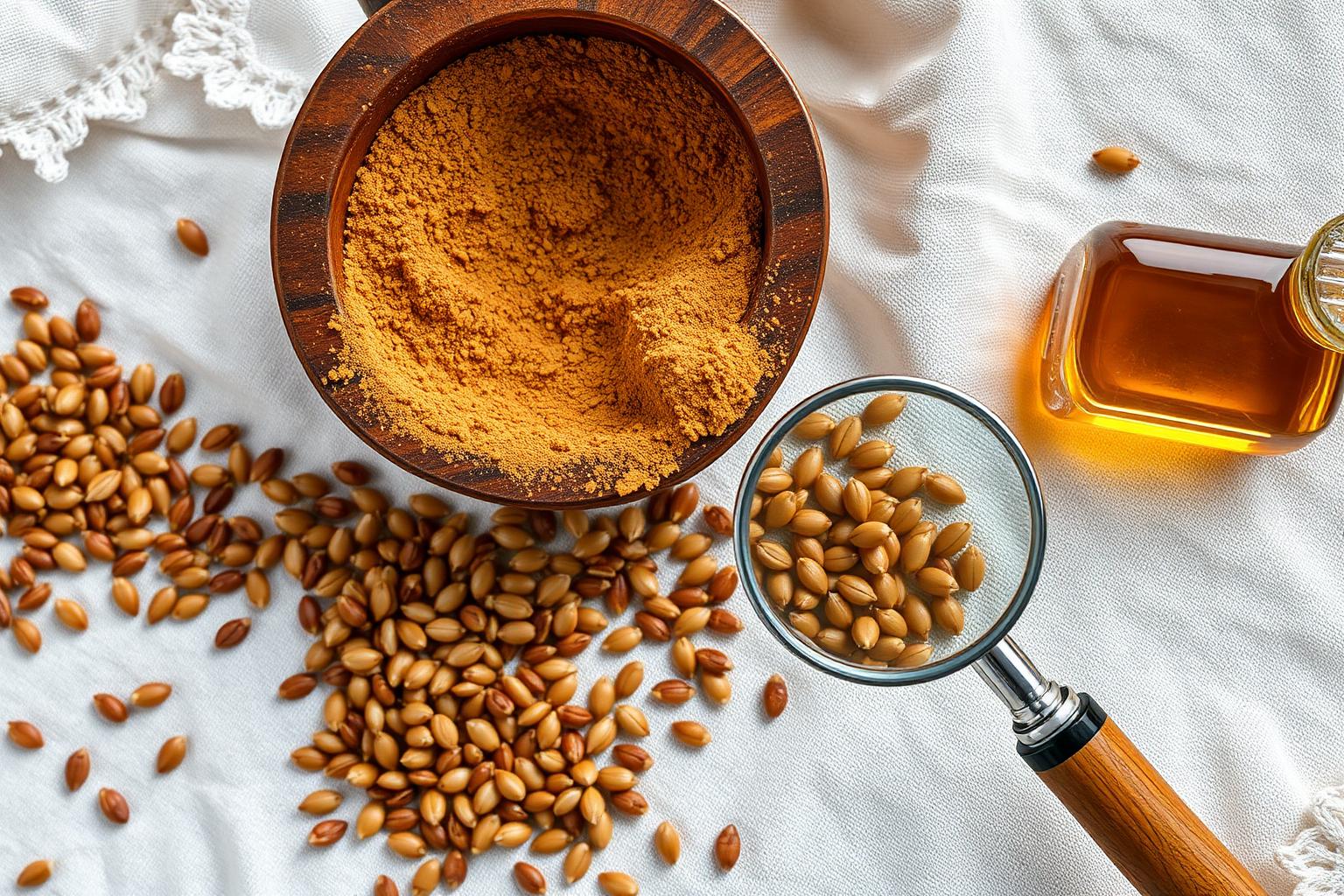
Bazrak is Persia's classical warming-and-moistening seed — grind it fresh, or it passes straight through.
The single richest dietary source of lignans (SDG). Gut bacteria convert them into weak phytoestrogens (plant compounds that act a little like the hormone oestrogen) with modest hormonal effects.
Meta-analyses (a study that pools the results of many trials) show consistent modest reductions in LDL (the harmful type of cholesterol) cholesterol (the kind of cholesterol that can build up in artery walls), systolic blood pressure (the top blood-pressure number — the pressure while the heart beats), and fasting glucose at ~30 g/day ground.
Grind fresh, refrigerate, and drink water alongside — three rules that make flax work and keep it safe.
Chapter 2 of 20
Flaxseed: What It Is and Which Part Is Used
People have grown flax (Linum usitatissimum) for at least 30,000 years, using its stem for linen fibre and its lens-shaped seed for food. Persian households know the seed as bazrak or tokhm-e katan. It goes into warm milk with honey as a lubricating winter tonic, is ground fresh into porridge, and is made into a soothing poultice (a soft paste held against the skin). Ground flaxseed is the richest dietary source of plant lignans (secoisolariciresinol diglucoside, SDG) — polyphenols (natural plant compounds studied for antioxidant activity) that gut microbes turn into enterodiol and enterolactone. It also brings viscous soluble fibre (mucilage) and the essential omega-3 alpha-linolenic acid (ALA). Good clinical trials test this trio of lignans, mucilage, and ALA together.
Chapter 3 of 20
Why Herbalists Still Reach for It
If you want one daily habit for your heart, hormones, and bowels, freshly ground flaxseed is hard to overlook. A spoonful gives you the strongest lignan (fibre-linked plant compounds found in seeds) story of any food on the shelf in one of the smallest, most-studied habits in the seed drawer.
Flaxseed brings together three quiet parts of healthy aging — lipids, blood pressure, and bowel comfort — along with a lignan (fibre-linked plant compounds found in seeds) story no other food matches. One freshly ground spoon a day, taken with water, is a low-cost habit backed by more study than most foods in the seed drawer.
Chapter 4 of 20
Why Herbalists Still Reach for It: What That Means Day to Day
Lignans (SDG) modestly support hormone balance — particularly hot-flash frequency and menstrual regularity.
Soluble fibre lowers LDL (the harmful type of cholesterol) cholesterol and total cholesterol in pooled RCTs (studies where people are randomly assigned to different groups).
Meta-analyses show small reductions in systolic and diastolic blood pressure (the top and bottom blood-pressure numbers) at ~30 g/day ground.
ALA contributes to a healthier omega-6:omega-3 ratio in the diet.
Mucilage (a soft, slippery plant gel) supports regularity, softens stool, and soothes reflux (stomach acid rising into the throat).
Improves fasting glucose and HbA1c (a blood test showing average blood sugar over about three months) in small trials in prediabetes and type-2 diabetes.
Chapter 5 of 20
What Is In It
Primary compounds
Secoisolariciresinol diglucoside (SDG) is the flagship lignan (~85–370 mg/100 g seed), converted by colonic bacteria into enterolactone and enterodiol.
Alpha-linolenic acid (ALA, ω-3) — 45–55% of seed lipid. The highest ALA density of any common food.
Soluble fibre (mucilage): arabinoxylans and rhamnogalacturonans that swell in water into a viscous gel.
Other Constituents
Cyanogenic glycosides (linustatin, neolinustatin) — low doses. Hydrolysed with grinding and heat, clinically relevant only above ~50 g raw per day.
Cadmium: flax accumulates it from soil. A real consideration only at concentrated therapeutic doses over years.
Vitamins
Thiamin (B1), Folate, Vitamin B6
Chapter 6 of 20
What Is In It
Other notable constituents
Minerals: Magnesium, Phosphorus, Copper, Manganese, Selenium · Antioxidants: Phenolic acids · Healthy Fats: Omega-3 ALA (~2.4 g per 2 Tbsp)
Protein: ~5 g per 2 Tbsp
Notable: Highest lignan (fibre-linked plant compounds found in seeds) density of any often eaten food, Whole seeds pass largely undigested — always grind
Chapter 7 of 20
What Studies in People Show
Moderate evidence
Ground flaxseed at ~30 g/day for ≥12 weeks modestly reduces systolic and diastolic blood pressure in pooled RCTs.Moderate evidence
Flaxseed supplementation lowers total and LDL (the harmful type of cholesterol) cholesterol in adults, with the strongest effect from whole-seed rather than oil-only preparations.Moderate evidence
Ground flaxseed reduces fasting glucose, insulin, and HOMA-IR in adults with metabolic syndrome (a cluster of findings — waist size, blood pressure, blood sugar and blood fats — that together raise heart risk) and type-2 diabetes across pooled RCTs.Moderate evidence
Early research
Flaxseed lignan (SDG) supplementation reduces the frequency and severity of postmenopausal hot flashes in placebo-controlled (compared against a dummy treatment) trials (a placebo is a look-alike treatment with no active ingredient), though effect sizes vary widely.Emerging evidence
Whole flaxseed intake is linked to lower heart and blood vessel risk in cohort follow-up when consumed as part of a whole-food plant-forward pattern.Emerging evidence
Chapter 8 of 20
How It Is Prepared
Grind whole seeds fresh in a small spice grinder — 20 seconds is enough.
Refrigerate ground flax in an airtight jar for up to a week. Freeze for longer.
For a soothing tea: simmer 1 tsp whole seeds in 1 cup water for 5 minutes, strain, sweeten.
Other Ways to Use It
For a poultice (a soft paste held against the skin): mix 3 Tbsp ground flax with hot water to form a thick paste. Wrap in linen and apply warm.
Cold-pressed flaxseed oil goes on finished dishes only — never heat it. Refrigerate and use within a month of opening.
Grind 1–2 Tbsp fresh daily in a spice grinder. Refrigerate what you don't use within 24–48 hours.
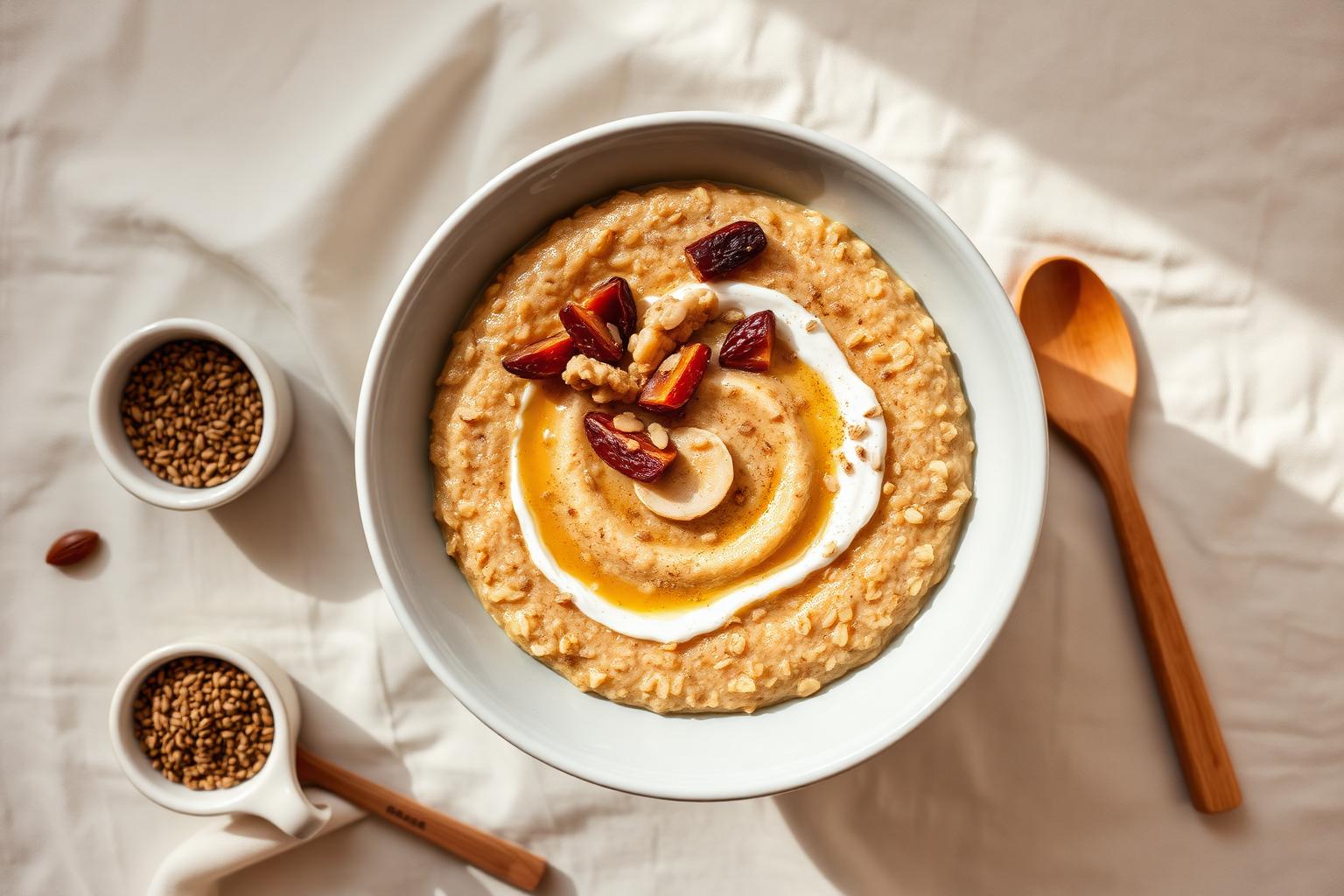
Stir into oatmeal, yogurt, or a smoothie with dates and cinnamon.
As a vegan egg replacer: 1 Tbsp ground seed + 3 Tbsp warm water, rest 5 minutes until gelled.
Chapter 9 of 20
How It Is Prepared: Further Preparations
Traditional Persian evening tonic: 1 tsp ground seed simmered 3 minutes in warm milk with honey and a pinch of cinnamon.
Drink a glass of water with every dose — mucilage (a soft, slippery plant gel) needs water to work.
Chapter 10 of 20
Medicines and Interactions
Medication interaction:
Warfarin (a blood-thinning medicine), DOACs (apixaban, rivaroxaban, edoxaban, dabigatran) — ALA and lignans (fibre-linked plant compounds found in seeds) have mild antiplatelet (medicines that stop blood cells sticking together, such as aspirin) activity — culinary 1–2 Tbsp/day isn't clinically important, but concentrated flaxseed-oil supplementation on anticoagulants (blood-thinning medicines) can add to bleeding risk. Discontinue supplements 1–2 weeks before elective surgery. (low concern)
Medication interaction:
Antihypertensives (ACE inhibitors, ARBs, calcium-channel blockers, diuretics) — Meta-analyses show ~30 g/day ground flaxseed modestly lowers systolic and diastolic blood pressure. Additive effects with antihypertensive therapy are usually welcome; monitor readings when starting. (low concern)
More Interactions to Know
Medication interaction:
Oral medications generally (levothyroxine, oral contraceptives, tetracyclines) — Mucilage (a soft, slippery plant gel) can bind and delay absorption of many oral medications. Space flax doses at least 1–2 hours from prescription medications, especially levothyroxine. (moderate concern)
Medication interaction:
Antidiabetics (insulin, sulfonylureas, metformin) — Small trials show flaxseed gently lowers fasting glucose and HbA1c. Additive glycemic effects at culinary doses are gentle; monitor if starting a concentrated lignan (SDG) supplement. (low concern)
Medication interaction:
Tamoxifen and other selective estrogen-receptor modulators — Flaxseed lignans (fibre-linked plant compounds found in seeds) have weak phytoestrogenic activity. Culinary intake appears compatible in most studies and may complement tamoxifen, but concentrated SDG supplements should be discussed with an oncology team. (moderate concern)
Chapter 11 of 20
Who Should Be Careful
General caution:
Always grind whole seeds — intact flax passes through undigested and delivers little benefit.
Medication interaction:
Drink water with every dose — mucilage without water can bloat or, rarely, cause bowel obstruction.
General caution:
Introduce gradually (start at 1 tsp) and build to 1–2 Tbsp over a week to let the gut adjust.
The Rest of It
General caution:
Refrigerate ground flax and flaxseed oil; both oxidise quickly and become rancid within days at room temperature.
General caution:
Do not heat flaxseed oil — the omega-3 ALA is heat-sensitive; reserve oil for finishing only.
General caution:
Active bowel obstruction, stricture, or severe gastroparesis — the swelling mucilage (a soft, slippery plant gel) can worsen the blockage.
Allergy:
Known IgE-mediated flaxseed allergy (rare but documented) — avoid seed, oil, and cross-reactive linseed products.
Chapter 12 of 20
Pregnancy, Children and Older Adults
Pregnancy and breastfeeding
Pregnancy and breastfeeding:
Ground flaxseed in ordinary culinary amounts (up to ~1 Tbsp/day) is generally regarded as safe during pregnancy and breastfeeding, though the evidence is thinner than for sesame — some early animal data raised hormonal-effect signals that have not been reproduced in humans at food-level intakes. Concentrated flaxseed-oil or SDG lignan (fibre-linked plant compounds found in seeds) supplements aren't recommended during pregnancy or lactation because their weak phytoestrogen activity isn't well-studied in this window. As always, discuss with the pregnancy provider before daily use.
Chapter 13 of 20
Pregnancy, Children and Older Adults: Other Groups to Consider
Children
Children:
Small culinary sprinklings of ground flaxseed (¼–1 tsp) stirred into porridge or yogurt are appropriate from ~9–12 months. Full 1-Tbsp doses are for older children and adults. Always paired with plenty of water. Do not offer flax to a child with a history of severe seed allergies until cleared by their clinician.
Older adults
Older adults:
Ground flaxseed is a quiet longevity food for older adults — it addresses three of the older kitchen's most persistent complaints at once: rising LDL (the harmful type of cholesterol), rising blood pressure, and a slower bowel. A daily 1–2 Tbsp of freshly ground flax stirred into warm oatmeal, kefir, or the Persian sharbat-e-bazrak nightcap is the classical form. Watch mucilage-mediated delay of levothyroxine, warfarin (a blood-thinning medicine), and other narrow-window medications — space them by at least 1–2 hours from the flax dose.
Chapter 14 of 20
What Persian Medicine Says
Persian temperament: Warm & Moist (1st degree seed — mucilage, oil neutral–moist). Persian medicine considers bazrak warming and softening — mulayyin (a gentle laxative), muqarrih (a demulcent for cough and sore throat), and mudirr al-hayd (an emmenagogue supporting menstrual regularity). Warming enough for winter kitchens and older adults. Moistening enough to belong in gut-soothing formulas.
Persian medicine describes bazrak as warm and moist in the first degree, and uses it for a dry, tight body — a stiff bowel, a dry raspy cough, or a tight winter chest. When an older person's bowels had grown dry, families would briefly simmer a spoonful of ground seed in water and sweeten it with honey to soften and soothe from within.
In the Household
They also worked the seed into a warm poultice (a soft paste held against the skin) for bruises, boils, and a sore, congested breast, believing its moistening nature drew out heat and swelling. Stirred into warm milk before bed, it became a gentle nightly habit for a dry cough or sluggish digestion.
Bazrak decoction (a drink made by simmering the plant in water) with honey for winter cough and dry throat (Persian household remedy).
Chapter 15 of 20
What Persian Medicine Says: Older Uses
Ground bazrak stirred into ash-e-jow (Persian barley soup) for a moistening winter grain.
NIH NCCIH clinical summary: ground flaxseed is likely safe and modestly effective for constipation and lipid modulation. Flaxseed oil offers ALA without the lignans (fibre-linked plant compounds found in seeds) or fibre. Rated: traditional observation.
Chapter 16 of 20
Traditional Formulas
Rowghan-e Bazrak (Persian flaxseed poultice oil) — Ground flax simmered with sesame oil into a warm compress. Traditional attari topical (put on the skin) for bruises, sore joints, and mastitis.
Ma'joon-e Mulayyin: persian gentle-laxative electuary combining bazrak, damask rose, and honey for chronic constipation of the elderly.
Chapter 17 of 20
In Persian Life
For over five thousand years across Persia, the Fertile Crescent, Egypt, and India, flax has clothed people as linen and fed them as ālsi / bazrak. Ancient Egyptian mummies were wrapped in linen, while oil pressed from the same seed lit lamps and helped paint Persian miniatures. In modern Iran, you'll still find tokhm-e katan on the winter attari shelf, sold whole or ground and often paired with sesame and nigella as a trio of warming seeds.
Chapter 18 of 20
Questions People Ask
Should I use flaxseed or flax oil?
Different tools. Ground seed carries the lignans (SDG), the mucilage (a soft, slippery plant gel), AND the ALA — most trials that show benefit for blood pressure, LDL (the harmful type of cholesterol), and glycemic markers used the whole ground seed. Flaxseed oil carries the ALA alone, useful for finishing salads but not a substitute for the seed.
How long before I notice a change?
Bowel comfort often shifts within a week. LDL (the harmful type of cholesterol) and blood pressure trials usually report meaningful change after 8–12 weeks of ~30 g/day ground flaxseed. Lignan (menopausal) effects are the slowest — give it a full 3 months.
Is flaxseed safe with my thyroid medicine?
Culinary flax is compatible, but the mucilage can bind levothyroxine and delay absorption. Space your morning flax at least 1–2 hours from your thyroid tablet.
Chapter 19 of 20
Sources
Flaxseed and Flaxseed Oil: clinical summary — US NIH National Center for Complementary and Integrative Health. https://www.nccih.nih.gov/health/flaxseed-and-flaxseed-oil.