Favism is real and non-negotiable — anyone with G6PD deficiency must avoid fava bean (and pollen) for life. Acute haemolysis can be severe.
For the majority who tolerate it, fava is one of the most nutrient-dense spring legumes — plant protein, folate, fibre, iron, and L-dopa in a single cup.
Persian tradition balances the cool-and-moist bāqalā with warming aromatics — dill, golpar, saffron — the classical mizaj correction.
Cook thoroughly and shell twice for the smoothest digestion. Raw fava isn't a food.
Chapter 2 of 17
Getting to Know Fava Bean
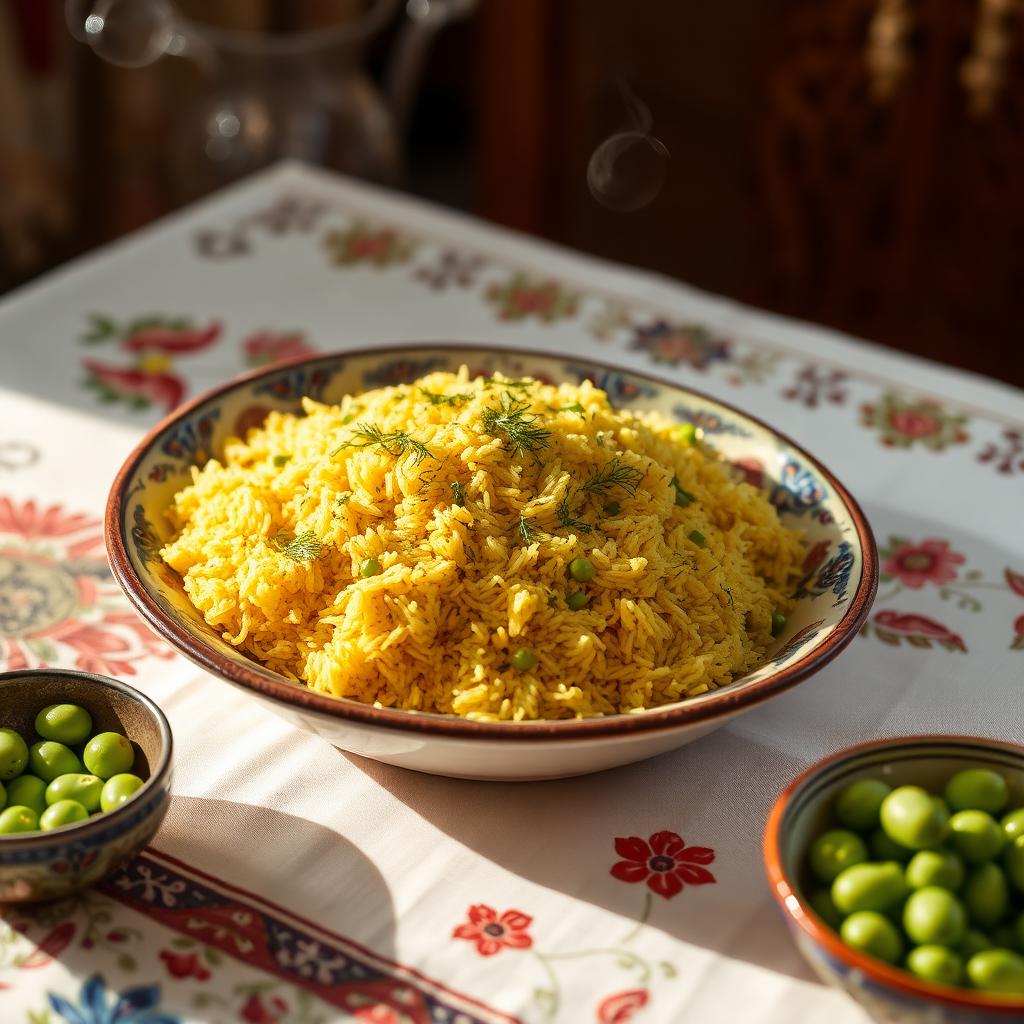
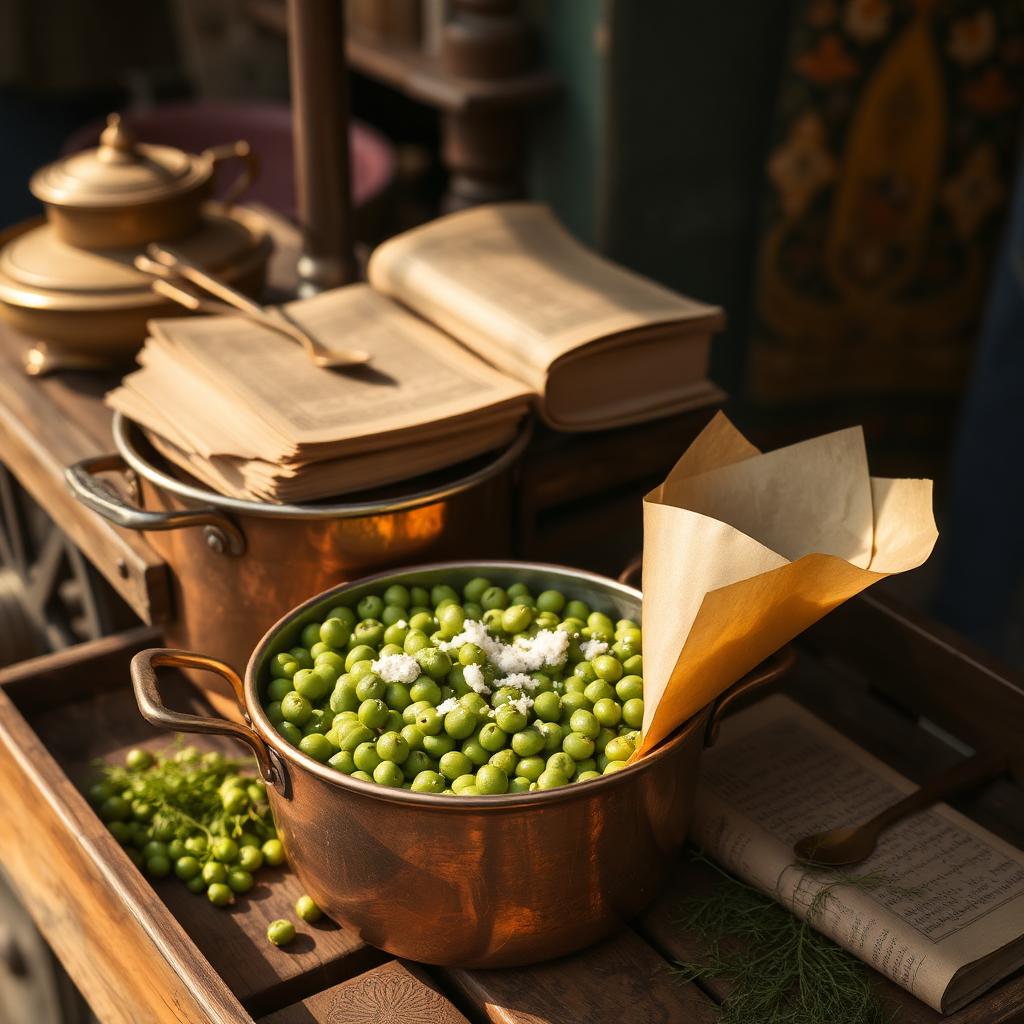
Fava bean (Vicia faba) is one of the oldest legumes people have grown, reaching back to Neolithic Fertile Crescent villages by ~8500 BCE before spreading across the Mediterranean, Persia, North Africa, and later the Andes. In Iran, fresh spring bāqalā stars in two much-loved foods: baghali polo (dill-and-fava saffron rice) and the steamed favas sold from Nowruz street stalls with salt and golpar (Persian hogweed) in paper cones.
A Little More Background
One cup of cooked fresh favas gives you roughly 13 g of plant protein, 9 g of fibre, 177 µg of folate (~45% RDA), plus meaningful iron, magnesium, and potassium at only ~190 kcal. But fava comes with one firm safety rule that sets it apart from every other legume: favism.
This is an acute haemolytic reaction in people with G6PD (glucose-6-phosphate dehydrogenase) enzyme deficiency, a hereditary trait carried by an estimated 400 million people worldwide and found more often in Mediterranean, Middle Eastern, and African populations. Anyone known to have G6PD deficiency must avoid fava bean (and even the pollen) for life.
Chapter 3 of 17
Why It Matters
For most families, spring fava brings plenty of plant protein and folate to the seasonal table. Its classical Persian pairing with dill, golpar, and saffron works both for flavor and as a mizaj correction. For the ~5% of Iranians (higher in some regional groups) with G6PD deficiency, though, this same food must be avoided for life. Every parent, grandparent, and cook should know that risk by name, so the safety chapter in this guide is essential reading.
What That Means Day to Day
One of the densest plant sources of folate (~45% RDA per cup) — supports red-cell formation and neural-tube development.
High-quality plant protein (~13 g per cup) for muscle and satiety (the feeling of being full).
Fibre supports gut motility, glycaemic control, and satiety.
Investigational L-dopa content studied as a small dietary adjunct in Parkinson's (specialist supervision only).
Chapter 4 of 17
What It Contains
Primary compounds
Plant protein (~13 g per cup cooked; ~26 g per 100 g dry) — high-quality legume protein with a full amino acid profile when paired with grain.
Folate (~177 µg per cup, ~45% RDA) — the flagship nutrient of spring fava. Essential for red-cell formation and neural-tube development.
L-dopa (levodopa, ~0.5–1 g per 100 g fresh green pod, less in the mature bean) — a natural precursor to dopamine studied as a small adjunct in Parkinson's disease.
Other Constituents
Vicine and convicine is the pyrimidine glycosides responsible for favism in G6PD-deficient people. Not detoxified by cooking.
Iron (~2.5 mg per cup), magnesium (~73 mg), potassium (~456 mg), copper, thiamin (B1), vitamin K.
Other notable constituents
Minerals: Manganese, Phosphorus · Antioxidants: Polyphenols (protective plant compounds), Flavonoids (a family of protective plant compounds) · Healthy Fats: Very low fat
Chapter 5 of 17
In the Laboratory
From laboratory work, not from people taking it
Vicine and convicine in Vicia faba trigger acute haemolytic anaemia (favism) in G6PD-deficient people — a mechanism established in the 1970s and consistent across large population studies. Rated: strong evidence.
Chapter 6 of 17
What Studies in People Show
Strong evidence
G6PD deficiency is one of the most common human enzyme deficiencies worldwide, with an estimated 400 million people affected and highest carrier rates across the Mediterranean, Middle East, Africa, and South Asia.Strong evidence
Fava bean is a dense source of folate, providing about 45% of the RDA per cup cooked, supporting periconceptional folate status.Strong evidence
Early research
Fava bean pod contains meaningful L-dopa (levodopa) and has been studied as a small dietary adjunct in Parkinson's disease under specialist supervision.Emerging evidence
Chapter 7 of 17
Preparation and Kitchen Use
Steam fresh shelled favas 5–10 min. Sprinkle with salt and golpar as a spring snack.
Shell fresh pods, then blanch and slip off the tough inner skin — a double-shell is worth the time.
Steam or simmer 5–10 minutes until tender. Never eat raw.
Cook into baghali polo with dill and saffron (the classical Persian mizaj-corrected dish).
In the kitchen: slow-simmer dried favas overnight for ful mudammas (Egyptian breakfast). Purée with olive oil, garlic, and lemon for a spring dip (Levantine style).
Add to spring khoresh (stews) with lamb shank and fresh herbs.
Chapter 8 of 17
Medicines and Interactions
Medication interaction:
Non-selective MAOI antidepressants (phenelzine, tranylcypromine, isocarboxazid) — The L-dopa in fava beans, combined with this type of antidepressant, can cause a sudden, dangerous rise in blood pressure — doctors call this a hypertensive crisis, and it needs emergency care. Avoid a fava-heavy meal on non-selective MAOI therapy. Selective MAO-B inhibitors (selegiline, rasagiline) at standard Parkinson's doses don't carry the same risk at culinary intake. (high concern)
Medication interaction:
Levodopa/carbidopa (Parkinson's therapy) — Fresh fava pod L-dopa is additive to prescribed levodopa. Small culinary intake is usually compatible; larger habitual fresh-pod use can complicate dose titration and belongs under the treating neurologist's guidance. (moderate concern)
More Interactions to Know
Medication interaction:
Warfarin (a blood-thinning medicine), DOACs — Vitamin K in cooked fava is meaningful but stable at a consistent weekly serving pattern. Big swings in fava intake can shift INR — the answer is consistency, not avoidance. (moderate concern)
Medication interaction:
Antidiabetics (insulin, sulfonylureas, metformin) — Fibre and protein blunt post-prandial glucose gently. Additive effects at culinary doses are mild and generally welcome; monitor if fava becomes a daily staple. (low concern)
Chapter 9 of 17
Who Should Be Careful
Children:
Ful mudammas and other whole-bean dishes are a choking hazard for young children — mash for toddlers.
Allergy:
G6PD deficiency (favism) — strict lifelong avoidance; even fava pollen can trigger haemolysis in sensitive people.
General caution:
Never eat raw — vicine, convicine, and lectins are minimised (though not eliminated) by cooking.
Allergy:
Confirmed G6PD deficiency — absolute lifelong contraindication for the bean, the pod, and the flowering-plant pollen.
Allergy:
Confirmed IgE fava allergy (less common than favism but documented).
Chapter 10 of 17
Pregnancy, Children and Older Adults
General
Children:
Introduce children to fava only after G6PD status is known if there's any family history of favism.
Children:
Family history of favism in an untested child — establish G6PD status before first introduction.
Pregnancy and breastfeeding
Pregnancy and breastfeeding:
Cooked fava bean is one of the most useful spring foods in pregnancy — dense folate (a critical periconceptional and first-trimester nutrient), plant protein, iron, and fibre in a single seasonal dish. The one absolute stop is confirmed maternal G6PD deficiency, in which fava avoidance is lifelong. If the mother's G6PD status is unknown and there's any personal or family history of favism, testing is quick and worthwhile before spring fava season. Cook thoroughly; skip raw or under-cooked fava.
Children
Children:
Cooked, mashed, or well-shelled fresh fava can be introduced from around 9–12 months once solids are established — but only after G6PD status is known if there's any family history of favism. Whole beans are a choking hazard under age 4. In Mediterranean, Middle Eastern, African, and South-East Asian families where G6PD carrier rates are higher, paediatric screening before first fava introduction is the safer pattern.
Chapter 11 of 17
Pregnancy, Children and Older Adults: A Few More Points
Older adults
Older adults:
A quietly useful spring food for older adults — dense plant protein for muscle preservation, folate for red-cell formation, and fibre for the slower older bowel. The classical baghali polo with dill and saffron is a mizaj-corrected dish that suits cold-and-dry older constitutions especially well. Watch the vitamin K–warfarin (a blood-thinning medicine) interaction with a sudden large seasonal increase, and check G6PD status on the medical record if it isn't clearly documented.
Chapter 12 of 17
Traditional Persian Perspective
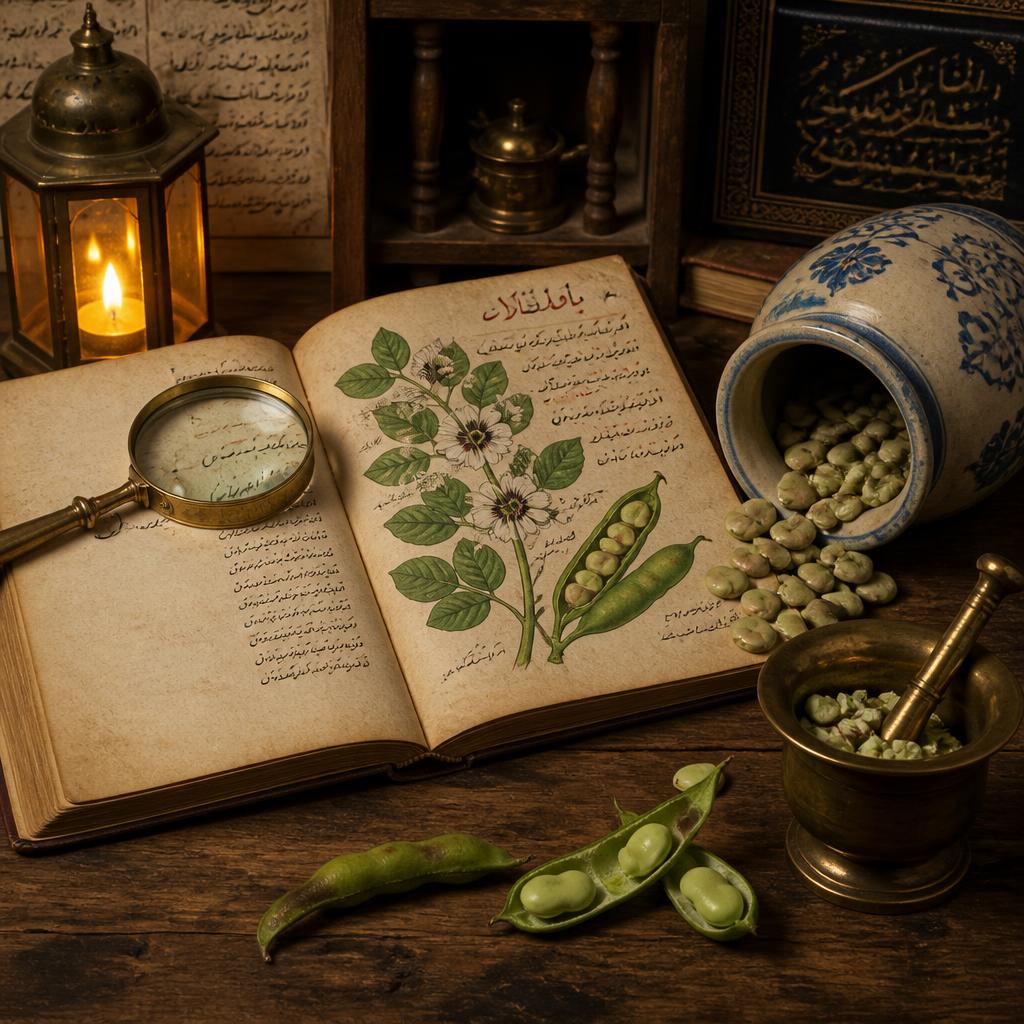
Persian temperament: Cool & Moist (Cold 1st, Moist 1st degree — fresh. Dry when aged). Classical Persian medicine (Aghili Khorasani, Makhzan al-Adwiya) reads bāqalā as cold and moist in the first degree — mughaddhī (nourishing), munaffikh (windy on cold digestions), and specifically needing warming correctors.
The household solution is the classical trio of shevid (dill), golpar (Persian hogweed / Heracleum persicum seed), and za'farān (saffron) — each of which is warming and carminative (traditionally used to settle gas and bloating), precisely balancing the beans' coldness and their tendency to produce gas. This is the reading behind baghali polo — the recipe is a mizaj-corrective architecture.
Aghili Khorasani describes bāqalā as cold-moist 1st degree, mughaddhī (building) and nourishing for the body, but munaffikh (wind-producing) for cold digestions. That's why it's best cooked with warming carminative (traditionally used to settle gas and bloating) aromatics. Ibn Sīnā also describes fava in Al-Qānūn as a nutritious legume that needs shevid (dill) and namak (salt) to balance its qualities.
Chapter 13 of 17
Traditional Persian Perspective: In the Household
The Persian kitchen follows this advice almost word for word: baghali polo isn't simply fava rice, but fava rice with dill and saffron, exactly the combination the classical texts recommend.
It was used: spring nourishing food for building the body after winter — Persian and Levantine seasonal tradition. Street snack of steamed favas with golpar and salt — the iconic Tehran spring cone. Ful mudammas as slow-simmered protein breakfast across the Arab world.
Chapter 14 of 17
In Persian Life
Bāqalā is one of the first signs in Tehran markets that spring has arrived and the cold months are ending. Vendors sell steamed favas dusted with golpar and salt from copper pots in paper cones, making one of Persia's best-loved street snacks. Baghali polo ba mahiche (dill-and-fava saffron rice with lamb shank) is a celebration plate around Nowruz. Across the Levant, ful mudammas, made from mature fava slowly cooked with cumin, lemon, and olive oil, has fed Egyptian, Syrian, and Palestinian families at breakfast for a thousand years.
Chapter 15 of 17
Questions People Ask
Why are fava beans dangerous for some people?
People with the genetic G6PD enzyme deficiency can have a severe reaction (haemolytic anaemia) known as favism — vicine and convicine in the bean trigger red-cell breakdown that cooking doesn't neutralise. Testing is simple and widely available. When there's any family history, establish G6PD status before the first spring bowl.
Why do Persians always pair fava with dill and saffron?
It isn't just flavour: it's a centuries-old mizaj correction. Aghili Khorasani reads bāqalā as cold-moist 1st degree and munaffikh (wind-producing). Dill and saffron are warming carminatives that precisely balance those qualities. Baghali polo is a recipe written by classical Persian medicine.
Chapter 16 of 17
Questions People Ask: More Questions
Are fava beans safe in pregnancy?
Cooked fava is one of the densest folate sources on the spring table — dense in exactly the nutrient pregnancy needs most — provided G6PD deficiency has been ruled out. It's worth the quick test before the first bowl of the season.
Can fava beans help with Parkinson's?
Fresh fava pod contains meaningful L-dopa and has been studied as a small dietary adjunct under specialist supervision. It isn't a substitute for prescribed levodopa/carbidopa and can complicate dose titration if intake is unpredictable — never adjust Parkinson's therapy without the treating neurologist.
Chapter 17 of 17
Sources
Office of Dietary Supplements: nuts & Seeds — US National Institutes of Health (NIH). https://ods.od.nih.gov/factsheets/list-all/.
FoodData Central: uS Department of Agriculture. https://fdc.nal.usda.gov/.