Best evidence: taken early, it may shorten a cold by around half a day to a day.
Species and plant part matter: purpurea tops and angustifolia root are different medicines.
Timing beats dose. Start at the first symptom.
People with autoimmune conditions or on immune-suppressing medicine should avoid it.
Chapter 2 of 12
Getting to Know Echinacea
Echinacea is the herbal world's best-selling cold remedy, and one of its most debated. Here's the honest picture: reviews of many trials suggest it may slightly reduce how likely you're to catch a cold and may shorten one by roughly half a day to a day. It isn't a shield. The trials disagree so much because they used different species, plant parts and extract strengths, so they weren't really testing the same thing. Two simple rules follow. Take it at the first scratchy throat, not a week in. And buy a product that names the species and the part.
Known to botanists as Echinacea purpurea / Echinacea angustifolia.
Chapter 3 of 12
Why It Matters
A cold isn't dangerous for most people, but a shorter one can mean getting a day back at work, a decent night's sleep, or a week that doesn't fall apart. Echinacea offers modest help for a modest problem. That's the honest way to see it — a small effect when used early.
Colds can hit older adults harder and take longer to clear, and every extra day of illness can mean lost strength. Even a modest shortening may be worth something. But echinacea is exactly the kind of supplement you need to check against existing medicines first, because immune-modifying herbs and immune-modifying drugs don't sit well together.
May modestly reduce the chance of catching a cold (pooled results from many trials).
Chapter 4 of 12
The Plant Itself
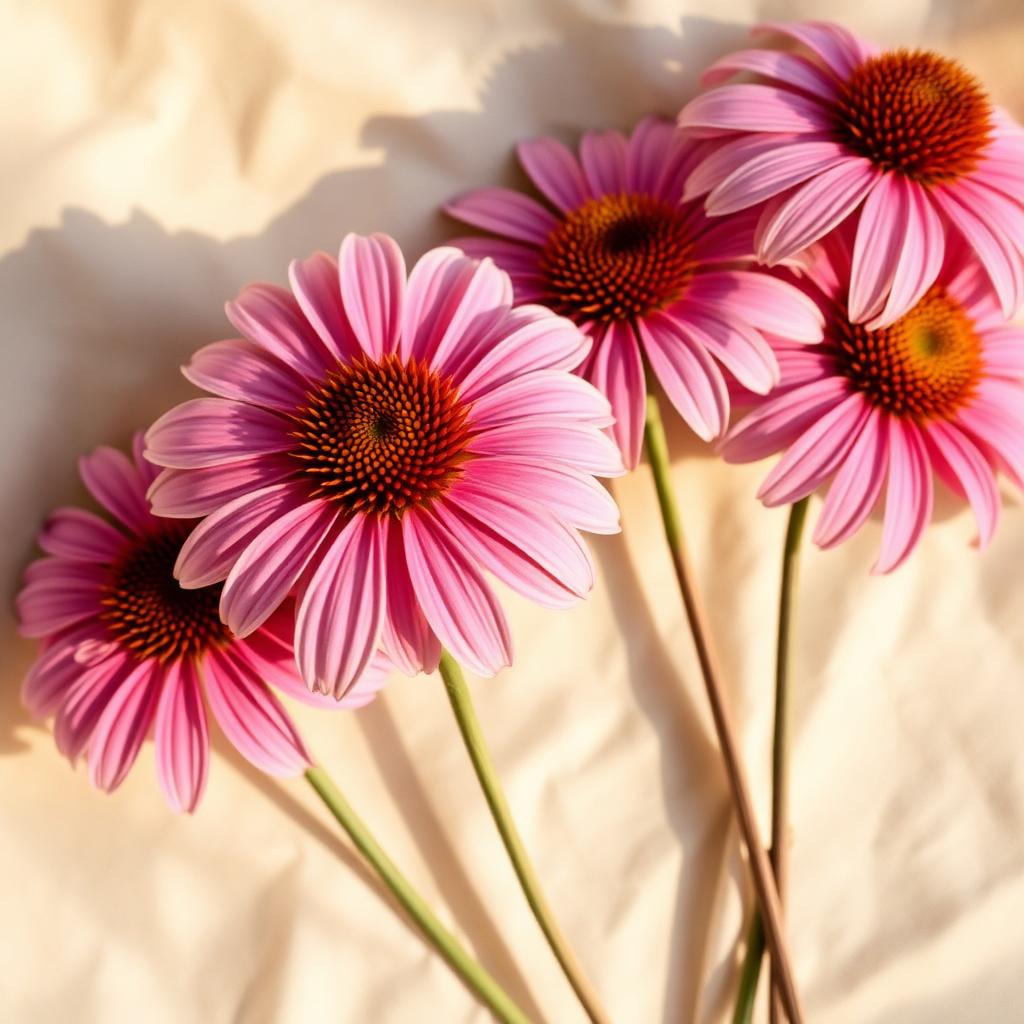
Echinacea is a prairie daisy with drooping purple petals around a raised, spiny orange centre. That bristly cone gives the plant its name, from the Greek word for hedgehog. Two species matter in medicine: Echinacea purpurea, where the flowering top is used, and Echinacea angustifolia, where the root is. They aren't interchangeable, and the difference explains a lot of the confusion in the research.
Family: Asteraceae (daisy family).
Chapter 5 of 12
What It Contains
Alkylamides are the compounds that make the tongue tingle. They interact with the body's immune-signalling system and are the main marker of a good tincture (a liquid extract made with alcohol).
Cichoric acid is an antioxidant marker compound, highest in Echinacea purpurea flowering tops.
Polysaccharides: large sugar molecules studied for their effect on immune cells.
Echinacoside is found mainly in the root of Echinacea angustifolia.
Chapter 6 of 12
What Studies in People Show
What studies in people show
Many trials exist, but products differ widely. A Cochrane review found only weak evidence that some products shorten colds, and prevention trials showed at most small effects.
A Cochrane review of 24 randomized trials (4,631 people) found the overall evidence that echinacea treats colds is weak. Prevention trials were not statistically significant, though most pointed toward a small effect.
Chapter 7 of 12
Preparation and Kitchen Use
Root decoction (a drink made by simmering the plant in water): angustifolia root simmered, the older American preparation.
Aerial-parts infusion (a drink made by steeping the plant in hot water): purpurea tops steeped as tea.
Tea: one to two teaspoons of dried herb steeped ten minutes, up to three cups a day during a cold.
Other Ways to Use It
In the kitchen: duration: short courses of one to two weeks, then a break. Start it within the first day of a scratchy throat.
Use it for a short run — one to two weeks.
Combine with rest, fluids and warmth. The herb is the smallest part of getting better.
Chapter 8 of 12
Extracts, Capsules and Concentrates
Capsules and standardised extracts carry many times the amount you get from food, which is why the cautions below matter more here.
Fresh-plant tincture (a liquid extract made with alcohol) is the standard modern form, preserving the alkylamides.
Throat spray is diluted tincture (a liquid extract made with alcohol) used directly on a sore throat.
Tincture (a liquid extract made with alcohol): the alkylamide tingle on the tongue is a rough sign of a well-made product. Follow label dosing.
Capsules: use a product that states species, plant part and extract strength.
Take a tincture (a liquid extract made with alcohol) in water three times a day while symptoms last.
Chapter 9 of 12
Who Should Be Careful
General caution:
Check the label for species and plant part. A product that doesn't say isn't worth buying.
General caution:
Not for people on immune-suppressing treatment.
General caution:
Start early or don't bother.
General caution:
A fever that climbs, or a cough that lasts beyond ten days, needs a doctor.
General caution:
Avoid if you have an autoimmune condition such as lupus, rheumatoid arthritis or multiple sclerosis, unless your specialist agrees.
Allergy:
It is in the daisy family — people allergic to ragweed, chamomile or marigold may react.
General caution:
Not recommended for continuous long-term use.
Medication interaction:
Avoid if you take immune-suppressing medicine, including after a transplant.
Chapter 10 of 12
Traditional Persian Perspective
Echinacea is a North American plant, so you won't find it in classical Persian medicine. Its tradition belongs to the Plains peoples — the Lakota, Cheyenne and others — who used the root for snakebite, sore throats, toothache and infected wounds. Iranian herbal practice adopted it in the twentieth century through European pharmacy. The Persian temperament language sometimes applied to it today is a modern addition.
In the Household
Infected or slow-healing wounds (external, historical use).
Echinacea entered mainstream Western medicine through nineteenth-century American practice. It faded when antibiotics arrived, then returned in the 1980s through German herbal medicine, which developed most of the standardised products used today. In Iran, it's now a pharmacy staple sold as sarkhargol drops during the cold season.
Chapter 11 of 12
Questions People Ask
Does echinacea actually work?
Modestly, and only if started early. Pooled trial data suggest a small reduction in how likely you're to catch a cold and a shortening of about half a day to a day. Anyone promising more than that's overselling it.
Why do studies disagree?
Because they tested different plants. Echinacea purpurea flowering tops and Echinacea angustifolia root have different chemistry, and extract strengths vary widely between products.
Can I take it all winter as prevention?
It's generally used in short courses. Long continuous use isn't well studied, and traditional practice cycled it rather than running it non-stop.
Chapter 12 of 12
Sources
Echinacea for preventing and treating the common cold — Cochrane Database of Systematic Reviews.
Assessment report on Echinacea purpurea (L.) Moench, herba recens — European Medicines Agency (HMPC).
Alkylamides from Echinacea and cannabinoid receptor signalling — Journal of Biological Chemistry.