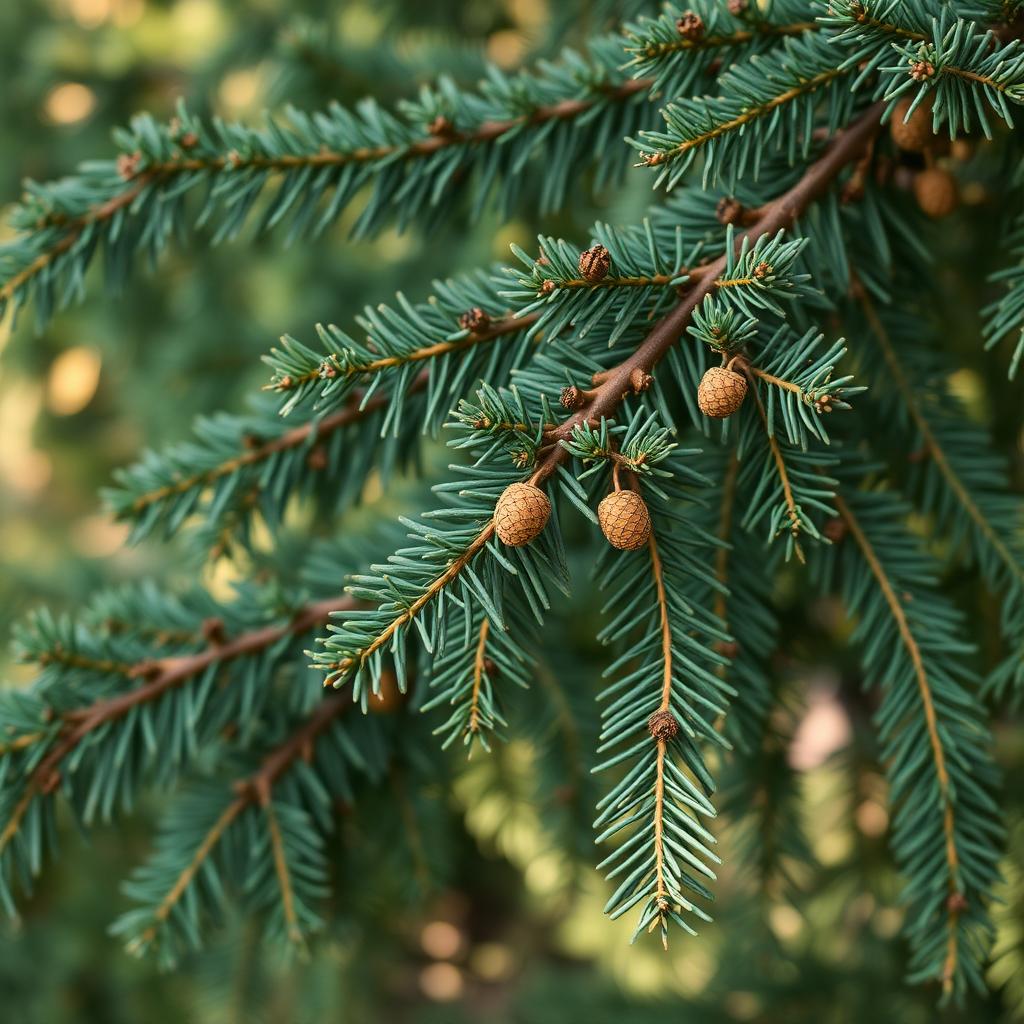
Astringent (tightens tissue and leaves a dry feeling in the mouth) cones traditionally used for varicose veins, hemorrhoids, and heavy menstrual flow.
Aromatic essential oil (rich in α-pinene and cedrol) supports respiratory tone.
A Persian symbol of healthy aging — long-lived, evergreen, upright.
Used externally far more than internally in modern herbalism.
Chapter 2 of 12
Getting to Know Cypress
The Mediterranean cypress (Cupressus sempervirens) is one of the oldest trees cultivated across the Persian world. In Saadi's Gulistan and Hafez's Divan, the tall, upright sarv stands for dignity, longevity, and resilience because it stays green through every season. Beyond the poetry, traditional Persian and Greco-Arabic medicine has used its small woody cones (jowz-e sarv) and young leafy branches for over two thousand years as a strong astringent (tightens tissue and leaves a dry feeling in the mouth) and respiratory tonic.
Known to botanists as Cupressus sempervirens (Cupressaceae).
Chapter 3 of 12
Why It Matters
Healthy veins, steady lymphatic flow, and easy breathing all matter as you grow older. Cypress stands out in classical Persian medicine because it focuses on the venous and capillary side of circulation — an area that often gets little attention until symptoms show up.
Weak, tired veins, needing the toilet more often, and tissue that loses its firmness all become common with age, and they rarely get much attention. Cypress is one of the few traditional Persian plants aimed squarely at this 'gravity side' of growing older, and using it on the skin is also its safest form.
Small clinical reports back the old use for heavy sweating.
External applications generally well tolerated when properly diluted.
Chapter 4 of 12
What It Contains
Antioxidants: Proanthocyanidins (a group of plant compounds concentrated in grape seeds and skins), Catechins (plant compounds common in green tea), Flavonoids (a family of protective plant compounds)
Notable: Astringent (tightens tissue and leaves a dry feeling in the mouth) tannins (plant compounds that give a dry, puckering taste), Volatile oils (α-pinene, cedrol, δ-3-carene)
Chapter 5 of 12
In the Laboratory
From laboratory work, not from people taking it
The aromatic oil (α-pinene, δ-3-carene, cedrol) gently fights germs and helps open the airways in lab studies.
A 2022 review of Mediterranean cypress found antimicrobial (slows the growth of germs), antioxidant and other effects in lab and animal studies, but no clinical trials in people.
Chapter 6 of 12
Preparation and Kitchen Use
Decoction (jushandeh): 1 Tbsp crushed cones simmered 15 min in 2 cups water. Used as a wash or sitz bath.
Fumigation is dried foliage burned on charcoal as a traditional air purifier.
Decoction (a drink made by simmering the plant in water) wash for hemorrhoids and varicose veins (cooled, applied with a cloth).
Other Ways to Use It
Steam inhalation: 2 drops oil in a bowl of just-boiled water, breathe under a towel 5 min.
Foot bath: simmer a handful of crushed cones in 2 L water 15 minutes. Soak tired, swollen legs.
In the kitchen: steam inhalation for lingering coughs and congested sinuses. Drop the oil on a tissue at the bedside for an evening forest-like calm.
Chapter 7 of 12
Extracts, Capsules and Concentrates
Capsules and standardised extracts carry many times the amount you get from food, which is why the cautions below matter more here.
Tincture (a liquid extract made with alcohol): 1:5 in 45% alcohol, 20–40 drops up to 3× daily (practitioner guidance).
Diluted essential oil (1–2%) in a carrier oil, massaged upward along the legs for vein tone.
Leg-tone massage oil: 5 drops cypress essential oil (the concentrated aromatic oil of the plant) in 1 Tbsp sweet almond oil.
Chapter 8 of 12
Who Should Be Careful
General caution:
Internal use of the essential oil is NOT recommended — use externally only.
Pregnancy and breastfeeding:
Avoid during pregnancy and breastfeeding.
General caution:
Always patch-test diluted oil before applying to large areas of skin.
Medication interaction:
May potentiate the effect of vasoconstrictor or hormone-sensitive medications — consult a clinician.
Chapter 9 of 12
Traditional Persian Perspective
Persian medicine describes cypress as warm and dry, with strong astringent (qābiḍ) action. Avicenna's Canon recommends the cones for excessive sweating, loose bowels, weakness of veins, and night urination in older men. Healers also used it externally as a poultice (a soft paste held against the skin) for hernias, swollen testicles, and varicose veins — a classic 'tightening' remedy. People burned cypress wood in sickrooms to purify the air.
It was used: varicose veins, hemorrhoids, and heavy menstrual bleeding. Excessive sweating (including night sweats and sweaty feet).
In the Household
Topical (put on the skin) wash for oily scalp and hair loss.
Drying tannins (plant compounds that give a dry, puckering taste) and proanthocyanidins (a group of plant compounds concentrated in grape seeds and skins) were traditionally used to firm up tired, weakened vein walls.
You’ll see cypress trees beside Persian shrines, gardens, and graves, where they stand for endurance, uprightness, and quiet longevity. The 4,000-year-old Sarv-e Abarkuh in Yazd is one of the oldest living things in Asia and a national symbol of healthy aging.
Chapter 10 of 12
Questions People Ask
Is cypress essential oil safe to ingest?
No. Cypress essential oil is for external use only. Traditional preparations are decoctions (a drink made by simmering the plant in water) of the dried cones taken in small, supervised amounts. The concentrated oil is far stronger and not appropriate for internal use.
How does cypress help varicose veins?
Astringent tannins and proanthocyanidins in the cones traditionally tone the walls of weakened veins. Diluted essential oil massaged upward along the legs, plus a cooled decoction (a drink made by simmering the plant in water) compress, is the classic external protocol.
Chapter 11 of 12
Sources
Cupressus sempervirens: memorial Sloan Kettering Herbal Database — Memorial Sloan Kettering Cancer Center. https://www.mskcc.org/cancer-care/diagnosis-treatment/symptom-management/integrative-medicine/herbs.
Avicenna's Canon of Medicine, Book II — Materia Medica — Translation, Laleh Bakhtiar (Great Books of the Islamic World).
Sad Giah Hezar Darman (صد گیاه و هزار درمان) — One Hundred Plants and One Thousand Remedies — Dr. Hossein Erfani, 4th edition (1375 / 1996–1997). Primary traditional Persian herbal reference cited throughout this platform. Presented as traditional knowledge, not as modern medical proof.
Office of Dietary Supplements: fact Sheets — US National Institutes of Health (NIH). https://ods.od.nih.gov/factsheets/list-all/.
Herbal Database: memorial Sloan Kettering Cancer Center. https://www.mskcc.org/cancer-care/diagnosis-treatment/symptom-management/integrative-medicine/herbs.
Chapter 12 of 12
Sources (continued)
Herbs at a Glance: uS NIH National Center for Complementary and Integrative Health (NCCIH). https://www.nccih.nih.gov/health/herbsataglance.
FoodData Central: searchable nutrient database — US Department of Agriculture (USDA). https://fdc.nal.usda.gov/.
The Nutrition Source: harvard T.H. Chan School of Public Health. https://www.hsph.harvard.edu/nutritionsource/.
PubMed — peer-reviewed biomedical literature — US National Library of Medicine. https://pubmed.ncbi.nlm.nih.gov/