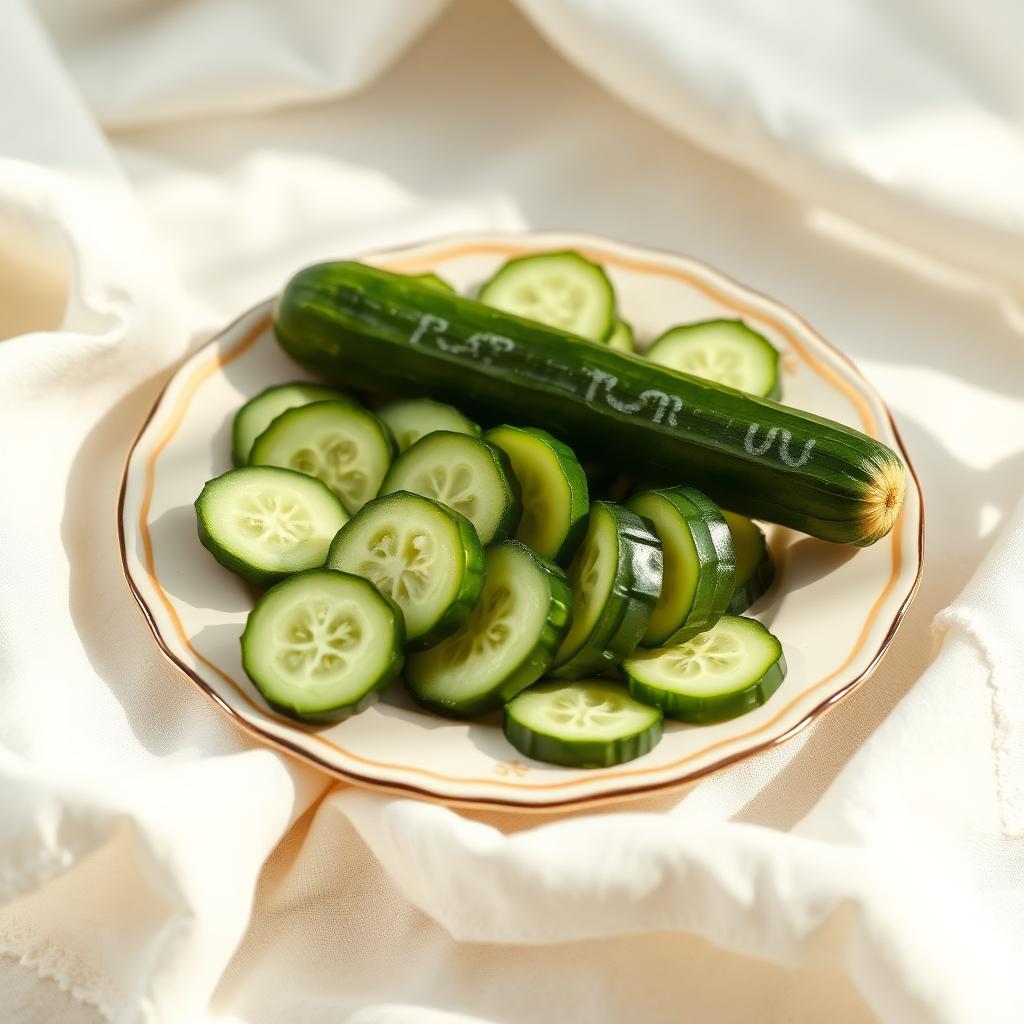
~95% water with potassium, silica, and flavonoid (a family of protective plant compounds) antioxidants — the original natural hydrator.
Persian-style snacking on whole cucumbers replaces a lot of sugary fruit calories. Mast-o khiar pairs cucumber's coolness with yogurt's probiotics — a daily gut-cooling combo.
Choose firm, unwaxed cucumbers and keep the skin for fiber and silica.
What Else to Know
In Iran, people treat cucumber as a fruit — slicing it into bowls at gatherings, dipping it in salt, blending it into doogh, or eating it whole from the market. It's roughly 95% water and brings a little electrolyte and antioxidant support too. Think of it as a natural hydrator and the starting point for two iconic Persian dishes (mast-o khiar and doogh).
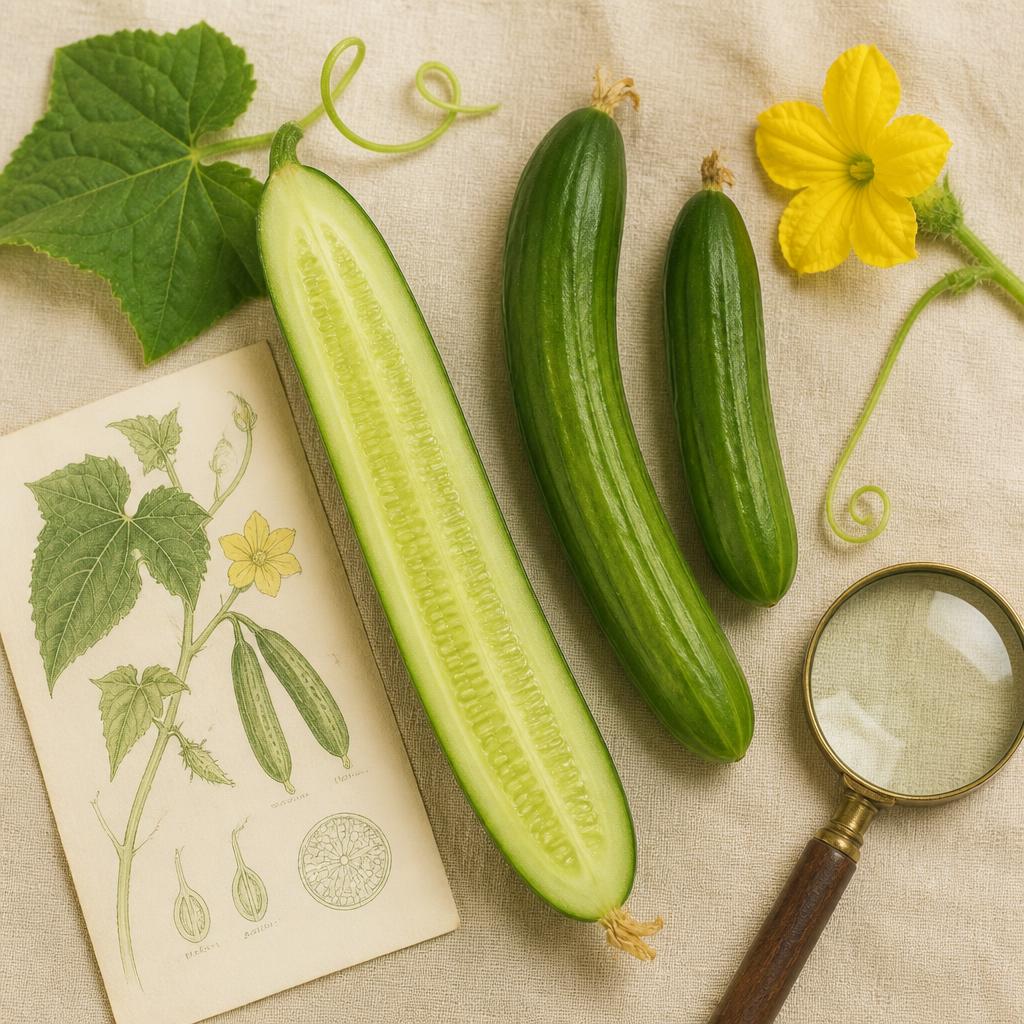
Known to botanists as Cucumis sativus.
Chapter 2 of 17
Why Herbalists Still Reach for It
Even mild ongoing dehydration can quietly affect your energy, focus, digestion, and skin elasticity — three visible parts of aging well. Cucumber + yogurt + mint is one of the easiest Persian habits for steady summer hydration and a calmer gut.
Steady hydration, a calm gut, and modest dietary potassium all support healthy aging in everyday life. Cucumber brings all three to the Persian summer table with almost no effort — and eating it whole can replace several hundred calories of sweeter snacks a week.
Potassium and silica support electrolyte balance, skin, and connective tissue.
What That Means Day to Day
It was used: flavonoid (a family of protective plant compounds) antioxidants (fisetin, quercetin). Naturally low calorie and satisfying as a whole snack.
A trailing or climbing annual vine with broad palmately lobed leaves, branched tendrils, and yellow five-petalled flowers that develop into cylindrical green fleshy fruits (botanically berries) containing flat pale seeds in a clear gel.
Family: Cucurbitaceae (gourd family).
Chapter 3 of 17
What Is In It
Primary compounds
Water (~95%) with dissolved potassium and magnesium — the electrolyte skeleton of natural hydration.
Silica is a trace mineral that supports skin, hair, and connective-tissue integrity.
Cucurbitacins: mild bitter triterpenes concentrated in stem-end and peel. The source of any noticeable bitterness.
Flavonoids (fisetin, quercetin, luteolin) — antioxidants studied for vascular (relating to the blood vessels) and neuronal aging.
Vitamin K and folate: modest but useful daily amounts, especially with the skin on.
Chapter 4 of 17
In the Laboratory
From laboratory work, not from people taking it
Fisetin, a flavonoid (a family of protective plant compounds) present in cucumber (and richer in strawberries), extended healthspan and reduced senescent-cell burden in aged mice — a mechanistic finding, not yet clinical, but of interest for hydration foods eaten daily. Rated: early research.
Chapter 5 of 17
What Studies in People Show
Moderate evidence
Water-rich fruits and vegetables (cucumber, watermelon, tomato, citrus) contribute meaningfully to daily hydration and improve markers of hydration status alongside plain water.Moderate evidence
Early research
A randomised trial of oral supplementation with Cucumis sativus extract in postmenopausal women reported significant improvements in wrinkles, moisture, and elasticity of facial skin over 8 weeks.Emerging evidence
Silica from dietary sources including cucumber has been associated with improved bone-mineral density in observational (based on watching what people already do) cohorts of older adults (Framingham Offspring).Emerging evidence
Chapter 6 of 17
How It Is Prepared
Any warm hour: but the Persian rhythm is afternoon tea (whole cucumber + salt), the noon meal (mast-o-khiar or salad Shirazi), and after a fatty dinner (a tall glass of doogh).
Eat 1–2 whole cucumbers a day as a snack — Persian style.
Other Ways to Use It
Doogh: blend 1 cup yogurt + 1 cup cold water + ½ grated cucumber + ½ tsp dried mint + a pinch of salt.
In the kitchen: salad Shirazi: small dice with tomato, onion, lime, and dried mint. Cooled slices applied to tired or puffy eyes (topical).
Slice into ice water with mint and lemon for an all-day hydration jug.
Chapter 7 of 17
Medicines and Interactions
Medication interaction:
Diuretics (furosemide, HCTZ, spironolactone) — Cucumber is very mildly diuretic (makes you pass more urine); large daily intake can be additive with prescription diuretics, especially in warm weather — usually welcome, occasionally worth watching for postural dizziness. (low concern)
Medication interaction:
Warfarin — Cucumber with its skin contributes a small, consistent amount of vitamin K. Occasional intake isn't clinically relevant; keeping intake steady rather than swinging from none to a great deal is the useful habit. (low concern)
General caution:
Advanced-kidney-disease potassium restrictions — A cup of cucumber contains ~150 mg potassium — modest, but relevant when a clinician has set a strict daily potassium ceiling. (low concern)
Chapter 8 of 17
Who Should Be Careful
General caution:
Wash well — skin retains pesticide residue (choose organic or peel waxed cucumbers).
General caution:
Very large amounts can be mildly diuretic — moderate before long activities without bathrooms.
General caution:
Severe IBS with cucurbit sensitivity (rare bloating from cucurbitacins).
General caution:
Discard any cucumber that tastes unusually bitter (high cucurbitacin content can cause GI upset).
Chapter 9 of 17
Pregnancy, Children and Older Adults
Pregnancy and breastfeeding
Pregnancy and breastfeeding:
Cucumber in every ordinary form — whole, grated into yogurt, blended into doogh, sliced into salad — is safe and traditional throughout pregnancy. Its water, potassium, and modest folate quietly support the workload of the growing body. Wash and peel waxed conventional cucumbers to keep pesticide exposure low.
Children
Children:
One of the earliest and safest Persian toddler foods — thin, peeled strips of Persian cucumber (well past the choking-hazard age of ~4) with a pinch of salt or a spoon of yogurt is a daily habit in Iranian homes. Older children love doogh; skip the salt for very young toddlers.
Older adults
Older adults:
A quietly powerful habit after 60 — steady hydration, gentle potassium, silica for skin and connective tissue, and none of the sugar of fruit. A whole cucumber and a small bowl of mast-o-khiar a day is one of the easiest healthy-aging equations in Persian cuisine. Skip only if a clinician has restricted potassium or fluids.
Chapter 10 of 17
What Persian Medicine Says
Persian temperament: Cool & Moist (2nd degree). Persian medicine reads cucumber as strongly cooling and moistening — the classical summer answer to over-warm hearts, irritated stomachs, hot-pattern urinary passages, and skin that has taken too much sun.
Persian medicine describes cucumber as cool and moist. People used it to quench thirst, cool summer heat, calm an overheated stomach and liver, support the kidneys, and balance warming meats and saffron rice. Avicenna recommended it for fevers, hot constitutions, and inflamed urinary passages.
It was used: hot, irritable digestion and acid reflux (stomach acid rising into the throat) from spicy meals. Hot, puffy eyes and skin redness (topical cooled slices). Balancing the warming nature of kebab, saffron rice, and stews.
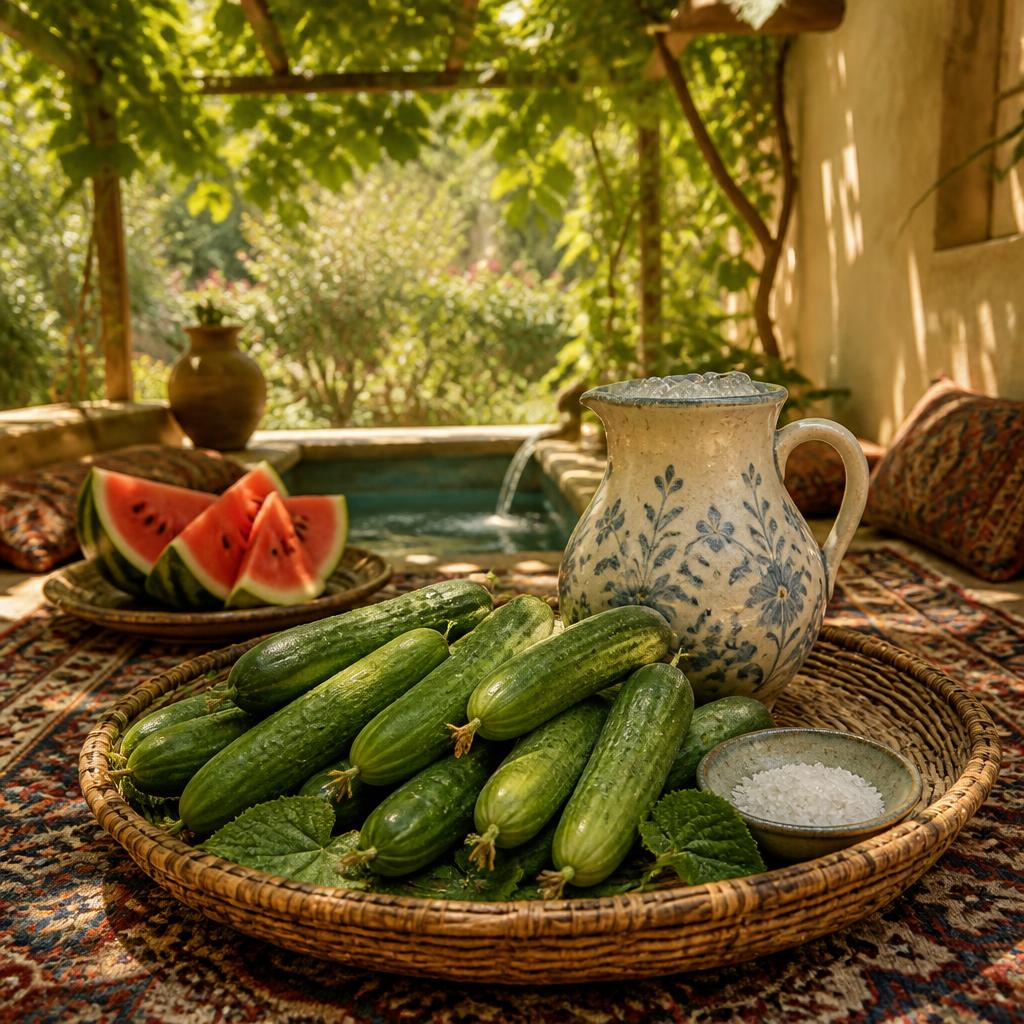
Persians slice cucumbers into fruit bowls and enjoy them as sweet, refreshing fruit, not only as something savory for a salad. One long-standing summer ritual is a peeled whole cucumber dipped in salt during afternoon tea.
Chapter 11 of 17
Traditional Formulas
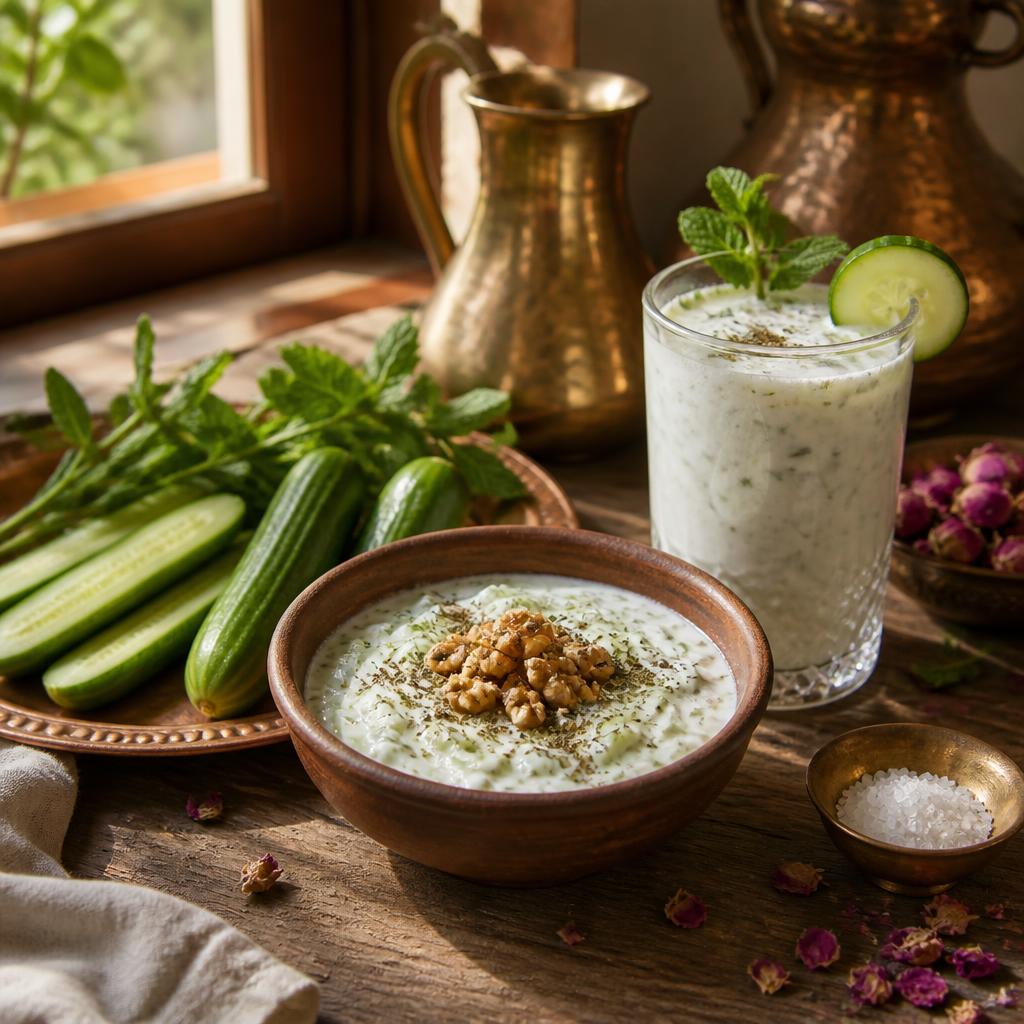
Mast-o khiar: grated cucumber, yogurt, dried mint, walnut, and a pinch of salt, which is the everyday Persian cooling side dish.
Doogh: salted yogurt drink blended with cucumber and dried mint. That makes it the classic Persian summer beverage with kebab.
Salad Shirazi: diced cucumber, tomato, onion, lime, and dried mint (a daily hydrating salad from Shiraz).
Chapter 12 of 17
What It Goes With
Herb:
Mint
Dried spearmint on cucumber-yogurt is the single most-repeated Persian summer pairing — mint's warmth balances cucumber's coolness so the belly stays settled.
Rose:
Rose
A whisper of dried rose petals in cucumber water is the Persian shortcut to a garden in a glass.
Pairing:
Dill
Fresh dill folded into mast-o-khiar sharpens the flavour and adds a gentle carminative (traditionally used to settle gas and bloating) lift for after-meal heaviness.
Chapter 13 of 17
What It Goes With: More Pairings
§ A Few More Pairings
Dairy:
Yogurt
Probiotics (live helpful bacteria) carry cucumber's electrolytes into a cooling, gut-balancing bowl. Cucumber + yogurt is the Persian everyday equation.
Pairing:
Walnut
A few crushed walnuts on mast-o-khiar add omega-3 fats and turn a side dish into a small meal.
Pairing:
Tomato
The salad Shirazi trio — cucumber, tomato, onion — is Persia's daily hydrating salad, one of the simplest healthy-aging habits in the cuisine.
Pairing:
Salt
A pinch of salt on peeled cucumber is the classical afternoon Persian snack — turning plain water into a small, natural electrolyte drink.
Chapter 14 of 17
Through the Year
Spring:
Spring
The first tender cucumbers arrive with the Nowruz sabzeh — sliced into salad Shirazi with tomato, onion, lime, and dried mint.
Summer:
Summer
The peak Persian ritual — whole cucumbers in a cold bowl on the tea table, doogh at every kebab, mast-o-khiar with every stew.
Autumn:
Autumn
As the heat fades, cucumber shifts from thirst-quencher to gut-cooler — grated into yogurt to balance the season's returning stews.
Winter:
Winter
Persian medicine cautions against cold-and-moist foods in cold-and-moist weather — reach for cucumber sparingly, and always paired with warming herbs (mint, salt, a drop of olive oil).
Chapter 15 of 17
Questions People Ask
Should I peel cucumbers?
Keep the skin if the cucumber is organic or homegrown — most of the silica, fiber, and antioxidants live there. Peel waxed conventional cucumbers (the wax traps pesticide residue) or scrub them well with a brush.
Persian cucumbers vs English vs slicing — which is best?
Persian cucumbers are small, thin-skinned, almost seedless, and the closest to what's eaten in Iran. English cucumbers are similar and a fine substitute. Standard American slicing cucumbers are bigger and waxier — peel them and discard mature seeds if bitter.
Is cucumber really enough for hydration?
Eating one to two whole cucumbers contributes about 250–500 mL of water plus potassium and silica. It's a meaningful supplement to plain water, especially in summer — not a complete replacement for it.
Chapter 16 of 17
Sources
Sad Giah Hezar Darman (صد گیاه و هزار درمان) — One Hundred Plants and One Thousand Remedies — Dr. Hossein Erfani, 4th edition (1375 / 1996–1997). Primary traditional Persian herbal reference cited throughout this platform. Presented as traditional knowledge, not as modern medical proof.
Office of Dietary Supplements: fact Sheets — US National Institutes of Health (NIH). https://ods.od.nih.gov/factsheets/list-all/.
Herbal Database: memorial Sloan Kettering Cancer Center. https://www.mskcc.org/cancer-care/diagnosis-treatment/symptom-management/integrative-medicine/herbs.
Herbs at a Glance: uS NIH National Center for Complementary and Integrative Health (NCCIH). https://www.nccih.nih.gov/health/herbsataglance.
FoodData Central: searchable nutrient database — US Department of Agriculture (USDA). https://fdc.nal.usda.gov/.
Chapter 17 of 17
Sources (continued)
The Nutrition Source: harvard T.H. Chan School of Public Health. https://www.hsph.harvard.edu/nutritionsource/.
PubMed — peer-reviewed biomedical literature — US National Library of Medicine. https://pubmed.ncbi.nlm.nih.gov/