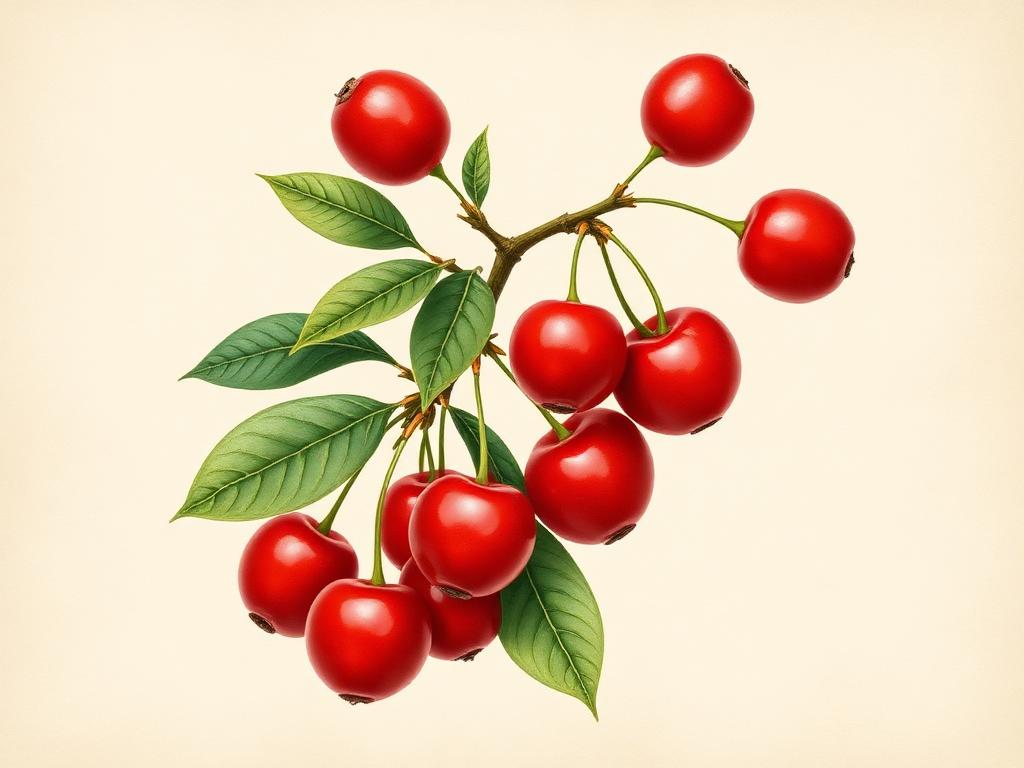
One of the most anthocyanin-dense fruits grown in Iran — the colour is the compound.
Traditionally a cooling fruit: taken in heat, thirst, and inflamed states.
Dried zoghal akhteh keeps for a year and makes a tart ruby tea out of season.
Chapter 2 of 10
Getting to Know Cornelian Cherry
Cornelian cherries are small, oval, ruby fruits with a sharp, tart flavour. Across Iran, Turkey, and the Caucasus, people eat them fresh in late summer, dry them for a tangy snack, or simmer them into syrups (sharbat). Despite the name, they aren’t cherries at all. They grow on a dogwood tree and are exceptionally rich in anthocyanins (the natural colour pigments that make fruit red, purple or blue) and vitamin C.
Known to botanists as Cornus mas.
Chapter 3 of 10
Why It Matters
Zoghal akhteh can be childhood street food and serious nutrition at the same time. The tart handful sold with salt on a Tehran corner carries more polyphenols (protective plant compounds) than most cultivated fruit can match.
Cornelian cherries are one of the most anthocyanin-dense fruits on earth — supporting heart and blood vessel, metabolic, and cellular aging. Early clinical work suggests benefit for blood sugar and lipid markers. A small daily portion (fresh, dried, or as unsweetened sharbat) is a flavorful way to add deeply pigmented antioxidants to an aging-well pattern.
Chapter 4 of 10
Why It Matters: What That Means Day to Day
Anthocyanin (the natural colour pigments that make fruit red, purple or blue) antioxidants studied for blood sugar and lipids.
Vitamin C and iron support immunity and blood-building.
Astringent (tightens tissue and leaves a dry feeling in the mouth) tannins (plant compounds that give a dry, puckering taste) support gut tone.
Zoghal akhteh has a short season and a sourness that most people meet in preserved form: dried whole, pressed into sour fruit leather, cooked into a syrup for sharbat, or made into jam.
Drying concentrates both the sugar and the acid, which is why a handful of dried cornelian cherries tastes far more intense than the fresh fruit.
Primary compounds
It was used: loganic acid, ellagic acid, and ursolic acid.
Other notable constituents
Minerals: Iron, Potassium, Calcium · Fiber: ~1 g per ¼ cup
Chapter 5 of 10
What Studies in People Show
What studies in people show
Cornelian cherry extract improved fasting glucose and lipid measures in small randomised human trials.Emerging evidence
Anthocyanin-rich fruit intake was associated with better cardiometabolic markers in cohort studies (a study that follows a group of people over time).Emerging evidence
Chapter 6 of 10
Preparation and Kitchen Use
Late summer for the fresh fruit. The dried fruit and its tea belong to the winter months.
Eat fresh in late summer: sprinkle with salt Iranian-style.
Steep dried fruit in hot water for a tart, ruby tea.
Simmer with sugar into sharbat-e zoghal akhteh.
Other Ways to Use It
Add a spoon of the dried fruit to ājeel-e tersh.
Each fruit holds one long hard stone that's not eaten and is easy to bite badly. Preserved forms are usually pitted. Dried whole ones often aren't.
Unripe fruit is astringent (tightens tissue and leaves a dry feeling in the mouth) enough to be unpleasant. Ripe cornelian cherries are deep crimson, slightly soft, and come away from the tree without pulling.
Chapter 7 of 10
Who Should Be Careful
General caution:
Highly tart — rinse the mouth after eating to protect tooth enamel.
General caution:
Astringent in quantity, which can be uncomfortable on a sensitive stomach.
General
Children:
Contains a single hard pit — eat around it and keep it away from small children.
Older adults
Older adults:
Very tart and firm when fresh; the dried fruit steeped as tea is gentler on the teeth and the stomach.
Chapter 8 of 10
Traditional Persian Perspective
Persian temperament: Cool & Dry (2nd degree). Cooling and astringent (tightens tissue and leaves a dry feeling in the mouth). Taken in heat, thirst, and looseness of the gut.
Persian medicine reads zoghal akhteh as cool and dry. People used it to cool the liver, firm a loose gut, and calm hot, irritated conditions. It was the classic summer fruit for someone feeling hot and thirsty.
In the Household
It was used: sharbat-e zoghal akhteh: cornelian cherry syrup with cold water as a summer cooler. Dried cornelian cherries brewed into a tart, ruby tea. Fresh zoghal akhteh with salt as an Iranian street snack.
Traditional decoctions (a drink made by simmering the plant in water) for diarrhea and digestive astringency.
Chapter 9 of 10
Sources
Cornus mas: phytochemistry and biological activities review — Journal of Ethnopharmacology (PubMed). https://pubmed.ncbi.nlm.nih.gov/27693772/.
Cornelian cherry and glycemic control in type 2 diabetes — RCT — Journal of Endocrinological Investigation (PubMed). https://pubmed.ncbi.nlm.nih.gov/24178896/
Sad Giah Hezar Darman (صد گیاه و هزار درمان) — One Hundred Plants and One Thousand Remedies — Dr. Hossein Erfani, 4th edition (1375 / 1996–1997). Primary traditional Persian herbal reference cited throughout this platform. Presented as traditional knowledge, not as modern medical proof.
Office of Dietary Supplements: fact Sheets — US National Institutes of Health (NIH). https://ods.od.nih.gov/factsheets/list-all/.
Herbal Database: memorial Sloan Kettering Cancer Center. https://www.mskcc.org/cancer-care/diagnosis-treatment/symptom-management/integrative-medicine/herbs.
Chapter 10 of 10
Sources (continued)
Herbs at a Glance: uS NIH National Center for Complementary and Integrative Health (NCCIH). https://www.nccih.nih.gov/health/herbsataglance.
FoodData Central: searchable nutrient database — US Department of Agriculture (USDA). https://fdc.nal.usda.gov/.
The Nutrition Source: harvard T.H. Chan School of Public Health. https://www.hsph.harvard.edu/nutritionsource/.
PubMed — peer-reviewed biomedical literature — US National Library of Medicine. https://pubmed.ncbi.nlm.nih.gov/