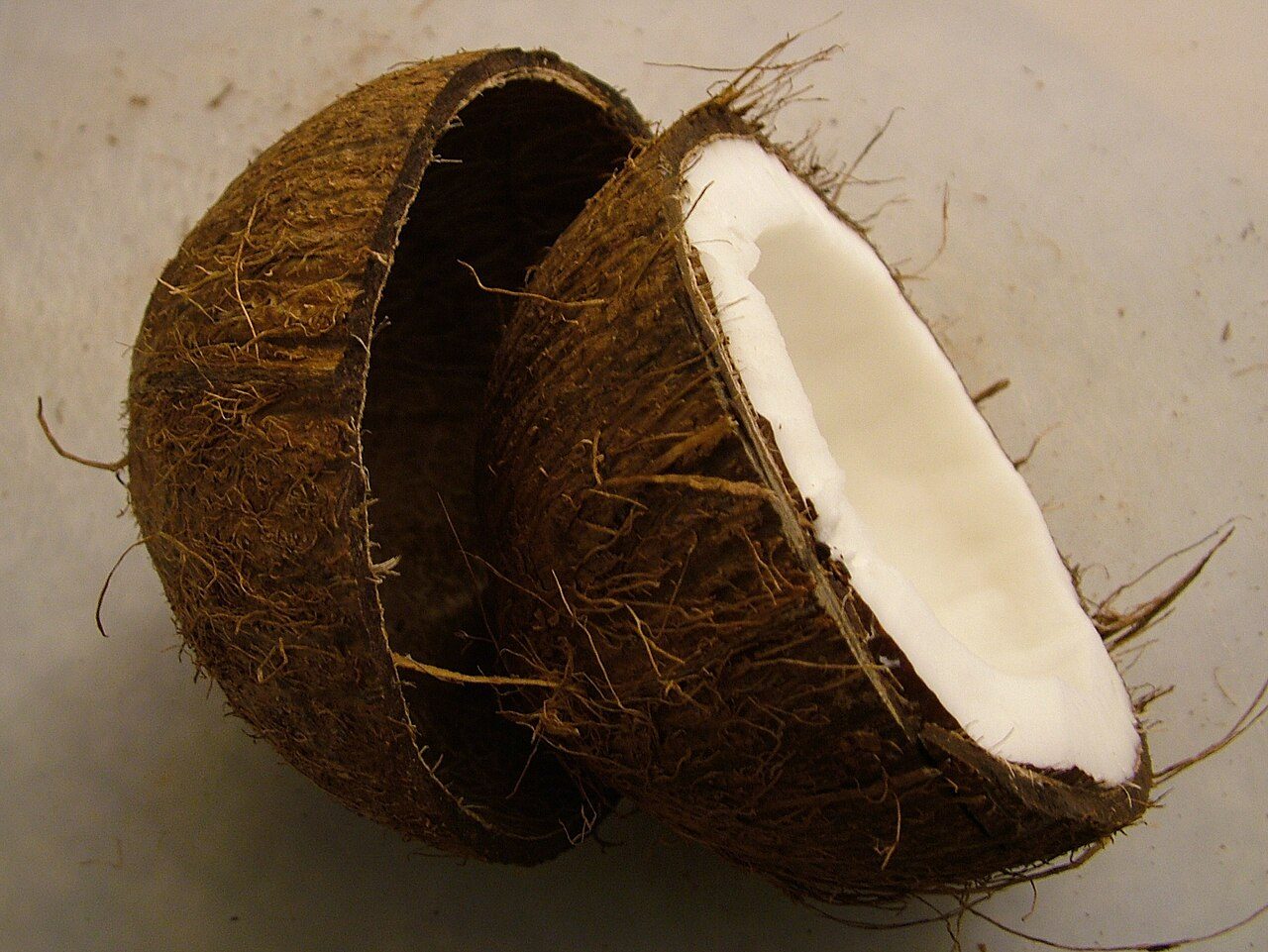
Water, flesh, milk and oil are four different foods with four different uses.
The water is an electrolyte drink with real rehydration evidence. The oil is almost pure saturated fat.
Fresh flesh carries about 7 g of fibre a cup, which most people don't expect.
Nārgil reached the Persian world along the Indian and Arabian sea routes and became part of the southern kitchen. Bandari cooks use the milk in fish curries, halwa shops use the shredded flesh, and people drink the water straight from the young green nut. The first thing to know is that each part behaves differently.
Known to botanists as Cocos nucifera.
Chapter 2 of 15
Why It Matters
You may have heard plenty of health claims about coconut, especially the oil, but most are thin. It helps to separate the four products. Once you do that, each one has an honest place in the kitchen.
For older adults, the picture is simple. Coconut water can be a good choice for someone who dehydrates quickly and dislikes plain water. Coconut oil is high in saturated fat and raises LDL (the harmful type of cholesterol) cholesterol, so it shouldn’t have the daily place some people give it.
Coconut water replaces potassium and sodium after sweating, and trials rate it alongside sports drinks for mild dehydration.
The fresh flesh is genuinely high in fibre, which the desiccated version keeps.
Medium-chain fats are absorbed quickly and used for energy rather than stored the way long-chain fats are.
Chapter 3 of 15
What It Contains
Primary compounds
Lauric acid, roughly half the fat in the oil. Medium-chain triglycerides (a type of fat in the blood), absorbed straight to the liver. Cytokinins and potassium in the water.
Vitamins
Vitamin B6, Folate, Vitamin C (in the water)
Other notable constituents
Minerals: Manganese, Copper, Iron · Antioxidants: Phenolic acids · Fiber: About 7 g per cup of fresh flesh
Chapter 4 of 15
In the Laboratory
From laboratory work, not from people taking it
Lauric acid has antimicrobial (slows the growth of germs) activity in the laboratory, which is interesting rather than proven in people.
Chapter 5 of 15
What Studies in People Show
Strong evidence
Coconut oil raised LDL (the harmful type of cholesterol) cholesterol compared with unsaturated plant oils in pooled trials.Strong evidence
Moderate evidence
Coconut water was as effective as a carbohydrate-electrolyte drink for rehydration after exercise.Moderate evidence
Medium-chain triglycerides were absorbed and used for energy faster than long-chain fats in metabolic studies.Moderate evidence
Chapter 6 of 15
Preparation and Kitchen Use
In the kitchen: the water in the summer heat. The milk and flesh in the cold months. Open a young nut by cutting a window in the soft top with a heavy knife.
For a mature nut, pierce the softest eye, drain it, then crack the shell around its middle.
Grate the white flesh away from the brown skin for halwa.
Other Ways to Use It
Tinned coconut milk separates. Shake it, or use the thick top for a richer stew.
Drink the water from a young green coconut, cold, after heat or exertion.
Coconut milk in a Bandari fish stew, where it belongs and where it does most good.
Shred fresh flesh into halwa and confectionery.
Use the oil sparingly, for high-heat cooking.
Young coconut water after a hot walk, in place of a sports drink.
Chapter 7 of 15
Medicines and Interactions
Medication interaction:
Potassium-sparing diuretics and ACE inhibitors — Coconut water is high in potassium and can add to medicines that already raise it. Ask before drinking it daily. (moderate concern)
Medication interaction:
Statins — Coconut oil works against what a statin is doing to your LDL (the harmful type of cholesterol). Use olive oil for daily cooking instead. (low concern)
Chapter 8 of 15
Who Should Be Careful
General caution:
Coconut water is high in potassium, which matters if you have kidney disease.
General caution:
Advanced kidney disease with potassium restriction, for the water.
General caution:
Coconut oil raises LDL cholesterol. Treat it as a flavour, not as a health food, and keep the daily amount small.
General caution:
Coconut milk in quantity is very rich and will loosen the bowel.
Allergy:
A small number of people with tree-nut allergy react to coconut. It is uncommon, but it happens.
Allergy:
Documented coconut allergy.
Chapter 9 of 15
Pregnancy, Children and Older Adults
Pregnancy and breastfeeding
Pregnancy and breastfeeding:
Coconut water is a good pregnancy drink, especially with nausea, when plain water is hard to keep down. The flesh and milk are ordinary foods in ordinary amounts.
Children
Children:
Coconut water suits a child recovering from a stomach bug better than a fizzy sports drink. Shredded coconut is a choking risk for the very young.
Older adults
Older adults:
Two useful things: the water for someone who forgets to drink, and the soft milk-based stews for someone who struggles to chew. Keep the oil to a minimum if cholesterol is being treated.
Chapter 10 of 15
Traditional Persian Perspective
Persian temperament: Warm & Moist (1st degree). Nourishing and strengthening. The water reads as cooling, the flesh and oil as warming.
Coconut travelled the Indian Ocean trade routes to the Persian Gulf ports over a thousand years ago.
In the Household
Unani physicians prescribed the flesh during convalescence and for underweight patients.
The oil was used in Persian and Indian households as a hair and scalp dressing long before it was a cooking fashion.
In many Persian households, nārgil halwa belongs at weddings. Coconut milk also gives the cooking of Bandar Abbas and Chabahar a flavour all its own, quite different from food on the plateau.
Chapter 11 of 15
What It Goes With
Pairing:
Dates
Shredded coconut pressed onto a stuffed date is the simplest sweet in the southern repertoire.
Spice:
Cardamom
In halwa and in coconut milk rice. The two flavours were made for each other.
Spice:
Turmeric
The base of a Bandari fish stew, where the milk carries the spice.
Pairing:
Banana
Coconut water and banana after exercise cover the potassium question between them.
Chapter 12 of 15
Through the Year
Spring:
Spring
Young coconut water starts to make sense as the days warm up.
Summer:
Summer
The water is at its best. This is the season it was made for.
Autumn:
Autumn
Milk and shredded flesh return as the cooking turns to stews and sweets.
Winter:
Winter
Nārgil halwa and coconut-milk curries, which is how the south eats it in the cold months.
Chapter 13 of 15
Questions People Ask
Is coconut oil healthy?
It's about 90 percent saturated fat and it raises LDL cholesterol in trials. Use it for flavour where you want that flavour, and use olive oil for everything else.
Is coconut water better than a sports drink?
For ordinary sweating, yes, and with no added sugar. For hard endurance work it's a little low in sodium.
Is coconut a nut?
Botanically it's a drupe, closer to a peach stone than to an almond. Most people with tree-nut allergy tolerate it, but not all.
Tinned or fresh milk?
Tinned is fine and consistent. Read the label for added thickeners if the texture matters to you.
Chapter 14 of 15
Sources
Sad Giah Hezar Darman (صد گیاه و هزار درمان) — One Hundred Plants and One Thousand Remedies — Dr. Hossein Erfani, 4th edition (1375 / 1996–1997). Primary traditional Persian herbal reference cited throughout this platform. Presented as traditional knowledge, not as modern medical proof.
Office of Dietary Supplements: fact Sheets — US National Institutes of Health (NIH). https://ods.od.nih.gov/factsheets/list-all/.
Herbal Database: memorial Sloan Kettering Cancer Center. https://www.mskcc.org/cancer-care/diagnosis-treatment/symptom-management/integrative-medicine/herbs.
Herbs at a Glance: uS NIH National Center for Complementary and Integrative Health (NCCIH). https://www.nccih.nih.gov/health/herbsataglance.
FoodData Central: searchable nutrient database — US Department of Agriculture (USDA). https://fdc.nal.usda.gov/.
Chapter 15 of 15
Sources (continued)
The Nutrition Source: harvard T.H. Chan School of Public Health. https://www.hsph.harvard.edu/nutritionsource/.
PubMed — peer-reviewed biomedical literature — US National Library of Medicine. https://pubmed.ncbi.nlm.nih.gov/