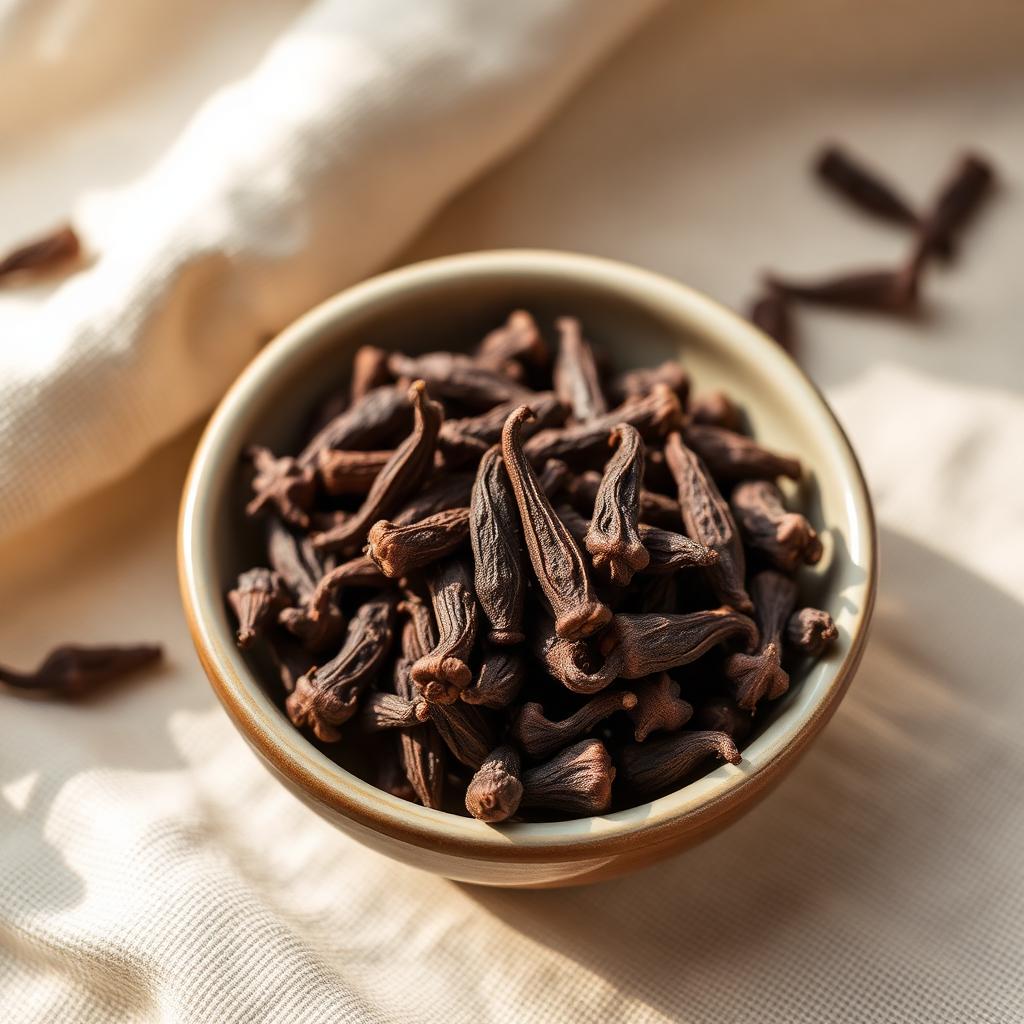
You'll notice clove's intensity straight away. Its main compound, eugenol, numbs pain on the surface of the gum. This is the best-supported use.
It's one of the strongest antioxidant spices, gram for gram, though nobody eats it by the gram.
Clove oil is very strong. Never swallow it, and never give it to a small child.
Clove is a dried flower bud with a very big flavour. A single bud can change a whole pot of rice. In Persian kitchens it goes into advieh spice blends, into rice, into stews, and into winter tea. In Persian homes it has another job too: a clove held against a sore tooth quiets the pain. That old habit turned out to have a real reason behind it. Clove oil contains eugenol, which numbs the surface of the gum. Dentists have used it for more than a hundred years.
Known to botanists as Syzygium aromaticum.
Chapter 2 of 16
Why Herbalists Still Reach for It
Most spices simply flavour a meal, but clove can do a little more. A pinch warms a slow, heavy stomach after a rich dinner. If a tooth aches, holding a whole bud against it may buy you some comfort until you can see a dentist. It's a good reminder that the kitchen shelf and the medicine shelf were once the same shelf.
Gum trouble becomes more common with age, and rich food may sit more heavily too. Clove speaks to both at the level of a pinch, not a pill. That's its real value: a small, affordable comfort people have trusted for centuries, without needing to make it more than it's.
It was used: numbs surface pain in the gums and teeth. Very high in antioxidant compounds. Freshens the breath.
Chapter 3 of 16
The Plant Itself
Cloves are flower buds. They grow on a tall evergreen tree and are picked before they open, then dried in the sun until they turn hard and dark brown. Each bud looks like a tiny nail with a round head — which is exactly what the Persian name mikhak means: little nail. Most of the smell and the strong taste comes from one oil called eugenol.
Family: Myrtaceae (myrtle family).
Chapter 4 of 16
What Is In It
Primary compounds
Beta-caryophyllene and eugenyl acetate (the other aromatic compounds in the bud).
Tannins (plant compounds that give a dry, puckering taste).
Vitamins
Vitamin K, Vitamin C, Vitamin E
Other notable constituents
Minerals: Manganese, Magnesium, Calcium, Iron · Antioxidants: Gallic acid · Fiber: Very high by weight, but a single bud contributes almost nothing to a daily total
Chapter 5 of 16
In the Laboratory
From laboratory work, not from people taking it
Clove essential oil (the concentrated aromatic oil of the plant) shows broad antimicrobial (slows the growth of germs) activity in laboratory testing. Rated: early research.
Chapter 6 of 16
What Studies in People Show
What studies in people show
Eugenol produces local anaesthetic and analgesic (pain-relieving) effects and is long used in dentistry for dental pain.Moderate evidence
Clove oil ingestion in children has caused acute liver injury in documented case reports.Moderate evidence
Chapter 7 of 16
How It Is Prepared
Advieh: ground clove blended with cinnamon, cardamom, rose petals and cumin for rice and stews.
Clove and cinnamon tea is one bud and one small stick steeped in black tea for five minutes.
Toothache clove is a single whole bud softened in the mouth, then held against the sore tooth.
Pomander: whole cloves pressed into an orange to scent a winter room.
Chapter 8 of 16
How It Is Prepared: Other Ways to Use It
Whole buds in rice, stews, and pickles — remove before serving.
Ground clove: a small pinch is enough for a whole dish.
Drop two whole buds into rice while it steams for a warm, sweet smell.
Press one whole bud gently against an aching tooth for a few minutes.
Add a pinch of ground clove to stewed fruit, halva, or spiced cake.
Chapter 9 of 16
Medicines and Interactions
General cautions
Medication interaction:
Stop clove oil before surgery.
Specific medicines
Medication interaction:
Warfarin (a blood-thinning medicine) and other blood thinners — Eugenol slows platelets, the blood cells that form clots. Normal food amounts are fine; clove oil taken by mouth or a daily supplement isn't, and raises bleeding risk. (high concern)
Medication interaction:
Diabetes medicines — Clove extracts have lowered blood sugar in animal work. If you take insulin or a sulfonylurea (a common type of diabetes tablet), don't add a clove supplement without telling your doctor. (moderate concern)
Medication interaction:
Paracetamol and liver-processed medicines — Large doses of clove oil are toxic to the liver. Never take clove oil internally alongside regular paracetamol. (high concern)
Chapter 10 of 16
Who Should Be Careful
Children:
Clove oil must never be swallowed. Even small amounts can harm the liver, especially in children.
General caution:
See a dentist for a tooth that keeps hurting — clove hides pain, it doesn't fix the cause.
Pregnancy and breastfeeding:
Whole cloves in food are fine in pregnancy; concentrated oil or supplements aren't.
Chapter 11 of 16
Pregnancy, Children and Older Adults
General
Children:
Keep clove oil away from children.
Pregnancy and breastfeeding
Medication interaction:
Cooking with cloves is fine. Clove oil taken by mouth and clove supplements aren't — the doses are far higher than food and the safety data don't exist. Applying a little clove oil to a tooth is a different matter and is generally considered acceptable, though the dentist is the better answer.
Children
Children:
Clove oil must never be swallowed by a child. Poisoning cases in small children have come from teaspoon amounts and are serious. Cooking with whole cloves is fine, though pick them out before serving so nobody bites one.
Older adults
Medication interaction:
Useful in a kitchen where salt is being cut, because clove gives a dish presence without sodium. Anyone on a blood thinner should stay with cooking amounts and avoid clove supplements entirely.
Chapter 12 of 16
What Persian Medicine Says
Persian temperament: Warm & Dry (3rd degree). One of the strongly warming spices. Used in small amounts and read as drying to a damp, cold digestion.
Persian medicine sees clove as strongly warm and dry. People used it for a cold, heavy stomach, wind and bloating, weak appetite, and toothache. Because that warming quality is so strong, the traditional approach keeps the amount small and often avoids it in people already described as hot and dry.
In the Household
It was used: toothache and sore gums. Cold, heavy digestion and bloating. Weak appetite in cold weather.
Clove is part of advieh, the Persian spice blend that scents rice and stews. Cloves are also pushed into an orange or an apple to perfume a room during winter gatherings, a habit shared across Iran, the Arab world, and Europe.
Chapter 13 of 16
What It Goes With
Spice:
Cinnamon
Two buds and one stick in the teapot. That ratio is worth remembering.
Spice:
Cardamom
Cardamom lifts, clove weighs down. Together they make the backbone of Persian advieh.
Grain:
Rice
Three whole buds in the water. Take them out before serving unless you enjoy surprises.
Fruit:
Orange
Cloves pressed into an orange peel is a winter smell older than anyone can date.
Chapter 14 of 16
Through the Year
Spring:
Spring
Back off. The warming spices suit the cold months.
Summer:
Summer
One bud in a pot of tea at most. More is heavy in heat.
Autumn:
Autumn
Returns to the rice pot and the advieh jar as the evenings cool.
Chapter 15 of 16
Questions People Ask
Does clove really help toothache?
For a short time, yes. Eugenol numbs the surface of the gum, and dentists have used clove-based pastes for over a century. It relieves pain but doesn't treat the cause, so it's a bridge to the dentist.
How much is too much?
In cooking it's hard to overdo, because the flavour stops you first. Clove oil is a different matter and should never be swallowed.
Chapter 16 of 16
Sources
Eugenol: a review of its pharmacological properties — Phytotherapy Research.
Clove (Syzygium aromaticum): a precious spice — Asian Pacific Journal of Tropical Biomedicine.