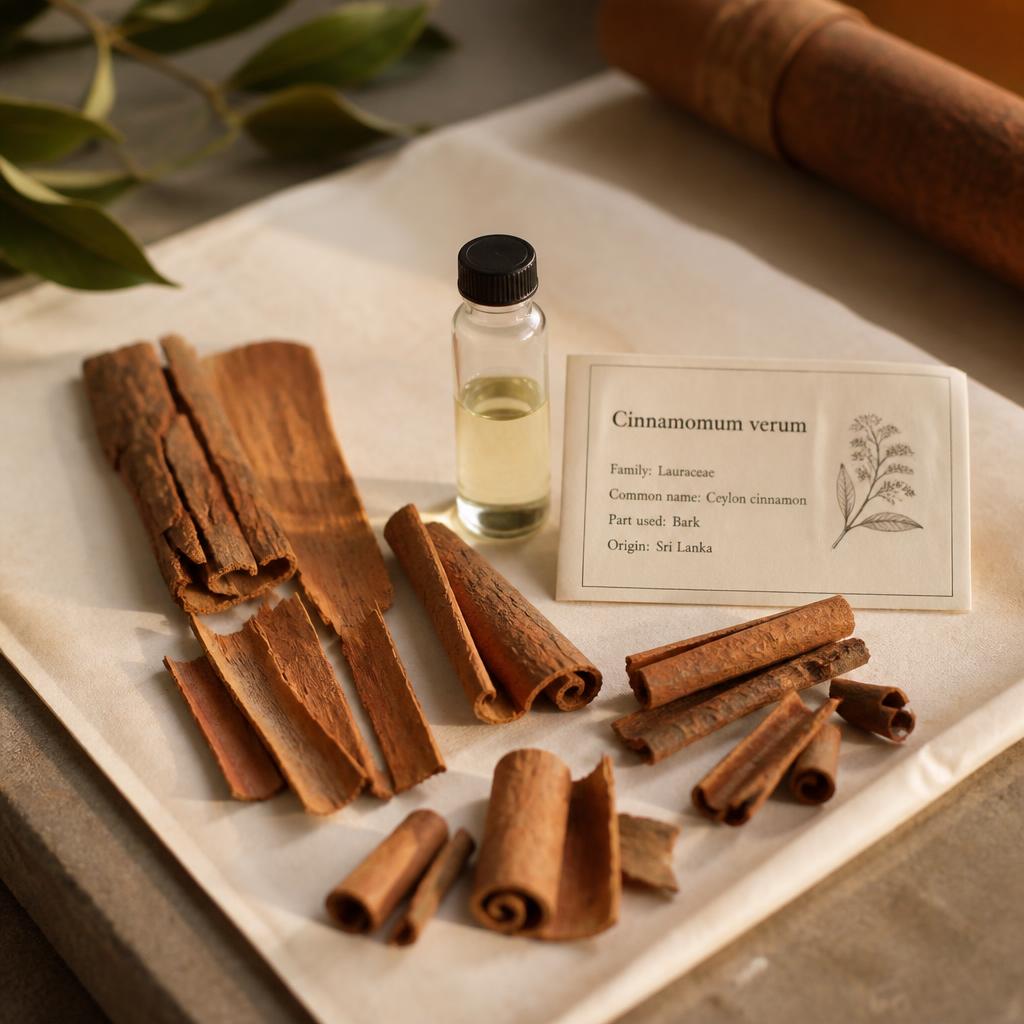
Here's the thing: Ceylon cinnamon is the safer bark for daily use. It holds far less coumarin (a natural plant compound that can strain the liver in large amounts) than Cassia. Across pooled type 2 diabetes trials, the effects on fasting glucose, HbA1c and post-meal blood sugar are modest but real.
It's also one of the oldest Persian warming digestives. A stick simmered in tea after a heavy dinner does most of what tradition asked of it.
For daily use, treat a quarter to one teaspoon of powdered Ceylon cinnamon as a reasonable everyday ceiling in food. Supplemental doses need a floor, a ceiling and a look at the coumarin math.
Chapter 2 of 21
Cinnamon: What It Is and Which Part Is Used
Cinnamon is the inner bark of the Cinnamomum tree. It's peeled, dried, and curls up into the sticks you know. There are two kinds on the shelf, and the difference matters. Ceylon, sometimes called 'true' cinnamon (Cinnamomum verum), is lighter and sweeter, and it holds very little coumarin (a natural plant compound that can strain the liver in large amounts). Cassia (C. cassia / C. burmannii) is the harsher, cheaper one most shops sell, and it holds a lot more. Persian doctors called it darchin and reached for it whenever the body felt cold, damp, or slow — a heavy stomach after a rich meal, a chill that won't shift, a chesty cough. Research has slowly caught up with them, mostly around blood sugar after meals, blood fats, and how quickly the stomach empties.
Chapter 3 of 21
Why Herbalists Still Reach for It
Three small things quietly speed up ageing: blood sugar that jumps after meals, digestion that runs cold and slow, and low-grade inflammation (a slow, simmering irritation in the body). Cinnamon nudges all three — gently, cheaply, day after day. A pinch on your morning oats, a stick in your evening tea, a little in a lentil soup. None of it is dramatic, and that's the point.
What matters is which bark you buy (Ceylon), how much you use (not much), and how often (most days, not in big bursts).
Chapter 4 of 21
Why Herbalists Still Reach for It: What That Means Day to Day
After 60, three things tend to drift together: blood sugar swings after meals, digestion that feels cold and slow, and gum health. Cinnamon is one of the few kitchen spices actually tested in trials on exactly those things — small drops in fasting glucose and HbA1c, small helpful shifts in blood fats, and activity against germs in the mouth. A quiet daily Ceylon habit is an easy way to smooth out a decade of small wear and tear.
Pooling the randomised trials, cinnamon may modestly reduce fasting glucose and HbA1c (a blood test showing average blood sugar over about three months) in type 2 diabetes. Total and LDL (the harmful type of cholesterol) cholesterol and triglycerides (a type of fat in the blood) shift slightly in the same direction.
Chapter 5 of 21
What Is In It
Primary compounds
Cinnamaldehyde is the primary aromatic aldehyde. Drives warmth, antimicrobial (slows the growth of germs) activity, and much of the blood-sugar effect.
Cinnamic acid & eugenol: antioxidant and mildly antimicrobial (slows the growth of germs) polyphenols (protective plant compounds).
Other Constituents
Proanthocyanidins (Type A): polyphenols (protective plant compounds) implicated in insulin-signalling effects in laboratory studies.
Coumarin is present at trace levels in Ceylon but substantial in Cassia. That's why bark choice matters for daily use.
As a warming digestive it helps the stomach empty and reduces bloating. Its cinnamaldehyde and polyphenols (protective plant compounds) show antioxidant activity, and laboratory studies find antimicrobial (slows the growth of germs) activity in the mouth and gut.
Laboratory studies show that cinnamaldehyde and Type-A proanthocyanidins (a group of plant compounds concentrated in grape seeds and skins) from cinnamon influence insulin-receptor signalling (how cells respond to insulin) and glucose uptake — a plausible mechanism for the modest blood-sugar effects seen in people, but not itself a clinical outcome. Rated: early research.
Chapter 7 of 21
What Studies in People Show
Strong evidence
Cassia cinnamon is a substantial dietary source of coumarin. Regular high intake can exceed the daily limit set by EFSA (the European food-safety agency) and stress the liver in susceptible people — Ceylon carries only trace amounts.Strong evidence
Moderate evidence
Cinnamon supplementation (typically 1–6 g/day) modestly reduces fasting glucose in adults with type 2 diabetes in meta-analyses (a study that pools the results of many trials) of randomised trials.Moderate evidence
Pooled randomised trials: cinnamon improves fasting glucose, HbA1c (a blood test showing average blood sugar over about three months), and blood fats in type 2 diabetes. Effects are modest and sit alongside standard care.Moderate evidence
Chapter 8 of 21
How It Is Prepared
Cinnamon's warmth suits mornings and the largest meal of the day best. A stick in a small pot of tea after lunch, or a pinch on oatmeal at breakfast, is the highest-leverage single use.
Choose Ceylon cinnamon (Cinnamomum verum) for daily long-term use, and treat a quarter to one teaspoon of powdered Ceylon cinnamon a day as a reasonable everyday ceiling in food. In cold months, chai-e darchin is one Ceylon stick simmered ten minutes, once or twice daily.
Steep a whole Ceylon stick in just-boiled water for ten minutes with a slice of ginger and a spoon of honey — a warming after-meal tea. In the morning, stir a quarter to half a teaspoon of Ceylon into oatmeal, yogurt or coffee.
Simmered into shir berenj, sholeh-zard or stewed fruit, a stick adds perfume and warmth without extra sugar.
Chapter 9 of 21
Extracts, Capsules and Concentrates
Capsules and standardised extracts carry many times the amount you get from food, so the cautions below matter more. Majūn-e darchin warms cinnamon briefly in raw honey with a pinch of cardamom, for a spoonful on cold mornings. For a stronger targeted dose, clinical protocols use a standardised aqueous extract at 500–1,000 mg a day. Check with a clinician first if you take diabetes medicine.
Chapter 10 of 21
Medicines and Interactions
Medication interaction:
Warfarin / DOACs (apixaban, rivaroxaban) — Cassia cinnamon contains coumarin and can add to the blood-thinning effect at heavy daily doses. Ceylon used in food is generally safe; discuss any daily supplemental dose with your clinician. (moderate concern)
Medication interaction:
Insulin & sulfonylureas (glipizide, glyburide) — Standardised cinnamon extracts may modestly lower blood glucose. On tightly titrated therapy this can push toward hypoglycemia (blood sugar dropping too low). Monitor carefully if adding a supplement. (moderate concern)
More Interactions to Know
Medication interaction:
Metformin (a common diabetes medicine) & other oral hypoglycemics — Additive glucose-lowering effect is usually modest and welcome. Monitor fasting glucose when starting a daily extract. (low concern)
Medication interaction:
Medicines that can be hard on the liver (methotrexate, isoniazid, high-dose acetaminophen) — Heavy chronic Cassia use adds a small extra burden on the liver through coumarin. Ceylon avoids this concern for daily use. (low concern)
Medication interaction:
Antihypertensives — Small blood-pressure-lowering signal in some trials. Use in food is safe, monitor if already running low on multiple agents. (low concern)
Chapter 11 of 21
Who Should Be Careful
General caution:
Cassia cinnamon contains coumarin — heavy daily use can stress the liver; Ceylon is preferred for a daily habit.
Medication interaction:
Chronic high-dose Cassia use with pre-existing liver disease — coumarin can harm the liver in susceptible people.
Medication interaction:
Very high doses can irritate the mouth, throat, and gut.
General caution:
The 'cinnamon challenge' (swallowing a spoon of dry powder) can send powder into the lungs and inflame them (aspiration pneumonitis) — never do this.
Allergy:
Known allergy to cinnamon, cinnamaldehyde, or balsam of Peru (a fragrance resin that can cross-react and cause an itchy skin rash).
Pregnancy and breastfeeding:
Pregnancy at supplemental / extract doses — normal food amounts are fine.
Chapter 12 of 21
Pregnancy, Children and Older Adults
Pregnancy and breastfeeding
Pregnancy and breastfeeding:
Cinnamon used as a spice in food and tea is considered safe throughout pregnancy. Standardised cinnamon extracts and heavy daily Cassia aren't well studied in pregnancy and are best avoided. There is no evidence that cinnamon in food triggers labour.
Children
Children:
Small amounts of Ceylon cinnamon in food, oatmeal, and diluted tea are safe and gentle for children over 2. Honey-based majūn should never be given to infants under 12 months (botulism risk). Never let a child attempt the 'cinnamon challenge' — dry cinnamon aspiration can cause serious lung injury.
Older adults
Medication interaction:
For adults over 60, Ceylon cinnamon may be used in ordinary food amounts as a daily kitchen spice. Its traditional use is for cold digestion, while clinical evidence suggests modest support for post-meal blood-glucose control. Prefer Ceylon for daily use. Watch for interactions with warfarin (a blood-thinning medicine), insulin, and sulfonylureas — use in food is almost always safe, but talk with your clinician before adding a daily standardised extract.
Chapter 13 of 21
What Persian Medicine Says
Persian temperament: Hot & Dry (2nd–3rd degree). Assertively warming and drying. Best for cold, damp, sluggish constitutions and cold-pattern illness — a cold slow stomach, a phlegmy chest, cold hands, winter aches. Use with restraint in already hot, dry, or inflamed constitutions. Pair with cooling foods like yogurt, cucumber, or rose water if you tend to run warm.
In the Household
Persian and Greco-Arab physicians describe cinnamon as hot and dry, and use it as a corrective: a warming spice added to foods considered cold, heavy, or slow to digest, so the dish suits a wider range of constitutions. It was given for a cold stomach, for sluggish appetite in winter, and to women for cramping, dragging periods — but avoided in quantity for hot, dry constitutions and in pregnancy.
Chapter 14 of 21
What Persian Medicine Says: Older Uses
The everyday dose is a food one, a pinch in tea, rice pudding, or stewed fruit, because the tradition treats cinnamon as a daily seasoning rather than a course of medicine.
Traditional practice uses cinnamon where things have gone cold and slow — sluggish digestion after rich meals, and a cold, damp constitution in winter.
With honey and ginger it's given for a cold-pattern cough and a phlegmy chest. Weak circulation and cold hands and feet are the other classical uses, along with delayed menstruation of cold origin.
Cinnamon perfumes Persian rice puddings, teas, stewed fruits, and winter sweets, adding comfort without relying on excess sugar.
Chapter 15 of 21
What It Goes With
Spice:
Ginger
Warming siblings — ginger kindles the digestive fire while cinnamon steadies the sweet edge. Together in tea for cold mornings and steady energy.
Spice:
Cardamom
Cardamom lifts cinnamon's heavy sweetness and adds aromatic ease (the classical Persian sweet-spice pair in tea, halva, and shir berenj).
Spice:
Turmeric
Cinnamon rounds turmeric's earthy edge and adds a gentle glucose-modulating layer.
Chapter 16 of 21
What It Goes With: More Pairings
Spice:
Saffron
Cinnamon warms while saffron lifts the heart. Together they perfume sholeh-zard and shir berenj — sweet-warming spice and gentle mood support at the same table.
Honey:
Honey
Warmed cinnamon in raw honey (majūn-e darchin) is a classical Persian winter tonic — both warming, both preservative, both gently blood-sugar-friendly in modest amounts.
Fruit:
Pomegranate
A cinnamon stick simmered into pomegranate juice becomes a warming autumn sharbat — bright vascular (relating to the blood vessels) polyphenols (protective plant compounds) carried on the Persian warming aromatic.
Chapter 17 of 21
What It Goes With: A Few More Pairings
Fruit:
Apple
Kompot-e sib — apples stewed with cinnamon, saffron and rose — is one of the oldest Persian evening desserts and a gentle bedtime remedy for a restless heart.
Dairy:
Yogurt
In summer, a pinch of Ceylon on cold yogurt or mast-o-khiar softens cinnamon's heat while keeping its digestive gift.
Chapter 18 of 21
Through the Year
Spring:
Spring
A light cinnamon-ginger tea after a heavier winter diet helps a spring digestion re-awaken without over-warming.
Summer:
Summer
Ease off strong cinnamon in a hot summer. A pinch on cold yogurt (mast-o-khiar) or in rose-water sharbat keeps its digestive help without adding fire.
Autumn:
Autumn
The season cinnamon belongs to. A daily chai-e darchin steadies the shift into cool weather, digestion, and mood.
Winter:
Winter
A stick in every kettle, a spoon of majūn-e darchin on cold mornings, a whisper in sholeh-zard — the classical Persian winter cabinet.
Chapter 19 of 21
Questions People Ask
How much cinnamon actually helps blood sugar?
The trials pooled together in type 2 diabetes usually used doses of 1–6 g/day of powder or 500–1,000 mg/day of extract. Fasting glucose and HbA1c effects are real but modest — a helpful thread inside a broader diet, exercise, and medicine plan.
Is cinnamon safe in pregnancy?
Normal food amounts in food and tea are considered safe. Concentrated extracts and heavy Cassia use aren't well studied in pregnancy and are best avoided. A stick in your evening chai is a very different thing from a daily capsule.
Can I take cinnamon with my blood-sugar medicine?
Small normal food amounts are fine. Standardised cinnamon extracts on top of insulin or a sulfonylurea (a common type of diabetes tablet) can add to their glucose-lowering effect. Talk with your clinician and watch for signs of hypoglycemia (blood sugar dropping too low) before adding a daily supplemental dose.
Chapter 20 of 21
Sources
Cinnamon — NCCIH — US NIH National Center for Complementary and Integrative Health. https://www.nccih.nih.gov/health/cinnamon
Cinnamon — Memorial Sloan Kettering Integrative Medicine — MSKCC. https://www.mskcc.org/cancer-care/integrative-medicine/herbs/cinnamon
Cinnamon supplementation and glycemic control in type 2 diabetes — meta-analysis of RCTs — Allen et al., Ann Fam Med, 2013 — PubMed 24019277. https://pubmed.ncbi.nlm.nih.gov/24019277/
Cinnamon in glycemic and lipid control in type 2 diabetes — updated meta-analysis — Namazi et al., Complement Ther Med, 2019 — PubMed 30837087. https://pubmed.ncbi.nlm.nih.gov/30837087/
Sad Giah Hezar Darman (صد گیاه و هزار درمان) — One Hundred Plants and One Thousand Remedies — Dr. Hossein Erfani, 4th edition (1375 / 1996–1997). Primary traditional Persian herbal reference cited throughout this platform. Presented as traditional knowledge, not as modern medical proof.
Chapter 21 of 21
Sources (continued)
Office of Dietary Supplements: fact Sheets — US National Institutes of Health (NIH). https://ods.od.nih.gov/factsheets/list-all/.
Herbal Database: memorial Sloan Kettering Cancer Center. https://www.mskcc.org/cancer-care/diagnosis-treatment/symptom-management/integrative-medicine/herbs.
Herbs at a Glance: uS NIH National Center for Complementary and Integrative Health (NCCIH). https://www.nccih.nih.gov/health/herbsataglance.
FoodData Central: searchable nutrient database — US Department of Agriculture (USDA). https://fdc.nal.usda.gov/.
The Nutrition Source: harvard T.H. Chan School of Public Health. https://www.hsph.harvard.edu/nutritionsource/.
PubMed — peer-reviewed biomedical literature — US National Library of Medicine. https://pubmed.ncbi.nlm.nih.gov/