The one 'nut' that's really a starchy fruit — very low in fat (~1 g/oz), rich in complex carbohydrates, and naturally gluten-free.
The only common nut with meaningful vitamin C (~10–20 mg per 100 g roasted).
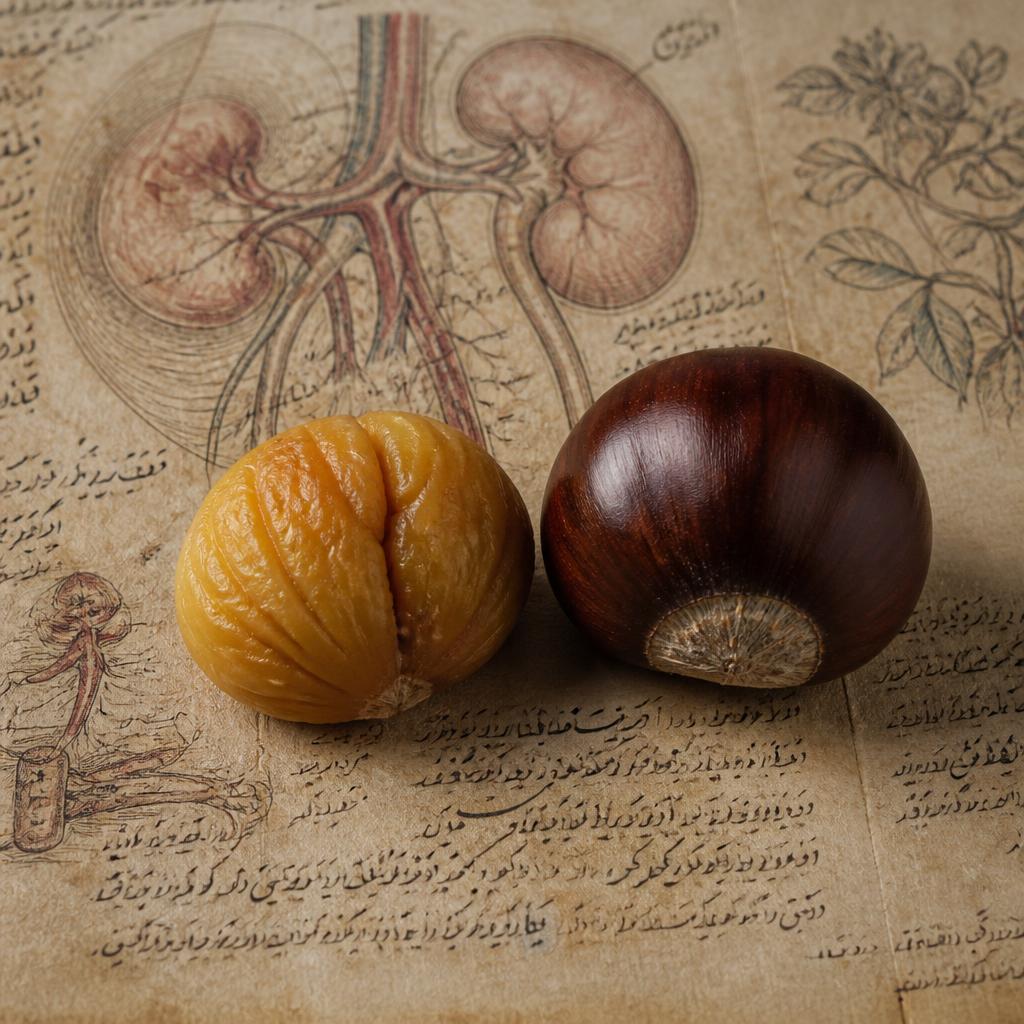
Persian medicine reads shāh-balūt as warm and dry — a fortifying winter food, especially for kidneys and cold-weak constitutions.
Always cook before eating — raw chestnuts carry tannins (plant compounds that give a dry, puckering taste) that irritate the gut. Scoring and roasting is the classical preparation.
Chapter 2 of 17
Getting to Know Chestnut
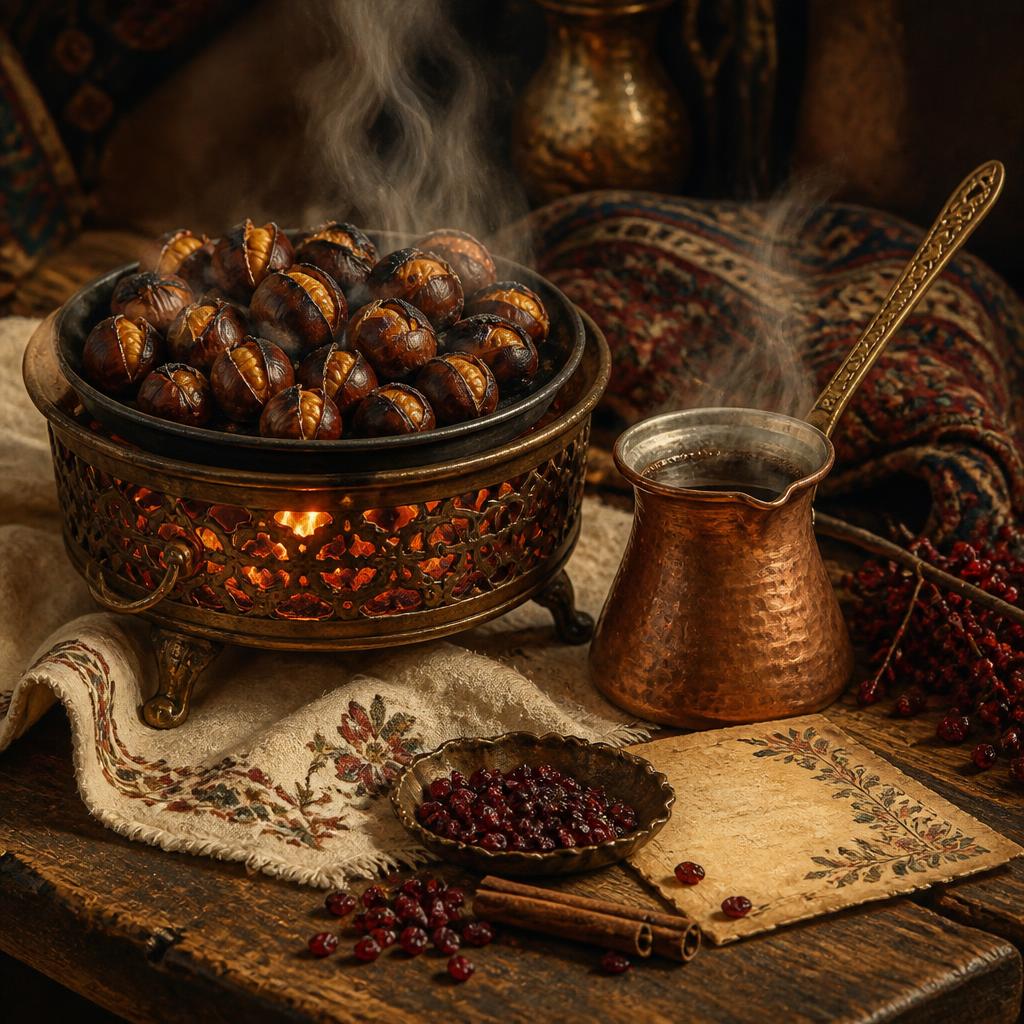
Castanea sativa is the odd one out on the ājīl plate. Unlike almond, walnut, or pistachio, chestnut is hardly a nut in the nutritional sense. It's a low-fat, high-carbohydrate, gluten-free starchy fruit inside a burnished mahogany shell. You can roast it over a coal brazier in old Tehran neighbourhoods, boil it for winter stews, or grind it into a mildly sweet gluten-free flour. However you use it, chestnut is a warming, grounding food for the coldest months, with a small but real amount of vitamin C that no other nut offers.
Chapter 3 of 17
Why It Matters
It's easy to group every 'nut' together as a high-fat heart helper, but chestnut breaks the pattern. It's a warming, satisfying, gluten-free carbohydrate that suits the coldest weeks, with a little vitamin C that no other nut brings. For older adults and anyone with weak digestion, roasted chestnut offers useful energy without the fat load of the ājīl plate.
Its low glycaemic index (compared to refined carbs) also makes it gentler on glucose than the bread or biscuit it often replaces.
Chapter 4 of 17
Why It Matters: What That Means Day to Day
Chestnut can be a quiet winter helper for older adults. It's a grounding, low-fat, gluten-free carbohydrate with a small but real amount of vitamin C. Warm chestnuts are easy to chew, kind to a low appetite, and gentler on glucose than the bread or biscuit they often replace. The classical Persian view — muqawwī-e kuliyeh, fortifying to weak kidneys and cold-weak constitutions — fits this picture of a nourishing seasonal food for the coldest, driest weeks of the year.
Complex carbohydrates for sustained, grounding winter energy.
Very low fat (~1 g/oz): lower calorie per ounce than any tree nut.
Potassium, manganese, and copper for muscle, bone, and connective-tissue function.
Chapter 5 of 17
What It Contains
Primary compounds
Complex starch (~40 g per 100 g roasted) — the grounding winter carbohydrate signal.
Vitamin C (~10–20 mg per 100 g roasted) — unusual for a nut. Supports collagen and non-haem iron absorption.
Potassium (~500 mg per 100 g) — vascular (relating to the blood vessels) tone and fluid balance.
Chapter 6 of 17
What It Contains: Other Constituents
Ellagic acid and gallic acid: polyphenols (protective plant compounds) in the skin with mild antioxidant activity · Manganese and copper: antioxidant enzyme and connective-tissue cofactors.
Resistant starch: colonic microbiome (the community of bacteria living in your gut) food when chestnuts are cooked and cooled.
Vitamins
Folate, Vitamin B6, Thiamin (B1), Riboflavin (B2)
Other notable constituents
Minerals: Magnesium, Phosphorus · Healthy Fats: Very low fat (~1 g per oz) · Protein: ~1 g per 1 oz
Fiber: ~2 g per 1 oz
Notable: Naturally gluten-free, Low glycaemic index (a measure of how quickly a food raises blood sugar) for a starch (~50–60)
Chapter 7 of 17
In the Laboratory
From laboratory work, not from people taking it
Chestnut polyphenols (protective plant compounds) shows measurable antioxidant activity in vitro (in laboratory dishes, not in people) and in animal models. Rated: early research.
Chapter 8 of 17
What Studies in People Show
What studies in people show
Chestnut consumption improves lipid profile and antioxidant status in short-term feeding studies.Moderate evidence
Chestnut flour has a lower glycaemic index (a measure of how fast a food raises blood sugar) than wheat flour and produces a flatter post-prandial glucose curve.Moderate evidence
Chestnut has been reported as a cross-reactive food in latex-fruit syndrome.Moderate evidence
Chapter 9 of 17
Preparation and Kitchen Use
A small handful of hot roasted chestnuts on a cold afternoon or evening, ideally with cinnamon-spiced black tea. Chestnut purée with warm milk, cardamom, and honey belongs in convalescent breakfasts. Winter, not summer, is the classical season.
Score the shell in a cross, roast at 200°C (400°F) for ~20 minutes — the classical Iranian and Italian winter street food.
Boil 20–30 minutes and peel while warm for stews and pilafs.
Boil, peel, and mash into a purée for winter desserts (marron glacé, chestnut cream).
Grind roasted chestnut into gluten-free flour for cakes (castagnaccio) and Persian winter breads.
In the kitchen: preserved in syrup (marron glacé) or dried and rehydrated in mountain kitchens. Fold into winter khoresh, stuffings, or Sabzi pilaf for grounding warmth.
Store fresh chestnuts refrigerated. They spoil faster than tree nuts.
Add whole roasted chestnuts to winter stews, pilafs, and stuffings for a warming, grounding starch.
Chapter 10 of 17
Medicines and Interactions
Medication interaction:
Antidiabetic medication (metformin, sulphonylureas, insulin) — Chestnut is a starchy food — it raises glucose more than a tree nut, though less than refined carbs at matched portion. Count as part of the daily carbohydrate allowance on insulin. (low concern)
Medication interaction:
Warfarin — Vitamin K content is modest and stable at culinary portions; no meaningful INR (the blood test that shows how fast your blood clots) swing at a handful of roasted chestnuts. (low concern)
General caution:
Levothyroxine, bisphosphonates — Divalent minerals from a chestnut-heavy meal can mildly bind and reduce absorption. Separate dosing by ≥ 2 hours from a large chestnut serving. (low concern)
Chapter 11 of 17
Who Should Be Careful
General caution:
Do not confuse with horse chestnut (Aesculus hippocastanum) — horse chestnut is inedible and toxic.
Allergy:
Tree-nut or seed allergies are common — avoid if affected.
General caution:
Never eat raw — raw chestnuts contain tannins (plant compounds that give a dry, puckering taste) that irritate the gut and are difficult to digest.
General caution:
Score the shell before roasting — un-scored chestnuts can burst violently in a hot oven.
Chapter 12 of 17
Who Should Be Careful: Latex-fruit syndrome
General caution:
Fresh chestnuts spoil quickly (higher water content than tree nuts); refrigerate and use within 1–2 weeks.
Allergy:
Confirmed chestnut or wider tree-nut IgE allergy.
Allergy:
Latex-fruit syndrome — chestnut is a classical cross-reactive fruit; latex-allergic patients introduce cautiously and under allergist guidance.
General caution:
Raw chestnut — always cook.
Chapter 13 of 17
Pregnancy, Children and Older Adults
General
Children:
Whole nuts and seeds are a choking hazard for young children.
Children:
Whole chestnuts are a choking hazard for children under age 4 — use puréed or mashed.
Pregnancy and breastfeeding
Pregnancy and breastfeeding:
Roasted chestnut is safe and useful throughout pregnancy as a grounding winter carbohydrate with modest vitamin C, folate, and potassium. Counts as part of the daily carbohydrate portion in pregnancy diabetes management. Confirmed tree-nut allergy and latex-fruit syndrome are the true stops.
Children
Children:
Puréed and mashed chestnut can be introduced from around 8–9 months once solids are established, watching for the uncommon chestnut allergy. Whole roasted chestnuts wait until age 4 due to choking risk. From childhood onward, a paper cone of shāh-balūt dāgh shared on a winter walk is one of the most beloved seasonal foods in the Persian household.
Older adults
Older adults:
Chestnut is a quietly useful winter food after 60: a low-fat, gluten-free, grounding carbohydrate that's easy to chew when warm, kind to appetite, gentler on glucose than the biscuit it often replaces, and specifically fortifying to cold-weak constitutions and kidneys in the classical Persian reading. Puréed chestnut with warm milk, cardamom, and honey is one of the gentlest convalescent foods after long winter illness.
Chapter 14 of 17
Traditional Persian Perspective
Persian temperament: Warm & Dry (Warm 1st–2nd, Dry 1st degree — Ibn Sīnā, Aghili Khorasani). Persian and Yūnānī medicine class shāh-balūt as warm (1st–2nd degree) and dry (1st degree) — muqawwī, mughaddhī, and specifically fortifying to weak kidneys and cold-weak constitutions in winter. The classical caution is that chestnut is thaqīl (heavy on the stomach). The household correction is to roast rather than boil, chew slowly, and pair with warming aromatics like cinnamon, cardamom, or a spoon of honey.
In the Household
Persian, Galenic, and Yūnānī medicine class shāh-balūt as warm (1st–2nd degree) and dry (1st degree). They describe it as muqawwī (strengthening), mughaddhī (nourishing), and especially kidney-fortifying (muqawwī-e kuliyeh). Ibn Sīnā and Aghili Khorasani both include roasted chestnut among winter foods for cold, weak, easily tired constitutions and for recovery after a long illness. Why roasted and not boiled?
The traditional caution is that shāh-balūt can feel heavy on the stomach (thaqīl), so households roast it, chew it well, and pair it with warming spices like cinnamon and cardamom — which is how it's given to anyone with a cold, tired constitution who needs building up gently.
Chapter 15 of 17
Traditional Persian Perspective: Older Uses
It was used: gluten-free flour for winter breads in mountain traditions (Corsica, Tuscany). Post-hunt and post-labour restorative in European village tradition.
Across Iran, Turkey, Italy, France, Japan, and the UK, roasted-chestnut vendors are part of winter. A paper cone of shāh-balūt dāgh warms a schoolchild's hands on the walk home from madraseh. In Iran, shāh-balūt also appears in winter pilafs and celebratory ājīl. Chestnut flour carried mountain villages in Corsica and Tuscany through winter for centuries, while Japan celebrates kuri in autumn wagashi.
Chapter 16 of 17
Questions People Ask
Can I eat chestnuts raw?
No. Raw chestnuts carry tannins and are difficult to digest — always roast or boil. Scoring the shell in a cross before roasting prevents them from bursting.
Are chestnut flour and chestnuts safe on a gluten-free diet?
Yes. Chestnut is naturally gluten-free and one of the classical winter starches for coeliac and gluten-sensitive kitchens.
Are horse chestnuts the same thing?
No. Sweet chestnut (Castanea sativa) is edible and delicious. Horse chestnut (Aesculus hippocastanum) is a different tree entirely and is toxic.
Chapter 17 of 17
Sources
Office of Dietary Supplements: nuts & Seeds — US National Institutes of Health (NIH). https://ods.od.nih.gov/factsheets/list-all/.
FoodData Central: uS Department of Agriculture. https://fdc.nal.usda.gov/.
Castanea sativa: a comprehensive review of its nutritional and health properties — J Sci Food Agric (PubMed). https://pubmed.ncbi.nlm.nih.gov/25640281/
Chestnut (Castanea sativa) fruit polyphenols and antioxidant activity — Food Chem (PubMed). https://pubmed.ncbi.nlm.nih.gov/26041205/
Glycaemic index of chestnut and chestnut flour products — Int J Food Sci Nutr (PubMed). https://pubmed.ncbi.nlm.nih.gov/22916813/