Black tea carries polyphenols (protective plant compounds) linked in large studies to heart and blood vessel health.
Modest caffeine: steadier and gentler than coffee for most people.
L-theanine in tea leaves is studied for calm, focused attention.
Hot fluid through the day helps people who otherwise drink very little water.
Chapter 2 of 13
What Persian Chai Actually Is
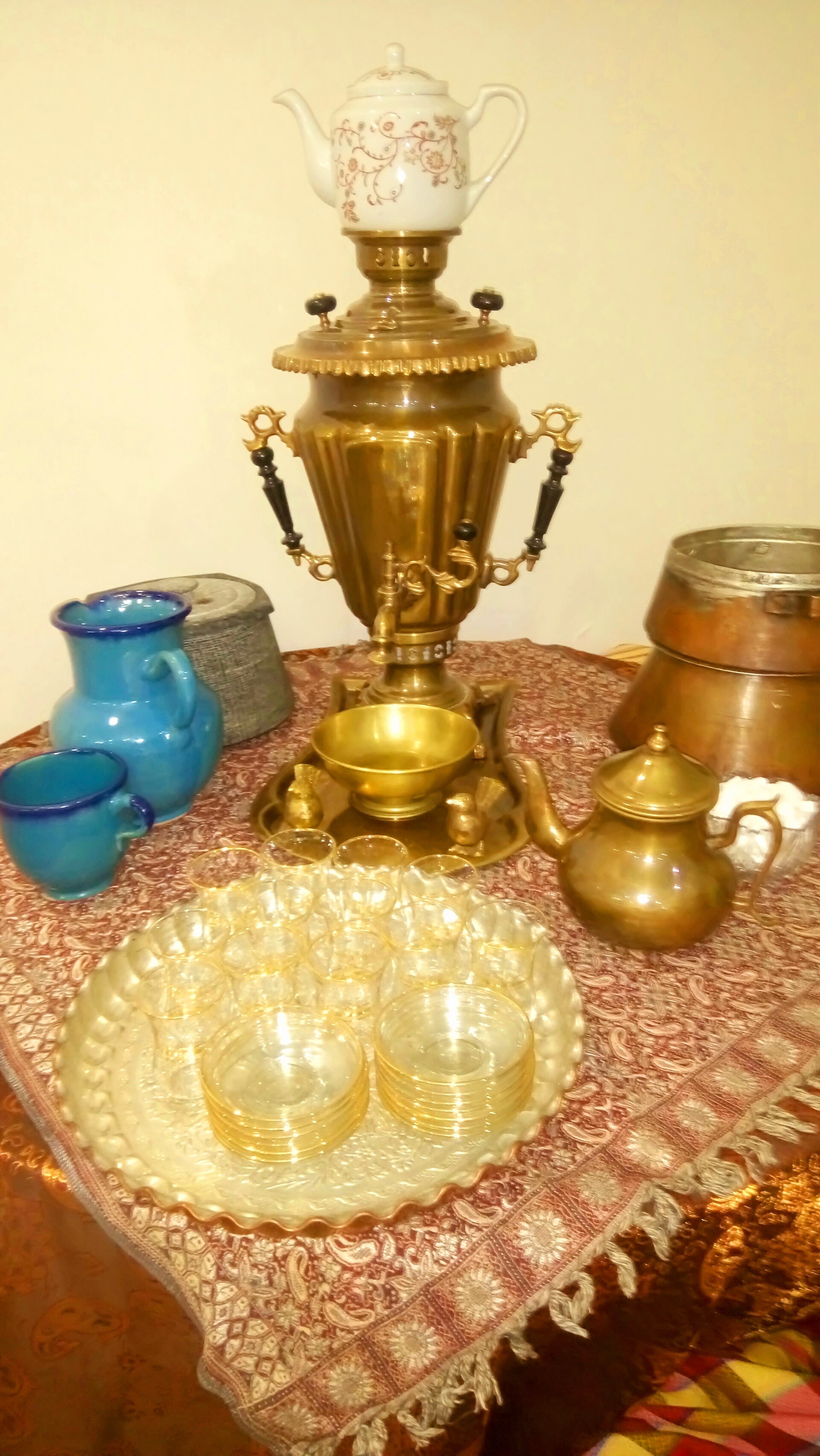
Tea arrived in Iran relatively late, then became part of daily life from morning to night. It grows in Gilan province around Lahijan, on the wet green slopes below the Caspian Sea. To brew it, strong tea steeps in a small pot resting over a kettle or samovar. Each glass gets some concentrate and some hot water, so everyone can choose their own strength.
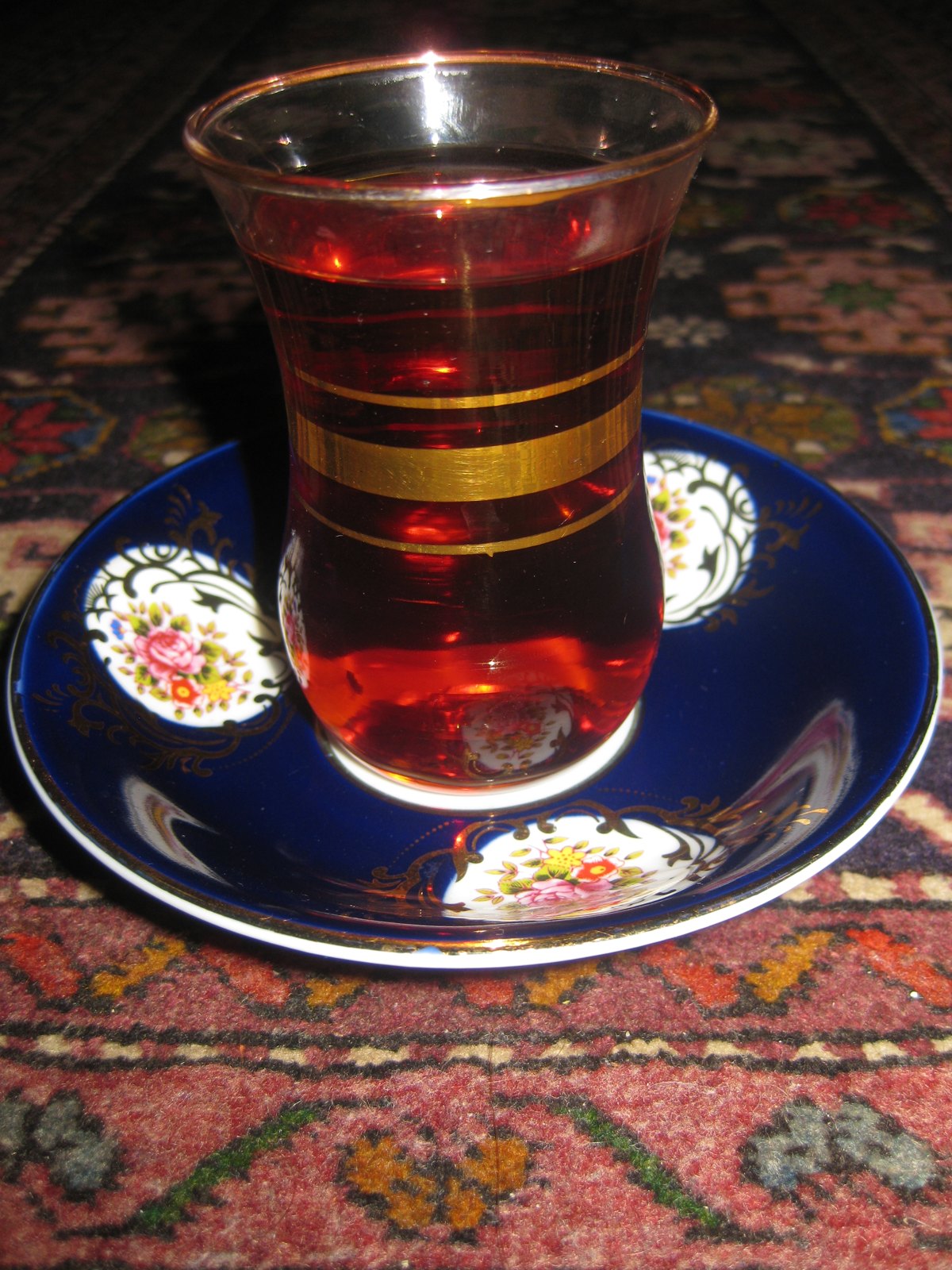
The tea comes in a kamar-barik — a small waisted glass — where you can see its colour. Instead of stirring in sugar, people may hold a cube between their teeth or swirl a stick of nabāt through the glass.
A social ritual that slows the pace of a meal — a real, underrated benefit.
Tea isn't native to Iran. It arrived late, and only took hold about a hundred years ago in the wet northern provinces of Gilan and Mazandaran.
Chapter 3 of 13
What Persian Chai Actually Is: A Little More Background
Iranian tea from Lahijan is picked, withered and dried locally. It brews a lighter, more perfumed cup than the strong Indian and Ceylon blends most families also keep in the house.
Green tea and black tea come from the same plant. The difference is one step: black tea leaf is bruised and left to oxidise before drying, which darkens it and deepens the taste.
Persian tea is almost always black, and often scented with cardamom, rose petals or a little bergamot. Green tea exists in Iran but belongs to the herbalist's shelf more than the family table.
Chapter 4 of 13
What It Contains
Antioxidants: Theaflavins, Thearubigins, Catechins (plant compounds common in green tea) · Notable: ~40–70 mg caffeine per cup, Essentially no calories without sugar, Contains fluoride and manganese
Chapter 5 of 13
What Studies in People Show
What studies in people show
Large studies that follow people over years link about 1.5–2 cups of tea a day with a lower risk of death from heart disease. These studies show an association.
A meta-analysis (a study that pools the results of many trials) of 38 long-term cohort data sets (nearly 2 million people) found moderate tea drinking (about 1.5–2 cups a day) was associated with lower death from all causes and from heart disease. These are observational (based on watching what people already do) findings.
Chapter 6 of 13
Using It in the Kitchen
Warm the pot, add one teaspoon of leaf per cup, and steep 4–5 minutes over the kettle.
Pour a little concentrate into the glass and top with hot water to the strength you want.
Add cardamom, cinnamon or dried rose petals to the pot in winter.
Sweeten with a stick of nabāt rather than stirring in loose sugar.
Don't boil the leaf itself — boiled tea turns bitter and dull.
Persian tea is made in two parts. The samovar holds boiling water. A small teapot sits on top, where a strong brew steeps slowly in the rising heat.
You pour a little of that strong brew into the glass, then top it up with water from the samovar. Everyone gets the strength they like from the same pot — that's the whole point of the design.
The Rest of It
Boiling the leaves directly makes the tea bitter. In this method the pot is kept hot, never boiled.
The teahouse is still called the ghahve-khaneh — the coffee house — from the days before tea replaced coffee in Iran.
What is served there's not really the drink. It's the hour: sitting, talking, an unhurried second glass. Tea in Iran is a reason to stay at the table, and most of its value to health lives in that habit as much as in the leaf.
Chapter 8 of 13
Caffeine, Iron and Very Hot Drinks
General caution:
Caffeine after mid-afternoon disturbs sleep in many people, and Iranian tea is drunk late.
General caution:
Very hot drinks are linked to a higher risk of oesophageal cancer. Let the glass cool a few minutes before drinking.
General caution:
Held between the teeth, sugar cubes and nabāt bathe the teeth in sugar. This is hard on tooth enamel.
Pregnancy and breastfeeding:
In pregnancy keep total caffeine under about 200 mg a day — roughly three to four glasses.
General caution:
Tannins (plant compounds that give a dry, puckering taste) in tea block iron absorption. Leave an hour between tea and an iron-rich meal or an iron tablet, especially if you're anaemic.
Chapter 9 of 13
Traditional Persian Perspective
Persian medicine describes tea as warm and dry, and traditionally uses it to lift a heavy stomach after a rich meal and clear a sluggish head. That's why tea often arrives after food. In cold weather, cardamom, rose petals, or cinnamon may go into the pot to warm it further.
Tea is drunk from a small clear glass, an estekan, so the colour can be seen. Most people take it plain and hold a sugar cube or a piece of nabat between the teeth while sipping.
Iron and Absorption
This is called chai ghand pahlu, and it uses far less sugar than stirring spoonfuls into the glass. The sweetness is only on the way in.
One practical note: strong tea taken with a meal makes it harder for the body to absorb iron from that food. If iron is a concern, drink tea between meals rather than with them.
Chai is hospitality in a glass. It often arrives before the conversation begins, and refusing the first one can feel awkward. Tea is there for visits, negotiations, funerals, weddings, and ordinary afternoons. In a Persian room, the samovar in the corner is rarely truly off.
Chapter 10 of 13
What It Goes With
Pairing:
Nabāt (rock candy)
Swirled through the glass — the traditional Persian sweetener for tea.
Spice:
Cardamom
A crushed pod in the pot is the standard winter addition.
Rose:
Rose
Dried petals in the pot give the perfumed tea served at ceremonies.
Chapter 11 of 13
What It Goes With: More Pairings
Pairing:
Dates
A date beside the glass is the plainest Iranian sweet with tea.
Spice:
Cinnamon
A stick in the pot warms the tea in cold weather.
Spice:
Saffron
A thread or two turns an ordinary pot into a golden, festive one.
Chapter 12 of 13
Sources
Sad Giah Hezar Darman (صد گیاه و هزار درمان) — One Hundred Plants and One Thousand Remedies — Dr. Hossein Erfani, 4th edition (1375 / 1996–1997). Primary traditional Persian herbal reference cited throughout this platform. Presented as traditional knowledge, not as modern medical proof.
Office of Dietary Supplements: fact Sheets — US National Institutes of Health (NIH). https://ods.od.nih.gov/factsheets/list-all/.
Herbal Database: memorial Sloan Kettering Cancer Center. https://www.mskcc.org/cancer-care/diagnosis-treatment/symptom-management/integrative-medicine/herbs.
Herbs at a Glance: uS NIH National Center for Complementary and Integrative Health (NCCIH). https://www.nccih.nih.gov/health/herbsataglance.
FoodData Central: searchable nutrient database — US Department of Agriculture (USDA). https://fdc.nal.usda.gov/.
Chapter 13 of 13
Sources (continued)
The Nutrition Source: harvard T.H. Chan School of Public Health. https://www.hsph.harvard.edu/nutritionsource/.
PubMed — peer-reviewed biomedical literature — US National Library of Medicine. https://pubmed.ncbi.nlm.nih.gov/