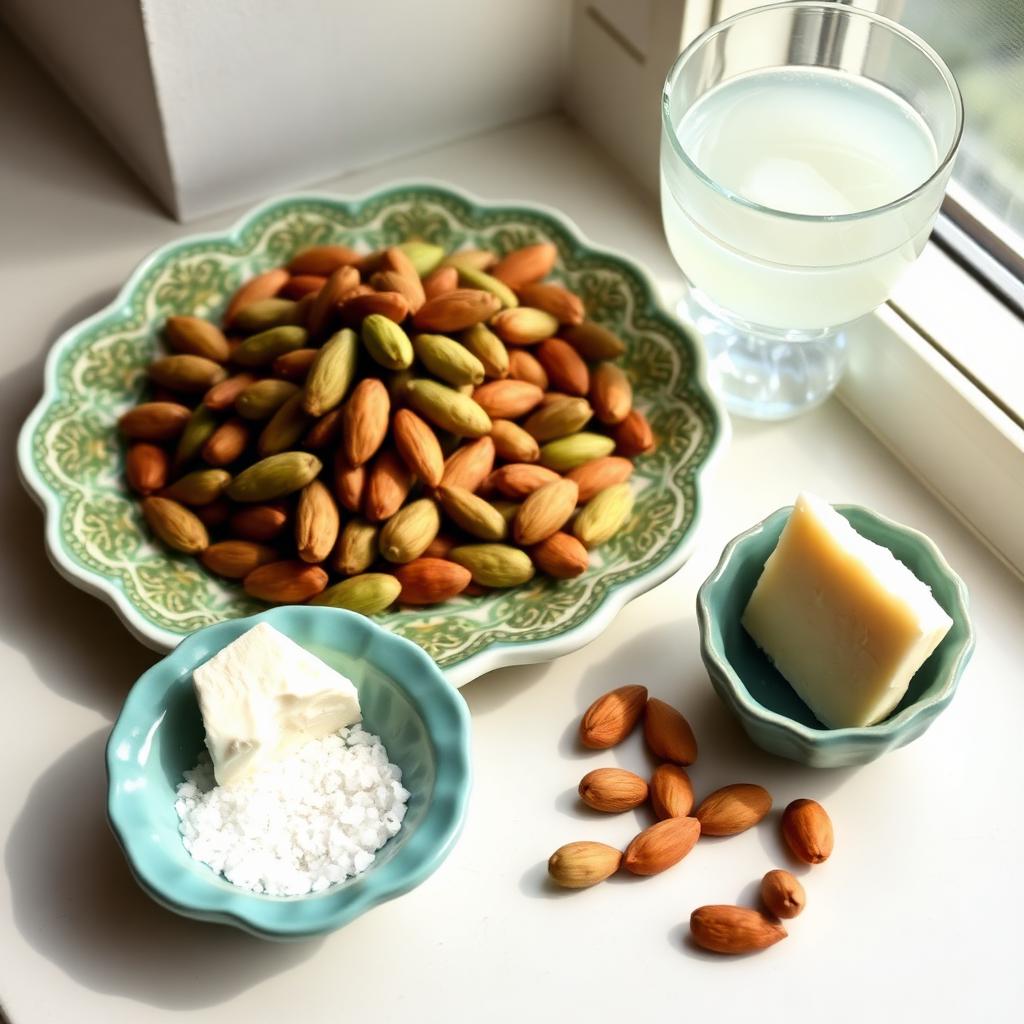
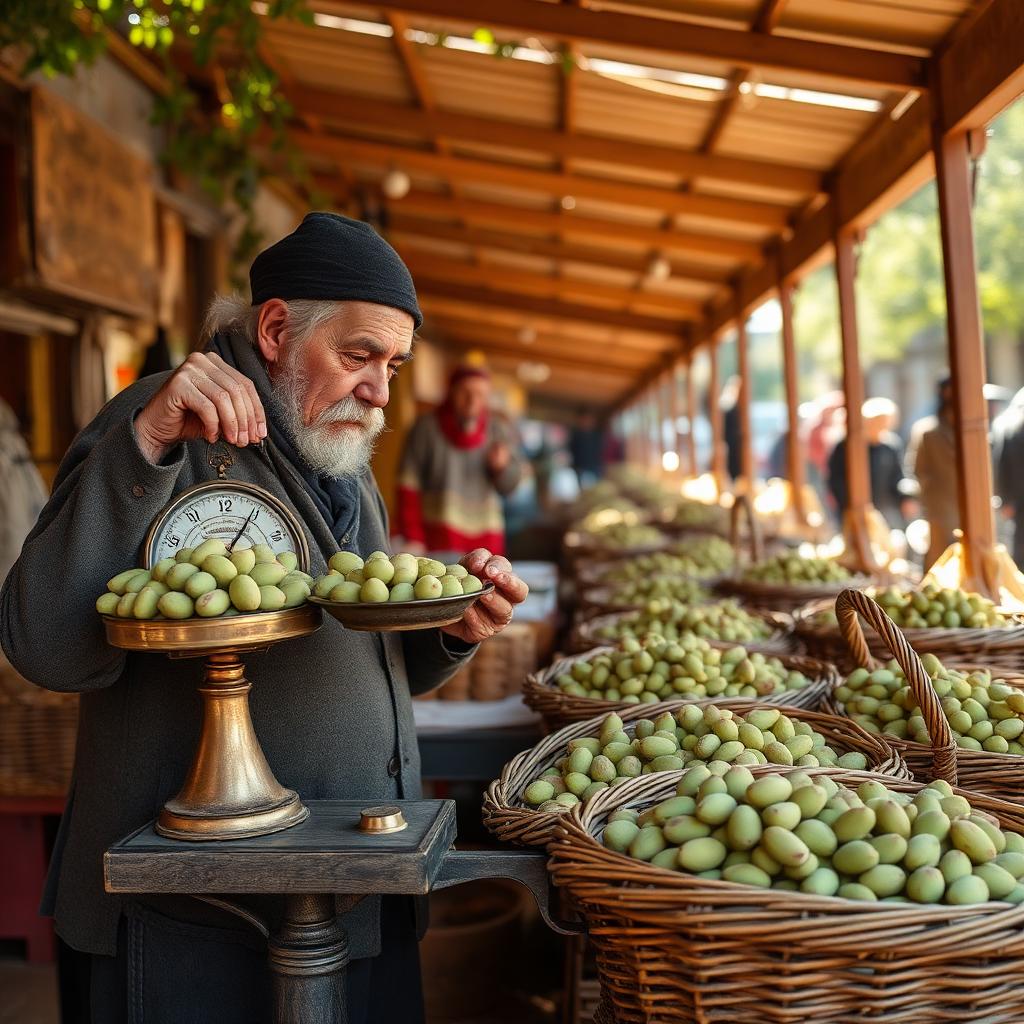
A strictly seasonal food is the four-to-six-week Persian spring window from mid-March through late April. Frozen or brined chaghāleh keeps the season alive year-round.
Cold-and-moist mizaj (Cold 2nd, Moist 1st) — the classical corrective for liver heat, gastric heat, and heartburn after rich Nowruz meals.
Eat the whole fruit, fuzz-skin and all, with a small dish of sea salt — the traditional pairing that lifts the flavour and balances the coolness.
Distinct from the mature dry almond (bādām) — different mizaj, different indications, different season on the calendar.
Chapter 2 of 14
Getting to Know Fresh Unripe Almond (Chaghaleh Badam)
Chaghāleh bādām is the young, unripe fruit of the almond tree (Prunus dulcis), picked in a four-to-six-week window from mid-March through late April, before the inner shell hardens and the seed turns into the dry almond you know. You eat the whole thing: fuzzy grass-green skin, tender green flesh, and the seed inside while it's still jelly-soft. In Iran and across the Levant people wait for it all year — it lands on Nowruz tables, fills copper trays at every spring bazaar, and gets dusted with sea salt at family picnics on Sizdah Bedar (the 13th day of the Persian new year, spent outdoors by tradition). Nutritionally, chaghāleh is water-rich (~75% water), quietly hydrating, with modest vitamin C, potassium, and a small dose of the almond's alpha-tocopherol and monounsaturated fat starting to accumulate in the developing seed. Classical Persian medicine reads it as cold-and-moist — a corrective for the hot-and-dry liver, gastric heat, and heartburn that trail the heavy meat-and-oil dishes of the Nowruz feast.
Chapter 3 of 14
Why It Matters
Chaghāleh bādām is one of the few Persian seasonal foods where the old mizaj reading lines up exactly with what we now know about it — a water-rich, cooling, low-fat spring fruit that answers the precise heat of the Nowruz table it shows up on. If you're cooking with the seasons, chaghāleh is spring's version of sour cherry and cucumber: a food whose whole job is to cool.
Modest vitamin C at spring's transition.
Potassium supports vascular (relating to the blood vessels) tone and hydration.
Chapter 4 of 14
What It Contains
Primary compounds
Water (~75% by weight) is the primary reason chaghāleh is hydrating and cooling.
Developing alpha-tocopherol and monounsaturated fat in the still-jelly seed — a small early dose of the mature almond's signature nutrients.
Polyphenols (proanthocyanidins, chlorogenic acid) in the green skin — mild antioxidant contribution.
Trace amygdalin in the developing seed — negligible at the fresh-fruit stage and eliminated as the seed matures. A real caution only for bitter-almond varieties (see contraindications).
Other notable constituents
Minerals: Calcium (small), Magnesium (small) · Protein: ~2 g per 100 g fresh · Fiber: ~3 g per 100 g fresh
Notable: ~75% water, One of the few fruits eaten with the skin, flesh, and undeveloped seed together
Chapter 5 of 14
In the Laboratory
From laboratory work, not from people taking it
Fresh unripe almond fruit (chaghāleh) is water-rich, low-fat, and contributes vitamin C, potassium, and polyphenols (natural plant compounds studied for antioxidant activity) at spring's transition — a compositional profile consistent with its traditional cooling role. Rated: moderate evidence.
Green almond and other unripe Prunus fruits carry meaningful antioxidant polyphenols (proanthocyanidins, chlorogenic acid) in the skin layer, consistent with in-vitro anti-inflammatory activity. Rated: moderate evidence.
Chapter 6 of 14
Preparation and Kitchen Use
Enjoy in its 4–6 week window (mid-March through late April). Don't force out-of-season imports.
Rinse briefly under cold water. Serve whole, fuzz-skin on, with a small dish of sea salt.
Chop coarsely into a bowl with a squeeze of lemon and a pinch of salt for a spring salad.
Steep chopped chaghāleh in cold water for 30 min with a little sugar and lemon for a cooling spring drink.
Freeze whole fresh chaghāleh in a single layer to keep the season alive year-round.
Brine in salt water for 2–3 weeks (traditional Levantine preserve) for out-of-season use.
Chapter 7 of 14
Medicines and Interactions
Medication interaction:
Warfarin (a blood-thinning medicine), DOACs — Vitamin K content is low; no clinically meaningful INR (the blood test that shows how fast your blood clots) effect at seasonal culinary intake. (low concern)
Medication interaction:
Antihypertensives — Modest potassium contribution; food-scale effect, no clinically important interaction at culinary intake. (low concern)
Medication interaction:
Oral medications generally — No significant chelation or delayed absorption at culinary spring intake — a small bowl isn't a supplement dose. (low concern)
Chapter 8 of 14
Who Should Be Careful
Allergy:
Wash thoroughly — chaghāleh is often sold fresh from spring orchards with residual pollen and dust on the fuzzy skin.
General caution:
Enjoy in season — out-of-season imports lose the mizaj and texture the classical texts describe.
General caution:
Bitter-almond varieties (rare, mostly ornamental Prunus dulcis var. amara) are NOT eaten fresh — amygdalin/cyanogenic content is real; the culinary chaghāleh is exclusively the sweet-almond varietal.
Uncertain provenance
General caution:
The still-jelly seed of the sweet-almond chaghāleh is safe in normal culinary amounts; don't seek out or eat bitter-almond chaghāleh.
Allergy:
Confirmed tree-nut (almond) IgE allergy — chaghāleh is the unripe fruit of the same tree and can cross-react; avoid entirely.
General caution:
Uncertain provenance — home-grown ornamental almond trees may be bitter-almond varietals and aren't safe to harvest without positive identification.
Chapter 9 of 14
Pregnancy, Children and Older Adults
General
Children:
Whole chaghāleh is a choking hazard for children under 4 — chop into small pieces.
Pregnancy and breastfeeding
Pregnancy and breastfeeding:
Fresh chaghāleh bādām in ordinary spring amounts is safe and traditional in pregnancy — cooling, hydrating, and a modest vitamin C and folate contribution at spring's transition. The only true stops are a confirmed tree-nut allergy (chaghāleh is the unripe almond and cross-reacts) and any bitter-almond varietal, which is never a food. Wash thoroughly.
Children
Allergy:
Chopped chaghāleh in small pieces can be introduced from around 12–18 months, once tree-nut allergy status is clear and chewing is reliable. Whole fresh green almonds are a choking hazard under age 4. In tree-nut-allergic families, discuss with the paediatrician before first introduction. Well-washed and sourced from a known sweet-almond varietal only.
Older adults
Older adults:
A gentle spring pleasure for older adults — cooling, hydrating, low in fat and sugar, and a modest vitamin C contribution at the transition of the year. The classical bowl of chaghāleh with salt is one of the least stressful spring foods on the older digestion and one of the most reliable for post-feast heartburn. Chop into small pieces for anyone with unreliable chewing.
Chapter 10 of 14
Traditional Persian Perspective
Persian temperament: Cool & Moist (Cold 2nd, Moist 1st degree). Aghili Khorasani's Makhzan al-Adwiya reads chaghāleh bādām as cold in the second degree and moist in the first — mubarrid (cooling), muraṭṭib (moistening), and specifically indicated for hararat-e kabed (liver heat), qola (aphthous ulcers of the mouth from heat), and hararat-e mede (gastric heat / heartburn). Salt is the classical corrective on the plate — it slightly warms the cold quality and lifts the flavour without undoing the cooling role.
In the Household
In Aghili Khorasani's Makhzan al-Adwiya and Ibn Sīnā's Al-Qānūn, the unripe stone fruits — chaghāleh bādām, gojeh sabz (green plum), ālūcheh (unripe plum), and unripe apricot — are grouped together as the cool-and-moist mubarridāt of spring, eaten because they answer the leftover heat of winter food and the richness of the Nowruz table.
The household rule is exact: eat them fresh, whole, in their short season, with a small dish of salt to lift the flavour and take the edge off the cold quality. Never dried, never kept in sugar, never out of season.
Chapter 11 of 14
Traditional Persian Perspective: Older Uses
It was used: spring cooling food for liver heat, gastric heat, and heartburn after Nowruz feasts. Sizdah Bedar picnic snack with salt, sold from copper trays at spring bazaars.
Cooling drink base is chopped and soaked in cold water with a little sugar and lemon (spring sharbat).
Ibn Sīnā's Al-Qānūn fi'l-Ṭibb groups unripe stone fruits (green almond, green plum, unripe apricot) as the classical spring mubarridāt correctives to the residual heat of winter foods. Rated: traditional observation.
Chapter 12 of 14
In Persian Life
Chaghāleh bādām is one of the most loved seasonal foods of the Persian year — sold from copper trays and glass jars at every spring bazaar from Tehran to Isfahan, handed to Nowruz guests as the first thing offered, and carried to Sizdah Bedar picnics dusted with salt and wrapped in cool cloth. Because the season is so short, it works as a marker of time — the way the Persian year announces itself.
Chapter 13 of 14
Questions People Ask
Why is chaghāleh eaten with salt?
Salt is the classical mizaj correction the Persian kitchen has always used. Chaghāleh is cold 2nd and moist 1st degree — deeply cooling. A small dish of sea salt slightly warms the cold quality and lifts the flavour without undoing the cooling role.
Is chaghāleh the same as an almond?
It's the same tree, but a different food — different mizaj, different indications, different season. Fresh chaghāleh is cool and moist, hydrating, and low in fat. The mature dry almond (bādām) is warm and moist, dense in fat and vitamin E. The Persian year uses both, at their proper moment.
Is chaghāleh safe in pregnancy?
Yes, in ordinary spring amounts — cooling, hydrating, and modestly contributing vitamin C and folate. The only true stop is a confirmed tree-nut allergy. Wash thoroughly and source from a known sweet-almond varietal (never bitter-almond).
Chapter 14 of 14
Sources
Office of Dietary Supplements: nuts & Seeds — US National Institutes of Health (NIH). https://ods.od.nih.gov/factsheets/list-all/.
FoodData Central: uS Department of Agriculture. https://fdc.nal.usda.gov/.
End of the Fresh Unripe Almond (Chaghaleh Badam) guide