The single lowest-fat common tree nut, with a proportionally dense magnesium and copper load. Ayurveda treats kaju as a warming, moistening rasayana for thin, dry, easily-fatigued constitutions.
Randomised trials show cashew intake is at worst lipid-neutral and at best mildly LDL-lowering — no adverse effect on weight at ~1 oz/day.
'Raw' cashews are always steamed. The whole-shell nut carries urushiol and is never safe unprocessed.
Chapter 2 of 17
Getting to Know Cashew
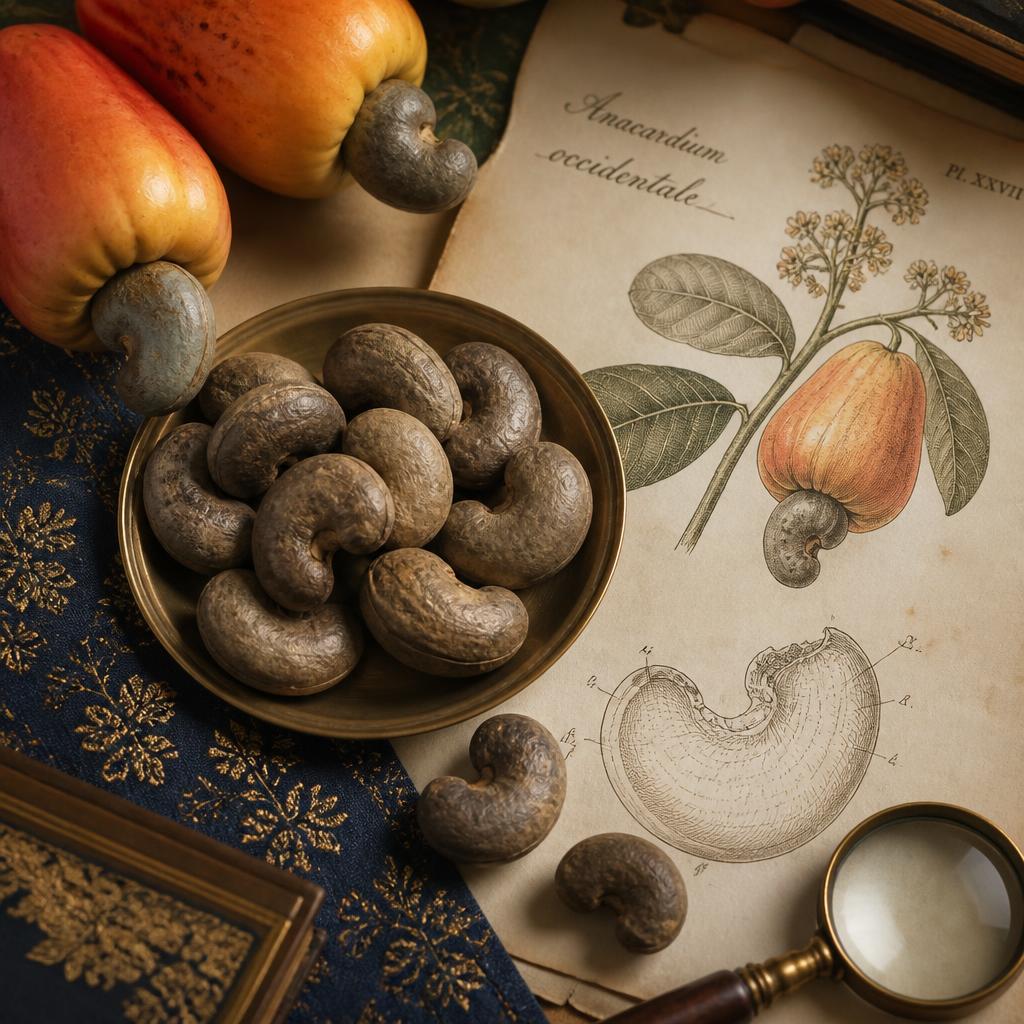
Anacardium occidentale comes from north-eastern Brazil and rode 16th-century Portuguese ships to India, East Africa, and South-East Asia, which is where most of it is grown and processed today. Each cashew apple carries one curved seed inside a burning double shell that has to be steamed before the kernel can come out — which is why no cashew you buy is ever truly raw. Ayurveda calls kaju ushna (warming) and snigdha (unctuous), a rasayana for weak, thin constitutions. Modern trials point the same direction: it doesn't upset blood lipids, and it carries a lot of minerals in a lower-fat package than most tree nuts.
Chapter 3 of 17
Why It Matters
Magnesium and copper both slip quietly in the second half of life — the first shows up as bad sleep and muscle cramps, the second as an anaemia that iron alone won't fix. A daily 1 oz handful of cashews carries a useful amount of each, in a lower-fat, buttery form that stays kind to weight and blood-lipid targets. And if you cook plant-forward, soaked-and-blended cashew is the most versatile dairy stand-in there's.
What That Means Day to Day
Cashew touches three quiet things that shape how the second half of life feels: magnesium (sleep, cramps, vascular tone), copper (connective tissue, antioxidant enzymes, and the rare anaemia iron alone won't fix), and a lower-fat, buttery texture that stays kind to weight targets. A small handful a day — or a spoon of cashew cream on soup or oatmeal — is one of the easier ways to hold all three steady.
A Few More Points
Oleic-heavy fat profile fits a Mediterranean/portfolio dietary pattern.
Plant protein and fibre support satiety (the feeling of being full) and steady energy.
Lowest total fat of any common tree nut — a lower-calorie option per ounce.
Chapter 4 of 17
What It Contains
Primary compounds
Oleic acid (~7 g per oz) — the Mediterranean fat behind cashew's neutral-to-favourable lipid signal.
Copper (~0.6 mg per oz, ~65% DV) — one of the densest food sources per serving. Supports lysyl oxidase, ceruloplasmin, and antioxidant enzymes.
Other Constituents
Magnesium (~83 mg per oz): vascular (relating to the blood vessels) tone, sleep, and neuromuscular calm.
Plant sterols (~40 mg per oz) — modest additional LDL (the harmful type of cholesterol) contribution alongside the oleic fats.
Chapter 5 of 17
What It Contains: The Rest of the Picture
Proanthocyanidins in the seed coat: polyphenols (natural plant compounds studied for antioxidant activity) with mild vascular (relating to the blood vessels) and antioxidant activity.
Zinc (~1.6 mg per oz) — taste, skin, and immune support.
L-arginine: nitric-oxide precursor for endothelial function (how well the thin lining inside your blood vessels works).
Protein: ~5 g per 1 oz · Fiber: ~1 g per 1 oz · Notable: Lowest total fat among common tree nuts, Highest copper density of the common tree nuts
Chapter 7 of 17
What Studies in People Show
Moderate evidence
Cashew nut consumption did not adversely affect body weight or blood lipids and modestly lowered blood pressure in a 12-week RCT in adults with type 2 diabetes.Moderate evidence
Cashew consumption reduced systolic blood pressure and total cholesterol in a meta-analysis (a study that pools the results of many trials) of controlled trials. The difference was unlikely to be due to chance (researchers call this statistically significant).Moderate evidence
A cashew-enriched diet was lipid-neutral (no adverse effect on LDL) compared with a control diet in overweight and obese adults.Moderate evidence
Early research
Cashew nut consumption improved HDL (the helpful type of cholesterol) cholesterol and reduced LDL (the harmful type of cholesterol):HDL ratio in adults with type 2 diabetes.Emerging evidence
Chapter 8 of 17
Preparation and Kitchen Use
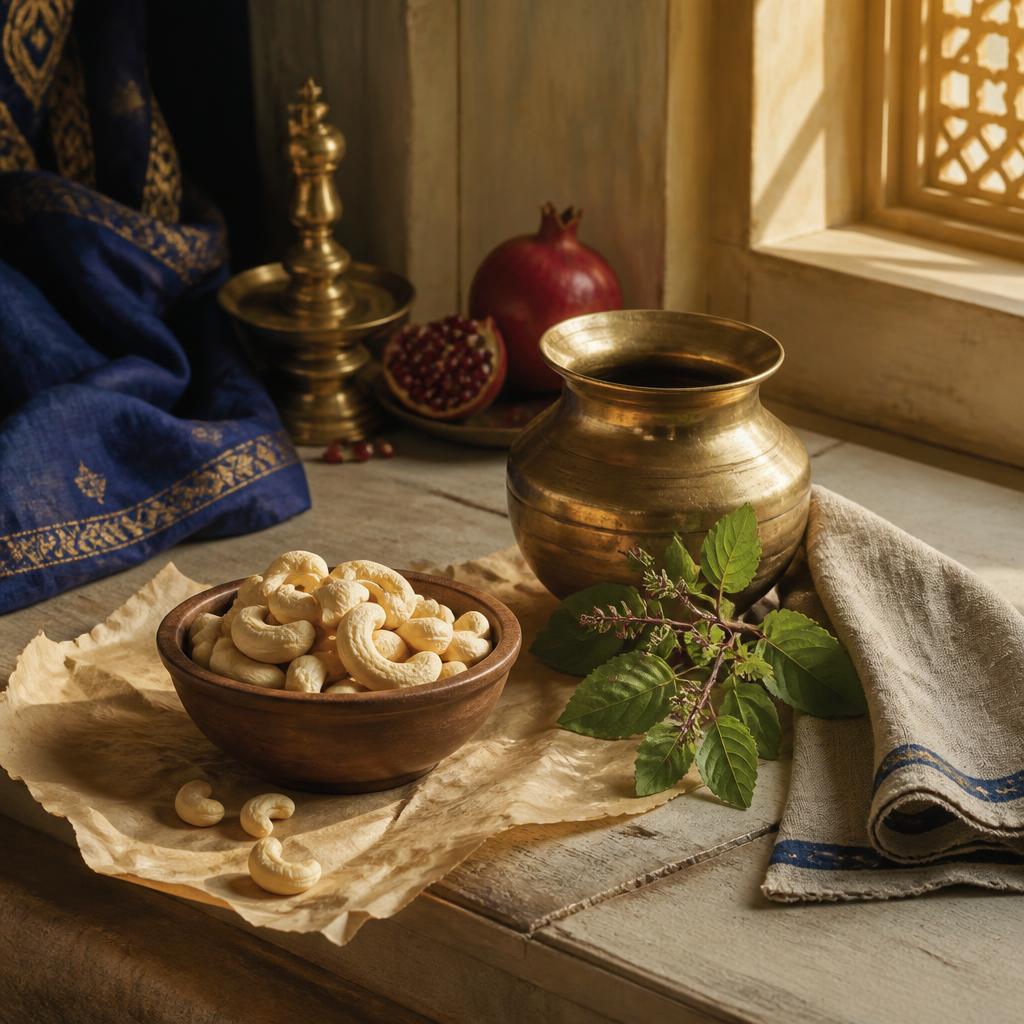
A daily 1 oz handful (~18 nuts) mid-morning or mid-afternoon with tea, or a spoon of cashew butter on whole-grain toast at breakfast for anyone who finds whole nuts hard to chew. The classical Ayurvedic preparation — warm milk with a spoon of ground cashew, cardamom, and saffron at bedtime — is reserved for convalescents and thin, easily-tired constitutions.
Ghee-roasted cashews with black pepper is the Indian household snack.
Other Ways to Use It
Soak 1–4 hours and blend with water, lemon, and salt for cashew cream — the base for dairy-free sauces, dressings, and desserts.
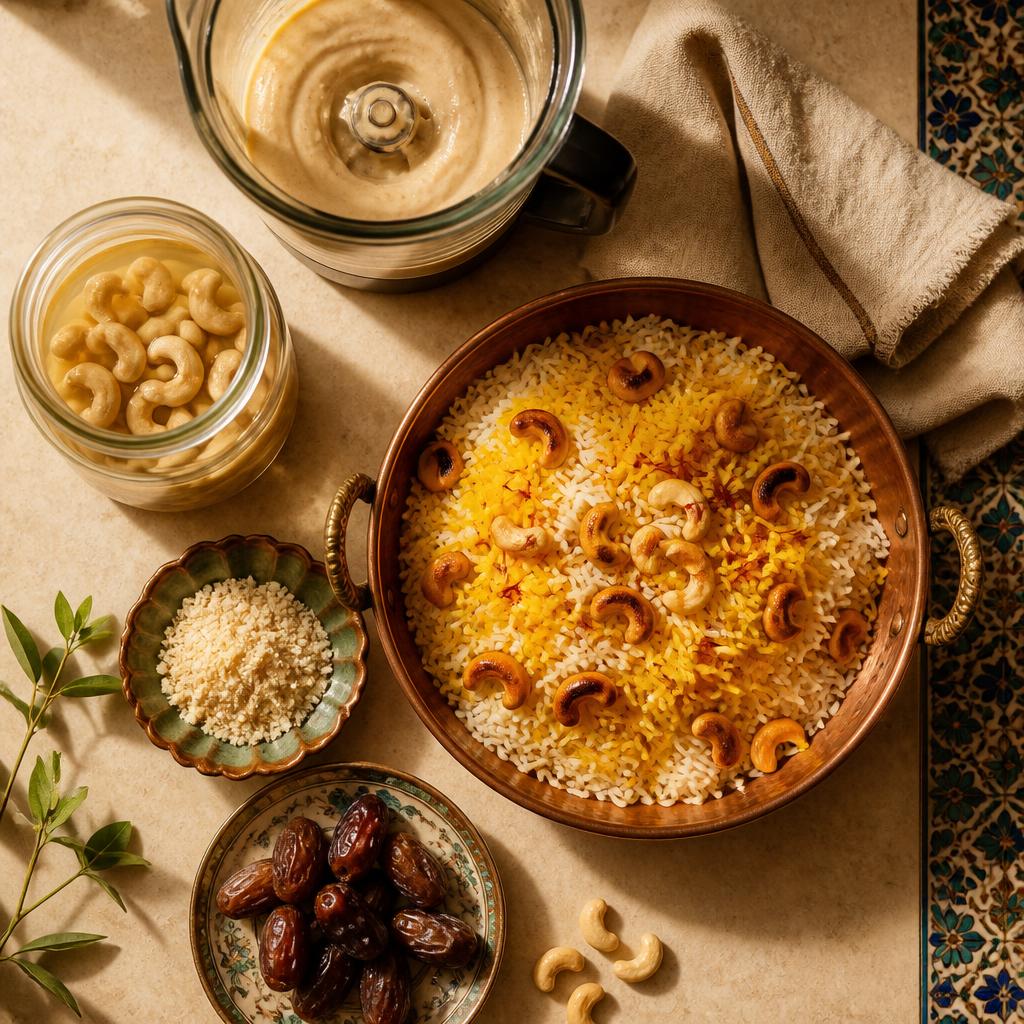
Ground into cashew paste to thicken korma, biryani, and shirin polo.
1 oz (~18 nuts) daily — the amount used across heart and blood vessel trials.
Toast lightly at 325°F for 8–10 min to deepen flavour without oxidising the oil.
Chapter 9 of 17
Preparation and Kitchen Use: In the Kitchen
Stir a small handful into stir-fries, kormas, and Persian rice at the end of cooking.
Blend with lemon, garlic, and nutritional yeast for plant cheese sauces.
Eat 1 oz (~18 nuts) daily — dry-toasted, unsalted, or lightly ghee-roasted in the Indian household style.
Chapter 10 of 17
Medicines and Interactions
General cautions
Medication interaction:
Recurrent calcium-oxalate kidney stones on a low-oxalate dietary prescription — cashew is a higher-oxalate nut.
Specific medicines
Medication interaction:
Statins — Plant sterols, oleic fat, and copper in cashew are complementary to statin LDL (the harmful type of cholesterol) lowering (portfolio-diet trials). No pharmacokinetic interaction at a daily 1 oz handful. (low concern)
More Interactions to Know
Medication interaction:
Antihypertensives (ACE inhibitors, ARBs, CCBs) — Magnesium, arginine, and oleic fat contribute a modest additive blood-pressure lowering at a daily 1 oz handful — a food-scale effect that layers gently with prescribed therapy. (low concern)
Medication interaction:
Copper-sensitive therapies (Wilson disease chelation with penicillamine or trientine, zinc-acetate maintenance) — Cashew is one of the densest dietary copper sources per ounce; regular handfuls should not layer onto Wilson-disease copper-restriction protocols without hepatologist review. (high concern)
Medication interaction:
Levothyroxine, bisphosphonates, tetracyclines, fluoroquinolones — Divalent minerals (calcium, magnesium, zinc, iron) from a cashew-heavy meal can bind and reduce absorption. Separate dosing by ≥ 2 hours from a cashew-butter breakfast or korma serving. (moderate concern)
Chapter 11 of 17
Who Should Be Careful
General caution:
Never eat whole-shell 'unprocessed' cashews — the shell carries urushiol (the poison-ivy irritant); commercial 'raw' cashews are always steamed.
General caution:
Higher oxalate load than most tree nuts — moderate in recurrent calcium-oxalate kidney stones.
Allergy:
Tree-nut or seed allergies are common — avoid if affected.
Allergy:
Strong cross-reactivity with pistachio and mango allergy — households with either should introduce cashew cautiously and under clinician guidance.
Allergy
Allergy:
Store refrigerated or frozen; the oleic oil is stable but the small linoleic fraction turns rancid on a warm shelf.
Allergy:
Confirmed tree-nut IgE cashew allergy — cross-reactivity with pistachio and mango is strong and well documented.
Allergy:
History of anaphylaxis to pistachio or mango — introduce cashew only under allergist guidance.
Allergy:
Contact urushiol dermatitis on artisanal or damaged 'raw' cashews — avoid handling any un-steamed shell.
Chapter 12 of 17
Pregnancy, Children and Older Adults
General
Children:
Whole nuts and seeds are a choking hazard for young children.
Children:
Whole cashews are a choking hazard for children under age 4 — use finely ground or smooth cashew butter.
Pregnancy and breastfeeding
Pregnancy and breastfeeding:
A daily 1 oz handful of unsalted cashews (dry-toasted or lightly ghee-roasted, homemade cashew butter, or a spoon of cashew cream stirred through soup or oatmeal) is safe and useful throughout pregnancy — a dense source of copper, magnesium, folate, and monounsaturated fat that supports the vascular (relating to the blood vessels) and connective-tissue demands of the second and third trimester. The classical Ayurvedic kaju-kheer with milk, cardamom, and saffron remains a compatible post-partum restorative and continues into breastfeeding. Confirmed tree-nut allergy — or a household history of pistachio or mango anaphylaxis awaiting an allergist review — is the only stop.
Chapter 13 of 17
Pregnancy, Children and Older Adults: Other Groups to Consider
Children
Children:
Smooth cashew butter and finely ground cashew can be introduced from around 7–8 months once solids are established, watching carefully because cashew is one of the more allergenic paediatric tree nuts (comparable to pistachio, hazelnut, and walnut). Whole nuts wait until age 4 due to choking risk. In pistachio- or mango-allergic households, first exposure to cashew belongs with a paediatric allergist. Small squares of kaju katli (cashew-milk fudge) are a traditional Indian post-fever restorative for older children — the honey-only-after-age-1 rule doesn't apply as kaju katli is sugar-based, but the sugar load itself argues for restraint.
Older adults
Older adults:
Among the more useful daily nuts after 60: dense copper and magnesium (three sleep, vascular, and antioxidant levers that quietly matter after 60), a lower-fat total for weight-sensitive plates, and a buttery texture that adapts to soaked-and-blended cashew cream for anyone whose chewing is unreliable. The classical Ayurvedic warm-milk-and-ground-cashew bedtime tonic with cardamom and saffron is one of the gentlest post-illness restoratives for a thin, dry, easily-tired older constitution. Refrigerate opened jars; the small polyunsaturated fraction oxidises on a warm shelf.
Chapter 14 of 17
Traditional Persian Perspective
Persian temperament: Warm & Moist (1st degree — Ayurvedic ushna-snigdha). Ayurveda classifies kaju as ushna (warming), snigdha (unctuous), madhura rasa (sweet), guru vipāka (heavy on digestion), and rasayana (regenerative) — nourishing for vata, moderated for kapha and pitta in excess. Persian household use — which received cashew only after the 16th century — follows the Ayurvedic warm-and-moist reading. The classical Ayurvedic caution is that kaju is heavy on the stomach.
In the Household
Soaking or gentle toasting is the household preparation for a delicate digestion.
Classical Persian medicine never met the cashew — the tree only reached Persia after the Age of Sail — so Persian households took the Ayurvedic reading as it came. Charaka and later Bhavaprakasha call kaju ushna-snigdha (warming and unctuous), madhura rasa (sweet in taste), guru vipāka (heavy on digestion), and rasayana (regenerative): feeding the nerves, easing dryness, settling vata, and used carefully and in small amounts for pitta and kapha types.
Chapter 15 of 17
Traditional Persian Perspective: Older Uses
Yūnānī (Unani) writers in the Indian subcontinent took the same warm-and-moist line and paired it with milk, honey, and saffron for people getting their strength back.
It was used: weak, thin, easily-fatigued constitutions (Ayurvedic rasayana). Convalescence after prolonged illness (kaju with milk and saffron).
Warming, moistening a cold-dry mizaj in modern Persian household use.
Kaju thickens North Indian korma and biryani and becomes Mughal kaju katli sweets. It holds up Goan cashew-coconut curries and cashew feni distilling, enriches Persian shirin polo and modern Iranian ājīl mixes, and sits behind the whole cashew-cream, cashew-cheese, cashew-milk wave in the 21st-century Western kitchen. In Iranian homes with Indian ties it still lands on the Yalda and Nowruz nut plate.
Chapter 16 of 17
Questions People Ask
Are cashews really nuts?
Botanically they're seeds of the cashew apple, but for culinary and allergy purposes they're treated as tree nuts.
Why are cashews never sold fully raw in shell?
The shell contains urushiol — the same caustic oil as poison ivy. Every cashew sold for eating, including 'raw' ones, has been steamed to deactivate it. Hand-processing the shell is one of the most hazardous tasks in the global nut trade.
How many cashews a day?
Trials use 1 oz (~18 nuts) daily as part of an otherwise Mediterranean pattern — enough to move copper and magnesium status without meaningful weight or lipid downside.
Are cashews bad for cholesterol?
No. Meta-analyses (a study that pools the results of many trials) show cashew intake is at worst lipid-neutral and at best mildly LDL-lowering compared to typical Western snacks it replaces.
Chapter 17 of 17
Sources
Office of Dietary Supplements: nuts & Seeds — US National Institutes of Health (NIH). https://ods.od.nih.gov/factsheets/list-all/.
FoodData Central: uS Department of Agriculture. https://fdc.nal.usda.gov/.
Cashew nut consumption and cardiometabolic risk — RCT — American Journal of Clinical Nutrition (PubMed). https://pubmed.ncbi.nlm.nih.gov/28202386/
Anacardium occidentale: A comprehensive review of its phytochemistry and pharmacology — Journal of Ethnopharmacology (PubMed). https://pubmed.ncbi.nlm.nih.gov/26342518/
Effects of cashew nut consumption on lipid profile — systematic review and meta-analysis — Complementary Therapies in Medicine (PubMed). https://pubmed.ncbi.nlm.nih.gov/31780016/
Nuts, cashew nuts, raw (FDC ID 170162) — USDA FoodData Central. https://fdc.nal.usda.gov/
Bhāvaprakāśa Nighaṇṭu: entries on kaju — Bhāvamiśra, 16th century.