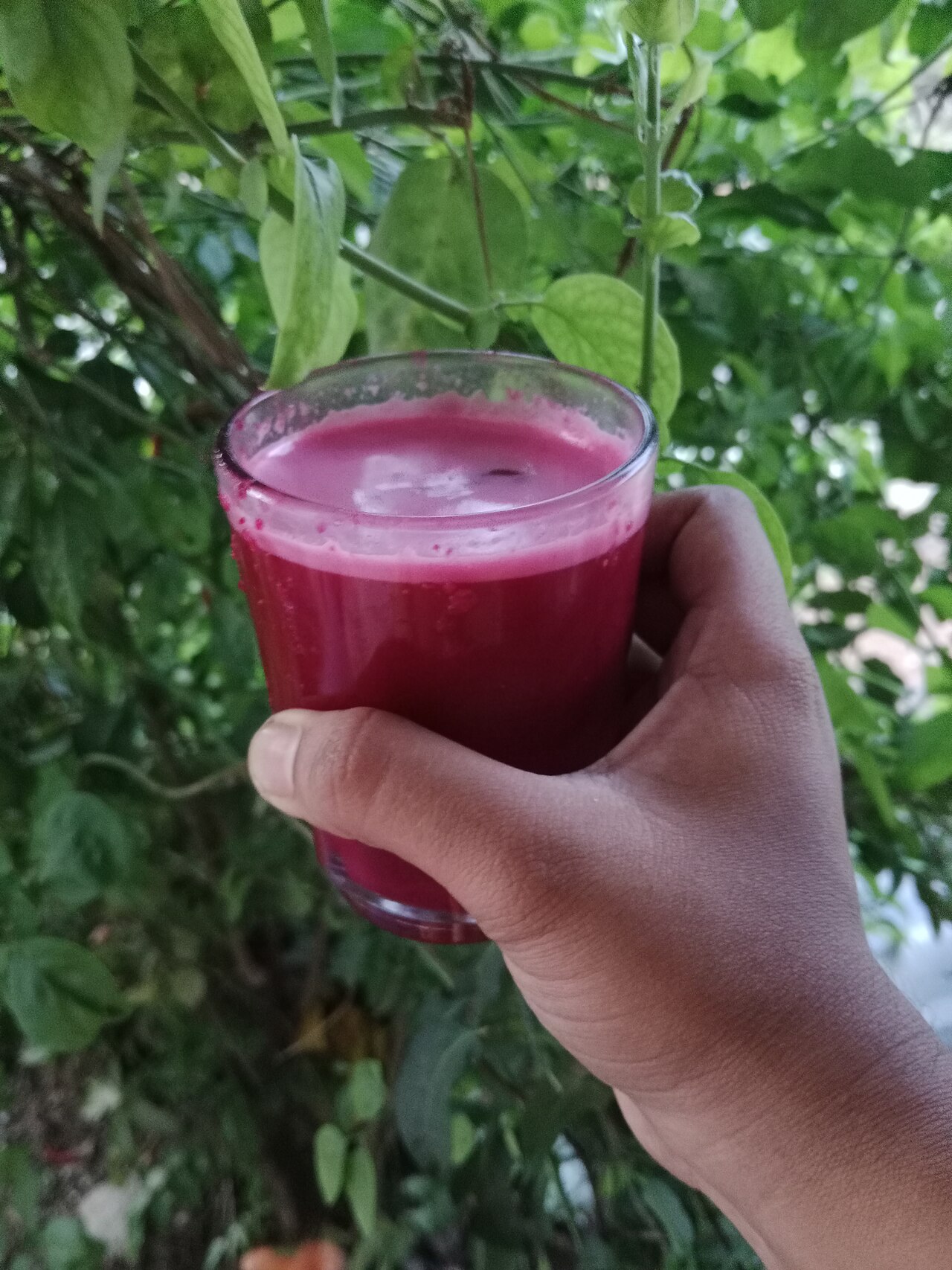
About one cup of juice a day is the dose used in most blood-pressure trials.
Red urine after eating beets is harmless and has its own name: beeturia.
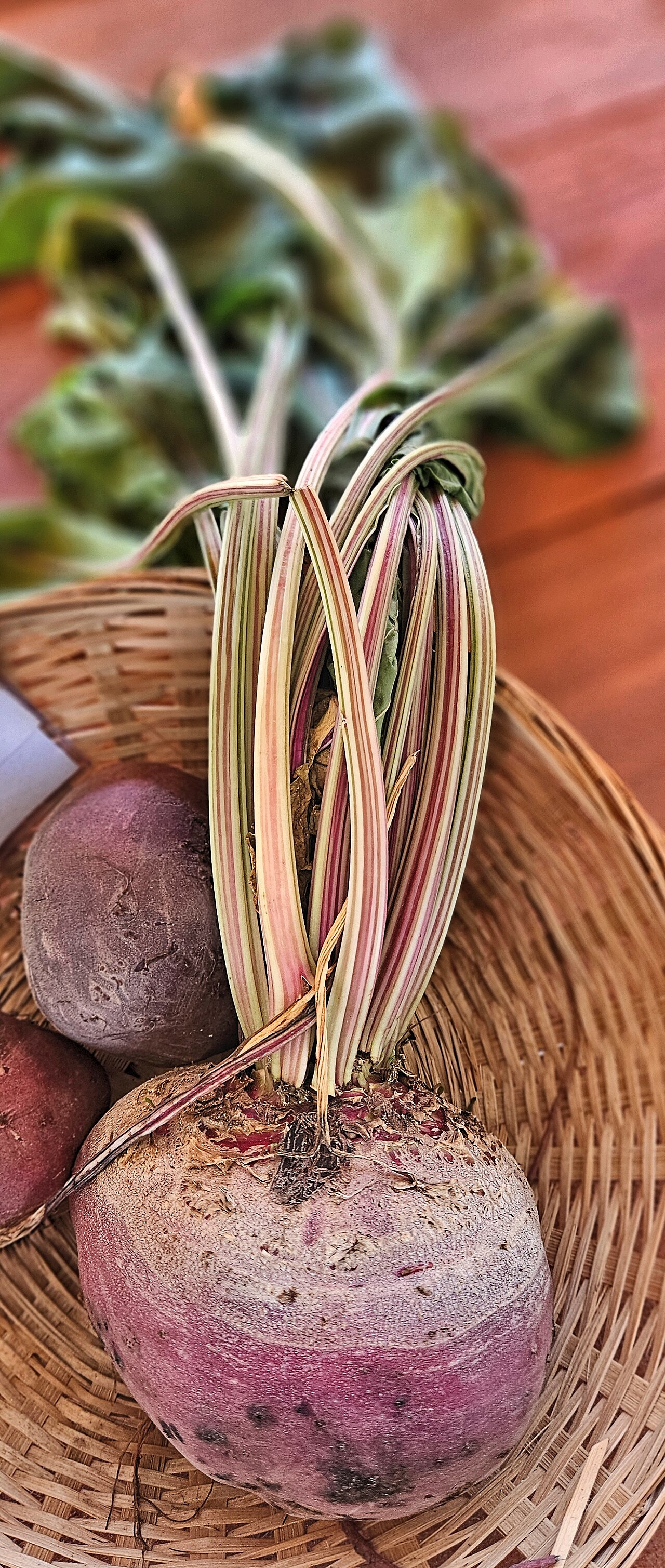
The leaves are food too, and they're better eating than the root for minerals.
Beetroot is packed with dietary nitrate. Your body turns that nitrate into nitric oxide, which relaxes the lining of your blood vessels and helps blood move more easily. That simple process sits behind the blood-pressure and endurance research, and it's unusually well tested for a vegetable. In Iran, beetroot has another life as labu, served hot from steaming pots on winter street corners.
Known to botanists as Beta vulgaris.
Chapter 2 of 15
Why It Matters
Many foods promoted for circulation have little evidence behind them. Beetroot is different. Trials in adults with raised blood pressure have measured real drops after daily juice, and cyclists and runners have used the same dose to get more work from the same oxygen. It's affordable, keeps for weeks, and is already familiar in Persian kitchens.
As we age, blood vessels stiffen and the body makes less nitric oxide of its own. That's one reason blood pressure often rises after sixty. Dietary nitrate is one of the few things we can eat that acts on that exact process. A few small studies also suggest better blood flow to the frontal lobe in older adults after beet juice, though that research is still early.
What That Means Day to Day
Daily beet juice has lowered blood pressure by a few points in controlled trials, most clearly in people whose pressure was already high.
Betaine, the compound that gives beets their name, helps the liver process fat.
A cooked beet carries about 3 g of fibre, which is why the old texts reached for it when the gut was slow.
Chapter 3 of 15
What It Contains
Primary compounds
Dietary nitrate is the active part. Gut bacteria reduce it to nitrite, and the body then makes nitric oxide, which relaxes blood vessels.
Betalains (the deep red pigments in beetroot) are the pigments that stain everything they touch, and in laboratory work they behave as antioxidants.
Betaine supports the liver's handling of fat and of homocysteine.
Other Constituents
Folate matters most in pregnancy, and a cup of cooked beet covers a useful share of the day's need.
Vitamins
Vitamin C
Other notable constituents
Minerals: Potassium, Manganese, Iron (in the leaves) · Fiber: About 3 g per cooked cup
Chapter 4 of 15
What Studies in People Show
Strong evidence
A month of daily beetroot juice lowered systolic blood pressure by around 8 mmHg in adults with untreated hypertension, and the effect disappeared within two weeks of stopping.Strong evidence
Moderate evidence
Trained cyclists given beetroot juice before a time trial produced more power for the same oxygen cost, with gains in the range of one to three per cent.Moderate evidence
Early research
Older adults drinking a high-nitrate diet including beetroot juice showed more blood flow to the frontal lobe of the brain on scanning.Emerging evidence
Beetroot juice modestly reduced muscle soreness and improved recovery in the days after hard exercise.Emerging evidence
Chapter 5 of 15
Preparation and Kitchen Use
Drink about 250 mL of juice two to three hours before hard exercise.
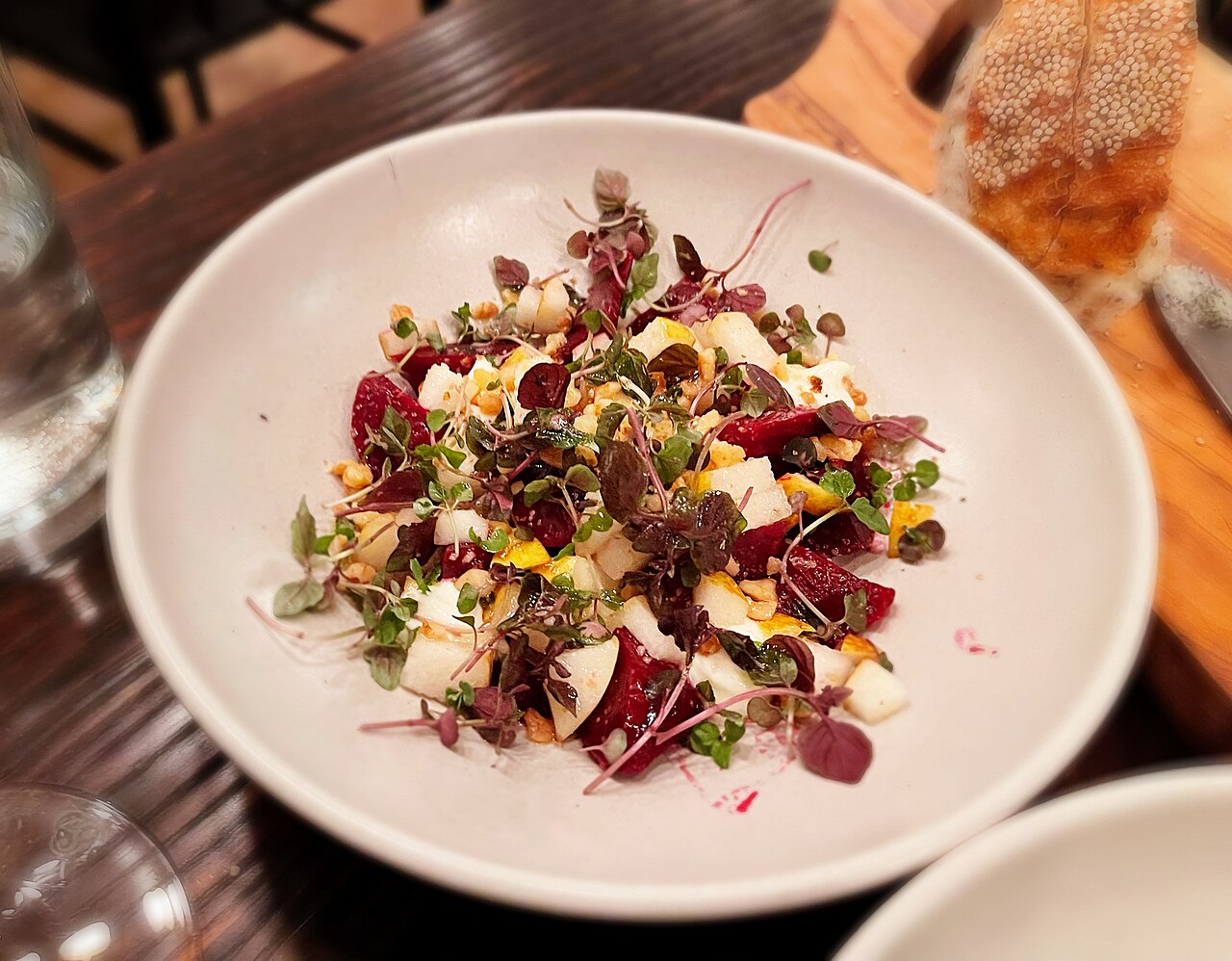
In the kitchen: a raw grated salad with lemon and walnut. A juice pressed with apple or carrot to soften the earth flavour. A borani stirred through thick yogurt with garlic.
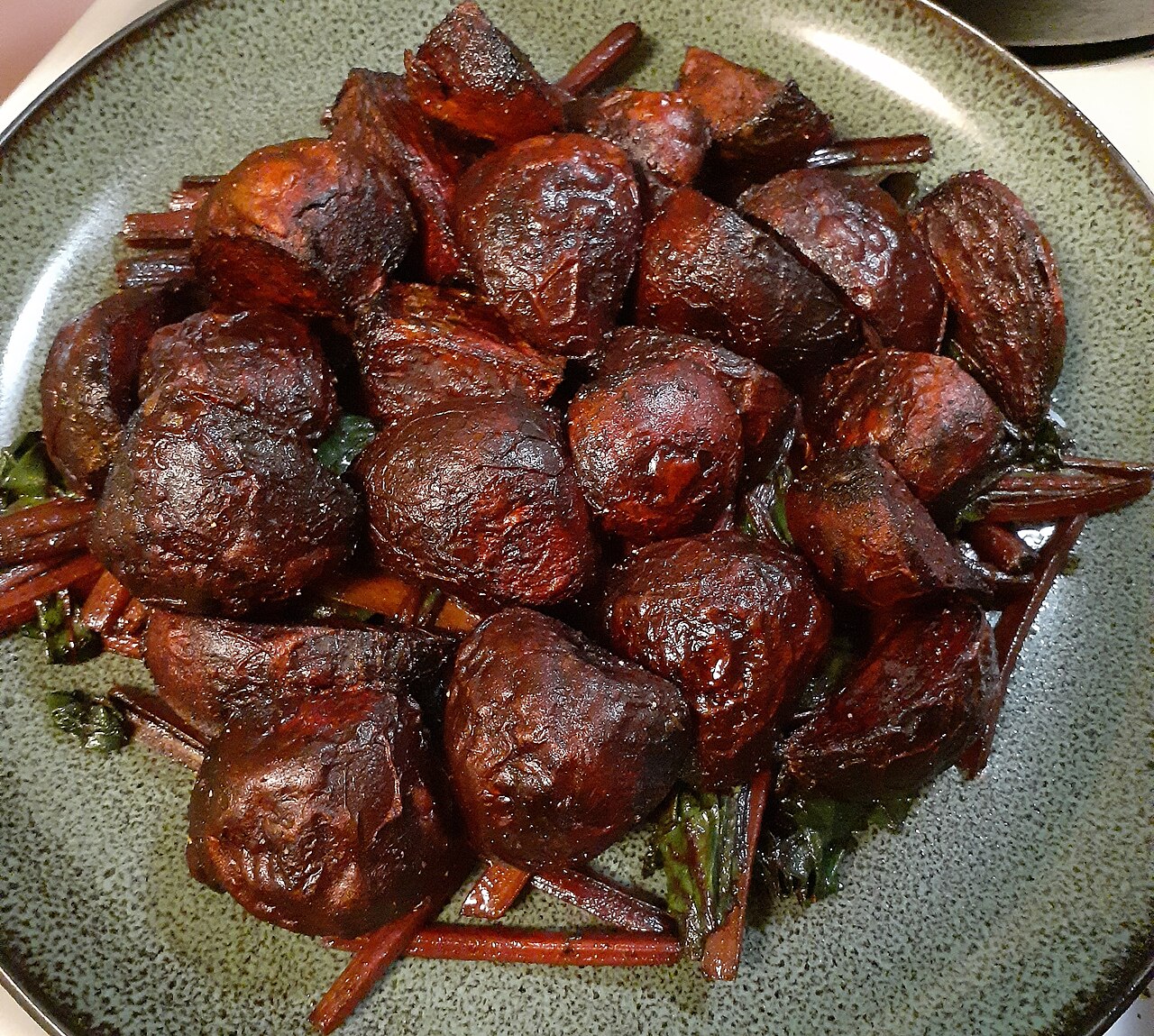
Roast whole beets in their skins at 200°C until a knife slides in easily, then rub off the skins under cold water.
Don't throw away the leaves. Sauté them like chard with garlic and olive oil.
Chapter 6 of 15
Medicines and Interactions
Medication interaction:
Blood pressure medication — Daily beet juice can lower pressure further. Tell your prescriber before making it a habit. (moderate concern)
Medication interaction:
Nitrate medicines for angina (isosorbide, nitroglycerin) — Concentrated beet juice may add to their blood-pressure effect. Ordinary portions of cooked beet are fine. (moderate concern)
Medication interaction:
Sildenafil and similar erection medicines — Combined with concentrated beet juice, these may cause a sharp blood-pressure drop. Check with your clinician. (high concern)
More Interactions to Know
Medication interaction:
Iron supplements — Beetroot doesn't block iron tablets or replace them. Keep taking prescribed iron as directed. (low concern)
Medication interaction:
Lithium — No direct food interaction is established. Ask your prescriber before starting daily concentrated beet juice. (low concern)
Chapter 7 of 15
Who Should Be Careful
General caution:
Beets are high in oxalate. Anyone who has formed calcium-oxalate kidney stones should keep to modest portions of the cooked root and leave the daily juice habit alone, since juice concentrates the oxalate along with everything else.
General caution:
Your urine and stool may turn red for a day or two after a decent portion. This is beeturia, it's harmless, and the only real danger is the fright it gives someone who was never warned it could happen.
General caution:
The juice is concentrated sugar with the fibre taken out. If blood sugar is a concern, eat the whole root instead and save juice for the days you actually train.
Chapter 8 of 15
Pregnancy, Children and Older Adults
Pregnancy and breastfeeding
Pregnancy and breastfeeding:
Beetroot is a good pregnancy food. It is one of the better natural sources of folate, and the fibre helps with the constipation that comes with the territory. Cooked root and cooked leaves are both fine; there's no reason to drink concentrated juice daily while pregnant.
Children
Children:
Children usually like labu because it's sweet and they can hold it. Warn them about the red urine before it happens rather than after. Roasted wedges with a little salt work better than raw grated beet, which most children find too earthy.
Older adults
Medication interaction:
This is the group with the most to gain, since nitric oxide production falls with age and blood pressure tends to rise. A cooked beet several times a week is a reasonable habit. Check with a clinician before starting daily juice if blood pressure medication is already in play.
Chapter 9 of 15
Traditional Persian Perspective
Persian temperament: Warm & Moist (1st degree). Opening and loosening. Hakims used it to move a stiff gut and to clear obstruction in the liver, and considered it nourishing for the depleted.
Persian medicine sees choghondar as warm and moist, a root used to open obstructions in the liver and spleen and loosen a stiff gut. Hakims gave the boiled root for constipation and used the juice of the leaves for the head and sinuses. Its sweetness was seen as nourishing, so it was also given to people recovering from a long illness.
Juice from the leaves was dropped into the nose for a blocked head.
The cooked root was fed to people convalescing after fever, for its sweetness and easy digestion.
Chapter 10 of 15
In Persian Life
Labu, whole beets steamed until soft and sold hot in paper, is a Tehran winter tradition. People eat it standing up on the cold journey home. It belongs beside boiled turnip and roasted beetroot in the city's street-food family, and it's one of the few sweet Iranian foods that needs no sugar. The seller keeps the pot over a low flame all evening and spoons the syrup from the bottom over each serving. At home, the same root is shredded into salad-e choghondar with yogurt and garlic or added to winter soups, where it turns the broth a surprising colour.
Chapter 11 of 15
What It Goes With
Pairing:
Feta
Salt cuts the sugar in a roasted beet, which is why the pairing turns up in every mezze in the region.
Pairing:
Walnuts
Bitterness and fat against sweetness and earth. Toast them first.
Fruit:
Lemon
Acid brightens the flat, earthy note that puts people off raw beetroot.
Chapter 12 of 15
Through the Year
Spring:
Spring
Young beets with their leaves still on. Cook the greens the same evening. They wilt fast.
Summer:
Summer
Grate raw and dress with lemon. Roasting a hot oven in July is nobody's idea of dinner.
Autumn:
Autumn
Main crop season. Buy them firm and store them cold and unwashed.
Winter:
Winter
Labu season. Whole beets simmered until soft, eaten hot in the street or at the kitchen table.
Chapter 13 of 15
Questions People Ask
How much beet juice for blood pressure?
Trials generally use about one cup, 250 mL, a day. The effect builds over one to four weeks and fades within a couple of days of stopping.
Why has my urine turned red?
That's beeturia, and it happens to roughly one person in seven. The pigment passes straight through. It isn't blood and it needs no attention.
Is juice better than eating the root?
Depends what you're after. Pressing removes the pulp, which concentrates the nitrate into a small glass you can drink in one go. Chewing the whole vegetable keeps the pulp, so the sugar arrives slowly and you stay full. Most people are better off chewing.
Chapter 14 of 15
Sources
Sad Giah Hezar Darman (صد گیاه و هزار درمان) — One Hundred Plants and One Thousand Remedies — Dr. Hossein Erfani, 4th edition (1375 / 1996–1997). Primary traditional Persian herbal reference cited throughout this platform. Presented as traditional knowledge, not as modern medical proof.
Office of Dietary Supplements: fact Sheets — US National Institutes of Health (NIH). https://ods.od.nih.gov/factsheets/list-all/.
Herbal Database: memorial Sloan Kettering Cancer Center. https://www.mskcc.org/cancer-care/diagnosis-treatment/symptom-management/integrative-medicine/herbs.
Herbs at a Glance: uS NIH National Center for Complementary and Integrative Health (NCCIH). https://www.nccih.nih.gov/health/herbsataglance.
FoodData Central: searchable nutrient database — US Department of Agriculture (USDA). https://fdc.nal.usda.gov/.
Chapter 15 of 15
Sources (continued)
The Nutrition Source: harvard T.H. Chan School of Public Health. https://www.hsph.harvard.edu/nutritionsource/.
PubMed — peer-reviewed biomedical literature — US National Library of Medicine. https://pubmed.ncbi.nlm.nih.gov/