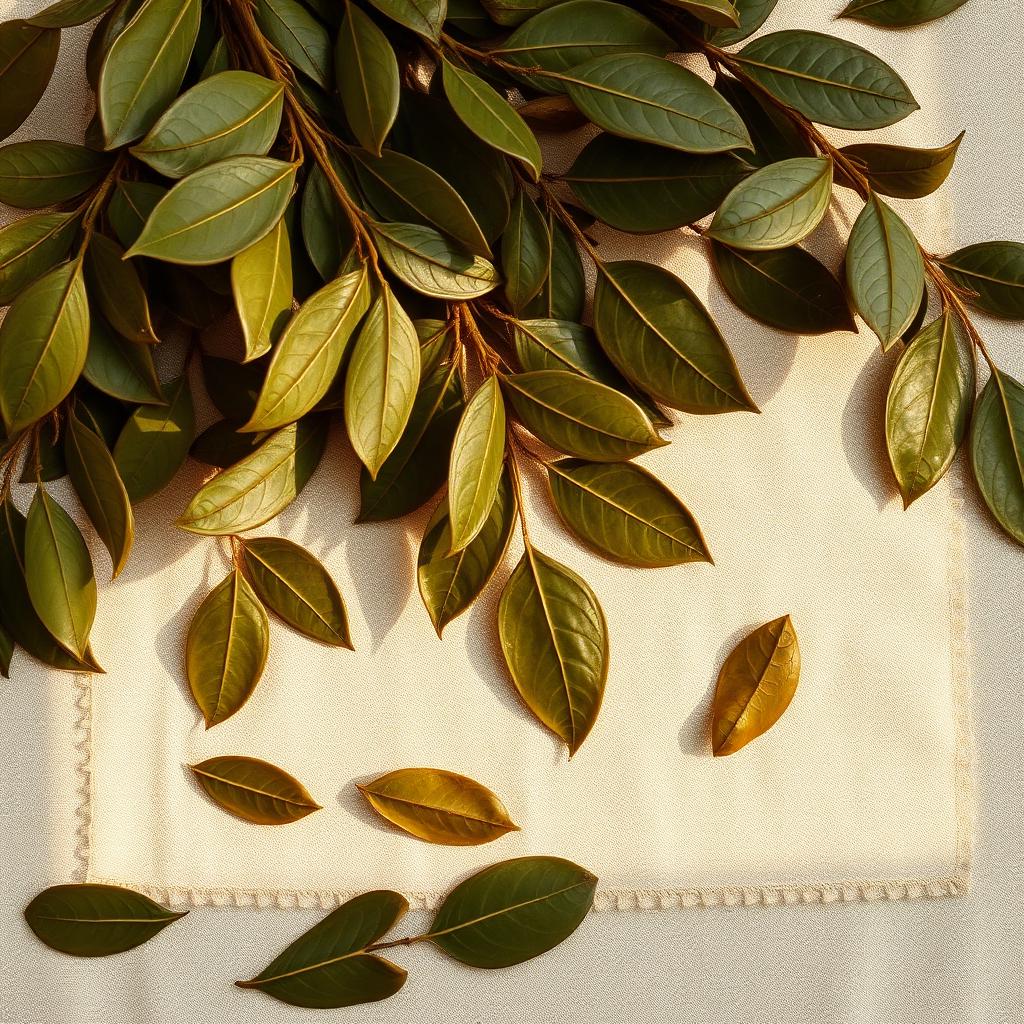
If you've ever wondered what bay is doing in the pot, here's the thing: the flavour needs time and liquid — bay belongs in long-cooked dishes.
Always remove the leaf before serving. It stays sharp and can hurt the throat.
Traditional use is mostly digestive: heaviness, wind, and cramping.
Buy whole leaves that still smell like something. A leaf with no scent has nothing to give.
Chapter 2 of 15
Bay Leaf: What It Is and Which Part Is Used
Bay leaf is the least showy spice in the cupboard and one of the most missed when it's gone. It doesn't announce itself. It gives long-cooked food a savoury depth underneath everything else. In Persian kitchens it goes into rice, into ash (a hearty Persian soup) soups, into pickles, and into stews. Older household medicine used a bay leaf tea for a heavy stomach and for cramping, and rubbed bay-infused oil into aching joints.
Known to botanists as Laurus nobilis.
Chapter 3 of 15
Why Herbalists Still Reach for It
Bay rewards patience. It gives its flavour slowly to a pot that has been on the stove for a while. That makes it a natural partner for a Persian stew, and a small reminder that some good things simply can't be rushed.
Slow-cooked food can suit a smaller appetite and teeth that need something softer, and bay makes that food taste richer. It builds deep flavour without asking you to reach for more salt, which is a simple kindness for an ageing heart and kidneys.
Bay-infused oil is a long-standing joint rub.
Chapter 4 of 15
The Plant Itself
Bay leaves come from an evergreen laurel tree of the Mediterranean. The leaves are thick, stiff, and glossy, with a wavy edge. Fresh leaves taste sharp and slightly bitter. Drying softens that and brings out a warm, tea-like smell. The leaf stays tough even after long cooking, which is why it's fished out before serving.
Family: Lauraceae (laurel family).
Chapter 5 of 15
In the Laboratory
From laboratory work, not from people taking it
Bay leaf essential oil (the concentrated aromatic oil of the plant) shows antibacterial and antifungal activity in laboratory testing. Rated: early research.
Chapter 6 of 15
What Studies in People Show
What studies in people show
Two grams of bay leaf daily for thirty days lowered fasting glucose and cholesterol in people with type 2 diabetes.Moderate evidence
Chapter 7 of 15
How It Is Prepared
Stew bay is one or two leaves simmered from the start of a long-cooked dish, removed at the end.
Damkardeh-ye barg-e boo (a bay leaf tea) is one leaf steeped five minutes in hot water after a heavy dinner.
Bay oil rub is a handful of leaves warmed gently in olive oil, strained, used on cold joints.
Pickle leaf is one leaf per jar of torshi (Persian pickles) for aroma and keeping.
One or two whole leaves per pot, added early, removed before serving.
A leaf in the rice water while chelow (plain steamed Persian rice) parboils.
One or two leaves in any stew, soup, or bean pot.
Chapter 8 of 15
Medicines and Interactions
Medication interaction:
Diabetes medicine — Bay leaf extracts lowered fasting glucose in a small human trial. Normal food amounts are unlikely to matter, but capsules alongside tablets can push readings low. (low concern)
Medication interaction:
Sedatives (medicines that make you sleepy) — Concentrated bay preparations have a mild sedative effect in animal work and may add to sleeping tablets. (low concern)
Chapter 9 of 15
Who Should Be Careful
General caution:
Always fish the leaf out before serving.
General caution:
Do not blend whole leaves into soup.
General caution:
A leaf with no smell has no value — replace it.
General caution:
Never swallow the whole leaf. It doesn't soften and can scratch or lodge in the throat or gut.
General caution:
Some people react to laurel on the skin — test bay oil on a small patch first.
Pregnancy and breastfeeding:
Avoid concentrated bay extracts in pregnancy; the leaf in food is fine.
Chapter 10 of 15
Pregnancy, Children and Older Adults
Pregnancy and breastfeeding
Pregnancy and breastfeeding:
The leaf in cooking is fine and has been eaten in pregnancy for as long as there have been stews. Bay leaf oil and concentrated extracts have not been studied and are worth skipping.
Children
Children:
Safe in food. Always remove the whole leaf before serving a child, because it stays sharp and stiff after hours of cooking and is a genuine choking risk.
Older adults
Older adults:
A useful way to make plain food taste of something without salt, which matters if blood pressure is being watched.
Chapter 11 of 15
What Persian Medicine Says
Persian temperament: Hot & Dry (2nd degree). Persian and Greek practice both read the leaf as warming and drying, which is why it goes into heavy bean and meat pots rather than light summer food.
Persian medicine sees bay as warm and dry. People used it to open a blocked, heavy digestion, ease wind and cramping, and warm cold, stiff joints when applied as an oil. Some households also burned it as a cleansing smoke.
In the Household
It was used: heaviness and bloating after rich food. Flavouring and preserving pickles.
Traditionally settles heaviness and wind after big meals.
The laurel wreath crowned Greek and Roman victors, and the tree carries that meaning of honour across the Mediterranean. In Iran, barg-e boo is a pantry staple rather than a symbol — the leaf that lives in the rice pot and the pickle jar.
Chapter 12 of 15
What It Goes With
§ More Pairings
Pairing:
Lentils
One leaf in the pot for the whole cooking time. Lentils take warmth well and bay keeps them from tasting flat.
Pairing:
Beans
Bay is the traditional answer to heavy beans. Cooks say it settles the stomach. It certainly settles the flavour.
Spice:
Black Pepper
Pepper goes in at the end, bay at the beginning. Together they carry a stew that has nothing else in it.
Pairing:
Onion
Onion, bay and a little fat is the base of half the slow food in the region.
Chapter 13 of 15
Through the Year
Spring:
Spring
Use it sparingly. Spring food is light and a bay leaf will sit on top of it.
Summer:
Summer
Mostly in pickling brine, where its job is preservation rather than flavour.
Autumn:
Autumn
The leaf comes into its own with beans, lentils and slow lamb.
Winter:
Winter
Two leaves in a winter stew for the whole afternoon. This is what the herb is for.
Chapter 14 of 15
Questions People Ask
Can you eat a bay leaf?
You should not. It stays tough and sharp-edged even after hours of cooking, and swallowing one can scratch the throat or lodge in the gut. Take it out before serving.
Does bay leaf actually add anything?
Yes, though only in long cooking. Cook the same stew twice, once with and once without, and the difference is obvious — a savoury backbone underneath the other flavours.
Chapter 15 of 15
Sources
Laurus nobilis: composition and biological activity — Journal of Ethnopharmacology.
Foreign body ingestion: bay leaf case reports — American Journal of Gastroenterology.