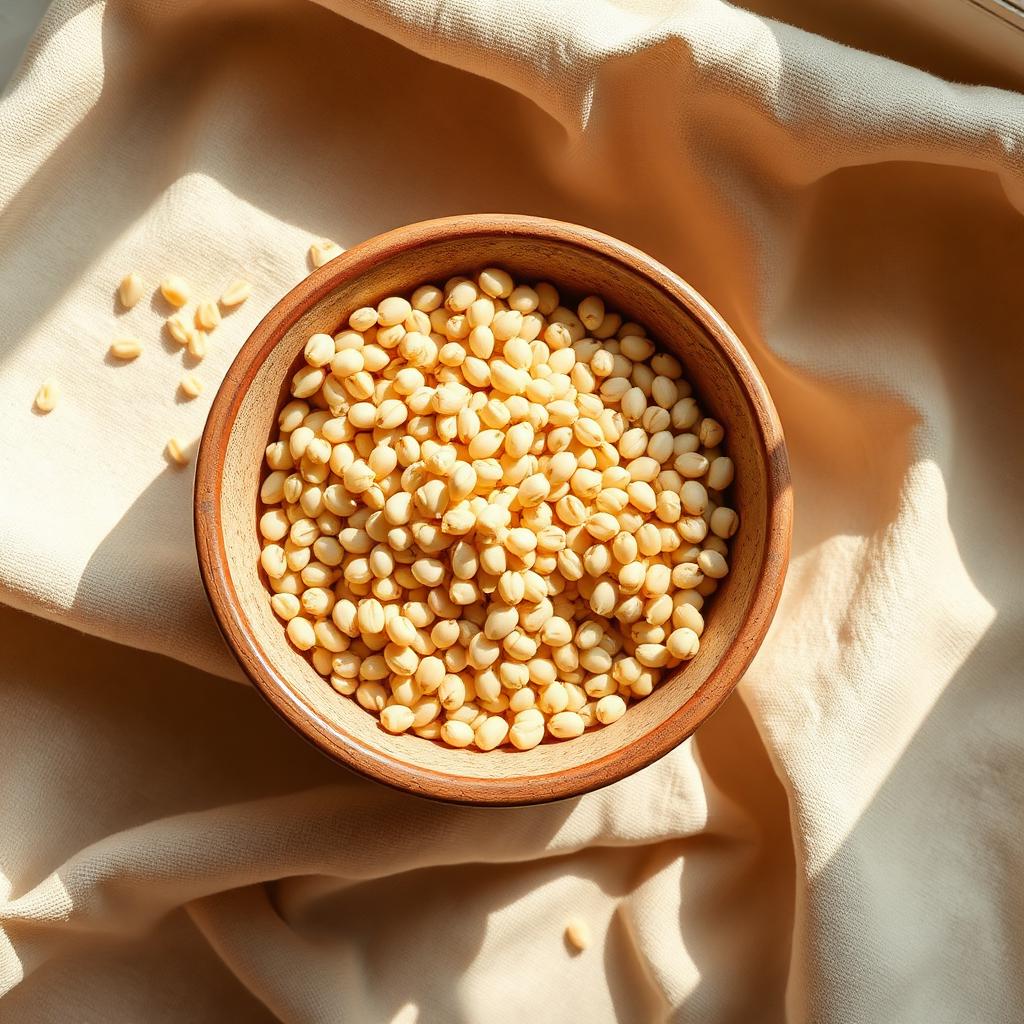
One of the most soluble-fiber-rich grains, thanks to beta-glucan.
FDA and EFSA recognize barley beta-glucan (a soluble fibre found in oats and barley) for lowering LDL (the harmful type of cholesterol) cholesterol.
Traditional Persian remedy for fever, dry gut, and convalescence. Cooked-and-cooled barley builds resistant starch for the gut microbiome.
Chapter 2 of 17
Why It Matters
Barley touches several parts of healthy aging at once: steadier blood sugar, healthier cholesterol, a more resilient gut microbiome, and a calmer inflammatory response. A daily bowl of barley soup or a mug of Avicenna's barley water is a simple, time-honoured way to support all four.
Barley beta-glucan is one of the few food ingredients with FDA-authorized language for cholesterol reduction, which matters as blood vessels age. Its soluble fibre also softens the post-meal glucose rise, feeds gut microbes that make short-chain fatty acids, and keeps you satisfied longer than refined grains. A daily half-cup of cooked barley is a small habit that can keep paying off into the 70s and 80s.
Feeds helpful gut bacteria — a prebiotic grain.
Resistant starch (when cooked and cooled) supports colon and metabolic health.
Chapter 3 of 17
What It Contains
Primary compounds
Beta-glucan: soluble fiber uniquely studied for cholesterol and blood sugar · Arabinoxylans: prebiotic (fibre that feeds the helpful bacteria in your gut) fibers.
Tocotrienols: vitamin-E family compounds studied for cholesterol.
Other Constituents
Lignans (fibre-linked plant compounds found in seeds) and phenolic acids.
Vitamins
Niacin (B3), Thiamin (B1), Vitamin B6, Folate
Other notable constituents
Protein: ~3.5 g per 1/2 cup cooked pearl barley · Minerals: Manganese, Selenium, Magnesium, Phosphorus, Copper, Iron
Chapter 4 of 17
What Studies in People Show
Strong evidence
Barley beta-glucan lowers LDL (the harmful type of cholesterol) cholesterol by 5–7% across RCT meta-analysis (a study that pools the results of many trials) of 58 trials.Strong evidence
Whole-grain and cereal-fiber intake is linked to lower all-cause and heart and blood vessel mortality across meta-analysis of prospective cohorts (n>786,000).Strong evidence
FDA-authorized health claim recognizing soluble fiber from barley for coronary-heart-disease-risk reduction (21 CFR 101.81).Strong evidence
Moderate evidence
Barley beta-glucan reduces postprandial (after a meal) blood glucose response by up to 27% versus refined-grain controls.Moderate evidence
Chapter 5 of 17
Using It in the Kitchen
At any meal, but especially at lunch — beta-glucan gentles the whole day's blood-sugar and cholesterol response most effectively when eaten earlier. A mug of Avicenna's warm barley water is the traditional bedtime drink for a hot, restless body.
Make Avicenna's barley water with 3 Tbsp barley + 4 cups water simmered 30 min, then strain and sip it warm.
Barley porridge (haleem-style) is soaked barley slow-cooked with cinnamon, walnuts, honey.
Cold, cooked barley grain bowls with cucumber, herbs, olive oil, and lemon.
Cook 1 cup pearl barley in 3 cups water/broth, 30–40 minutes.
Substitute for rice in grain bowls and salads.
Try 1/2 cup barley in place of white rice as the base of a hearty grain bowl.
Cook barley ahead, cool it, and reheat it the next day to give the gut resistant starch.
Chapter 7 of 17
Medicines and Interactions
Medication interaction:
Any medication with a narrow absorption window — Beta-glucan slows nutrient and drug absorption — take medications ≥2 hours from a barley-heavy meal. (moderate concern)
Medication interaction:
Insulin and sulfonylureas — Modest additional blood-sugar lowering — welcome for most, monitor when introducing. (low concern)
Medication interaction:
Warfarin — Barley is a modest source of vitamin K; keep intake steady rather than cutting or spiking. (low concern)
Chapter 8 of 17
Who Should Be Careful
General caution:
Contains gluten — not suitable for celiac disease or non-celiac gluten sensitivity.
General caution:
High soluble fiber — increase slowly and drink water to avoid gas or bloating.
Allergy:
Celiac disease and wheat/barley allergy.
General caution:
Severe gastroparesis (very slow gastric emptying — fiber load can worsen symptoms).
Chapter 9 of 17
Pregnancy, Children and Older Adults
Pregnancy and breastfeeding
Pregnancy and breastfeeding:
Barley soup and barley water are traditional foods of Persian pregnancy — cooling, gentle, and nourishing. Safe for most pregnancies. Avoid if you have celiac or non-celiac gluten sensitivity.
Children
Children:
Well-cooked barley in soup is an excellent early grain for infants over 8 months as textures allow (contains gluten — introduce as with wheat). Barley water sweetened lightly with a little date syrup is a traditional Persian drink for a mild fever or dry throat in older children.
Older adults
Older adults:
For older adults, daily barley is one of the highest-leverage aging habits — beta-glucan for cholesterol, resistant starch for gut and metabolic health, and a soft, satisfying grain that's easy to chew. Coordinate with a clinician if on blood-sugar or cholesterol medications, as effects may be additive.
Chapter 10 of 17
Traditional Persian Perspective
Persian medicine sees barley as cool and dry, one of its classic cooling and cleansing grains. Avicenna gave mā' al-shaʿīr (barley water) a full chapter in the Canon and prescribed it for fevers, thirst, dry cough, inflamed digestion, and recovery after illness. Where wheat was seen as warming and building, barley was cooling and gentle, the grain chosen when the body felt over-hot, irritated, or worn down.
Fever, thirst, and heat exhaustion (Avicenna's barley water).
In the Household
Traditional Persian cooling remedy for fever and dry, irritated tissues.
Across Iran, soup-e jow, Persian barley soup with chicken, lemon, and parsley, is the bowl families reach for to soothe a sore throat, comfort a cold, and settle a recovering gut. In Tehran, Shiraz, and Isfahan, barley water sweetened with rock candy is also a familiar summer cooler.
Chapter 11 of 17
What It Goes With
Spice:
Ginger
A thumb of ginger in soup-e jow warms barley's cool nature. That makes it the Persian convalescent bowl.
Spice:
Saffron
A pinch of bloomed saffron lifts a plain barley soup into a gentle mood-and-heart tonic.
Spice:
Cinnamon
Cinnamon in barley porridge deepens flavor and adds an insulin-sensitivity nudge.
Chapter 12 of 17
What It Goes With: More Pairings
Herb:
Thyme
Thyme with roast vegetables over barley is a Mediterranean-Persian bridge.
Pairing:
Lentils
The classical Persian ash duo — beta-glucan + plant protein + soluble fiber in one bowl.
Pairing:
Olive oil
A slow pour of extra-virgin olive oil on warm barley multiplies fat-soluble absorption.
Chapter 13 of 17
What It Goes With: A Few More Pairings
Dairy:
Yogurt
Cool yogurt over warm barley (a Persian and Levantine grain-bowl classic).
Pairing:
Walnuts
Chopped walnut on barley porridge is a heart-and-brain breakfast supported by both traditions.
Fruit:
Pomegranate
Ruby arils over a cool barley salad make one of the most polyphenol-dense plates on earth.
Chapter 14 of 17
Through the Year
Spring:
Spring
A light lemon-barley water on warm days — Avicenna's cooling drink as the season turns.
Autumn:
Autumn
Soup-e jow — chicken-and-barley soup with saffron and lemon as evenings cool.
Winter:
Winter
A daily warm bowl of barley porridge with cinnamon, walnut, and honey — comfort and cholesterol both.
Chapter 15 of 17
Questions People Ask
Is barley better than oats for cholesterol?
Both are top-tier soluble-fiber grains. Trials suggest 3 g/day of beta-glucan from either oats or barley lowers LDL by roughly 5–10%. Rotate them — variety supports the gut microbiome.
Is barley safe for people with diabetes?
Yes for most — its low glycemic index (a measure of how fast a food raises blood sugar) and high beta-glucan soften the post-meal glucose curve. If on insulin or sulfonylureas (a common type of diabetes tablet), monitor when introducing and coordinate with your clinician.
Does barley contain gluten?
Yes. Barley contains a gluten-related protein (hordein) and isn't safe for celiac disease or wheat/gluten sensitivity.
Chapter 16 of 17
Sources
Whole grains, cereal fiber, and heart and blood vessel disease — 2016 BMJ meta-analysis — BMJ. Https://pubmed.ncbi.nlm.nih.gov/27296701/
Health claim: soluble fiber from certain foods and risk of coronary heart disease — 21 CFR 101.81 — US Food and Drug Administration. https://www.ecfr.gov/current/title-21/chapter-I/subchapter-B/part-101/subpart-E/section-101.81
Beta-glucan from oats and barley and the reduction of blood cholesterol — EFSA scientific opinion — European Food Safety Authority. https://www.efsa.europa.eu/en/efsajournal/pub/2207
Sad Giah Hezar Darman (صد گیاه و هزار درمان) — One Hundred Plants and One Thousand Remedies — Dr. Hossein Erfani, 4th edition (1375 / 1996–1997). Primary traditional Persian herbal reference cited throughout this platform. Presented as traditional knowledge, not as modern medical proof.
Office of Dietary Supplements: fact Sheets — US National Institutes of Health (NIH). https://ods.od.nih.gov/factsheets/list-all/.
Herbal Database: memorial Sloan Kettering Cancer Center. https://www.mskcc.org/cancer-care/diagnosis-treatment/symptom-management/integrative-medicine/herbs.
Chapter 17 of 17
Sources (continued)
Herbs at a Glance: uS NIH National Center for Complementary and Integrative Health (NCCIH). https://www.nccih.nih.gov/health/herbsataglance.
FoodData Central: searchable nutrient database — US Department of Agriculture (USDA). https://fdc.nal.usda.gov/.
The Nutrition Source: harvard T.H. Chan School of Public Health. https://www.hsph.harvard.edu/nutritionsource/.
PubMed — peer-reviewed biomedical literature — US National Library of Medicine. https://pubmed.ncbi.nlm.nih.gov/