Whole-wheat barbari supplies fibre, B vitamins and minerals that white flour loses.
Long fermentation lowers phytates (a natural substance in grains and beans that lowers mineral absorption), so more of the iron and zinc in wheat is absorbed.
Sesame and nigella seeds on the crust add fat, calcium and flavour.
A filling, cheap staple that carries protein foods rather than replacing them.
Chapter 2 of 11
Barbari Bread in Persian Cooking
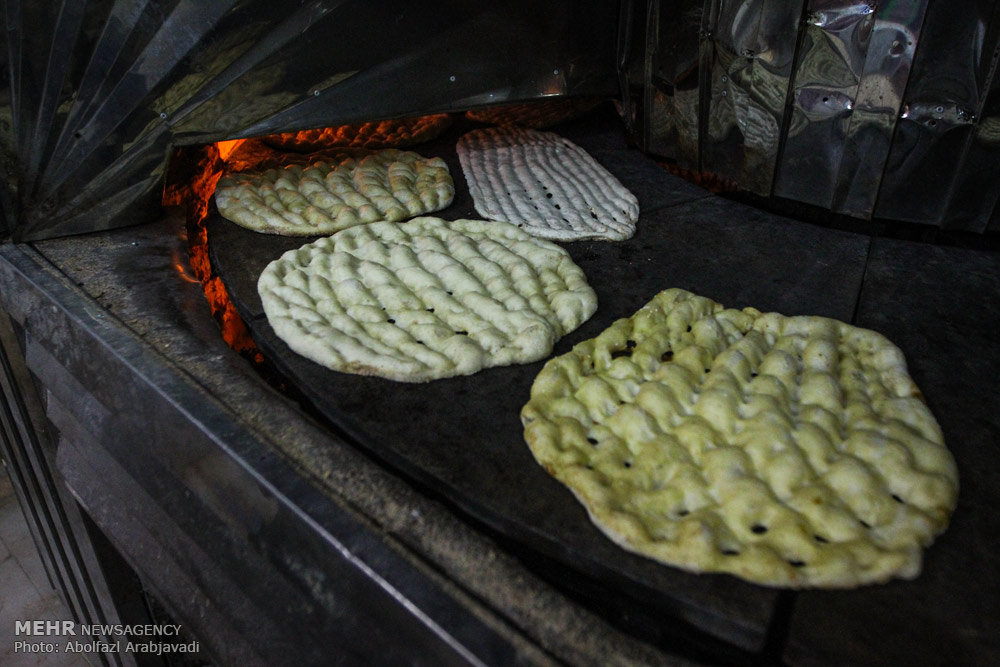
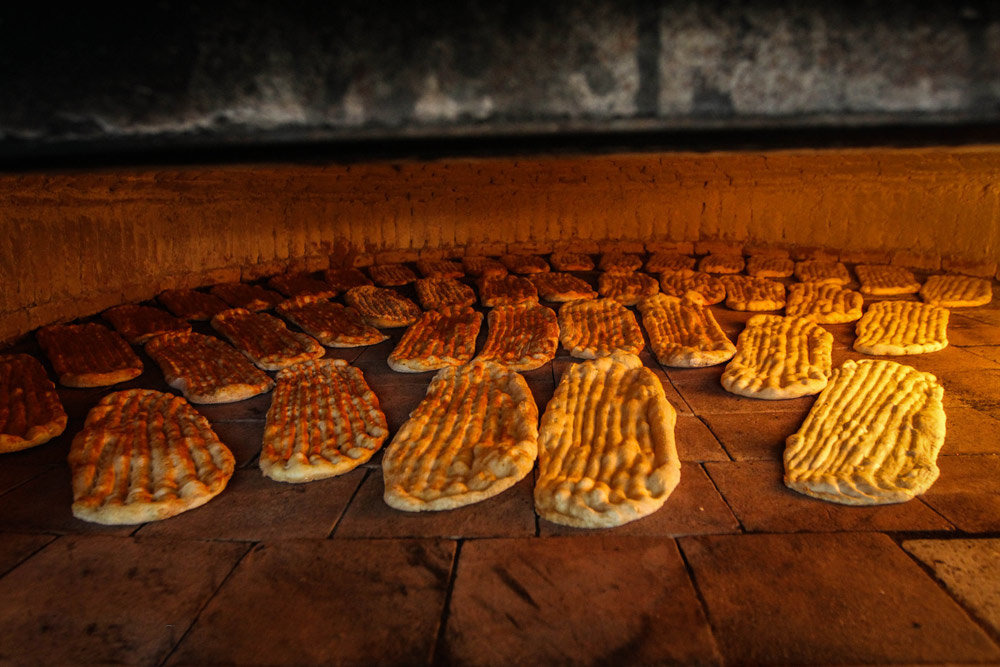
Barbari is a long, flat loaf with deep grooves running down its length and sesame or nigella seeds scattered on top. It's thicker and softer than the other Iranian breads — sangak is thin and stony, lavash is paper-like, but barbari has crumb inside it. Before baking, the baker brushes the surface with roomal, a cooked paste of flour and water that makes the crust glossy and deep gold.
A Little More Background
It comes out of the oven in the early morning and is best within a few hours. By evening it has gone dry, which is why Iranian households buy bread daily rather than by the week.
Of the four everyday Iranian breads, barbari is the thick one. Sangak is thin and pebbled, lavash is paper-thin, taftoon is soft and flat — barbari has real crumb inside a crisp crust.
It's a morning bread. Families buy it hot, carry it home under an arm, and eat it the same day with cheese, butter and tea.
Chapter 3 of 11
What It Contains
Vitamins
Thiamin (B1), Niacin, Folate
Other notable constituents
Protein: ~5 g per 60 g piece · Minerals: Iron, Magnesium, Selenium, Sodium · Notable: ~170 kcal per 60 g piece
Eat it fresh the day it's baked — this bread doesn't keep.
Tear, don't cut: bread is torn by hand at a Persian table.
Freeze what you'll not eat, then reheat straight from frozen in a hot oven.
Sprinkle with water and warm for 3–4 minutes to bring a stale piece back.
Ask for whole-wheat (sabooz) barbari when the bakery has it.
Other Ways to Use It
Those long grooves aren't decoration. The baker presses them with wet fingers so the thick dough bakes evenly instead of ballooning in the middle.
Before it goes in, the loaf is brushed with roomal — a thin cooked paste of flour and water. That glaze is what gives barbari its shine and its deep brown colour, and it helps sesame or nigella seeds stick.
Fresh barbari has a crisp crust and a soft, slightly chewy inside. By evening it's dry, and by the next day it's hard.
Iranians solve this by freezing. Cut the loaf into portions the day you buy it, freeze them, and reheat straight from frozen in a hot oven for a few minutes. It comes back close to fresh.
Whole-wheat barbari, where a bakery offers it, keeps you fuller for longer than the white version and raises blood sugar more slowly.
Chapter 6 of 11
Salt, Refined Flour and Blood Sugar
General caution:
Wheat bread contains gluten — not suitable in coeliac disease or gluten sensitivity.
General caution:
White-flour barbari raises blood sugar quickly. Eat it with cheese, egg or yogurt rather than alone.
General caution:
Commercial bread can be salty. If you're watching sodium, it adds up faster than you expect.
General caution:
Some large-scale bakeries still use baking soda instead of proper fermentation, which makes the bread harsher on digestion and worse for mineral absorption.
Chapter 7 of 11
Traditional Persian Perspective
Persian medicine reads bread as warm and dry, and treats it as the base of the meal rather than a side. Fully leavened, properly fermented bread was considered easier on the stomach than flat unleavened dough — an old observation that lines up with what is now known about how long fermentation breaks down phytates (a natural substance in grains and beans that lowers mineral absorption) in wheat.
In the Household
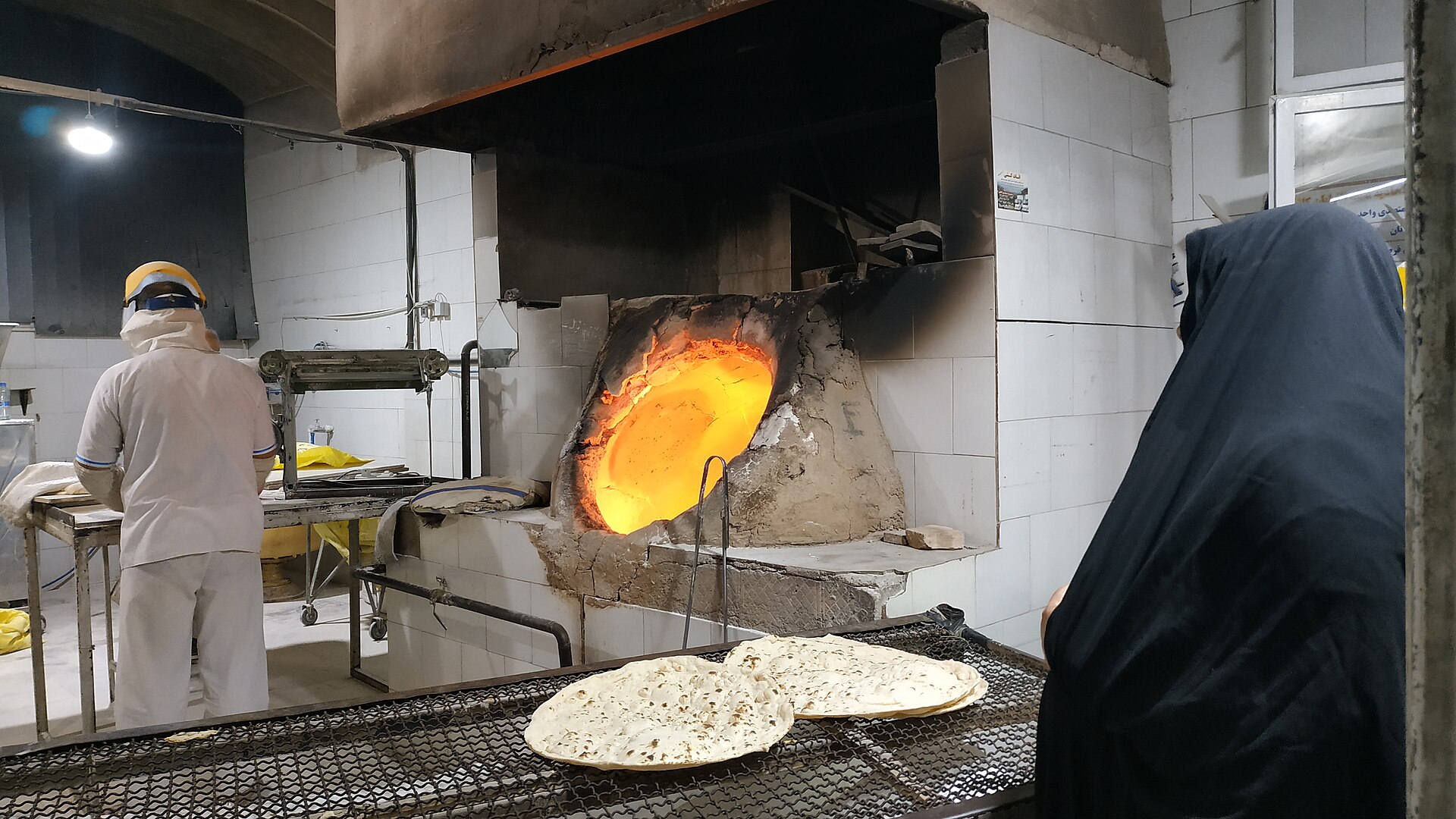
Barbari is baked directly on the hot floor of a deck oven, not in a tin. The heat hits the base hard and fast, which sets the crust before the inside dries out.
That's why home-baked barbari rarely matches the bakery version. A domestic oven doesn't get hot enough. A pizza stone, heated as hot as the oven allows, comes closest.
Chapter 8 of 11
In Persian Life
Barbari belongs to breakfast: bread still warm from the bakery, white cheese, herbs, walnuts, tea. Bakery queues in the early morning and around Nowruz are part of the season. Bread is treated with respect in Iranian homes — it isn't thrown away, and a dropped piece is picked up and set aside rather than binned.
Chapter 9 of 11
What It Goes With
§ More Pairings
Dairy:
Feta cheese (panir)
The default partner — bread and salty white cheese is breakfast.
Pairing:
Walnut
Bread, cheese and walnut is the complete traditional plate.
Pairing:
Butter
Butter and honey on warm barbari is the sweet version of the same breakfast.
Honey:
Honey
Spooned over butter on hot bread, the Iranian sweet breakfast.
Pairing:
Persian chai
Tea is poured before the bread arrives and drunk throughout.
Pairing:
Tahini (Ardeh)
Sesame paste and grape syrup on barbari, which is the winter morning version.
Chapter 10 of 11
Sources
Sad Giah Hezar Darman (صد گیاه و هزار درمان) — One Hundred Plants and One Thousand Remedies — Dr. Hossein Erfani, 4th edition (1375 / 1996–1997). Primary traditional Persian herbal reference cited throughout this platform. Presented as traditional knowledge, not as modern medical proof.
Office of Dietary Supplements: fact Sheets — US National Institutes of Health (NIH). https://ods.od.nih.gov/factsheets/list-all/.
Herbal Database: memorial Sloan Kettering Cancer Center. https://www.mskcc.org/cancer-care/diagnosis-treatment/symptom-management/integrative-medicine/herbs.
Herbs at a Glance: uS NIH National Center for Complementary and Integrative Health (NCCIH). https://www.nccih.nih.gov/health/herbsataglance.
FoodData Central: searchable nutrient database — US Department of Agriculture (USDA). https://fdc.nal.usda.gov/.
Chapter 11 of 11
Sources (continued)
The Nutrition Source: harvard T.H. Chan School of Public Health. https://www.hsph.harvard.edu/nutritionsource/.
PubMed — peer-reviewed biomedical literature — US National Library of Medicine. https://pubmed.ncbi.nlm.nih.gov/