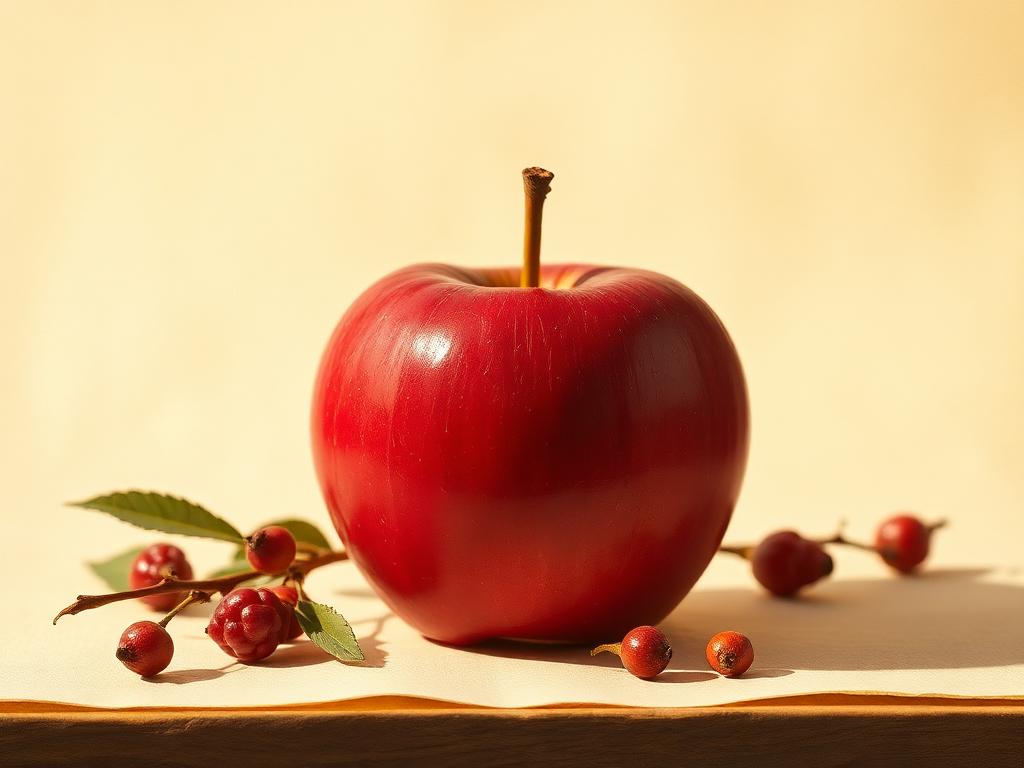
One of the highest-evidence everyday fruits — pectin (a soft fibre in fruit that thickens jam), quercetin (a plant compound found in onions, apples and tea), and polyphenols (protective plant compounds) compound quietly over decades.
The peel carries most of the polyphenols — whole-fruit-with-skin is the medicinal form.
What Else to Know
Apple juice is a different product from a whole apple. Portions and effects on blood sugar aren't comparable.
Kompot-e sib — apples stewed with cinnamon, saffron, and rosewater — is one of the oldest Persian evening desserts and a gentle bedtime remedy for a restless heart.
Chapter 2 of 12
Getting to Know Apple
Sib is the fruit a Persian household reaches for without thinking. The mountain orchards below Damavand grow some of the world's most fragrant apples, small and dense with a sweet-tart flavour that industrial fruit rarely matches. Persian and Unani medicine see sib as cool and moist, calming for the heart and steadying for the stomach. Modern nutrition values the same fruit as an easy source of soluble pectin fibre, quercetin (a plant compound found in onions, apples and tea), and food-form polyphenols (protective plant compounds) you can keep right on the counter.
Known to botanists as Malus domestica.
Chapter 3 of 12
Why It Matters
A whole apple with the skin is one of the simplest useful habits you can keep throughout life. It quietly supports the heart, gut, glucose, and even mood, and it takes little more than a moment at the counter.
Apple may be the most reliable daily fruit for healthy aging in the Persian tradition. Pectin (a soft fibre in fruit that thickens jam) quietly supports the microbiome and cholesterol, quercetin (a plant compound found in onions, apples and tea) supports vascular (relating to the blood vessels) tone, and stewed sib with cinnamon can settle a restless heart in the evening. You don't need to make the habit complicated. You just need to eat the apple.
What That Means Day to Day
Steady, gentle energy in whole-fruit form.
Hydrating and naturally sweet is a real everyday alternative to refined sugar.
Long studies following large groups: apples are among the fruits most strongly linked to less heart disease and a longer life.
Chapter 4 of 12
What It Contains
Primary compounds
Pectin (a soft fibre in fruit that thickens jam) — the driver of the gut, cholesterol, and steady-glucose benefits.
Quercetin is the flavonoid (a family of protective plant compounds) behind the vascular (relating to the blood vessels) and respiratory literature.
Catechins (plant compounds common in green tea), chlorogenic acid, phloridzin — the peel's polyphenol (protective plant compounds) package.
Other Constituents
Vitamin C and potassium: food-form everyday coverage.
Amygdalin (seeds only) — the reason flesh and peel are safe and deliberate seed ingestion isn't.
Other notable constituents
Minerals: Copper
Chapter 5 of 12
What Studies in People Show
Strong evidence
Flavonoid (a family of protective plant compounds) intake — with apple as a major dietary source — is linked to lower all-cause and heart and blood vessel mortality in large cohorts.Strong evidence
Early research
Apple pectin (a soft fibre in fruit that thickens jam) and polyphenols (protective plant compounds) favourably adjusts gut microbiota composition and short-chain fatty acid production.Emerging evidence
Regular apple intake is linked to modest reductions in LDL (the harmful type of cholesterol) cholesterol and heart and blood vessel risk markers.Emerging evidence
Chapter 6 of 12
Preparation and Kitchen Use
One whole apple a day, ideally mid-morning or afternoon with the peel on. Kompot-e sib in the evening in cold months as a bedtime restorative.
Eat one whole apple with the peel — the peel carries most of the polyphenols (protective plant compounds).
Other Ways to Use It
In the kitchen: grate raw sib into cool mast with a swirl of honey for a gentle-gut morning bowl and baked: with rose petals for a Persian autumn dessert.
Pair a sliced apple with a small handful of walnut halves as an afternoon plate.
Halve or slice for children under 4 to reduce choking risk.
Chapter 7 of 12
Medicines and Interactions
Medication interaction:
Fexofenadine and other OATP substrates (atenolol, aliskiren) — Apple juice can reduce absorption of fexofenadine, atenolol, and aliskiren when co-ingested. Space by 4 hours; whole fruit in normal food amounts isn't the same interaction. (moderate concern)
Medication interaction:
Warfarin — Apple peel contains moderate vitamin K but is stable in normal food amounts; sudden shifts in daily intake are worth flagging while INR (the blood test that shows how fast your blood clots) is being tuned. (low concern)
Medication interaction:
Antidiabetic medication (insulin, sulfonylureas) — Whole apple's pectin (a soft fibre in fruit that thickens jam) fibre is gentle on glucose; apple juice is a different product and coordinates with medications differently. (low concern)
Chapter 8 of 12
Who Should Be Careful
General caution:
Apple seeds contain trace cyanogenic amygdalin — don't chew handfuls of seeds.
General caution:
Conventional apples carry a heavy pesticide residue — organic or peel where possible.
General caution:
Do not deliberately consume apple seeds in quantity (cyanogenic amygdalin).
Allergy:
Known Rosaceae/birch-pollen oral allergy to raw apple — cooked forms often tolerated.
Chapter 9 of 12
Pregnancy, Children and Older Adults
Pregnancy and breastfeeding
Pregnancy and breastfeeding:
Fresh apples are safe and traditional in pregnancy. Stewed sib with cinnamon is a classical Persian bedtime remedy for pregnancy heartburn.
Children
Children:
Grated raw apple from ~6 months; small slices from ~9 months; halve to reduce choking risk under age 4. Peel-on for older children when tolerated.
Older adults
Older adults:
One of the most reliable daily fruits for the older constitution — pectin (a soft fibre in fruit that thickens jam) supports the microbiome and cholesterol, quercetin the vascular tone, and a stewed sib with cinnamon settles restless-heart evenings gently.
Chapter 10 of 12
Traditional Persian Perspective
Persian temperament: Cool & Moist (1st degree). Persian and Unani medicine read sib as cool and moist — calming for the heart and spirit, steadying for the stomach when eaten with the peel. Kompot-e sib with cinnamon warms the mizaj for cold-pattern evenings.
Ibn Sīnā and Aghili Khorasani describe sib as cool and moist in the 1st degree. They saw it as calming for the heart, steadying for the stomach, and gentle on nearly every constitution. Kompot-e sib with darchin (cinnamon) is the classical warming preparation for cold-pattern evenings, restless hearts, and pregnancy heartburn.
In the Household
Pregnancy heartburn (stewed sib with saffron and rosewater).
Gentle daily bowel and cholesterol support (whole apple with peel).
Cooling remedy for hot-pattern indigestion (fresh raw sib on empty stomach).
Sib sits on the Yalda-night table beside pomegranate and watermelon. Persian households have seen these as the three fruits of long life for centuries. Sib-o-gerdoo, sliced apple with walnut halves, is a classic Persian afternoon plate. Kompot-e sib is also a familiar bedtime dessert at Nowruz and across the diaspora.
Chapter 11 of 12
Sources
Sad Giah Hezar Darman (صد گیاه و هزار درمان) — One Hundred Plants and One Thousand Remedies — Dr. Hossein Erfani, 4th edition (1375 / 1996–1997). Primary traditional Persian herbal reference cited throughout this platform. Presented as traditional knowledge, not as modern medical proof.
Office of Dietary Supplements: fact Sheets — US National Institutes of Health (NIH). https://ods.od.nih.gov/factsheets/list-all/.
Herbal Database: memorial Sloan Kettering Cancer Center. https://www.mskcc.org/cancer-care/diagnosis-treatment/symptom-management/integrative-medicine/herbs.
Herbs at a Glance: uS NIH National Center for Complementary and Integrative Health (NCCIH). https://www.nccih.nih.gov/health/herbsataglance.
FoodData Central: searchable nutrient database — US Department of Agriculture (USDA). https://fdc.nal.usda.gov/.
Chapter 12 of 12
Sources (continued)
The Nutrition Source: harvard T.H. Chan School of Public Health. https://www.hsph.harvard.edu/nutritionsource/.
PubMed — peer-reviewed biomedical literature — US National Library of Medicine. https://pubmed.ncbi.nlm.nih.gov/